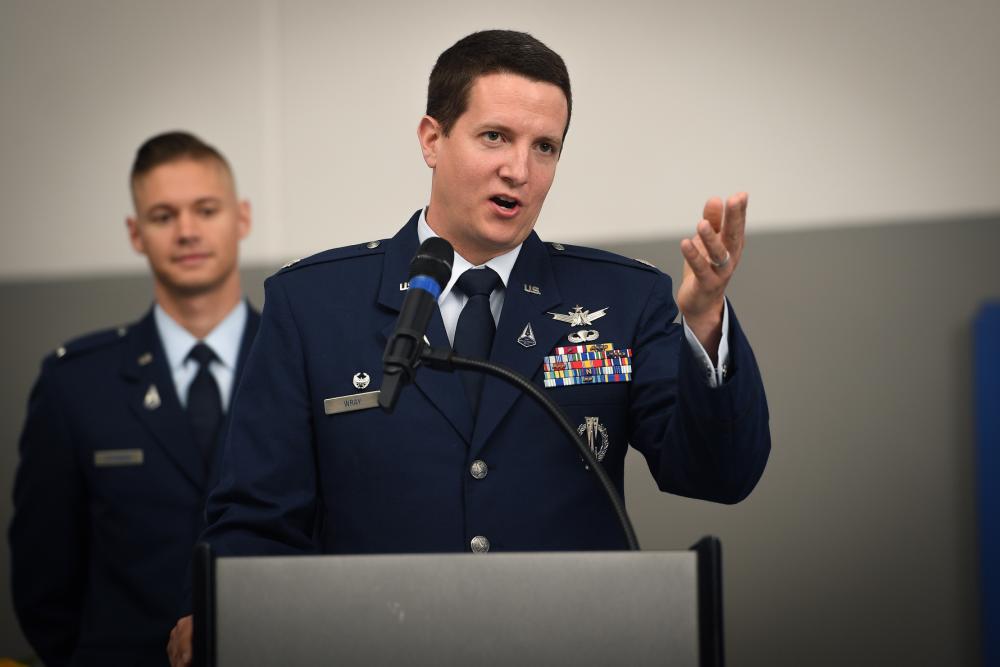
USSF Lt Col Robert Wray takes command of 2SOPS. (Photo: USSF/Dennis Rogers)
The 2nd Space Operations Squadron (2 SOPS), which oversees the GPS constellation, now has a new leader. Outgoing U.S. Space Force (USSF) Lt. Col. Michael Schriever relinquished command of the unit to USSF Lt. Col. Robert Wray.
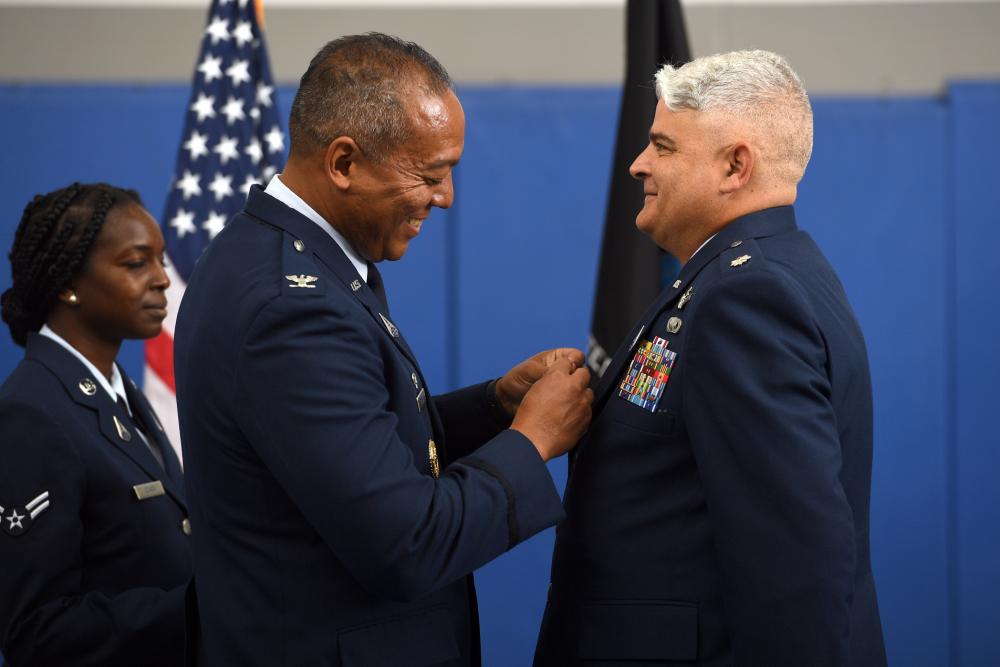
The squadron conducted a change of command ceremony at Schriever Space Force Base, Colorado, on July 6, officiated by Space Delta 8 Commander Col. Matthew Holston.
As the new commander, Wray assumes the responsibility of overseeing the daily operations of a unit whose mission is to operate the GPS constellation, which provides global navigation, time transfer, and nuclear detonation detection.
Col. Matthew Holston honors Lt. Col. Michael Schriver for his 2SOPS service. (Photo: USSF/Dennis Rogers)
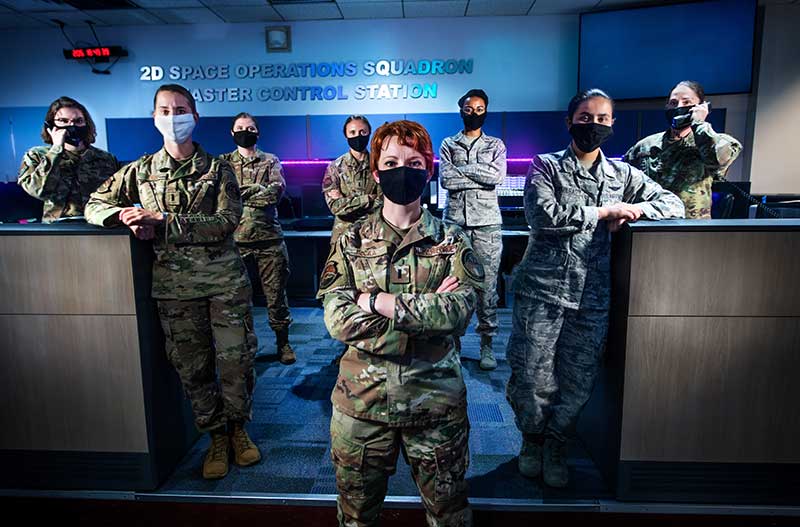
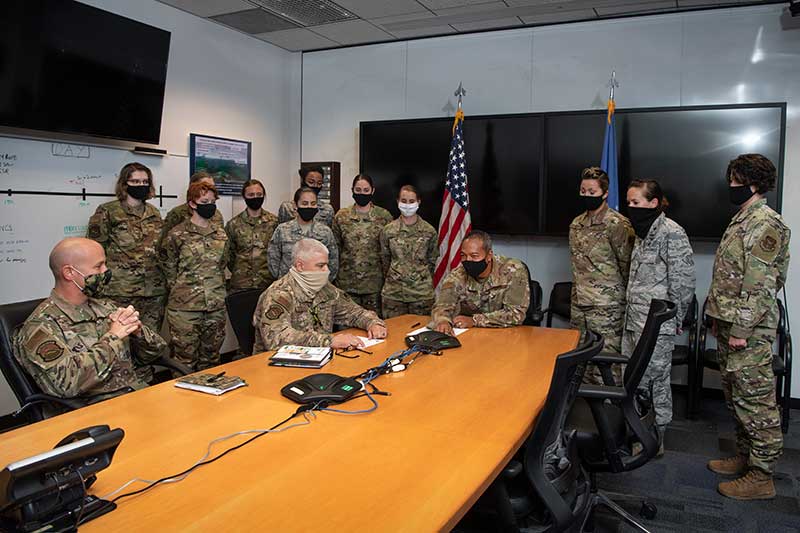
On July 23, the 2nd Space Operations Squadron (2 SOPS) gained Satellite Control Authority of GPS satellite vehicle number 76 — also known as GPS III SV03 — which was launched on June 30. This handover was special: for the first time, a crew of eight women space operators took control of the satellite.
Schriever’s 2 SOPS, the providers of GPS signals to billions of users worldwide, made history July 23 when a crew of eight women space operators gained satellite control authority of satellite vehicle number 76 (SVN 76), previously known as GPS III SV03.
The crew included 1st Lt. Kelley McCaa, 2 SOPS satellite vehicle operator; 1st Lt. Alexis Thuli, 2 SOPS operations assistant flight commander; Staff Sgt. Kelly Malone, 2nd SOPS satellite systems operator and crew chief; 1st Lt. Mary McLaughlin, 2 SOPS payload system operator; 1st Lt. Mikayla Roberts, 2 SOPS mission analyst; Senior Airman Joelle Schritt, 19th SOPS mission planner; Airman 1st Class Gillian Clover, 2 SOPS satellite systems operator; and Airman 1st Class Larissa Contreras, 2 SOPS SSO.
“It’s like the grandparents hand the keys to the parent, then the parent hands the keys to us,” said McCaa. “When a new satellite is launched, we don’t have full authority of it. [Lockheed Martin] takes it over [after launch], then we bring it into our systems and then we actually gain full control of [the satellite] as a squadron.”
The 2nd Space Operations Squadron gained satellite control acceptance of satellite vehicle number 76, July 23, 2020, at Schriever Air Force Base, Colorado. The new satellite will provide more than 5 billion users across the globe with stronger precision, navigation and timing signals. It will also bring improved capabilities to warfighters. (U.S. Air Force photo by Dennis Rogers and Kathryn Calvert)
The new satellite will provide more than 5 billion users across the world with stronger precision, navigation and timing signals, Schriever Air Force Base said.
“With these new satellites, they have a lot of capabilities we didn’t previously have,” said McCaa. “There are certain things the new generation of satellites are capable of doing that are brand new to us, and will immediately enhance our GPS signal, helping the warfighters down-range.”
The crew included eight uniformed 2 SOPS and 19 SOPS (the Air Force Reserve component) Airmen who gained SCA of the satellite.
“We have a lot of females in the squadron, and given the crew scheduling, we had the opportunity to establish an all-female crew,” said Thuli. “We decided to have this female team on crew during the SCA, creating a more historic event for the squadron.”
Maj. Lucia White, 2 SOPS assistant director of operation, said the 45th Space Wing female meteorologists at Cape Canaveral Air Force Station, Florida, who determined weather was suitable for rocket launch June 13, inspired her to bring the idea to life in 2 SOPS.
First Lt. Mikayla Roberts, 2nd Space Operations Squadron mission analyst, poses with a model satellite July 23, 2020, at Schriever Air Force Base, Colorado. Roberts was one of eight women who worked on the historic all-female crew. (U.S. Air Force photo by Dennis Rogers and Kathryn Damon)
“We want to inspire future generations of young women and let them know they can have a place in the Space Force,” White said. “[The Space Force] is the place to be, especially for those who may have barriers to overcome.”
In addition to the operational crew, Brig. Gen. Traci Kuekermurphy, Mobilization Augmentee to the Space Force Director of Operations and Lt. Col. Maggie Sullivan, Space and Missile Systems Center, granted SCA approval for their respective entities making the entire transfer an all-female event.
Not only did 2 SOPS and the 45th SW have female crews, the Department of the Air Force also made history when it selected Chief Master Sgt. JoAnne Bass to serve as the 19th Chief Master Sergeant of the Air Force. Bass is the first woman to serve in this role.
According to the National Science Foundation, women make up only 28% of employment in science and engineering career fields. Furthermore, an even smaller percentage of women serve in the Air Force, at about 21%.
Feature image: The women of the 2nd Space Operations Squadron made history as the first ever all-female space operations crew July 23, 2020, at Schriever Air Force Base, Colorado. The crew gained satellite control acceptance of SVN-76, officially adding another satellite to the GPS III fleet. (U.S. Air Force photo by Dennis Rogers and Kathryn Calvert)
By Airman 1st Class Jonathan Whitely, 50th Space Wing Public Affairs
News from Schriever Air Force Base
The 2nd Space Operations Squadron performed the first station keeping maneuver on a GPS III satellite to Satellite Vehicle Number 75 on May 14 at the Schriever Air Force Base in Colorado.
The maneuver set a new standard for how GPS maneuvers should be conducted for the squadron that provides precision, navigation and timing signals to billions of users around the world.
A station keeping maneuver is performed to keep vehicles in their node (or parking spots in orbit) and involves burning the satellite’s thrusters and changing the vehicles speed at a particular point in its orbit. This causes the orbit to change, in turn, keeping the vehicle in the ideal position to provide coverage.
“All operational GPS vehicles are assigned nodes, when all nodes are filled with healthy vehicles there is good global GPS coverage,” said 1st Lt. Michael Gallagher, GPS subsystems analyst. “When new vehicles are launched they typically aren’t launched directly into their final node. This means that the 2 SOPS analysis flight must perform a re-phase maneuver to put a vehicle in its node.”
The maneuver required GPS III’s signal to be turned off. Turning off the navigation signal while performing the maneuver prevents users from receiving inaccuracies generated by a change in satellite velocity.
“This was a new process that we could learn from as it was the first station keeping [maneuver] performed for the newest generation of GPS satellites,” said Senior Airman Harrison Sherwood, 2 SOPS satellite systems operator, who sent the commands to the satellite during the maneuver. “[Since] this was the first [maneuver] of the newest generation satellites, it was a bit of a guinea pig for future maneuvers.”
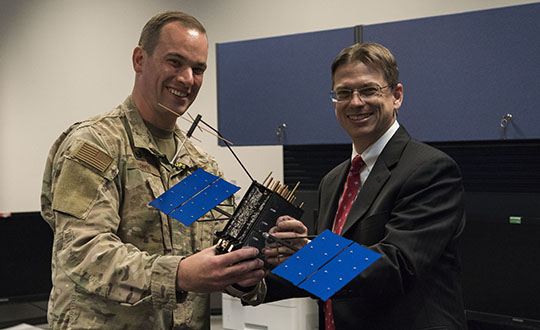
Johnathon Caldwell, Lockheed Martin Space vice president of navigation systems, right, presents Lt. Col. Stephen Toth, 2nd Space Operations Squadron commander, with a GPS III model satellite as a token of appreciation for the 2nd SOPS critical mission in space at Schriever Air Force Base, Colorado, July 29, 2019. The squadron performed its first station keeping maneuver on a GPS III satellite May 14, 2020, at Schriever AFB. (Photo: U.S. Air Force/1st Class Jonathan Whitely)
However, the unit was able to complete the maneuver flawlessly. The maneuver was completed in a special mission area and there were no changes to the normal operations floor.
“This maneuver had no effect on the rest of the [GPS satellite] constellation,” Gallagher said. “SVN-45 was in the node SVN-75 was being placed into, so there was no decrease in GPS signal quality as a result of this maneuver.”
This procedure was also the first of its kind to be performed with the 2nd SOPS Architecture Evolution Plan, which all active satellites in the program are operated. Since GPS III vehicles are fully integrated into the program with this maneuver, all maintenance is conducted through AEP.
“Station keeping maneuvers are essential to satellite operations and must be done for regular maintenance,” said 2nd Lt. Tyler Gorman, 2nd SOPS navigation payload engineer. “This activity helped validate a nominal maintenance activity for a new generation of vehicles.”
The unit plans to continue to use this new method and program for future GPS satellites that are being launched and need to be re-phased into their operation slots. The next satellite that will need a station maneuver performed is SVN-76, which is scheduled to launch in the next few months.
“GPS maintenance requires a coordinated effort to ensure our worldwide service is preserved,” Gorman said. “That means careful planning and execution from our analysts in 2 SOPS, our satellite system operator and the operational support from Lockheed Martin and the Aerospace Corporation.”
News by Airman 1st Class Jonathan Whitely
50th Space Wing Public Affairs Schriever Air Force Base
The 2nd Space Operations Squadron at Schriever Air Force Base, Colorado, initiated the disposal of the last operational GPS IIA satellite, satellite vehicle number 34, April 13-20.
The GPS satellite program currently uses 31 satellite vehicles to transmit precise position, navigation and timing signals to more than 6 billion users around the world. To support the Air Force’s GPS III modernization efforts, 2nd SOPS operators phase out older models to make room for the new GPS III satellites.
The disposal of SVN-34 marks the end of a 26.5-year era in which the satellite outlived its 7.5-year design life by 19 years.
“As we continue to manage the influx of GPS III (the newest iteration of GPS satellites) and maintaining other vehicles in a residual status, we have to be cognizant of effective risk management,” said Capt. Angela Tomasek, 2nd SOPS GPS mission engineering and analysis flight commander. “As SVN-34 continued to age, we had to manage its aging components and likelihood of having a critical malfunction. We are at a stage where we are confident in the robustness of the overall GPS constellation to remove the last remaining IIA vehicle.”
Disposal process. Units conduct satellite disposals when a satellite reaches the end of its operational life and no longer requires daily caretaking and maintenance.
“We push the satellite vehicle to a higher, less congested, ‘disposal orbit’ to eliminate the probability of collision with other active satellites,” Tomasek said. “[Then,] the vehicle is put into a safe configuration by depleting the leftover fuel and battery life and shutting off the satellite vehicle transmitters so no one else can access the satellite in the future.”
Once SVN-34 is in its final orbit, 2 SOPS will on April 20 hand over full tracking responsibility to the 18th Space Control Squadron at Vandenberg Air Force Base, California, where it will be treated and cataloged like every other space object.
“This disposal marks the end of an era in GPS history,” said Lt. Col. Stephen Toth, 2nd SOPS commander. “There are senior leaders and long-time contractors [who] launched and operated the IIA satellites at the beginning of their careers [who] are nowhere to see it end. It is an opportunity to reflect on the legacy and heritage of 2 SOPS and GPS to see how far we have come.”
Feature image: Artist’s depiction of a GPS IIA satellite in orbit. (Image: USAF)
By Senior Airman William Tracy, 50th Space Wing Public Affairs
The 2nd Space Operations Squadron took formal command of Architecture Evolution Plan 7.5, the largest GPS architectural change in operational history, after its successful installation at Schriever Air Force Base, Colorado, Nov. 16.
“AEP 7.5 is a milestone in GPS history and improves our cybersecurity capabilities and postures us to better operate in a contested, degraded and operationally limited environment,” said 1st Lieutenant Jonathan Campbell, 2nd SOPS assistant operations flight commander.
The 2nd SOPS installation replaced 600,000 lines of code in AEP and implemented more than $29 million worth of hardware and software changes.
Additionally, AEP 7.5 sets the platform for the installation of AEP 8.0, which will deliver the capability to command and control GPS III satellite vehicles — the first GPS III satellite scheduled to be launched from Cape Canaveral Air Force Station, Florida, next month.
Campbell said AEP 7.5 is a significant step up from the previous AEP 7.3, with overall improvements allowing Airmen to command and control satellites with better efficiency.
The program’s successful installation was the result of extensive training from a Mission Operations Transfer at the squadron’s Alternate Master Control Station at Vandenberg Air Force Base, California. Both rotations of the Space Mission Force crew structure were activated to ensure full operational capabilities at both sites, performing security control assessments on the system and taking other measures.
“Training consisted of acclimating to AEP 7.5, learning how to navigate it and utilize it to the best capability,” said Senior Airman Ryan Lape, 2nd SOPS satellite systems operator. “Because our constellation was so big, upon taking command at Schriever we had to iron out the changes on a large scale.”
Campbell said the hard work was worth it — the successful installation and command of AEP 7.5 through the squadron’s efforts will prepare for changes in the near future.
“This will provide combat ready space warfighters delivering position, navigation and timing to optimize the full range of Air Force, joint force and civilian operations, across all domains,” he said. “The updated hardware provided in the AEP 7.5 installation lays the foundation for a software update next year enabling the command and control of GPS Block III vehicles.”
Campbell added not only will the installation advance the 2nd SOPS’s mission, but the 50th Space Wing’s as well, helping evolve space and cyberspace warfighting superiority through integrative and innovative operations.
“The capabilities provided in this update, and those coming in the next year, provide a significant improvement to our warfighters,” he said.
With this milestone, Campbell said the continuation of the U.S. military’s dominance in position navigation and timing systems is secured.
“This update furthers the U.S. military’s and Schriever AFB’s position as the center of satellite command and control and space operations,” he said.
Lape said the milestone will make an impact outside of the military as well.
“We are the premier PNT system in the world with the largest satellite constellation,” he said.
“With measures like these, it will definitely make our adversaries think twice.”
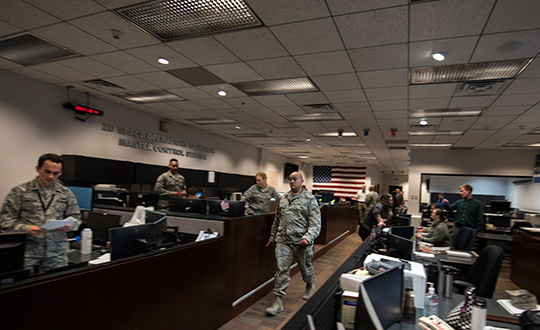
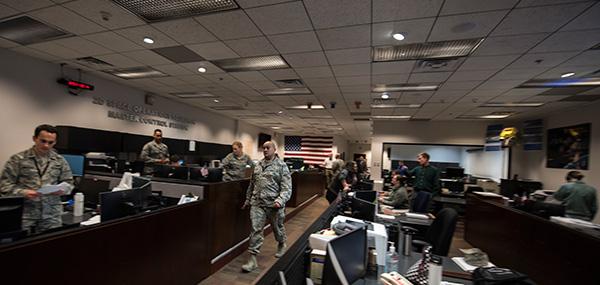
The 2nd Space Operations Squadron operations floor is a flurry of activity during 2nd SOPS’s formal command of Architecture Evolution Plan 7.5. (Photo: USAF/Senior Airman William Tracy)
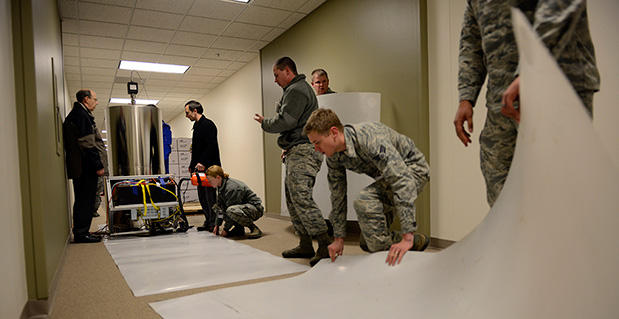
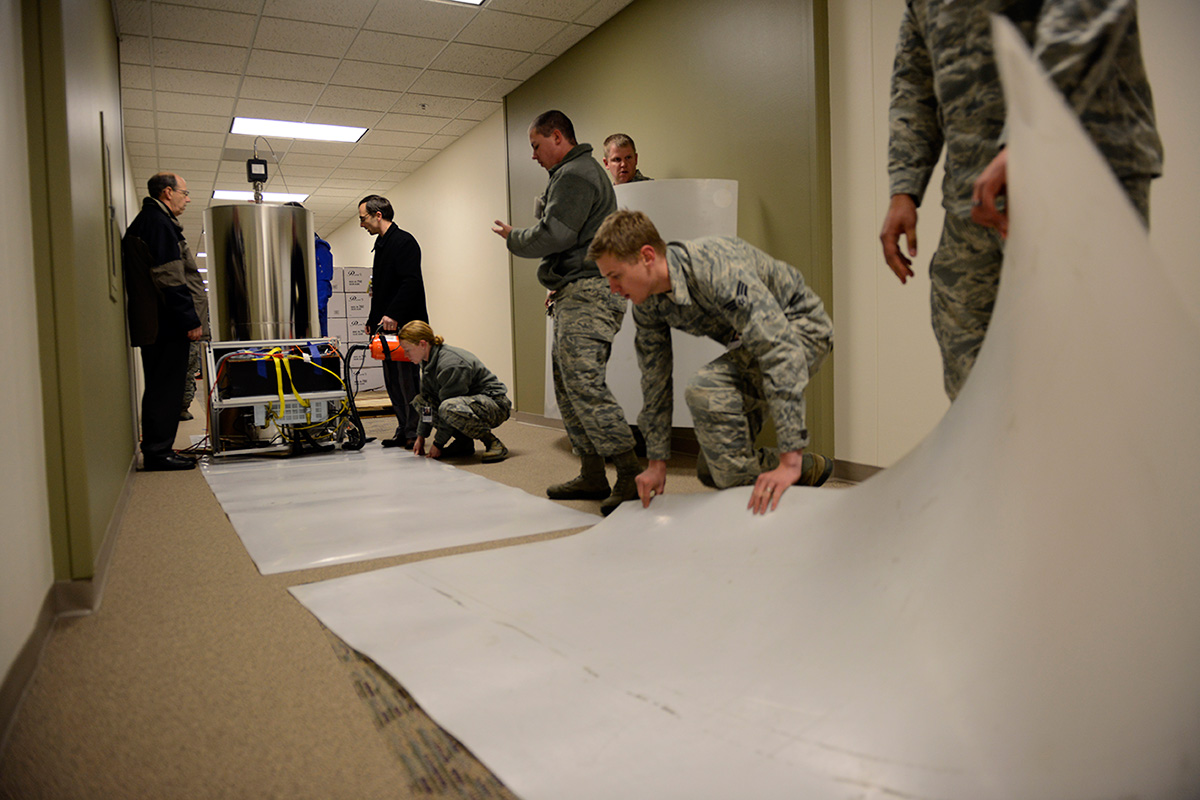
Personnel with the U.S. Naval Observatory-Detachment Colorado and 2nd Space Operations Squadron move the rubidium fountain clock into its new home Tuesday at Schriever Air Force Base. The USNO monitors the GPS constellation and provides time offsets to the 2nd Space Operations Squadron for their daily navigation uploads to each individual GPS satellite. (U.S. Air Force photo/Christopher DeWitt).
The U.S. Naval Observatory’s Alternate Master Clock on Schriever Air Force Base received its second rubidium fountain clock February 4 to ensure it has the most precise time in the world.
Both the USNO’s Washington D.C.-based primary and its local Alternate Master Clock facility serve as the Department of Defense’s common time reference. Additionally, the USNO monitors the GPS constellation and provides time offsets to the 2nd Space Operations Squadron for its daily navigation uploads to each individual GPS satellite.
“With the new rubidium fountain clock, we are going from the time standard of 1 to 2 nanoseconds down to 300 picoseconds,” said Bill Bollwerk, Head of USNO Detachment Colorado.
One nanosecond is equivalent to one billionth of a second, while a picosecond is equal to one trillionth of a second. Though these small slices of time may not sound important, every nth of a second is significant, especially in GPS operations.
“A nanosecond matters because it is equivalent to a 1-foot of error for GPS,” Bollwerk said. “If the GPS satellite clocks were off by 3 nanoseconds, you have 1-meter of error introduced into GPS.”
Designed and produced by physicists at the USNO laboratory in Washington D.C., the powered rubidium fountain clock traveled by dedicated truck to Schriever. Once the fountain clock arrived at Colorado base, with the help of members of the 2nd Space Operations Squadron, the 50th Security Forces Squadron and 50th Civil Engineering Squadron, the USNO team moved it to a climate controlled chamber in the USNO’s laboratory via an airsled hover lifter.
“The 2 SOPS men and women are able to operate and provide accurate instantaneous reliable support to U.S. military forces around the world, thanks to our partnership with the U.S. Naval Observatory,” said Lt. Col. Thomas Ste. Marie, 2 SOPS commander. “We are happy to be able to work together to support their upgrade. Our relationship allows 2 SOPS to continually reach our goal of record breaking time-transfer performance and navigation accuracies.”
Although 2 SOPS was happy to support the move, it’s not as easy as one might think.
“The process of moving the rubidium fountain was very complicated,” said Ken Dreiling, USNO Detachment Colorado. “We had to ensure the fountain clock was not actually in contact with the floor or the walls as we moved it from the loading dock through the hallways and elevator into our facility.”
The careful transport of the fountain was essential to prevent damage that could affect the clock’s performance.
“The fountain clock collects billions of rubidium atoms, encased in a spherical vacuum chamber and laser-cooled to a millionth of a degree above absolute zero degrees Kelvin, approaching the coldest temperature anything can be,” Bollwerk said. “The reason we do that is because we want to observe and measure the atoms for long time in an environment that minimizes unwanted noise like the Doppler Shift.”
Though the Alternate Master Clock provides precise timing for several communication and space systems, Missile Defense Agency, DOD facilities and several civilian infrastructures around the world, the new system was installed primarily to support GPS operations.
“It is great to have the most precise time standard in the world but it is useless unless you can get it to the user, not everyone can come to the facility and set their watch,” said Bollwerk. “GPS is USNO’s primary means of providing global precise time to the warfighter. It is a great partnership between the Navy and the Air Force.”
Dreiling said the new fountain clock will help improve GPS operations.
“The new rubidium fountain clock is the next-generation new frequency standard,” Dreiling said. “This will boost the GPS’s timing by 10-fold.”
December is typically the month when writers of regularly featured columns wax nostalgic and engage in a certain amount of prognostication. This year I enlisted the help of Lt. Col. Jennifer Grant, the 2SOPS/CC at Schriever AFB, the home of GPS, to help us with our year-end review and crystal-ball gazing as we look ahead to the GPS horizon. Lt. Col. Grant reminisces about her first 16 months as 2SOPS/CC, reviews numerous major accomplishments, and updates us on the status of the GPS constellation as well as the often overlooked, ever contentious and always seemingly in flux critical Command and Control (C2) segment.
By way of introduction, I first met Lt. Col. Grant when she was assigned to the Command Suite at Headquarters Air Force Space Command at Peterson AFB in Colorado Springs, Colorado, and served under the four-star commander General Robert Kehler, who is now the commander of USSTRATCOM (United States Strategic Command). At the time she impressed me as being intelligent and insightful. Her professional reputation as a perfectionist certainly supported that assessment. The next time I met Jennifer, we were both wearing different hats and serving in different roles.
Several of us on the GPS Independent Review Team (GPS-IRT) were sent by General Kehler to Schriever AFB to check in with the new 2SOPS/CC and see if we could offer her any assistance. This is a role we, the IRT, have played many times in the past, and just like the old saw concerning Inspector General (IG) visits, our mantra was and is “…we are only here to help…that’s our story and we are sticking to it.” Regardless of the perception or even trepidation over our visit, Jennifer and her staff were extremely supportive and it was abundantly clear that Lt. Col. Grant was drinking from a fire hose and doing more than surviving. She actually seemed to be handling it well and possibly even enjoying herself. While she was not new to Space Command, she was new to the GPS.
More than a year later, I and another IRT member paid Lt. Col. Grant another official visit and the transformation was nothing short of amazing. Did I fail to mention that she is also known as a quick study? In 16 months’ time Jennifer went from the new kid on the block in GPS operations to a sophisticated, erudite, extremely knowledgeable and passionate advocate and supporter of the GPS and all aspects of 2SOPS operations.
Recently she stood toe-to-toe in a meeting with the same GPS-IRT members that visited her 16 months ago and proved without a doubt that she has matured as a commander and GPS operator beyond our wildest imaginations. To her credit she is not intimidated by titles, rank or history. She knows her job. She walks the talk and will not hesitate to challenge anyone, although very politely and with a smile, who is not totally accurate and fair in his or her assessment of GPS operations yesterday, today and tomorrow.
Like any good commander, she is totally and relentlessly supportive of her command and her people. However, she is pragmatic enough to know that changes, and big ones, are on the horizon. At the same time she realizes that she commands not only the largest and most well-known military space constellation on orbit today, but also one that supports the entire planet’s critical infrastructures with crucial timing, frequency, position and navigation information. GPS has become the de facto time and time frequency distribution system for the world we live in today. There are more than two billion known users worldwide, and that conservatively equates to more than 5 billion GPS receivers. Indeed, given the number of stealth GPS receivers in almost every appliance we use today, that number could easily grow to more than 10 billion. No stress there!
When I called Lt. Col. Grant about a follow-up IRT visit and mentioned that an interview might also be in order, she replied that she would get right on that as soon as she spent Thanksgiving with her family. Imagine that, she actually took a day off. In the real world she seems to balance being a wife, mother and commander of the world’s most visible satellite constellation with a maturity beyond her years.
Now that we have peeled back the curtain just a bit, let’s see what Lt. Col. Jennifer Grant has to say about the Global Positioning System and PNT in general.
DJ: Don Jewell, GPS World Defense Editor JG: Lt. Col. Jennifer Grant, 2SOPS Commander
DJ: What can you tell us about your first year as the 2SOPS/CC? What makes you happy about your command job and GPS specifically?
JG: Don, my time as the new 2SOPS/CC has really passed quickly! Commanding the largest DoD satellite constellation is both humbling and invigorating. It is amazing to look back over the past year and recount our accomplishments as a team: I accepted satellite control authority of the first two GPS IIF satellites; we completed the largest satellite repositioning in history with expandable-24; we successfully completed two major test exercises involving demonstrations of flex power and SA/ASM (Selective Availability and Anti-Spoofing Module), respectfully; we successfully completed the largest major software sustainment installation, AEP 5.7.0 [ed. Architecture Evolution Plan]; we flawlessly executed two operation mission transfers to our back-up (Command & Control) location; we’ve completed dozens of station-keeping maneuvers; we’ve resolved on-orbit anomalies and sustained the constellation of satellites which have outlived their estimated design life — and celebrated the 21st birthday of SVN-23, our oldest IIA satellite on orbit. We’ve also disposed of SVN-24 and are preparing for the disposal of SVN-30. Our GPS Operations Center (GPSOC) has provided 75,000+ products to our mission planners and warfighters down range, and we have seen the implementation of our GPS Google Earth tool.
On the personnel front, we were part of the team, along with 19SOPS and SMC — Space and Missile Systems Center, awarded the USAF Chief of Staff Team Excellence Award (CSTEA) in Washington, D.C., for the GPS IIF Launch; and we were part of the past and present GPS team of personnel earning the International Aerospace Federation’s 60th Anniversary Award for excellence in aerospace. General Shelton accepted this award in Johannesburg, South Africa, on behalf of the U.S. Air Force contributions to the GPS. We have also achieved the most accurate signal-in-space in our history, far surpassing the office of the Secretary of Defense, Standard Positioning Service Performance Standard requirement of seven meters!
2SOPS, with assistance from our reserve mission partner, 19SOPS, supports more than two billion position, navigation and timing (PNT) users worldwide. The work we do every day and the mission we execute supports critical infrastructure, life-saving missions and worldwide operations.
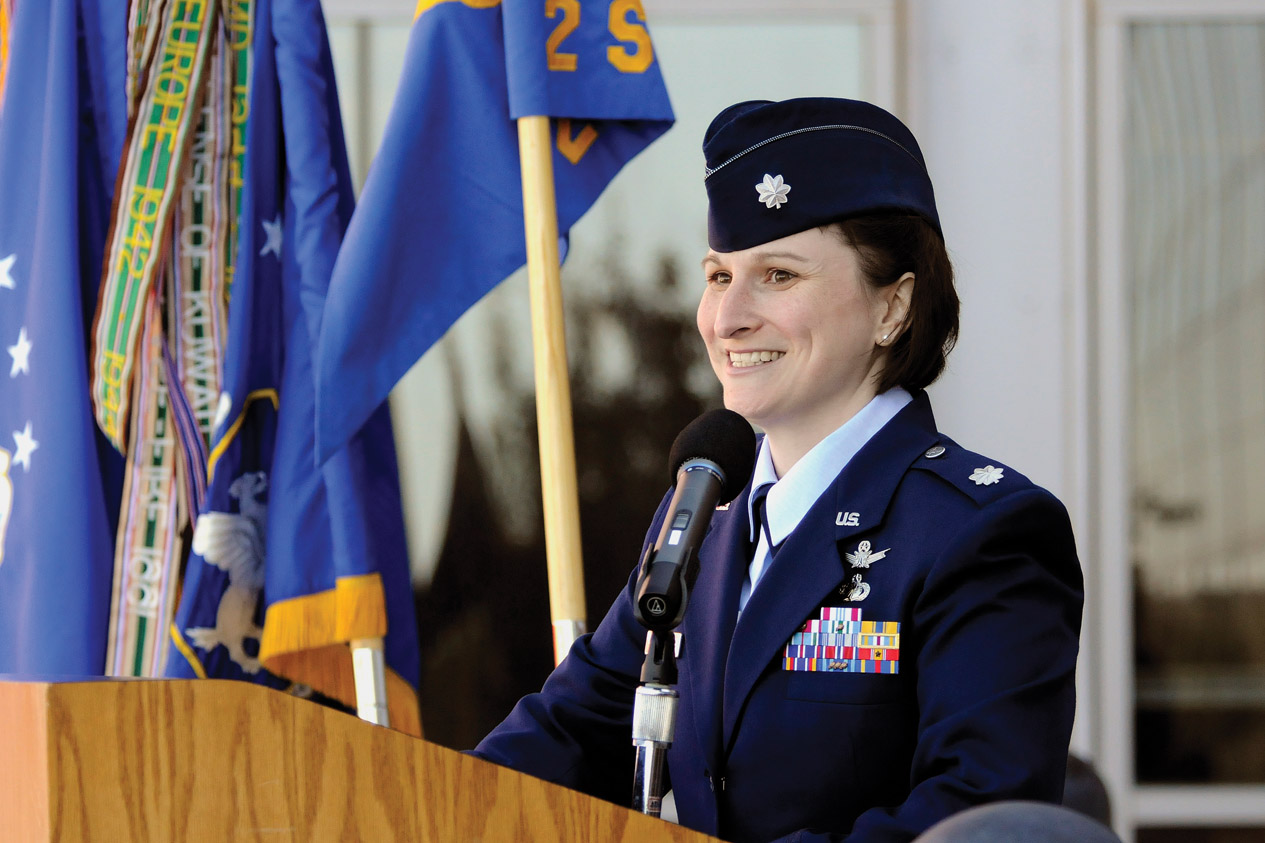
Lt. Col. Grant speaks at the change of command ceremony in August 2010, when she took over command of 2SOPS.
In short, Don, I love my job — and I have the sharpest, best and brightest team of personnel employed to execute these tasks. I am amazed every day at the level of proficiency and professionalism demonstrated by our Total Force team of active duty, reservists, aerospace engineers, contractors and government personnel. Our team has managed and maintained the position, navigation and timing gold standard and will continue to do so.
Making a difference in the lives of people gives me a great deal of personal and professional satisfaction. We are not doing our jobs right if we are not making the world a better place…one contact at a time, be it people or payloads.
DJ: Can you give us a status of GPS as a system of systems, to include ground control, monitoring and the on-orbit constellation? Give us, if you will, a status brief of where GPS stands today, including SVN-49. And, since you are known for being precise when you speak about GPS matters, can you please answer using the nomenclature we should all use when we refer to the various segments of the GPS?
JG: Absolutely, Don! The GPS constellation is the most robust and capable system in the history of space. We currently have 30 actively engaged operational satellites on orbit (9 GPS IIAs, 12 GPS IIRs, 7 GPS IIR-Ms and 2 GPS IIFs). We maintain a program baseline minimum 24-satellite constellation consisting of six orbital planes each containing four primary satellite slots. Our four dedicated ground antennas and six monitoring stations are working as intended, and our MCS (Master Control Station) at Schriever AFB as well as our AMCS (Alternate Master Control Station) at Vandenberg AFB are both fully functional.
On 15 June 2011, we completed expansion of a total of three primary slots, which added 3 satellites into our current baseline and enables us to optimize GPS assets to improve operational effectiveness for global users and warfighters in terrain-challenged areas.
Currently, there are 30 satellites set healthy to users, and a 31st satellite, a GPS IIA, will be set healthy on 16 December 2011. We have one satellite awaiting disposal and three remaining satellites in residual status. Each of the three remaining residual satellites are in LADO, which is our unique Launch/Early Orbit, Anomaly Resolution, Disposal, and Operations system. One of the residual satellites is SVN-49, and they will all be tested and checked out for determination of future use and viability as a long-term operational decision.
DJ: Those of us who have been Squadron Commanders know there are persistent problems in any organization that just won’t go away, be they programmatic, operational or personnel issues. What is it that keeps you up at night?
JG: Thankfully, Don, I am a sound sleeper with peace of mind, so not much! But really, one of the main responsibilities we manage is maintenance and sustainment of the GPS constellation, and the older the satellites in the constellation get, the more care and feeding they require. Right now, about a third of our constellation has exceeded its satellite design life by 100% — satellites designed to last 7.5 years are between 15 and 21 years old. So we have invested a great deal of time into contingency planning in the event of component failures, multiple vehicle anomalies, etc. We are doing everything we can to continue to extend the lives of our satellites, and it is a tribute to engineering, design and the satellite builders as well as the expert sustainment operations and engineering that they have lasted as long as they have.
We need to ensure our replenishment launches for the current generation IIF vehicles stay on schedule and a priority.
DJ: Would you give us your view and hopefully the MAJCOMs view of the way ahead for GPS as it supports military, civil and commercial users around the globe? Look forward to the future for us — how do you see GPS operations evolving in the years ahead?
JG: Don, the Air Force is constantly being asked to do more with less — resources, manpower and time. In this fiscally constrained environment we are being challenged to find effective and efficient ways to accomplish our mission. We have come a long way from the legacy systems in improving our operations, and I think we will see even more improvements in increased automation, faster satellite contact times, and increased downlink capabilities, as well as streamlined operations.
We will also, I believe, see an increased need for interaction and interoperability with our international position, navigation and timing providers and consumers. GPS, though still the largest PNT provider, is no longer the only game in town.
Although the GPS satellite constellation is procured and operated by the US Air Force, we understand we support a much broader user community in the civil, commercial and military sectors. We take pride in providing extremely accurate PNT services to billions of users worldwide.
And we are spending considerable resources to modernize the GPS constellation to provide even better service in the future. The continued fielding of new GPS IIF satellites and GPS control segment software updates are key to current modernization efforts. GPS III satellites and the Next Generation Control System (OCX) will further enhance GPS capabilities. Fully compliant user equipment is essential as modernization efforts continue.
We’ll continue to improve our constellation with the launches of new satellites; the next GPS IIF is scheduled to launch in September of 2012 and the first GPS III should be available for launch in FY 2014. And OCX remains on-track for a Ready-To-Operate (RTO) date in 2015.
DJ: And finally, if you were Queen for a Day, what would you like to see changed?
JG: For operators, there is always an interest in and a desire for greater capability, faster processing…and for us it is in pushing the envelope for even greater accuracy with precision timing, position and navigation.
There is also an interest in expanding application of our NAVWAR (Navigation Warfare) knowledge, application and operations — having an even greater number of people trained and embedded with warfighters as NAVWAR experts. This is where I think we will see some real growth in the future.
DJ: Colonel Grant, I know you are incredibly busy and I can’t thank you enough for your time, your expertise and the look ahead to the future of GPS. Best of luck in all your future endeavors.
Editor’s Note: I have visited the 2SOPS more than 20 times in the past five years, and I have known and visited every 2SOPS commander since that organization began to include then Lt. Col. and now General William Shelton, the four-star AFSPC/CC. I have never seen a more motivated GPS crew force than the one I saw during my last visit with Lt. Col. Grant. Squadrons tend to reflect the work ethic, mores and integrity of their commander, and my hat is off to Lt. Col. Jennifer Grant because her crews are obviously very motivated to support the warfighter, and they seem very happy in their jobs. The atmosphere in 2SOPS these days is positive, upbeat and very customer (that’s you and me) oriented. Plus, many of the crewmembers are just back from tours in Afghanistan and Iraq, so they know the needs of the warfighter and they are working hard to fulfill them.
Till next time, happy holidays and happy navigating.