Tag: 2SOPS

  • How GPS III is performing in orbit

    How GPS III is performing in orbit

    Plus an update on GPS III satellites in production

    Editor Alan Cameron talked with Johnathon Caldwell, Lockheed Martin’s vice president of navigation systems.

    Tell us about the on-orbit performance of the GPS III SV01, launched in December.

    On Jan. 8 we began broadcasting navigation data across all signal chains, and the satellite has been in checkout mode since then. According to all the reports I get from various independent agencies, the vehicle has been performing outstanding, and the payload performance has been exceeding expectations.

    We’ve been evaluating in depth how the payload performs, including independent agencies assessing the signal quality. Later this fall we’ll transition satellite ground control from the OCX Block 0 ground control system installed at Lockheed Martin’s Waterton Launch & Check Out facility over to the GPS Operational Control Segment (OCS) the 2SOPS is using now, and we’ll really see the performance improving from where it is today.


    “We’re certainly at the top end of what
    we thought we might be able to achieve
    in terms of signal accuracy.”


    The satellite is doing what everybody had hoped. There’s always great anticipation when a new system goes up. It’s actually been a very smooth on-orbit test campaign. We’re wrapping up on the early side; we’ll be ready to transition into the OCS this fall.

    This past December we completed a major Architecture Evolution Plan (AEP) 7.5 OCS upgrade. This included both hardware and software upgrades to the legacy control system, and the Contingency Operations (COps) upgrade is coming later this fall. This is the software upgrade that will let OCS fly this first GPS III satellite and let the Air Force take advantage of great new capabilities. We will deliver the upgrade in May; it will get packaged up and delivered into the OCS in the fall. SV01 will then move from Lockheed Martin’s Waterton launch and checkout facility control to Air Force 2SOPS control and join the constellation on the OCS.

    A GPS satellite doesn’t do its mission by itself. It takes an entire system to run. You’re always monitoring signal quality and tweaking things to get the optimal performance. Today, we’re flying SV01 by itself. The OCS and the 2SOPS crew will start flying it like they do the others, giving it the daily update and looking at the signal quality and maximizing the performance.

    We’re certainly at the top end of what we thought we might be able to achieve in terms of signal accuracy.

    And GPS III SV02 has shipped to the Cape.

    We’ve wrapped up functional testing; it’s in great shape. We’re now in a quiet period prior to final review leading up to fueling decisions in May for a planned July launch.

    Using the Delta IVb rocket for SV02 offers a good opportunity to demonstrate the wide range of launch vehicles that GPS III is capable of. The satellite has great compatibility across platforms, a flexibility that’s a benefit for the Air Force.

    The factory was also getting pretty full so it was great to ship out SV02. When it gets to the end of the line and ready to go, you want to get it out and have it doing the mission it’s designed to do.
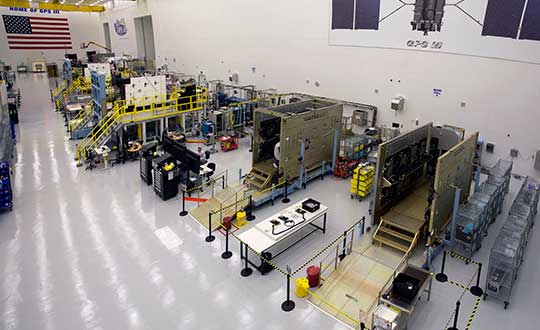
    GPS III production line. (Photo: Lockheed Martin)
    GPS III production line. (Photo: Lockheed Martin)

    How about the production status of SVs 03 through 10 on the factory line?

    SV03 has gone through complete environmental tests and is ready for delivery to the Air Force later this spring. SV04 is in final environmental test and will deliver later this year. SV05 is in thermal vacuum (TVAC) testing now, and doing an outstanding job. TVAC is the hardest test we go through, and it’s as if it’s flying in the environment of space. It’s the stress test. SV06 is put together, and now in its initial functional testing.

    There aren’t many production lines of this size of large satellites. It’s very impressive. As you look down the line, our high bay is modeled after the best of production lines. Hardware and avionics and power systems are coming in as piece parts, getting built in. As you go down the bay, the vehicles are getting more and more complete. Now on the front end of the line we’ve got SV07 and SV08 starting. SV09 will begin later this summer, and not long after we hope to open up space for the 10th vehicle.

    Last words: Progress so far on GPS IIIF?

    We’re now in the full design campaign for the follow-on satellites that will lead to critical design review, the capstone of the process. The CDR will wrap up in February 2020.
  • Lockheed Martin assembles third U.S. Air Force GPS III satellite

    Lockheed Martin assembles third U.S. Air Force GPS III satellite

    The U.S. Air Force’s third GPS III satellite in production flow at Lockheed Martin’s advanced satellite manufacturing facility in Denver is now fully integrated into a complete space vehicle.

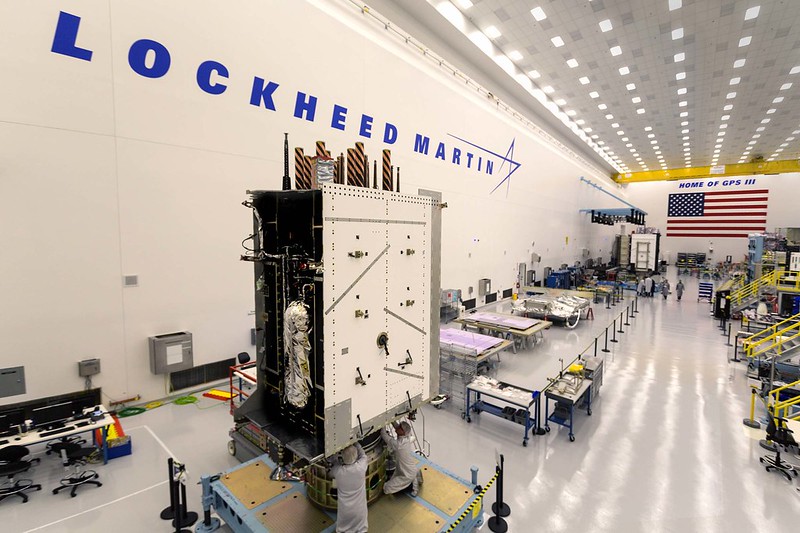
    GPS III Space Vehicle 03 (GPS III SV03) followed the first two GPS III satellites on a streamlined assembly and test production line. Technicians successfully integrated the satellite’s major components — its system module, navigation payload and propulsion core — into one fully assembled space vehicle on Aug. 14.

    GPS III SV03 was assembled in Lockheed Martin’s GPS III Processing Facility, a $128 million, cleanroom factory designed in a virtual reality environment to drive efficiency and reduce costs in satellite production. Now fully assembled, the third satellite is being prepared to begin environmental testing.

    GPS III SV03 is scheduled to launch on June 30.. (Photo: Lockheed Martin)
    GPS III SV03 is scheduled to launch on June 30. (Photo: Lockheed Martin)

    GPS III SV03 closely follows the company’s second satellite in production flow. GPS III SV02 completed integration in May, finished acoustic testing in July and moved into thermal vacuum testing in August. The second GPS III satellite is expected to be delivered to the U.S. Air Force in 2018.

    The fourth GPS III satellite is close behind the third. Lockheed Martin received the navigation payload for GPS III SV04 in October and the payload is now integrated with the space vehicle. The satellite is expected to be integrated into a complete space vehicle in January 2018.

    In August, Lockheed Martin technicians began major assembly work on GPS III SV05.

    All of these satellites are following Lockheed Martin’s first GPS III satellite, GPS III SV01, through production flow. In September, the Air Force accepted and declared GPS III SV01 “available for launch,” with launch expected in 2018.

    “GPS III is the most powerful and complex GPS satellite ever designed and built, and it’s now into a smooth production flow,” said Mark Stewart, Lockheed Martin’s vice president for navigation systems. “The real credit goes to the Air Force for all the Back to Basics work done in advance, reducing program risk for all the GPS III satellites going forward. We are looking forward to bringing GPS III’s advanced capabilities to our warfighters in 2018.”

    Lockheed Martin is under contract for 10 next-generation GPS III satellites as part of the Air Force’s modernized GPS. GPS III will have three times better accuracy and up to eight times improved anti-jamming capabilities. Spacecraft life will extend to 15 years, 25 percent longer than the newest GPS satellites on-orbit today. GPS III’s new L1C civil signal also will make it the first GPS satellite to be interoperable with other international global navigation satellite systems.

    Lockheed Martin’s unique GPS III satellite design includes a flexible, modular architecture that allows for the insertion of new technology as it becomes available in the future or if the Air Force’s mission needs change. Satellites based off this design are already proven compatible with both the Air Force’s next generation Operational Control System (OCX) and the existing GPS constellation.

    The GPS III team is led by the GPS Directorate at the U.S. Air Force Space and Missile Systems Center. Air Force Space Command’s 2nd Space Operations Squadron (2SOPS), based at Schriever Air Force Base, Colorado, manages and operates the GPS constellation for both civil and military users.

  • Lockheed Martin begins modernizing receivers for GPS monitoring stations

    Lockheed Martin begins modernizing receivers for GPS monitoring stations

    Three of six new Lockheed Martin-developed state-of-the-art receivers are now deployed to help the U.S. Air Force maintain the accuracy of GPS satellite signals.

    In June, the first new Monitor Station Technology Improvement Capability (MSTIC) receiver became operational at Cape Canaveral Air Force Station, Florida. The upgrades continued at U.S. Air Force monitoring stations on the Kwajalein Atoll and Hawaii.

    These critical upgrades of the GPS Monitoring Stations from early 1990s technology are part of an overall effort to modernize and maintain the current GPS ground control system, known as the Architecture Evolution Plan Operational Control Segment.

    GPS monitoring stations are globally dispersed, fixed-position sites that monitor GPS satellite signals and help maintain their navigation and positioning accuracy for users around the world.

    Under Lockheed Martin’s GPS Control Segment (GCS) Sustainment contract, the company used an agile development methodology to develop and deploy the first MSTIC receiver on schedule in under 36 months. The three remaining Air Force GPS Monitoring Stations will be upgraded with MSTIC receivers by the end of 2017.

    “Taking advantage of current commercial technology trends has allowed us to provide the Air Force with a monitoring capability that can support the Air Force’s GPS mission for years to come,” said Vinny Sica, vice president and general manager of Mission Solutions for Lockheed Martin. “The MSTIC receiver addresses today’s obsolescence problem while providing the opportunity for the monitoring of modernized navigation signals in the future.”

    The new MSTIC receiver’s software-defined radio (SDR) technology will replace the legacy monitor station receiver element (MSRE)’s hardware-based ASIC (application-specific integrated circuit) platform originally deployed almost two decades ago, Sica said.

    MSTIC leverages commercial off-the-shelf hardware without the need for custom firmware. Standard interfaces and the inherent configurability of the architecture simplifies sustainment and enables MSTIC software to migrate to new hardware platforms as commercial vendors increase processing power, improve reliability and enhance cybersecurity, Sica said.

    “MSTIC’s new SDR technology enables the remote application of mission specific software updates which will improve performance and enable reception of modernized GPS signals,” added Sica.

    The GPS Directorate at the U.S. Air Force Space and Missiles Systems Center contracted the MSTIC upgrade. Air Force Space Command’s 2nd Space Operations Squadron (2SOPS), based at Schriever Air Force Base, Colorado, manages and operates the GPS constellation for both civil and military users.

    Gen. David L. Goldfein, chief of staff of the Air Force, listens to 1st Lt. Mark Skinner, 2SOPS GPS mission commander, explain current 2SOPS activities during his visit to Schriever AFB Dec. 20, 2016. (U.S. Air Force photo/Christopher DeWitt)
  • Lockheed completes COTS upgrade of ground control system

    Lockheed completes COTS upgrade of ground control system

    Lockheed Martin has completed a major upgrade to modernize the current ground control system of the U.S. Air Force’s GPS constellation.

    The Commercial Off-the-Shelf (COTS) Upgrade #2 (CUP2) project is the latest step in the Air Force’s multi-year plan to refresh technology and transform the legacy Operational Control Segment — known as the Architecture Evolution Plan (AEP) — into a modern, high-performance command and control system.

    On Oct. 15, CUP2 became fully operational and began managing the 31 GPS IIR, IIR-M and IIF satellites that make up today’s GPS constellation.

    Capt. Adam Moody, 2SOPS GPS Operations Support flight commander, and Staff Sgt. Carl Ellinger, 2 SOPS GPS mission chief, review a checklist of procedures for a transfer operation at Schriever Air Force Base. (U.S. Air Force photo/Dennis Rogers)
    Capt. Adam Moody, 2SOPS GPS Operations Support flight commander, and Staff Sgt. Carl Ellinger, 2 SOPS GPS mission chief, review a checklist of procedures for a transfer operation at Schriever Air Force Base. (U.S. Air Force photo/Dennis Rogers)

    The Air Force awarded Lockheed Martin the CUP2 project in November 2013 under its GPS Control Segment (GCS) contract, and the system is now fully deployed into the AEP’s GPS Master Control Station and the Alternate Master Control Station.

    This is the third major technology refresh of the GPS command and control system since the GCS contract began in January 2013.

    This upgrade to the existing ground control system provides the Air Force with flexibility. In May, as part of Contingency Operations (COps) under the GPS III contract, Lockheed Martin demonstrated a preliminary design to build off CUP2 and further upgrade the AEP to support next-generation GPS III satellites as they perform their positioning, navigation and timing mission. COps is a temporary gap filler prior to the entire GPS constellation’s transition onto the next-generation Operational Control System (OCX) Block 1, which is currently in development.

    “Under CUP2, Lockheed Martin and the Air Force installed modern commercial hardware and a major software upgrade that enhances the system’s ability to protect data and infrastructure from cyber threats, as well as improves its overall sustainability and operability,” said Vinny Sica, vice president and general manager of Mission Solutions for Lockheed Martin. “Continued modernization and cyber-hardening of the GPS control system is vitally important to the sustainment of navigation services for our military and all global GPS users.”

    The GPS Directorate at the U.S. Air Force Space and Missile Systems Center contracted the CUP2 upgrade. Air Force Space Command’s 2nd Space Operations Squadron (2SOPS), based at Schriever Air Force Base, Colorado, manages and operates the GPS constellation for both civil and military users.

  • Launch of last GPS IIF satellite shifts to Friday

    The U.S. Air Force plans to launch the 12th — and final — satellite in the Block IIF series of modernized GPS spacecraft this week. Originally scheduled to launch Feb. 3, the launch has been moved to Friday, Feb. 5. According to United Launch Alliance (ULA), the cause for the schedule slip was “concerns over the integrity of electrical connectors on the Atlas V booster.”

    The Air Force has produced 12 IIF satellites, featuring new clocks, new civil and military signals, and other upgrades for enhanced accuracy and robustness. Currently, 31 GPS satellites are in operational service, including 11 Block IIF satellites and 20 spacecraft from previous generations.

    The Air Force Second Space Operations Squadron (2SOPS) indicates that IIF-12 (SVN-70/PRN-32) will replace SVN-41/PRN-14 in the F plane, slot F1. SVN-41 will be re-phased from the F1 location to a newly defined F7 node (GLAN = 45°) once SVN-70 is set healthy.

    Meanwhile, SVN-23/PRN-32 (IIA-10) will be taken out of the operational constellation before IIF-12’s launch and sent to Launch, Anomaly, Resolution, and Disposal Operations (LADO).

    “SVN-23, launched on Nov. 26, 1990, has been an ‘Iron Bird’ workhorse in the E-plane and has successfully served the world’s GPS users for over 25 years,” said Rick Hamilton, CGSIC Executive Secretariat, in an email. “This is over 18 years past its designed service life, having operationally outlasted (and, in many cases, outperformed) its peers on-orbit due to the diligent efforts of the men and women of the U.S. Air Force.”

    PRN-04 is tentatively scheduled for assignment to the first of the new generation of GPS-III satellites, available for launch sometime in 2017.

    Date/Site/Launch Time: Wednesday, Feb. 03, 2016, from Space Launch Complex-41 at Cape Canaveral Air Force Station, Florida. The 19-minute launch window opens at 8:38 a.m. EST, and a ULA webcast will start at 8:18 a.m. EST.

    Rocket/Payload: A United Launch Alliance Atlas V 401 will launch the GPS IIF-12 mission for the U.S. Air Force.

    Launch Updates: To keep up to speed with updates to the launch countdown, dial the ULA launch hotline at 1-877-852-4321 or join the conversation at www.facebook.com/ulalaunch, twitter.com/ulalaunch and instagram.com/ulalaunch; hashtags #GPSIIF12 and #AtlasV.

    Source: GPS world staff
    The Air Force’s twelfth Global Positioning System (GPS) IIF satellite is encapsulated inside an Atlas V 4-meter payload fairing. (Photo: ULA)