Tag: accuracy

  • Advancements in satellite-driven farming

    Advancements in satellite-driven farming

    Precision agriculture — which promises to reduce inputs of water, fertilizers and pesticides by matching them to variations in soil conditions, thereby reducing environmental impacts, while increasing yields and productivity and reducing fuel consumption —has been around for a long time. This magazine published a few issues of a special supplement on the subject more than 20 years ago. In recent years, the convergence of enabling technologies — including improved satellite-based sensors, unmanned aerial vehicles, ground-based sensors, and GNSS corrections services — and greater demand has made agriculture one of the largest users of GNSS.

    Compared to autonomous vehicles on public roads, autonomous tractors, sprayers, combines, and other farming equipment pose much lower safety concerns, because they need not deal with the vagaries of traffic, accidents and construction. They also are not subject to the kind of signal occultation and multipath that is the bane of GNSS navigation in urban canyons and, at least for now, they are not at significant risk of jamming or spoofing. However, they face other challenges, including severe roll and pitch due to bumpy terrain, some multipath from silos and other tall structures, occasional signal interference, occasional dense tree canopies, the requirement to maintain exact heading at very low speeds, the need to receive corrections over very large areas, complicated weather conditions (including rain, fog and dust clouds) and, like every other sector, cost constraints.

    Despite this, guidance for farm vehicles must be consistently accurate at the decimeter-level, lest the machines damage the valuable crops that they are designed to service.

    In the following articles, seven companies briefly describe their advancements in precision agriculture:

    Advanced Navigation robots take to the field

    CHC Navigation provides affordable auto-steering

    Harxon & Hexagon | NovAtel’s Smart Antenna rides steady on uneven ground

    Hexagon | NovAtel keeps rows straight despite the weather

    Septentrio’s careful tractors weeding vineyards

    Trimble weeds out the uninvited guests in the field

    Unicore’s position accuracy matters for all farm tasks


    FeaturePhoto: Trimble

  • Skytraq Technology modules meet market needs

    Skytraq Technology modules meet market needs

    SkyTraq Technology, a fabless semiconductor company, develops GPS/GNSS chipsets and modules for meter-level accuracy vehicle navigation and tracking applications and for centimeter-level accuracy real-time kinematic (RTK) surveying and precision guidance applications.

    Photo: SkyTraq
    Photo: SkyTraq

    The company’s chipset design is driven by market trends, said Oliver Huang, the company’s general manager. He explained the company has moved from single-frequency to dual-frequency devices.

    SkyTraq’s chipset is designed to be common hardware for different target applications enabled by customized software. Traditionally, in the automotive market, vehicle navigation systems have relied on fusing GNSS receivers with dead-reckoning technology that uses micro-electromechanical (MEMS) inertial measurement units (IMUs) and wheel-tick data.

    “We are now seeing more aftermarket vehicle tracking applications that take advantage of superior GNSS/DR performance using untethered dead-reckoning technology that uses sensor fusion of GNSS receiver and MEMS IMUs without the need for wheel-tick data,” Huang said. “GNSS receivers with decimeter or better accuracy, combined with dead-reckoning that uses low drift IMUs, will be important in emerging autonomous vehicle applications.”

    SkyTraq’s PX100 chipset for L1 meter-level accuracy applications and centimeter-level accuracy RTK applications uses L1 and L1/L2 signals from all four major GNSS constellations (GPS, GLONASS, Galileo and BeiDou).

    Because of the trend toward high-precision, which requires good carrier-phase raw measurement data, the biggest challenge in receiver design is with the antenna, Huang explained. “Using an advanced semiconductor process, one can have low power, small size chipsets taking advantage of all the available GNSS signals, yet there is no small antenna capable of producing high-quality carrier phase data for high-precision GNSS applications. So far, we have only seen bulky RTK antennas capable of generating high-precision results.”

  • Datumate offers updated imagery software

    Datumate offers updated imagery software

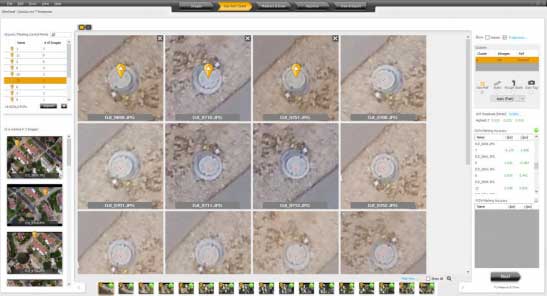
    Datumate's DatuSurvey 5.5 software offers 2D vectorized measurements and 3D point clouds models. (Screenshot: Datumate)
    Datumate’s DatuSurvey 5.5 software offers 2D vectorized measurements and 3D point clouds models. (Screenshot: Datumate)

    Datumate, a photogrammetry solution and 3D mapping software developer, has released its updated DatuSurvey 5.5 software, which offers 2D vectorized measurements and 3D point cloud models.

    According to the company, with the updated software, users can now process thousands of images locally in an accelerated mode while maintaining survey-grade accuracy and professional engineering results. Organizations can also deploy Datumate’s solutions on single or multiple computers and take advantage of the accelerated and user-friendly processing of the project field data.

    In addition, DatuSurvey 5.5 can process large amounts of drone imaging data locally and quickly. The software can also achieve survey-grade accuracy and geo-reference the model quickly and easily, the company added. Finally, it can plan and execute consecutive drone missions on unmapped and frequently changing areas.

    According to Datumate, its team improved the geo-referencing workflow of the software when using ground control points. Users can now quickly and easily mark ground control points using zoomed-in image projections.

    The company also added the ability to import coordinates to DatuFly Professional in addition to on-site or on-map mission planning. This will enable an efficient and accurate drone mission execution on specific and designated areas without depending on satellite and map source views, Datumate said.

  • GPS World report: Survey sector favors multi-GNSS

    GPS World report: Survey sector favors multi-GNSS

    Health compares favorably with rest of industry

    2018 State of the GNSS Industry survey respondents who identified themselves as from the survey sector constituted 30% of the total, corresponding to the percentage of the magazine’s readership.

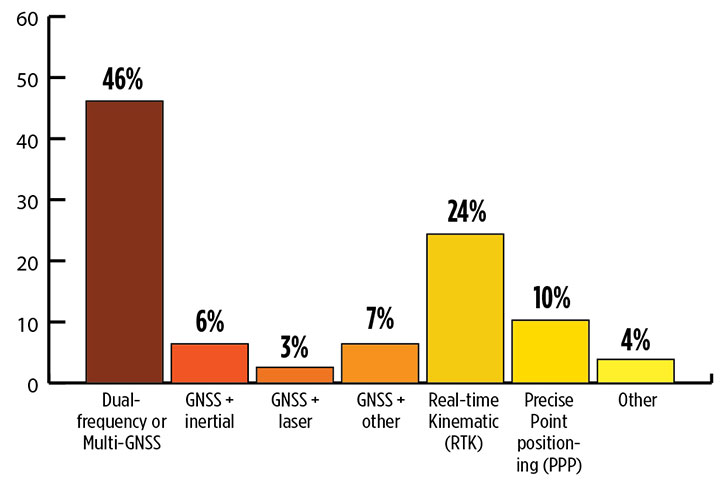
    What is the most promising and practical way to gain the increased accuracy that survey and other high-precision applications continue to demand? (Source: GPS World 2018 State of the Industry survey)
    What is the most promising and practical way to gain the increased accuracy that survey and other high-precision applications continue to demand? (Source: GPS World 2018 State of the Industry survey)

    Higher Accuracy. Regarding the most promising technology to get the increased accuracy that surveying continues to demand, the outright choice was “dual-frequency, dual- or multi-constellation GNSS,” with “real-time kinematic” coming in second. Surprisingly, the newest technology to be introduced to GNSS receivers, inertial correction, lagged at just over 5%.

    Inertial correction devices, which contain gyroscope and accelerometer technology, are now being installed in survey-grade receivers to increase accuracy and productivity. It’s a gamechanger in GNSS data collection for surveyors, so I am surprised by the survey results. These sensors work in conjunction with the receiver to more accurately collect positional information in relation to the point being acquired. While RTK positions are normally collected at 1-20 Hz, the inertial device works in tandem to further refine a more accurate location. As this technology becomes more publicized in phones and other devices, the surveying community will begin to take notice.

    What role will drones (UAVs) play during the next three years in the survey sector? (Source: GPS World 2018 State of the Industry survey)
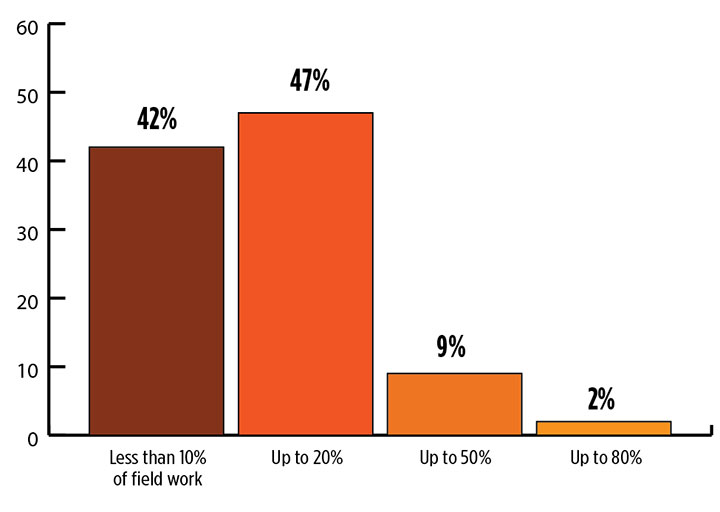
    What role will drones (UAVs) play during the next three years in the survey sector? (Source: GPS World 2018 State of the Industry survey)

    Drones. Concerning the role that drones (UAVs) will play in the next three years, by a slim margin — 47% to 42% — respondents state that up to 20% of their work will be completed by UAVs vs. those who feel less than 10% of their work will be done by a drone. Only1.3% answered that UAVs will take over most of their work and displace surveyors in the field for specific survey tasks.

    I see UAVs becoming a standard equipment much like the EDM/total station and GNSS receivers, as it is clearly a unique tool for not just collecting visual images but as a remote sensing device. While it won’t replace workers in the field, it will allow crews to become more efficient, tech-savvy and valuable for human-only types of data collection.

    Business. A whopping 85% of the survey sector found this market either “very healthy, with strong growth” (37%) or “relatively healthy, with moderate growth” (48%). This compares with total of 79% across all GNSS industry sectors. So we’re on top! That is, we are doing comparatively well amid the rest of the GNSS industry — which itself is in very good shape indeed.

    Poll results reflect the positive nature of the surveying profession in relation to technology, specifically GNSS and the utilization of UAVs, in our every day work. Previously, introduction of new technology has been historically unreliable, less than user-friendly, and expensive. The trend with newer technologies, however, has been quite the opposite with shorter, easier learning curves and lower cost of entry. These factors have led more surveyors to upgrade their equipment, implementing newer technologies and thus creating more efficiency in the profession.


    For more results from the 2018 State of the GNSS Industry, see this page.


    TIM BURCH is a professional land surveyor and secretary, Board of Directors, National Society of Professional Surveyors.

  • Research Online: Urban positioning accuracy enhancement using 3D buildings model

    Research Online: Urban positioning accuracy enhancement using 3D buildings model

    By Nesreen I. Ziedan, Zagazig University, Egypt / Presented at ION GNSS+ 2017, September 2017

    Above: The constructed 3D model for 26 buildings; below: illustration of the direction of recording of surfaces. (Images: Authors)
    Above: The constructed 3D model for 26 buildings; below: illustration of the direction of recording of surfaces. (Images: Authors)

    Multipath is a major source of positioning accuracy degradation in urban areas. Advances in 3D mapping and the availability of 3D city models have encouraged a set of new techniques for multipath mitigation.

    This paper presents three algorithms to enhance the accuracy of urban positioning using all the available line-of-sight, multipath and non-line-of-sight signals:

    • An accelerated ray tracing technique that first eliminates the 3D surfaces that are invisible with respect to a position, and then analyzes the visible surfaces to predict the existence and path lengths of reflected signals. The ray tracing algorithm is applied on the possible range of positions.
    • A Markov Chain Monte Carlo-based algorithm that applies both the Gibbs sampler and the Metropolis-Hastings technique to analyze the received correlated signals to estimate the delays of reflected signals for all the received signals.
    • A Van Rossum-based technique that measures the discrepancy between the estimated delays and the predicted ones at a range of possible positions, where the position that generates the minimum discrepancy is taken as the estimated position. Test results indicate the ability of the algorithms to successfully utilize reflected signals to enhance urban positioning accuracy.
  • Project to advance multi-GNSS development uses Spirent test systems

    Project to advance multi-GNSS development uses Spirent test systems

    Spirent Communications’ testing systems are being used by the European Union TREASURE project (Training, REsearch and Applications network to Support the Ultimate Real-time high-accuracy EGNSS).

    The aim of the four-year project is to provide instantaneous and high-accuracy positioning anywhere in the world, exploiting different satellite systems operating together to provide users with positional accuracy of a few centimeters.

    Spirent’s GSS7000 test system.

    By 2020 Galileo, the European GNSS system (EGNSS), will be fully operational and provide positioning data of unprecedented accuracy. Galileo’s integration with other satellite systems through the TREASURE project is key to increasing Europe’s competitiveness in the field, which has been mainly based on the GPS system in the past 20 years.

    Higher accuracy services will not only assist safety-critical industries such as air and maritime navigation services, but also help industries such as the global agri-tech market, autonomous vehicles and capital-intensive sectors.

    Kimon Voutsis, Robust PNT Solutions Architect, works on a professional services project for a client.

    For example, more accurate real-time positioning data can assist farmers in maximizing food production, reducing costs and minimizing the environmental impact. Equally, a deep-sea drilling platform that experiences any temporary degradation in positioning accuracy could lead to significant financial losses.

    “Spirent is proud to support multi-national initiatives that advance our industry and provide better end user performance,” said Martin Foulger, general manager of Spirent’s positioning business unit. “More systems are using GNSS data, and users always want better accuracy, so TREASURE will help to provide this.”

    TREASURE is an EU-funded project under the H2020-Marie Skłodowska-Curie Innovative Training Network. It is coordinated by the University of Nottingham, and Spirent is the partner providing GNSS simulation systems.

    For more information on Spirent’s GNSS testing solutions, visit the website. To learn more about how to test receivers of GPS, Galileo and other GNSS, download Spirent’s eBook.

    To learn more about TREASURE, contact Marcio Aquino, Nottingham Geospatial Institute.

  • High-precision positioning to improve as next-gen GNSS begins

    A four-satellite dispenser for Galileo’s Ariane 5 is shown during shaker testing at Airbus Defence and Space near Bordeaux, France. The dispenser has had four Galileo engineering models attached to it for test purposes. (Photo: ESA)
    A four-satellite dispenser for Galileo’s Ariane 5 is shown during shaker testing at Airbus Defence and Space near Bordeaux, France. The dispenser has had four Galileo engineering models attached to it for test purposes. (Photo: ESA)

    In Geospatial Solutions’ sister publication, GPS World magazine, I’ve written quite a bit about how high-precision GNSS is going to significantly improve over the next few years.

    Most GNSS users have receivers capable of using GPS (31 satellites) and Glonass (about 24 satellites). That generally equates to between 13 and 20 satellites in view with a clear sky and average terrain. However, add in variable terrain, some trees and perhaps a nearby building or two, and it can be a challenge to find enough solid satellites to track to obtain a high-precision GNSS position (less than a meter).

    As the demand for high-precision GNSS positioning continues to grow, users are going to want to work in increasingly more difficult environments where high-precision GNSS struggles. More satellites will help, but they won’t come from GPS, nor GLONASS.

    The GPS constellation is currently full, and is not going to grow any larger than 31 satellites (due to limitation in current GPS ground control software) in the foreseeable future. Even if GPS could fly more satellites, the orbit design accommodates only 27 satellites. GLONASS appears happy at 24 satellites and is not expanding anytime soon.

    The answer lies in Europe, with China following.

    After two decades of start, stop, restart, retool, regroup and start again, Europe’s Galileo constellation is real — very real. It’s all fun and games until Galileo starts launching four satellites at a time, which it is scheduled to start doing in a couple of months. Those four new satellites, added to the 12 in orbit (plus two in odd orbits), should be enough for Galileo to begin initial operation in Q4 of this year. Then, each new launch of four additional Galileo satellites will only improve the reliability and robustness of high-precision positioning. That’s a big deal for high-precision GNSS users.

    Get ready for another jump in performance in high-precision GNSS positioning.

    Do you remember the value that GLONASS added to GPS-only receivers 10-plus years ago? It was a premium feature on high-precision GNSS receivers in those days. Now, GLONASS is a standard feature on your smartphone.

    Not very long from now, we’ll be making similar comments about Galileo. Satellite positioning in general, and high-precision GNSS positioning specifically, are satellite-hungry. As high-precision GNSS technology continues to embed itself deeper into a wide variety of industries, users will expect the technology to work. Some of those expectations, maybe many expectations, will be unreasonable. In dense urban environments? Under heavy tree canopy? In rugged terrain?

    Unreasonable expectations are O.K. — that’s what pushes GNSS product managers and GNSS engineers to think outside of the box. More satellites will help meet some of the unreasonable user expectations.

    What’s even better is that China’s global BeiDou system isn’t far behind Galileo. China’s regional BeiDou system (16 satellites in regional orbits over China) already makes China the best place in the world for high-precision GNSS positioning. Like Galileo, China’s global constellation is said to consist of 30 satellites.

    That means in the not-too-distant future (about 2018 for Galileo and 2020 for BeiDou):

    31 x GPS
    24 x GLONASS
    30 x Galileo
    30 x BeiDou
    Total: 115

    This translates into more than double the satellites in view that we have at this point in time. But, you don’t have to wait. Galileo satellites are usable this year if your receiver has been designed to use them. With each new Galileo launch, you’ll have access to four more satellites until the constellation reaches 30. The same goes for BeiDou.

    Don’t take this wrong, GPS isn’t done. Not by a long shot. However, historically speaking, at one satellite per rocket launch, it’s only averaging about one launch every six months. To complicate things, the U.S. Air Force has launched all of the current GPS model (IIF) satellites and aren’t ready to launch GPS III satellites yet. See Don Jewell’s August column in GPS World magazine for details.

    The good news is that the user community doesn’t have to rely on an expanded GPS constellation to improve performance any more than the “gold standard” it has become. The difference-makers are going to be Galileo beginning this year and BeiDou beginning in 2018. So, get ready folks, and fasten your seatbelt. The next generation of GNSS is about ready to begin, and your geodatabase is about ready to get a double-shot of Vitamin B.

    Follow me on Twitter @GPSGIS_Eric.

  • What really matters to GIS professionals

    MLD6

    Last week I attended a workshop sponsored by the Oregon GPS User’s Group (soon to be Oregon GNSS User’s Group). OGUG invited Michael Dennis, RLS, PE, current Ph.D. geomatics student, former full-time National Geodetic Survey (NGS) employee, all-around smart guy and entertaining speaker to present an all-day workshop entitled “Space Time and Datum Forensics – A Geodetic Workshop.” Let me tell you, its 260 slides of stuff that matters in GIS, surveying and GNSS if you’re working with data at the sub-meter level and better.

    The audience was largely surveyors, and that’s a problem. I’d go as far as saying that it’s significantly more important for GIS professionals to understand this topic than surveyors. The reason is because surveyors are project-oriented. For example, Joe Surveyor is hired to complete a boundary and topo survey for a new commercial real estate development project. He does the research, does the field work, completes the deliverables, issues an invoice, and places the project file into storage. Joe might look at the file again in six months when construction begins and may never look at it again after that.

    Surveyors are short-term, project-based data generators. On the other hand, GIS professionals are long-term data managers. Therefore, for surveyors, their data doesn’t require accuracy, it requires precision. On the other hand, GIS professionals value accuracy much more, or at least they should.

    The reason is because all the data layers in their GIS need to play together. GIS layers need to be spatially consistent. Managing a spatial and tabular-robust GIS database is a substantially more complex task than the typical surveyor encounters. Perhaps that complexity is one of the reasons that the spatial geodesy of a GIS database largely falls below the noise floor. In other words, there are much larger problems to tackle in a substantial GIS database other than geodesy.

    How many surveyors have ever had to deal with SAP databases? How about an SDE (how many of you had to Google the acronym)? How about writing a script that queries a MySQL database to extract features with particular attributes? That’s just the beginning.

    Before a surveyor criticizes a GIS for its accuracy, or lack thereof, that person should spend some time dealing with some of the data-management issues encountered by a GIS professional. There are entire conferences focused on only this subject. That’s what GIS is all about: data management, long-term data management.

    A GIS doesn’t get filed after every project is completed; it gets added to the last project, and with each project, the database grows larger, more unwieldy, and likely more difficult to manage. And then, someone or some company throws a curveball at them, a new schema, a new operating system, or a new enterprise GIS software version that impacts the entire database. The IT department gets involved, and then procurement gets involved. Before you know it, it’s meetings after meetings. You get the picture.

    Among all of the complex GIS database management issues, the geodesy of GIS has stayed below the noise floor. In other words, it’s been largely ignored. But as I’ve written in the past for GPS World magazine and this publication, GNSS, remote sensing and other sensors are becoming cheaper, faster and more precise. Therefore, data being appended to GIS databases are becoming more precise.

    This creates challenges by highlighting the legacy inaccurate or imprecise data in the GIS database, which in turn creates the necessity for another decision to be made: what should we do about it? The answer to that question is for another article, or three.

    With that, there are a few slides from Michael’s total of 260 slides in the workshop that I would like to highlight.

    His second slide is one my favorites. It’s a bit rhetorical in that there is no answer, but succinctly states the problem. The value of a GIS database is the relationship of spatial data amongst its elements. How close is the gas pipeline to the nearest home? Where’s the shut-off valve for main water line on First Street? Which homes will be at risk of flooding during a storm surge in Galveston, Texas? How fast will the latest virus likely spread if the first case is discovered in Atlanta vs. Nowhere, USA? GIS can answer these questions, but its answers are only as good as the data in the GIS. Good ol’ garbage-in, garbage-out.

    MLD1

    Before we get into the weeds, this is another setup slide that succinctly frames the challenge.

    MLD2

    To be clear, a coordinate system always includes a datum (a.k.a. geographic coordinate system, geometric reference system/frame), and it may or may not also include a map projection. Examples of projected coordinate systems include UTM (Universal Transverse Mercator), US SPC (State Plane Coordinates), Web Mercator (think Google Earth), Lambert Conformal Conic, and Gauss-Kruger for my European brethren. These systems must always include a specific datum. Common geodetic datums are ITRF08, IGS08, NAD83, NAD27, ED50, and WGS-84. You may have different map projections for each datum. For example, UTM or SPC can be referenced to NAD83. It’s a straight-forward mathematical operation to change the projection if the underlying datum is the same. However, UTM coordinates referenced to NAD83 or WGS-84 is a different subject altogether. Going to/from UTM/NAD83 to UTM/WGS-84 is far from being a straight-forward mathematical operation.

    The next feature slide gets into the weeds a bit. This is a subject I’ve written about for a few years and was somewhat highlighted in two articles I wrote (and a webinar I moderated) called “Nightmare on GIS Street.” How many of you think you use data referenced to WGS-84?

    MLD3

    MLD4

    WGS-84 referenced data is probably the most widely mis-used. As you can see from the above slide, the definition of WGS-84 has changed over time. You’ll never find a survey mark on the ground with coordinates referenced to WGS-84. If you do, it’s wrong. This is because it’s a military thing. WGS-84 is managed by the US Department of Defense. More specifically, the US National Geospatial Intelligence Agency (formerly NIMA, formerly DMA). Fortunately, in recent years, the Department of Defense has aligned WGS-84 with ITRF (International Terrestrial Reference Frame) — most recently to ITRF08 — and ITRF/IGS coordinates are publically available. For example, IGS08 (International GNSS Service of 2008) coordinates are published for NGS CORS and available in NGS OPUS solutions (for the purpose of this discussion we can consider ITRF and IGS the same). However,  there is a caveat: ITRF08/IGS08/WGS-84 coordinates are referenced to specific dates (epochs).

    WGS-84 was aligned with ITRF08 at epoch 2005.00, meaning that the WGS-84 coordinates were defined for the date of January 1, 2005. NGS publishes IGS08 coordinates at epoch 2005.00 for CORS. But OPUS solutions give IGS08 coordinates at the date of the GPS data file, and both autonomous and WAAS-corrected GPS gives positions at the mid-year epoch of the current year (i.e., positions are now at epoch 2016.5). This matters because stuff moves, including the ground you are standing on. Some places move more than others. California moves more than Missouri. Chile moves more than Germany. January 1, 2005 is 11+ years ago. If the ground is moving 3cm/yr, that’s 33cm over 11+ years. If you’re counting centimeters, that’s quite a few of them.

    Software vendors have a hard time keeping up with modern datum transformations, and this next slide is a perfect example of that. It’s not just one vendor. Nearly all software vendors “aren’t doing it right.” In this slide, this software vendor displays 10 different transformations from “WGS84” to “NAD83”. Which one do you use? None of them get it right.

    MLD5

    The most accurate one is still 20 cm in error. The worst is more than a meter in error. It makes you wonder why you spent $8,000 on that sub-foot GPS handheld when your GIS software may be introducing three feet of error.

    Finally, should you be concerned about this stuff?

    MLD6

    If you expect some of your data layers to be accurate to less than three meters, the answer is “yes.”

    I’ll likely continue this discussion next month or in the coming months,and also provide a link to Michael’s 260-page slideshow.

    Thanks, and see you next month.

    Follow me on Twitter at GPSGIS_Eric

  • More, More, More. Accuracy, Accuracy, Accuracy.

    More, More, More. Accuracy, Accuracy, Accuracy.

    Reliable, consistent positioning accuracy has always driven new product development in the survey and mapping sector of the GPS/GNSS market. It’s remarkable how quickly the provided accuracy in successive new survey products over the years has increased the required accuracy from users and customers in the field, and consequently the desired accuracy in a feedback loop to the product developers.

    In other words, the degree of required accuracy has risen steadily over the three and a half decades since GPS was born. “Accuracy is addictive.” Somebody said that in the second decade of GPS development, that is, sometime in the 1990s. This statement continues to hold true, as true for this industry as Moore’s Law does for computer technology as a whole.

    Moore’s Law states that overall processing power for computers will double every two years; as a corollary or an extension, the size of said computers gets cut in half every two years, and the cost (sometimes) also comes down by 50 percent. Moore’s Law in action in the GPS/GNSS industry has driven the product developments that we have consistently seen for many years.

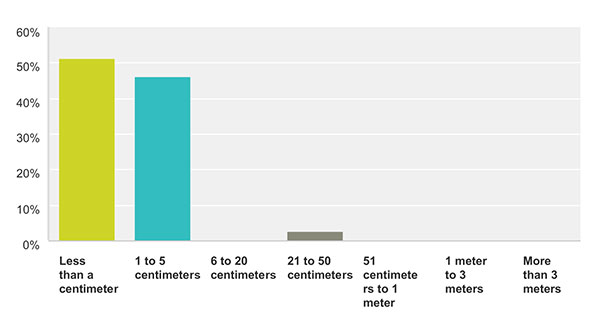
    We have seen the gradual tightening of accuracy requirements across all sectors of the positioning, navigation and timing (PNT) community with each passing year and with each new State of the Industry Report. This is the first time we have seen it cross the 1-centimeter line. Not in capability; sub-centimeter capability has been available for some time. But now that level of performance is the minimum acceptable “good enough” for more respondents in the survey and high-precision sector than any lesser degree of accuracy; in fact, greater than all other ranges combined.

    To put this into measurable, statistical form, GPS World has just released its fourth annual “State of the GNSS Industry Report.” In the years that we have conducted the survey, the accuracy required for the majority of survey applications has steadily come down. No surprises here.

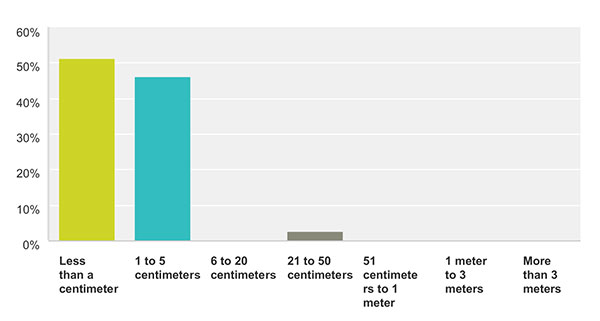
    In 2013, those who said that the majority of this market sector needed accuracy of better than a centimeter amounted to only 8 percent of total respondents.

    In 2014, this group rose dramatically to 35 percent, while close to a majority, or 47 percent, held that a range of 1 to 5 centimeters was “good enough.”

    Now, in this year of 2015, the majority has shifted clearly to the side of 1 centimeter or better as the new standard of required precision; 51.25 percent held this view. From 8 percent to more than half in just two years — that’s some change!

    How accurate is good enough for the majority of this sector?
    How accurate is good enough for the majority of this sector?

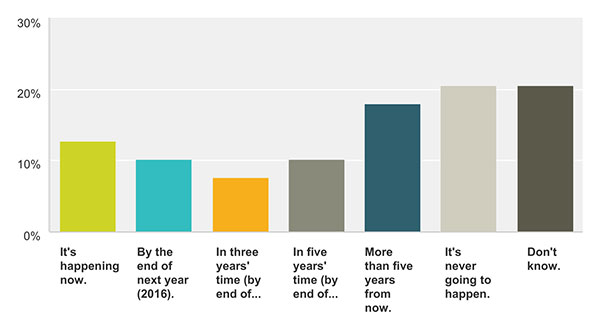
    Fewer people believe that a survey done completely on a computer and driven by remote-sensor data will occur in less than five years. Counter to last year’s expectations, most now think it will take longer than five years to come about.

    How soon will a survey be performed entirely from a computer, using high-resolution satellite and/or UAV-collected data, without any instrumented field work?
    How soon will a survey be performed entirely from a computer, using high-resolution satellite and/or UAV-collected data, without any instrumented field work?

    Those who are addicted to 1-centimeter accuracy form the new majority. Their preferences and their behaviors will rule the positioning world, not just in survey, but across all sectors supplied by GNSS and increasingly by a broad range of PNT technologies: defense, transportation, UAVs, machine control, precision agriculture, and much more. These other sectors will presumably answer likewise — “1 centimeter accuracy, that’s what I need!” in coming years, following the trail blazed by the you high-precision surveying pioneers.

    We have crossed the Rubicon. Unlike other obsessive behaviors, there is no going back in our case. This path is a one-way road to to the promised land of always-on, always-true, near-perfect provision of positioning.

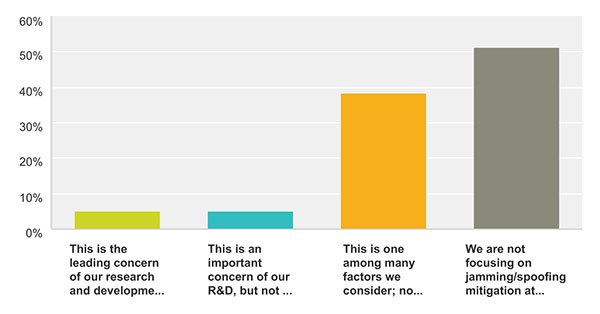
    How much effort are you devoting to mitigation of GNSS jamming or spoofing?
    How much effort are you devoting to mitigation of GNSS jamming or spoofing?


    Graphics: GPS World staff

  • Out in Front: Addiction on the Rise

    Out in Front: Addiction on the Rise

    How accurate is good enough for the majority of your market sector? This chart show the answers from those who identified themselves as members of the survey and high-precision community. For more results from this and other sectors, see the 2015 State of the GNSS Industry Report.
    How accurate is good enough for the majority of your market sector? This chart show the answers from those who identified themselves as members of the survey and high-precision community. For more results from this and other sectors, see the 2015 State of the GNSS Industry Report.

    Memory fails as to who first said “Accuracy is addictive.” Or perhaps it’s my knowledge base that is deficient. At any rate, I’ll gladly publish documented evidence from anyone who can show the earliest — print or audio — expression of that dictum. It continues to hold as true for this industry as Moore’s Law does for computer technology as a whole.

    We have seen the gradual tightening of accuracy requirements across all sectors of the positioning, navigation and timing (PNT) community with each successive iteration of our State of the GNSS Industry Survey, now in its fourth year. This is the first time we have seen it cross the 1-centimeter line. Not in capability; sub-centimeter capability has been available for some time. But now that level of performance is the minimum acceptable “good enough” for more respondents in the survey and high-precision sector than any lesser degree of accuracy; in fact, greater than all other ranges combined. These addicts form the new majority. Their preferences and their behaviors will rule our world.

    Other sectors will presumably answer likewise in coming years, following the trail blazed by the high-precision pioneers.

    We have crossed the Rubicon. Unlike other obsessive behaviors, there is no going back in our case. This path is a one-way road to  — well, not to the various hells entailed by other addictions — but to the promised land of always-on, always-true, near-perfect provision of positioning.

    Let’s not kid ourselves, however. The perfect world does not exist. The closer we get to millimetric accuracy, the more obstacles we find in our way. Indoor continuity aka ubiquity, jamming, spoofing, hacking, budget cutbacks, slides to the right — this list will surely grow.

    The more acute our addiction, the lower our tolerance for less-than-total fulfillment.

  • Directions 2014: Great Expectations

    Directions 2014: Great Expectations

    Peter Large
    Peter Large

    By Peter O. Large, Vice President, Trimble

    November 29, 2013, marks the 210th anniversary of the birth of Christian Doppler. His work laid down the fundamental concepts that enabled researchers at Johns Hopkins University in the United States to make observations on the signals of Sputnik I during the International Geophysical Year of 1957. From those observations more than 60 years ago, we can trace the development of GNSS as we know it today. The very genesis of GNSS drew on the combined science, technology, and innovation from Europe, the United States, and Russia. Today, GNSS is a truly global technology that has changed for the better the lives of an estimated one billion people.

    2013 also saw a major milestone in the global history of GNSS with the announcement by the European Space Agency (ESA) that the Galileo system had generated its first position fix using operational space vehicles. Here at Trimble we have for some time been providing user equipment that is ready for the modernized, multiple-constellation environment emerging in the coming years. It is still exciting to see the plans of the GNSS operators gradually become a reality, whether it is the ongoing deployment of Galileo and BeiDou or the modernization of GPS and GLONASS. There is no doubt that GNSS users worldwide will benefit significantly from these new developments, and it is natural to expect that we will see continued user-driven adoption and integration of these systems in the year ahead, together with new applications and services that make full use of the expanding GNSS capabilities.

    Global Addiction to Accuracy

    We have come to expect — if not demand — that technologies continuously evolve to become faster, smaller, and more cost-effective, while also providing expanded functionality and benefits. For GNSS, this expectation includes increased accuracy and precision for a growing proportion of the total user base, together with a desire to determine location in more places or, ultimately, ubiquitously.

    From a technological perspective, the trend to increased accuracy is moving beyond local or regional land- or satellite-based differential augmentation toward global networks and services. New technologies such as Trimble RTX use data from a global network of GNSS stations together with global connectivity and communications to facilitate precise point positioning without the need to connect to local or regional reference station networks. Such capabilities simplify the user’s experience with precise positioning, while at the same time vastly expanding the areas on Earth where such positioning can be quickly and conveniently carried out.

    Over the past decades, high-precision GNSS positioning has been adopted by increasingly larger numbers of users in the context of end-to-end work-process solutions in industries from agriculture to construction, surveying and mapping, energy, mining, utilities, transportation, and government, to name but a few. With assets, workers, and work sites spread over large geographic areas, these industries and operations have transformed how their work is done through the use of systems that incorporate real-time location information. While we should expect adoption and advancement in these areas to continue due to the compelling economic, safety, and environmental benefits provided, we should also expect to see increasing adoption of high-precision GNSS positioning in new applications such as intelligent transportation and within some proportion of the consumer user base. Accuracy is, after all, addictive.

    Availability, Too. Along with accuracy, availability of position is also proving to be addictive; once we come to depend on location-enabled systems in our professional and personal lives, our needs and expectations will naturally tend toward that of continuous availability at all times and regardless of location. Although new constellations with more satellites and new, stronger signals help in this regard, augmentation of GNSS plays a key role on the path to more robust ubiquity. From a Trimble perspective, many of our new product launches during the past year incorporated deep integration of multiple measurement technologies. New systems combine GNSS with inertial measurement units, gyros, tilt sensors, seismometers, optical measurement, imaging systems, lasers, and other sensors or technologies, all enabling location and movement determination (increasingly in three dimensions) of more objects in more places — including, in some cases, even inside buildings. Looking to the future,we can expect the appetite for ubiquitous positioning to continue unabated.

    Multiple sensors are also used to collect non-geographic information. Increasingly, innovation is taking place at the intersection and aggregation of many different types of data, providing new insights and enabling more informed, more timely, and more insightful decisions across almost every facet of human activity. GNSS is rapidly expanding its role as an enabling technology in this regard. While we know that delivering consistently accurate positions is a decidedly nontrivial achievement, those positions are often just one component of increasingly large and complex endeavors. In fact, much of the innovation today lies in applications that enable new, more efficient approaches to work and enterprise management, and in the creation of new and powerful analytics from aggregated data.

    Global Utility, Global Business

    2013 marks another important anniversary: GPS officially reached Initial Operating Capability twenty years ago on December 8, 1993. In his 2011 State of the Union address, U.S. President Barack Obama cited GPS, along with the Internet, as key examples of how government-funded fundamental research can stimulate innovation and create whole new industries. The combination of those two technologies has transformed our lives in ways even the early visionaries may not have imagined. The U.S. government has contributed to the global success of GPS in ways beyond technological innovation. Following the 1983 Korean Airlines 007 disaster (caused in part by inaccurate navigation), President Reagan declared that GPS should be free and available to all, providing a stable policy foundation upon which successive U.S. administrations have continued to build, increasingly recognizing the importance of civilian GPS applications.

    Importantly, the United States strengthened this open-access policy framework by publishing the Interface Control Document for GPS, which enabled entrepreneurs and innovators anywhere in the world to bring to life their ideas about how this new technology in space could be used on Earth. For the most part, other governments have followed U.S. leadership in announcing predictable policy access to worldwide satellite positioning and timing availability, allowing innovation to take place wherever it may. In the process it spawned a truly global industry.

    Technology alone has not achieved the global impact of GNSS. Rather, it is the combination of technology, a transparent, stable policy environment conducive to global innovation and adoption, and the economics of a global market that together have led to so many people today enjoying the benefits that GNSS provides. Such alignment is equally important for the future: just as GNSS from the beginning built upon knowledge and achievement from around the world, its full international potential will be best realized through global, user-driven innovation, vibrant international entrepreneurship, and robust open markets. Given that we are still far from reaching that full potential, there is good reason for us all to have great expectations of GNSS operators, the industry, and the user community in 2014 and beyond.


    Peter O. Large joined Trimble in 1996 and has served as a vice president and a member of the executive committee since 2010. He holds a BSc (Hons) in surveying and mapping science from the University of Newcastle upon Tyne, UK, and an M.S. in management from Stanford University.

  • Out in Front: Welcome to Accuracy Anonymous

    The following was delivered as an invited presentation at the Civil GPS Service Interface Committee plenary session, held September 20 in Portland, Oregon.


    Hi, my name is Alan, and I’m an accuracy addict.

    I got my first taste of accuracy back in 2000 when I started at GPS World, and discovered the vast range of very advanced things that people were doing with the signals of the Global Positioning System.

    This filled me with a great feeling of elation, expansiveness, and effectiveness. I can position anything. I can track anything. I can go anywhere, and know where I am. I can direct something else to go somewhere, and have it hit exactly on target. I can examine the minute movements of the earth, the swaying of skyscrapers, the moisture content of the atmosphere, and I can know all.

    I began to feel the illusion of omnipotence — of power over all.

    The more I found out about accuracy, the more I used it, the more addicted I became.

    Very early, I learned that advanced practitioners, such as some of the people in this room, had developed ways of taking two GPS signals, not just one, but two signals, including one that they weren’t even entitled to use, and combining them, distilling them, refining them to produce an even more potent product: high precision.

    High. I was getting pretty high. Almost as high as some of you.

    Because we’re all in this together. In this room, we are all addicts. And when our supply of accuracy gets cut off, or restricted, or we learn that it might soon be diminished in some way, or even that its projected future rate of increase might not be as rapid as expected, or that it might not increase at all, it might just simply stay the same­ — well then, we get upset.

    We want to get high precision, we want to stay high precision, and we want to get higher precision.

    We may have a problem with our accuracy habit.

    It’s not just us, the highly educated, highly equipped, highly advanced users, with near-lifelong histories of accuracy use. Outside this room, outside this convention center and all who gather here this week, outside our offices and labs, the great unwashed masses are getting their first taste of low-grade accuracy. With their cell phones or smart phones, maybe 50-meter, maybe 15-meter, maybe even 5-meter accuracy.

    They’re liking it, that first taste. Once they learn how to exploit it, and learn that higher accuracy is possible, they’re going to demand it.

    And some enterprising young engineers are going to build a high-powered LBS app that needs high accuracy, just like other new apps need broadband or WiFi or 3G or 4G. If the capability exists, someone wants to make money off it.

    We may be raising a generation of monsters, who will absorb our habit into their bloodstreams and into their lifestyles.

    Things might get ugly. We know they’re going to change, altering the landscape in ways we may not recognize.

    I’m not talking about just the social landscape, the way accuracy users behave. Not just the user segment. I’m talking about the way accuracy is produced and administered. I’m talking about

    the supply of accuracy, the supply of a substance that is in high demand and to which an increasing number of people are becoming addicted.
    I’m talking about the ground control segment and the space segment.

    Ultimately, I’m talking about who makes the decisions, who funds the decisions, who enacts the decisions, and who enforces the decisions about how much accuracy can and will be produced.

    Today, we know, or think we know who those people are: the GPS Wing, the Air Force, the Department of Defense, the Administration of the U.S. government. We may think we know that those same people will be in charge tomorrow.

    I’m not so sure. Revolutions have happened before.

    I don’t mean to be U.S.-centric. The same developments are taking place, perhaps a bit lagged, in Europe and Russia and China. When the great mass of the Chinese market gets into using accuracy, gets the habit, you’re going to see some effects.

    Returning to the United States, simply because it has the most known and most established of these systems, it is not inconceivable that some Tea Party-like movement, a groundswell should roll right up to Washington, into Congress, and say:

    “Higher accuracy is possible. We are paying for GPS with our taxes, and we want you to spend that money producing and supplying us with a higher grade of accuracy. Don’t give us this talk of responsible stewards. We are calling the shots now. Just do it. Revise the ICD. Up the ante.
    “Give me accuracy or give me death.”

    Ladies and gentlemen, I have expanded, exaggerated only slightly, and perhaps exploded the old dictum that I’ve heard attributed to Charlie Trimble, I don’t know who first said it, but it bears repeating and repeating often: accuracy is addictive.

    Indeed it is. I’m here to tell you.

    I was asked to give you a user perspective. I’ve chosen what is today a relatively small user segment, but a very real one, and a growing one. And most important, one that augurs for the future.

    Perhaps the scenario I just imagined for you exaggerates a bit. Perhaps. I am consciously trying to push further out the boundaries of our thinking.

    We’ve been waiting, some of us, for a long time for the mass market to get involved in GPS. This is now happening, bit by bit. But it has not yet fully happened. When it does, great changes will come. When LBS figures out the key to making money out of location, you’ll see changes you can’t imagine today.

    I started to become aware of how pervasive and how strong accuracy addiction has grown when we experienced a succession of anomalies in the GPS constellation over the last year or so: SVN-49, the last IIR-M satellite; carrier-phase anomalies detected on SVN-48; and now SVN-62, a small variance in the L5 signal on the first IIF. “The signal variation results in no more than a 5-centimeter error with a predictable periodicity of about six hours.”

    In each case, GPS performed within spec, and some therefore viewed these issues as non-issues. “What seems to be lacking is context: what relevance their findings on unspecified and unrequired signal characteristics really have to do with the real-world GPS IIF mission and requirements.”

    I’ve repeated here two printed quotes in the magazine; offline, the point-counterpoint discussion grew a good deal more inflamed. Passions run high when the supply and quality of accuracy appears in question.

    This might seem a minor flare-up today, off in a corner of the field: specialized scientific research spatting with industry giants and their military-industrial complex benefactors.

    But today’s developing applications in aviation, ground transportation, structural monitoring, machine control, infrastructure, and more use techniques such as carrier phase that are not governed, are not even mentioned in the GPS ICD.

    When LBS gets figured out, and high-accuracy LBS and vehicle navigation and crash avoidance become regularly supplied commercial services, when the dependence of financial and communications infrastructure on high precision becomes fully understood and appreciated, then you’ll see some large corporate money that has become accuracy-addicted. Imagine this room in another few years, with GM, Ford, Google, Microsoft, AT&T, and Verizon attending and very interested, very much so, in aspects of user accuracy that are not currently addressed in the ICD.

    This community will change. Its needs will change. Balances of power and funding will shift. Are we prepared for that? Are we prepared to be surp
    rised? Or are we prepared only to be left behind by tides of change, to become obsolete?