Tag: app

  • New app helps local governments reduce traffic

    New app helps local governments reduce traffic

    Photo: Geoxphere
    Photo: Geoxphere

    A new software app helps local governments in the UK plan alternative routes, infrastructure and access that facilitate walking and cycling in cities, reducing traffic. XMAP, a cloud-based web geographic information system (GIS) for local governments from Geoxphere, now offers Isochrone. It provides a detailed and visual insight into existing transport infrastructure, assessing accessibility and the local environment to calculate and compare travel times by foot, cycle and car. The tool enables planners to understand how the existing infrastructure is enabling or restricting green journeys. It also helps them model and visualize how improvements to the transport network can be made and engage with communities to promote specific schemes and opportunities for active travel.

    The XMAP Isochrone tool allows a user to create polygons on a map showing how far it is possible to drive, walk or cycle in a set amount of time. Using algorithms that take into consideration the actual road, foot path or cycle network, as well as historic speed data and average walking and cycling rates, it provides a more accurate methodology of calculating travel times compared to traditional concentric circles based on straight line distances.

    XMAP is accessible from any web-enabled device, without plug-ins, bolt-ons or additional installations. It includes a suite of inbuilt workflows to support delivery of local government services such as planning, housing, waste and recycling, and street services. XMAP comes complete with more than 250 geospatial data layers, from a variety of government agencies, as well as a fully maintained Ordnance Survey map stack.

    Provided as a Software as a Service (SaaS), XMAP allows users to create and share business-critical map data without the risks involved in using open-source silos of GIS or the high cost of traditional GIS solutions. XMAP gives access to Ordnance Survey mapping, aerial photography, together with third party and in-house datasets, for more than 1,700 government organizations as well as a range of commercial clients. 
  • Global GNSS launches survey application

    Global GNSS launches survey application

    Image: Global GNSS
    Image: Global GNSS

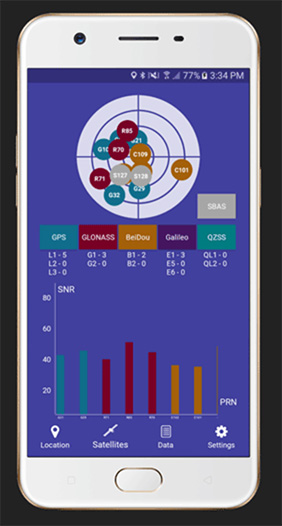
    Global GNSS, a subsidiary of Polosoft Technologies, has launched a new mobile application named GNSS Surveyor, which is designed for the geospatial industry.

    The application GNSS Surveyor provides location information and quality position data in real-time with sub-meter to centimeter accuracy. It needs to be connected to any external GNSS receiver via Bluetooth.

    Features of the application include:

    • A one-touch configured command to communicate directly with the GNSS Bluetooth device.
    • Location information and quality of the position data in real-time with centimeter accuracy.
    • GPS data such as position, height, satellites and velocity.
    • Constellation information for GPS, GLONASS, Galileo, BeiDou, QZSS and SBAS satellites in the orbit.
    • Direct IP feature for RTK corrections data.
    • DMS to DD conversion or vice versa.

    Real-time kinematic (RTK) correction data can be forwarded to a high-accuracy external device. The internal NTRIP client loads the RTCM data from the internet.

    With GNSS Surveyor, location information is collected as latitude and longitude, altitude, speed or pace, bearing and UTC time.

    GNSS precision includes global coverage, centimeter-level accuracy, fast time to first fix, multi-constellation and multi-band, and highest security, the company said.

    Navigation uses include ground robotics navigation, lane-level navigation, heavy machine navigation, industrial navigation and tracking and commercial UAV.

    GNSS Surveyor can be downloaded from the app store.

  • DJI’s privacy mode enables flight without internet data transfer

    DJI has launched a new Local Data Mode that stops internet traffic to and from its DJI Pilot app, providing enhanced data privacy assurances for sensitive government and enterprise customers.

    Local Data Mode will be available in the next update on the DJI Pilot app on CrystalSky and for select Android tablets.

    When an operator activates Local Data Mode, the app will stop sending or receiving any data over the internet. This adds an additional layer of security for operators of flights involving critical infrastructure, governmental projects or other sensitive missions.

    “We are creating Local Data Mode to address the needs of our enterprise customers, including public and private organizations that are using DJI technology to perform sensitive operations around the world,” said Brendan Schulman, DJI’s vice p resident of policy and legal affairs. “DJI is committed to protecting the privacy of its customers’ photos, videos and flight logs. Local Data Mode will provide added assurances for customers with heightened data security needs.”

    Since Local Data Mode blocks all internet data, the DJI Pilot app will not be able to detect the location of the user or show map and geofencing information such as No Fly Zones and temporary flight restrictions, nor will it notify drone operators of firmware updates.

    Telemetry data on flight logs such as altitude, distance or speed will remain stored on the aircraft even if the user deactivates Local Data Mode.

    Whether Local Data Mode is activated or not, photos and videos captured by the user are always stored on the drone’s SD card and are only shared if the user chooses to upload them online to the SkyPixel community, social media or other websites.

    When using Local Data Mode, drone operators are reminded that they are solely responsible for the safety of their flight operation and that they understand that features that may enhance and support the safety of their operations, but that rely on internet connectivity, are no longer available.

    Drone operators can enable Local Data Mode by opening the DJI Pilot app, clicking on “Activate LDM Mode” and entering a password which will be required to deactivate Local Data Mode when they decide to go online again.

    New drones will still have to be activated first by logging into the user’s DJI account with an email and a password. To ensure the drone has the latest firmware, users can download and update it while they have internet connectivity before re-activating Local Data Mode.

    The Local Data Mode feature may not be available in locations where an internet connection is required or highly advisable due to local regulations.

  • Sygic incorporates augmented reality into GPS navigation app

    Advanced GPS navigation app Sygic has released its new augmented reality (AR) feature. More than 200 million Sygic users worldwide can engage with AR for an improved navigation experience on the road.

    Sygic’s new AR feature uses a smartphone’s GPS and camera to implement its augmented reality-powered GPS navigation system. With the AR feature, the driver no longer needs to follow a map on their phone. Instead, they’re guided by a virtual path on the smartphone camera preview.

    The AR feature is not only intuitive, but is also safer than traditional navigation apps. Drivers can rest assured they won’t miss anything crucial on roads or highways, as the real-time camera preview enables them to check conditions on the screen without impacting driving safety.

    “We are so pleased to make Sygic’s AR feature available to users around the world. We understand the value of bringing the latest technology features into Sygic GPS Navigation, and to bringing smart life to your device,” said Michal Stencl, CEO of Sygic. “However, our new AR capability isn’t just a shiny new tool. Whether you’re in the car with your loved-ones, friends or by yourself, the AR featured is designed promote the highest form of road safety.”

    The AR feature called Real View Navigation is available for all Android and iOS users as in app purchase for 9,99 EUR.

    Sygic posted a video clip of the new feature on its Twitter account.

    According to a 2015 Pew Research Center study, 67 percent of smartphone users surveyed said they occasionally use their phones for turn-by-turn navigation while driving. Even more, 31 percent said they frequently use navigation apps.

    Sygic was described as one of the world’s most successful apps by the BBC.

    “Sygic’s philosophy is to explore the boundaries of navigation, and we look forward to bringing more revolutionary tools and features to users later in 2017,” Stencl said.

  • MapSmart app hits the field

    Laser Technology’s MapSmart app for Android is a tool for expert field data collection without complicated equipment, the company said.

    The software is designed for quick and accurate mapping of anything, including stockpile volumes, with or without GPS coordinates for every data point.

    The survey-quality mapping app, using the smart device’s internal GPS or the user’s own external GPS, integrates with LTI TruPulse lasers and enables users to establish an origin and begin capturing field data in minutes.

    MapSmart:

    • offers four mapping methods to accommodate user preferences
    • provides an intuitive interface with icons and buttons
    • organizes and classifies data to ease the process of decrypting field measurements in the office
    • enables real-time addition of height and missing line values to mapped features
    • delivers advanced image capabilities, including tablet photo association with data points and TruPoint 300 image integration
    • supports a variety of report formats and wireless data transfer.

    The smart features and remote-fire capabilities are especially useful for stockpiles, where users can measure and calculate the volume and tonnage of any material from a safe location.

  • CNES offers new Android apps for GNSS

    PPPWizzlight
    PPP Wizzlight.

    French space agency CNES has made available two applications on the Google Play store for Android apps. Both are compatible with Android N (Nougat).

    RTCM Converter: This app aims to convert the smartphone GNSS raw measurements to Radio Technical Commission for Maritime Services (RTCM message type 1077) and send them to a caster, for use by third-party software.

    PPP WizzLite: This app is a port of the CNES PPP client (code and Doppler only, light version) on Android. Accuracies of 1-2 meters can be reached in kinematic mode, and sub-meter in static mode (using external SBAS data). To do so, users need to pull external RTCM streams for orbits/clocks corrections and broadcasts, such as ones available from the International GNSS Service Real-Time Service (IGS RTS).

    Both apps have been validated on a Nexus 5X device with no phase support.


  • Spireon unveils connected car solution for dealerships

    Spireon unveils connected car solution for dealerships

    Spireon Inc., an aftermarket telematics company for risk management and business optimization, will introduce its latest connected car solution, Kahu.

    Kahu_Screen_Shots_Spireon-W
    Photo: Kahu

    Kahu is designed for dealers, providing streamlined lot management while delivering a new finance and insurance (F&I) profit center by offering consumers a modern location tracking and stolen vehicle recovery service, Spireon said.

    Additionally, Kahu empowers dealers to grow service retention with car buyers by providing accurate vehicle data for proactive maintenance reminders that can improve vehicle health and keep vehicles within warranty.

    “New car dealer margins have been flat for several years, driving a need to create new revenue and profit opportunities,” said Kevin Weiss, CEO at Spireon. “Connected cars are changing the industry, but dealers are receiving little value from this shift. Kahu changes that dynamic, giving dealers the tools they need before, during and after the sale to grow profits and benefit from the connected car revolution.”

    Kahu includes an aftermarket GPS device and mobile apps for both dealers and their customers. The solution provides these features and benefits to dealers:

    • Lot Management — Dealers can manage inventory, track specific vehicle location, and see low-battery indicators using a mobile phone or tablet, streamlining operations and creating a better buying experience for consumers. Virtual geofences and after-hours alerts allow dealers to identify and recover stolen vehicles within minutes.
    • F&I Profit Center — Kahu offers dealers a high-value add-on for consumers who seek peace of mind with a next-generation vehicle recovery service and an arsenal of easy-to-use mobile features. From 24/7 vehicle location visibility, so consumers can track their vehicle and family at all times, to smart alerts for speeding and low battery, Kahu is an attractive add-on that safeguards consumers while driving dealer profit.
    • Customer Loyalty — Kahu uses GPS-based mileage tracking to improve the accuracy of service reminders and increase service retention. Consumers benefit by being able to maximize warranty protection and ensure recommended service intervals are maintained.

    “Our partnership with Spireon has paid for itself tenfold,” said Jon Hansen, general sales manager, Burien Nissan. “Being able to offer a product that I find value in to our customers and making it a revenue generator for the dealership is really big for us. I would absolutely recommend Spireon to other dealerships.”

    Spireon’s aftermarket GPS devices are installed on more than 3.5 million vehicles and offered by 14,000 dealerships across North America. With Kahu, car dealers and consumers now have access to state-of-the-art mobile location services, which protect their vehicle assets and can lead to reduced insurance premiums.

    Kahu is already installed with a select group of early adopter customers, and will be generally available in the second quarter of 2017.

  • Datumate introduces new DatuFly release 

    Datumate introduces new DatuFly release 

    Datumate has launched a new version of DatuFly for iOS, a UAV app with industry-specific capabilities for surveying, construction and infrastructure companies.

    Photo: DatumateThe new version 1.1.1. includes:

    • DJI Inspire 1 Pro Support – Two new bundles were added to support DJI Inspire 1 Pro drones, one with the X5 camera and the other with the X3.
    • DJI Matrice 600 Support – A new bundle was added to support DJI Matrice 600 with X5 camera.
    • Speed Control for Vertical Missions – Control the drone speed when taking vertical images. This includes the option of taking images when the drone is hoovering.
    • Optional Automatic Takeoff and Landing – Application is set by default to “manual takeoff and landing” for safety purposes. The operator will need to turn it off to enable automatic takeoff and landing. With manual takeoff and landing option, the operator will be asked to manually elevate the drone to a certain height and then start the automatic mission. When the mission is completed the operator will be asked to manually bring the drone back.
    • More Flexible Control of Mission Altitude — The operator can flexibly set the mission altitude for both oblique and vertical missions.
    • Control the Camera Angle for Oblique Missions – The operator has the option to change the angle if needed for oblique mission.
    • Chinese language support – DatuFly has a Chinese user interface.

    The app is available through the Apple Store.


  • Accident locator launched

    Saphibeat Technologies’ new Adventure Monitor PhiPAL can save lives of outdoor enthusiasts by recognizing when an accident has taken place.

    PhiPAL uses a proprietary machine-learning algorithm for accident recognition. If the user is unconscious, PhiPAL automatically sends a distress message with GPS coordinates to teammates and first responders through a cellphone or satellite connection.

    PhiPAL uses an activity monitor mounted on or integrated into the user’s sports helmet.

  • DJI and DroneSAR launch rescue app for first responders

    DJI and DroneSAR launch rescue app for first responders

    DJI, maker of unmanned aerial vehicles, and DroneSAR, an Irish tech start-up for search and rescue, on Thursday announced a new search and rescue app that seamlessly integrates a drone’s unique aerial perspective on life-and-death searches into incident management software, ensuring rescue crews can use drones effectively to save lives.

    DroneSAR can stream live images and video, from a regular or thermal imaging camera, to an incident command center as well as other rescue teams on the ground. The software can tag the GPS coordinates of a victim and automatically transmit them by email or SMS, enabling ground crews to reach victims more quickly. Completed search patterns are all recorded and logged for easy handover to oncoming rescue crews.

    Screengrab: DroneSARThe app takes into account various types of terrain, allowing the drone to fly patterns to survey an area faster and more effectively. Flight paths can be adjusted for any terrain including hills, mountains, trees or flat land. The software allows users to choose an automatic aerial search pattern based on variables such as altitude, field of view, battery life and probability of detection. By organizing the process of data collection and providing a framework to manage and analyze it, DroneSAR ensures drones can be used methodically as part of a rescue protocol, allowing personnel to work more safely and effectively.

    “From understanding on how to use the technology, to communicating findings and data, to figuring out the most appropriate tactical approach, first responders can benefit greatly from this software app on our DJI hardware,” said Romeo Durscher, director of Education at DJI. “Many of the tasks and strategies deployed during a search and rescue operation can get sped up with automation, helping to reduce the time it takes to find a victim and save lives.”

    The software was developed based on research done by DJI in conjunction with the European Emergency Number Association and Ireland’s Donegal Mountain Search and Rescue team. The groups found that while a five-person rescue team on foot needs an average of two hours to find a victim in one square kilometer, a drone can do the job in 20 minutes or less while taking additional active steps to achieve a successful rescue.

    “Our aim is to save lives,” said Oisin McGrath, co-founder and CEO of DroneSAR. “Our software will reduce risk to search teams and reduce search time. If we can save just one life, that is mission success for us at DroneSAR.”

  • Datumate unveils DatuFly, professional imagery app for drones

    Datumate has released a new tablet app for drone flight planning and automated, high-resolution photo-shooting. The DatuFly app saves up to 80 percent of field surveying time and eliminates follow-up site visits, according to the company.

    “DatuFly automates the entire field surveying process, while keeping field work simple and safe,” said Tal Meirzon, Datumate CEO. “Ease of use and survey-grade results makes DatuFly a valuable tool for any surveyor and drone operator. The bundle of Drone, DatuFly app and DatuGram 3D photogrammetry software forms the ideal site surveying solution for professional results.”

    A friendly, wizard-type user interface makes it easy to select the job type and the required outputs to achieve best results. The area of interest is instantly marked on the map, including complex polygons, and the drone is ready for launch.

    Flight and aerial photography, vertical or oblique, are automatic and optimized per job type, such as topography, stockpiles and roads. Mission progress is constantly monitored on the tablet screen, including flight time, distance, waypoints and the required number of batteries.

    Once a battery is exhausted, the drone automatically returns for a battery exchange and resumes flight and photo-shooting from where it left off.

    The DatuFly image-taking plan is executed based on the best-practice requirements of DatuGram 3D, Datumate’s field-to-plan software that automates surveyors’ field and office work, ensuring survey-grade accuracy, high quality and quick results.

    DatuFly is compatible with DJI drones and is available on AppStore for iPads. An Android app will be available in the Google Play store in October 2016.

  • Using GPS, Pokémon GO takes on the world

    Using GPS, Pokémon GO takes on the world

    Nintendo has launched a beta test of a new Pokémon game that takes place in the real world. The beta testing began July 6.

    Using Pokémon GO, gamers travel between the real world and the virtual world of Pokémon with iPhone and Android devices.

    Pokémon GO is built on Niantic’s Real World Gaming Platform for augmented reality. It uses GPS to encourage players to search far and wide in the real world to discover Pokémon. The game allows players to find and catch more than a hundred species of Pokémon as they explore their surroundings.

    Pokemon-Go-2-W
    Players are represented on an augmented reality map of the real world.

    Moving around, the smartphone vibrates when near a Pokémon. When players encounter a Pokémon, they take aim on their smartphone’s touchscreen and throw a Poké Ball to catch it. the player is indicated on a map showing their actual location.

    The game encourages users to explore the cities and towns where they live to capture as many Pokémon as they can. Also, PokéStops are located at interesting places, such as public art installations, historical markers and monuments, where players can collect more Poké Balls and other items.

    Players can also join teams, and “battle” with their captured Pokémon at “gyms” that can be found at real-world locations.

    The Pokémon GO wearable can be removed from the band and worn on a shirt.
    The Pokémon GO Plus wearable can be removed from the band and worn on a shirt.

    The Pokémon video game series has used real-world locations such as the Hokkaido and Kanto regions of Japan, New York, and Paris as inspiration for the fantasy settings in which its games take place. This is the first time the popular game franchise has used the real world as its setting.

    While the game is free to play, Nintendo will be rolling out a $35 wearable that enables play without looking at a smartphone, such as for joggers on their morning run.