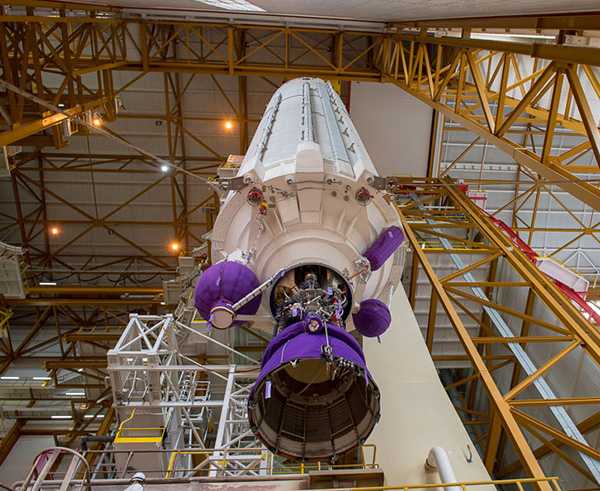
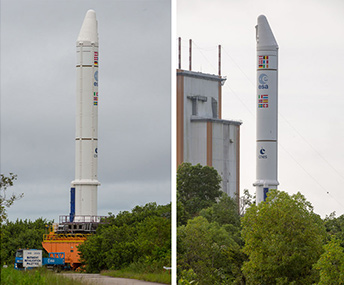
Tag: Ariane 5

  • Ariane 6 — Galileo’s next ride — undergoes hot-fire tests

    Ariane 6 — Galileo’s next ride — undergoes hot-fire tests

    The Ariane 6 launch vehicle program has taken a dramatic step towards first flight with the start on Oct. 5 of hot-fire tests of the rocket’s upper stage and its all-new Vinci engine, according to the European Space Agency (ESA).

    The tests are a significant step forward. They are being conducted using the specially built P5.2 test bench for engine and stage testing at the German Aerospace Center (DLR) in Lampoldshausen. The P5.2 test bench subjects the entire upper stage to operating conditions representative of a flight from Europe’s Spaceport in French Guiana, with the exception of vacuum and microgravity.

    New Vinci Engine

    Vinci, the upper stage engine of Ariane 6 fed by liquid hydrogen and oxygen, can be stopped and restarted multiple times — a critical capability for the complex missions demanded by launch customers today.

    The rocket can place several satellites into different orbits and de-orbit the upper stage, leaving a minimum of hazardous debris in space. Vinci also has been developed for reliability, simplicity and lower costs.

    Replacement Heavy Launcher

    This test series is a critical milestone on a development path that will soon see Ariane 6 replace Ariane 5 as ESA’s heavy launcher.

    For more than a quarter century, Ariane 5 has been a reliable partner for commercial, institutional and scientific clients. One of its most notable missions was the Dec. 25, 2021, flight that carried the NASA/ESA/CSA James Webb Space Telescope to its operational outpost in deep space.

    But Ariane 6 will be an even more versatile vehicle, strengthening Europe’s autonomy in accessing space.

    Auxiliary Power Unit

    The tests being run at Lampoldshausen are also evaluating an innovative auxiliary power unit (APU) that works in tandem with the Vinci engine and is instrumental to Ariane 6 upper-stage performance.

    To restart in space, earlier engines relied on large quantities of tanked helium to generate the necessary pressure and temperature in the propellant tanks and to ensure there are no bubbles in the fuel lines. However, the APU delivers these conditions using only small amounts of the cryogenic hydrogen and oxygen already carried in the main tanks.

    Heading to ESTEC

    The test series is being run by DLR and ArianeGroup, the Ariane 6 launcher prime contractor. When the test series is complete, the upper stage — integrated by ArianeGroup at its facility in Bremen, Germany — will be shipped to ESA’s ESTEC technical center in the Netherlands for stage separation and acoustic tests.

    Ultimately, the Lampoldshausen tests will investigate hardware behavior and system function of the complete stage with its tanks, engines and avionics.

    “The preparation for these hot firing tests is even more complex than for an actual launch,” said Ariane 6 launcher program manager Guy Pilchen. “Our colleagues in Lampoldshausen have decades of experience in rocket propulsion with extremely advanced test facilities. With ArianeGroup colleagues to control the upper stage and DLR people operating the test bench, we couldn’t ask for a better team.”

    Space independence for Europe

    ESA Director of Space Transportation Daniel Neuenschwander said that this new engine and the upper stage it powers are indispensable components of Ariane 6 and its objective — to guarantee that Europe maintains independent, competitive and sustainable access to space.

    “It’s a fact in the 21st century that Europeans depend on space for safety, prosperity and security,” Neuenschwander said. “Europe needs to work toward complete autonomy in accessing and operating in space. Ariane 6 is key to this, and we are eager to see the liftoff from Europe’s Spaceport in French Guiana.”
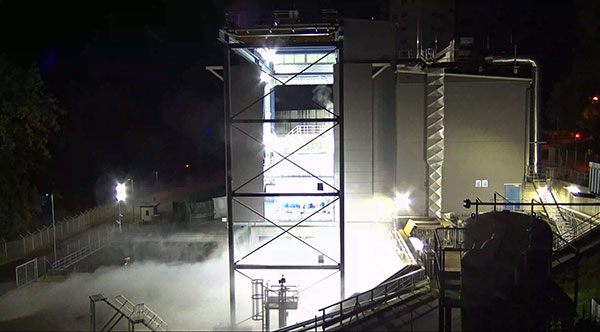
    Ariane 6 Vinci engine testing at DLR Lampoldshausen. (Photo: ESA)
    Ariane 6 Vinci engine testing at DLR Lampoldshausen. (Photo: ESA)
  • Second SpaceDataHighway satellite successfully launches on Ariane 5

    The EDRS-C satellite, the second node of the SpaceDataHighway network — also known as the European Data Relay System (EDRS) — has successfully launched into geostationary orbit at 31 degrees East by an Ariane 5 rocket from Kourou, French Guiana. According to Airbus, after a test period, it will double transmission capacity of the system in order to serve two observation satellites simultaneously and provide redundant back-up for the SpaceDataHighway.

    This second satellite is joining EDRS-A, which transmits the images of Earth acquired by the Copernicus program’s four Sentinel observation satellites on a daily basis.

    According to Airbus, the SpaceDataHighway is the world’s first “optical fiber” network in the sky based on cutting-edge laser technology. A public-private partnership between the European Space Agency and Airbus, it is a network of geostationary satellites permanently fixed over a network of ground stations that can transmit data at a rate of 1.8 Gbit/s.

    SpaceDataHighway satellites can connect to low-orbiting observation satellites at a distance up to 45000 km, intelligence UAVs or mission aircraft via laser, Airbus added. From its position in geostationary orbit, the SpaceDataHighway system relays data collected by observation satellites to Earth in near-real-time.

    “The SpaceDataHighway makes our data connections more secure, more stable, more reliable, with more bandwidth and in near real time,” said Evert Dudok, head of communications, intelligence and security at Airbus Defence and Space. “The launch of our second satellite is just the start, laser communication will be a revolution for many industries.”

    Full operations, including EDRS-C, are expected by the end of 2019, when its inter-satellite link and end-to-end service will be tested and commissioned with the Sentinel satellites. A third communication node is to be positioned over the Asia-Pacific region by around 2024.

    In addition, from 2021, the Pleiades Neo Earth observation satellites will begin to use the SpaceDataHighway, and by the end of 2019, the system will also provide a fully European broadband communication service to the Columbus module of the International Space Station, Airbus said.


    Featured photo: Airbus

  • Latest satellite launch extends Galileo’s global reach

    Latest satellite launch extends Galileo’s global reach

    News from the European Space Agency

    Four more Galileo satellites were launched July 25 by an Ariane 5. Their arrival in orbit brings the Galileo constellation to 26 satellites, extending the global coverage of the constellation.

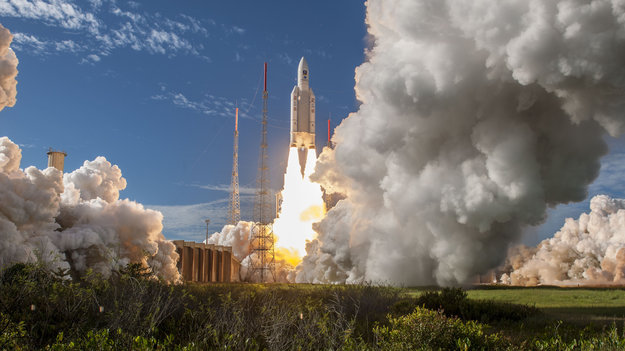
    Ariane 5 flight VA244, operated by Arianespace under contract to ESA, lifted off from Europe’s Spaceport in Kourou, French Guiana, at 11:25 GMT (13:25 CEST, 08:25 local time), carrying Galileo satellites 23–26. The first pair of 715 kg satellites was released almost 3 hours 36 minutes after liftoff, while the second pair separated 20 minutes later.

    They were released into their target 22 922 km-altitude orbit by the dispenser atop the Ariane 5 upper stage.

    In the coming days, this quartet will be steered into their final working orbits by the French space agency CNES, under contract to the Galileo operator SpaceOpal for the European Global Navigation Satellite System Agency (GSA).

    There, they will begin around six months of tests by SpaceOpal to verify their operational readiness so they can join the working Galileo constellation.

    “Galileo is ESA’s largest ever satellite constellation, built up to its present size in rapid time, with 22 Full Operational Capability satellites added within just the last four years,” remarked Jan Wörner, ESA’s director general.

    “We must thank our industrial partners OHB (DE) and SSTL (GB) for the satellites, as well as Thales Alenia Space (FR/IT) and Airbus Defence and Space (GB/FR) for the ground segment and all their subcontractors throughout Europe for their continued support to the programme. Together with ESA, the entire industrial team has worked hard for the point at which we now are and this cooperation have proven to be very successful, as we can show in the excellent performance of Galileo.”

    Paul Verhoef, ESA’s director of navigation, added, “Galileo has been providing Initial Services on a worldwide basis since 15 December 2016, and today has more than 100 million users, and rapidly increasing. Today’s satellites will increase the global coverage of Galileo with a performance that is widely recognized as excellent.

    “This is the end of the current phase of Galileo deployment, but our pace is not slacking. A further 12 Galileo ‘Batch 3’ satellites are in preparation as in-orbit spares and as replacements for the oldest Galileo satellites, first launched in 2011, in order to keep the system working seamlessly into the future.


    Photo: ESA

  • Galileo launches four more satellites

    Galileo launches four more satellites

    The European Space Agency launched the next four Galileo satellites on an Ariane 5 on Wednesday July 25, at 11:25 GMT (13:25 CEST, 08:25 local time) from Europe’s Spaceport in Kourou, French Guiana.

    These latest four Galileo satellites will bring the constellation in orbit up to 26 satellites.

    You can watch the launch live starting at 4 a.m. local time.

    Livestream coverage of the launch starts at 11:00 GMT (13:00 CEST) with liftoff at 11:25 GMT (13:25 CEST).

    Live coverage resumes with confirmation of the satellites separating from their upper stage from 14:50 GMT (16:50 CEST).

    Separation of the Ariane 5’s upper stage occurs about nine minutes after liftoff, followed by the first 10-minute firing of the upper stage.

    The upper stage — carrying four 715-kg Galileo satellites — flies in ballistic configuration for three hours and eight minutes, after which a second upper stage firing lasting just over six minutes will place it into circular separation orbit.

    Once stabilized at 3h 36 min after liftoff, the Galileo dispenser will release the first two satellites, followed by the second pair 20 minutes later.

    In the meantime, check out ESA’s new Galileo video.

    The Ariane 5 carrying Galileo satellites 23-26 is in place at the ZL3 launch site ready for liftoff. (Photo: ESA)
    The Ariane 5 carrying Galileo satellites 23-26 is in place at the ZL3 launch site ready for liftoff. (Photo: ESA)
  • 4 Galileo satellites fueled for July 25 launch

    4 Galileo satellites fueled for July 25 launch

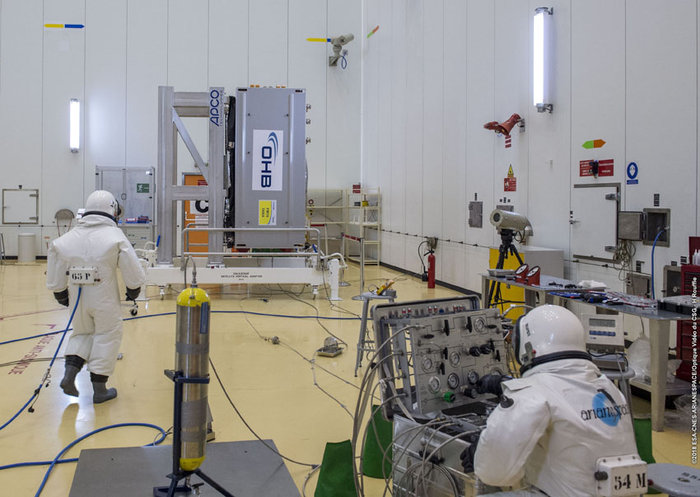
    Technicians in SCAPE (Self Contained Atmospheric Protection Ensemble) suits fill Galileo satellites 22-26 with hydrazine fuel. (Photo: ESA)

    Europe’s next four Galileo satellites have been fueled at Europe’s Spaceport in Kourou, French Guiana, in preparation for their launch on July 25, according to the European Space Agency (ESA).

    The four satellites were placed into their protective containers to be transported from the S1A processing building to the S3B payload preparation building, where they were filled with the hydrazine fuel that will keep the satellites manoeuverable during their 12-year working lives.

    The next step is to fit the quartet onto the dispenser that holds them in place securely during launch and then releases them into space once the upper stage of the Ariane 5 rocket reaches its 22,922-kilometer-altitude target orbit.

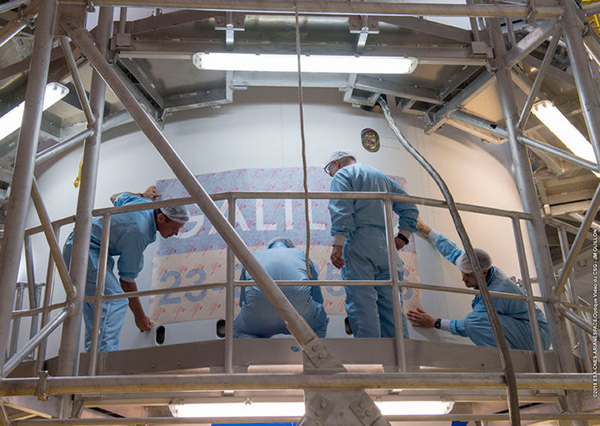
    After that, the satellites plus dispenser will be fitted onto the upper stage then enclosed by the two sides of the protective launch fairing — one of which has had the mission logo added to it.

    Meanwhile, the Ariane 5 for this launch (Flight VA244) has undergone assembly inside the Spaceport’s Launcher Integration Building.

    Galileo’s Flight VA244 mission logo is attached to the Ariane 5 fairing ahead of the July 25 four-satellite launch. (Photo: ESA)
  • Satellites and rocket readied for July 25 Galileo launch

    Satellites and rocket readied for July 25 Galileo launch

    Ariane 5’s cryogenic main stage is moved into position over the mobile launch table inside the Spaceport’s Launcher Integration Building. (Photo: Arianespace)

    Four more Galileo satellites will be launched on a customized Ariane 5 on July 25.

    The next Arianespace rocket to orbit Galileo satellites has begun taking shape at the spaceport in French Guiana, reported Arianespace. Build-up of the heavy-lift vehicle is now underway inside the spaceport’s Launcher Integration Building.

    Following the established assembly flow, the rocket build-up began with this week’s positioning of the launch vehicle’s central core cryogenic stage over one of two mobile launch tables used for Ariane 5.

    Ariane 5’s two solid propellant boosters are rolled out. (Photos: Arianespace)

    It was followed by integration of the two large solid propellant boosters — installed directly on the launch table and mated to the core stage — clearing the way for placement of the upper stage, topped off with the vehicle equipment bay.

    Once the Ariane 5’s basic build-up is completed under the direction of production prime contractor ArianeGroup, it will be moved to the spaceport’s Final Assembly Building for installation of its four Galileo FOC (Full Operational Capability) satellite passengers, which are undergoing their own pre-flight preparations at the spaceport.

    The Ariane 5 will deploy its satellite passengers at a targeted orbital altitude of 23,222 kilometers in circular medium Earth orbit. The launch is designated Flight VA244 by Arianespace.

    Galileo satellites arrive

    In early June, Galileo satellites 25 and 26 landed at Europe’s Spaceport in Kourou, French Guiana, joining their two predecessors, satellites 23 and 24, according to the European Space Agency (ESA).

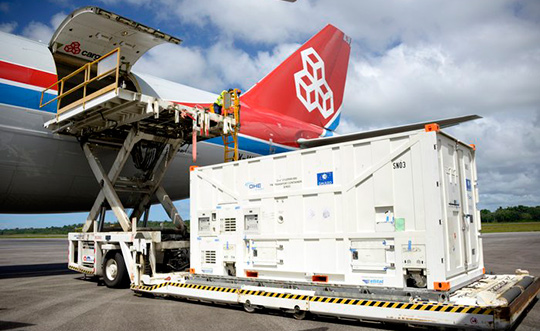
    One of the two Galileo satellites 25 and 26 is unloaded from a Boeing 747 cargo jet at Cayenne – Félix Eboué Airport in French Guiana on June 1. The satellites travel inside protective air-conditioned containers. (Photo: ESA)

    The pair left Luxembourg Airport on a Boeing 747 cargo jet on the morning of June 1, arriving at Cayenne – Félix Eboué Airport in French Guiana that evening.

    After they were off-loaded, they were driven by truck to the cleanroom environment of the S1A payload preparation facility at Europe’s Spaceport, still in their protective air-conditioned containers. In the cleanroom, they joined Galileo satellites 23 and 24, which arrived last month.

    The cryogenic main stage of the Ariane 5, known as the EPC — from its French title Etage Principal Cryogénique — arrived by sea at French Guiana’s Port Pariacabo on May 30.

    A further 12 Galileo “Batch 3” satellites were ordered in 2017, supplementing the 26 built so far to provide further in-orbit spares and replacements for the oldest Galileo satellites, first launched in 2011.

    A steady stream of orbital spares, ready to replace satellites reaching the end of their operational lives, is essential to ensure Galileo continues operating seamlessly, according to ESA.

    Looking further ahead, with the aim of keeping Galileo services as a permanent part of the European and global landscape, new satellites will be required by the middle of the next decade, offering improved performance and added features.

  • Satellites Leadership Award presented to Wolfgang Paetsch

    For his leadership in setting up the routine production of the Galileo satellites leading to Galileo constellation deployment, including thequadruple Ariane 5 launch in November 2016, Wolfgang Paetsch was named the winner of the 2017 Satellites Leadership Award. Since he was unable to attend, Paul Verhoef, director of the Galileo Programme, accepted the award on his behalf at the GPS World Leadership Awards dinner. The award was presented by Rob Scott from Rockwell Collins, a co-sponsor of GPS World’s Leadership Dinner and Awards Ceremony.

  • Four more Galileo satellites launched into orbit

    Four more Galileo satellites launched into orbit

    Updated with additional details and reaction.

    Liftoff of Ariane 5 Flight VA240 from Europe’s Spaceport in Kourou took place at 18:36 UTC on Dec. 12, 2017, carrying Galileo satellites 19–22. (Photo: ESA)

    On Dec. 12, four more Galileo satellites headed into space to join the navigation constellation. Galileos 19–22 lifted off aboard an Ariane 5 rocket from Europe’s Spaceport in Kourou, French Guiana, at 18:36 UTC (19:36 CET, 15:36 local time).

    After today’s successful launch, only one more launch remains before the Galileo constellation is complete and delivering global coverage.

    Separation of the upper stage occurred about nine minutes after liftoff, followed by the first firing of the upper stage.

    The first pair of 715-kg satellites was released almost 3 hours 36 minutes after liftoff, while the second pair separated 20 minutes later.

    They were released into their target 22,922 km-altitude orbit by the dispenser atop the Ariane 5 upper stage. In the coming days, this quartet will be steered into their final working orbits. There, they will begin around six months of tests — performed by the European Global Navigation Satellite System Agency (GSA) — to check they are ready to join the working Galileo constellation.

    This mission brings the Galileo system to 22 satellites. Initial Services began almost a year ago, on Dec. 15, 2016.

    “Today’s launch is another great achievement, taking us within one step of completing the constellation,” remarked Jan Wörner, ESA’s director general.

    “It is a great achievement of our industrial partners OHB (DE) and SSTL (GB) for the satellites, as well as Thales-Alenia-Space (FR, IT) and Airbus Defense and Space (GB, FR) for the ground segment and all their subcontractors throughout Europe, that Europe now has a formidable global satellite navigation system with remarkable performance.”

    Paul Verhoef, ESA’s director of navigation, added, “ESA is the design agent, system engineer and procurement agent of Galileo on behalf of the European Commission. Galileo is now an operating reality, so, in July, operational oversight of the system was passed to the GSA.

    “Accordingly, GSA took control of these satellites as soon as they separated from their launcher, with ESA maintaining an advisory role. This productive partnership will continue with the next Galileo launch, by Ariane 5 in mid-2018.

    “Meanwhile, ESA is also working with the European Commission and GSA on dedicated research and development efforts and system design to begin the procurement of the Galileo Second Generation, along with other future navigation technologies.”

    Next year’s launch of another quartet will bring the 24‑satellite Galileo constellation to the point of completion, plus two orbital spares.

    Keep up to date here.

  • Galileo satellites atop rocket for Dec. 12 flight

    News from the European Space Agency

    Europe’s next four Galileo navigation satellites are in place atop the Ariane 5, ready to be launched Dec. 12.

    Liftoff from Europe’s Spaceport in Kourou, French Guiana is scheduled for 18:36 GMT (19:36 CET, 15:36 local time), carrying Galileo satellites 19–22.

    Four Galileo satellites seen before being encapsulated by the protective payload fairing on Dec. 7, completing the Ariane 5 for flight VA240, scheduled for Dec. 12.

    Completion of Galileo’s Ariane 5 rocket took place in the Spaceport’s Final Assembly Building, following the arrival there of the quartet of satellites, already attached to the dispenser that will hold them in position during launch, then release them into their target 22 922 km-altitude orbit

    Next, the satellites plus dispenser were placed atop the Ariane 5’s upper stage, after which the 14 m-long protective fairing was lowered over the Galileos — the last time they will be seen by human eyes. This fairing will protect them from the onrushing atmosphere during ascent.

    The next step will be Monday’s rollout to the launch zone.

    This mission will bring the Galileo system to 22 satellites. Initial Services began almost a year ago, on Dec. 15, 2016.

    Next year’s launch of another quartet will bring the constellation of 24 satellites to completion, plus two orbital spares.

    Galileo is Europe’s civil global satellite navigation system. It will allow users worldwide to know their exact position in time and space with great precision and reliability.

  • Galileo satellites readied for Dec. 12 launch

    Galileo satellites readied for Dec. 12 launch

    News from the European Space Agency

    Three of the four Galileo satellites 19-22 undergoing fit check with the dispenser that will support them during their Dec. 12 flight into orbit. (Photo: ESA)

    Europe’s next four Galileo navigation satellites and the Ariane 5 rocket due to lift them into orbit are being readied for their Dec. 12 launch from Europe’s Spaceport in Kourou, French Guiana.

    On Nov. 21, Galileo satellites 19–22 were declared ready for flight, along with their Ariane. Combined activities are now under way, culminating in the satellites meeting their rocket in the Final Assembly Building.

    The satellites were flown in pairs to French Guiana last month. Once safely unboxed in the Spaceport’s cleanroom environment, they were tested to ensure they had suffered no damage during their transatlantic flights.

    The four Galileo satellites mounted on top of a customised Ariane 5 rocket inside the aerodynamic fairing. (Image: ESA)

    Next came their fit check, when they were mechanically and electrically linked one by one to the dispenser that will carry them during their ascent to the target 23,500 km-altitude orbit, before releasing them into space.

    Last Friday saw the satellites filled with enough fuel to fine-tune their orbits and orientation during their projected 12-year working lives. Next, they will be attached to their dispenser together for the final time.

    In parallel, their customised Ariane 5 is being assembled. Two solid-propellant boosters were mated with its main cryogenic stage before the addition of the interstage that carries the electronics to control the vehicle.

    Next came the addition of the storable propellant stage, powered by a reignitable engine, which will deliver the quartet to their target orbit.

    Once fully checked, the Ariane will be moved to the final building for the addition of the satellites atop their dispenser, sealed within their protective fairing.

    This launch will bring the total Galileo constellation to 22, boosting the global availability of navigation signals. Galileo began Initial Services just under a year ago, the first step before full operations, on Dec. 15.

    Galileo’s Ariane 5’s vehicle equipment bay is lowered for installation within the Final Assembly Building of Europe’s Spaceport in French Guiana. Flight VA240 carrying Galileo satellites 19–22 into orbit is scheduled for Dec. 12. (Photo: ESA)
  • Second pair of Galileo satellites reach launch site

    Second pair of Galileo satellites reach launch site

    News from the European Space Agency

    Two more Galileo satellites have reached Europe’s Spaceport in French Guiana, joining the first pair of navigation satellites and the Ariane 5 rocket due to haul the quartet to orbit this December.

    Inside the 747. (Photo: ESA)

    Galileos 21 and 22 left Luxembourg Airport on a Boeing 747 cargo jet on the morning of Oct. 17, arriving at Cayenne-Félix Eboué Airport in French Guiana on the same day.

    Resting within distinctive white air-conditioned containers, the satellites were driven to the cleanroom environment of the preparation building within the space centre.

    Waiting for them there were Galileos 19 and 20, which arrived in September.

    The four satellites will be launched together in mid-December by a customised Ariane 5, the elements of which reached French Guiana last month by sea.

    Galileos 21 and 22 being unloaded from their 747 cargo aircraft at Cayenne – Félix Eboué Airport in French Guiana on Oct. 17. (Photo: ESA)

    Galileo is Europe’s own satellite navigation system, providing an array of positioning, navigation and timing services to Europe and the world.

    A further eight Galileo Batch 3 satellites were ordered last June, to supplement the 26 built so far.

    With 18 satellites now in orbit, Galileo began initial services on Dec. 15, 2016, the first step towards full operations.

    Further launches will continue to build the constellation, which will gradually improve performance and availability worldwide.

  • Ariane 5 to Launch Galileo Constellation

    Jean-Yves Le Gall, chairman and CEO of Arianespace, and Didier Faivre, director of the Galileo Program and Navigation-related Activities at the European Space Agency (ESA), signed an agreement February 2 in London to launch satellites in Europe’s Galileo satellite positioning system by Ariane 5 launchers.

    This agreement provides for the possibility of using Ariane 5 launchers in 2014 and 2015 to complete the deployment of the Galileo constellation. Arianespace will have launched the 26 satellites in this constellation using a combination of Soyuz launch vehicles (two satellites per launch), and Ariane 5 launchers (four satellites per launch). The contract for adapting the Ariane 5 launcher to enable simultaneous launch of four Galileo satellites was also signed today by the European Space Agency and EADS-Astrium.

    The Galileo satellite launch contract is managed by ESA on behalf of the European Commission. The contract signing ceremony was also attended by David Willets, U.K. Minister of State for Universities and Science, and Antonio Tajani, Vice President of the European Commission.

    These satellites, built by the team of OHB Technology of Germany and Surrey Satellite Technology, Ltd. of the United Kingdom, will be placed in a circular orbit at an altitude of 23,000 kilometers by Soyuz and Ariane 5 launchers operating from the Guiana Space Center in French Guiana.

    Arianespace and its subsidiary Starsem have already orbited the Giove-A and Giove-B in-orbit validation satellites, thus securing the frequencies allocated to the Galileo constellation. On October 21, 2011, Arianespace launched the first two satellites in the constellation — built by Astrium during the IOV (In Orbit Validation) phase — using a Soyuz launcher at the Guiana Space Center.

    With both Ariane 5 and Soyuz, Arianespace offers the best solution for launching the entire Galileo constellation, thus guaranteeing independent access to space for Europe, Arianspace said.