The Mobile World Conference (MWC) returns to the Las Vegas Convention Center on September 26 to 28, 2023.
The event will feature exhibition from major U.S. operators, including AT&T business, T-Mobile business, and Verizon business as well as new sessions dedicated to sports and entertainment, software developers and the GSMA’s SEC CON event.
MWC, in partnership with the Cellular Telephone Industries Association (CTIA), invites industry leaders and attendees to connect and discuss topics such as the industry’s transition to a circular economy, the future role of artificial intelligence (AI) in society, and what comes after 5G.
To reflect the United States’ position as a global technology hub and a market at the forefront of 5G innovation, the event is centered around four key themes:
5G Acceleration, as adoption explodes to become the most common mobile technology in North America by 2025.
Age of AI, as the world awakes to the opportunities and challenges of generative AI.
Digital Everything, as the expansion of digital technologies is felt across every industry, from sports and entertainment to manufacturing, financial services and smart mobility.
Enterprise Mobility, as the revolutionary phase of 5G in enterprise is well underway.
The event will feature a variety of keynote speakers, including Amanda Toman, the director for the Public Wireless Supply Chain Innovation Fund at the National Telecommunications and Information Administration (NTIA) within the U.S. Department of Commerce.
For the first time, the GSMA will bring its SEC CON event to MWC Las Vegas on day two, welcoming leading security experts to explore the importance of keeping telecoms infrastructure secure in times of conflict.
A full directory and registration can be found on the MWC Las Vegas website.
“Seen & Heard” is a monthly feature of GPS World magazine, traveling the world to capture interesting and unusual news stories involving the GNSS/PNT industry.
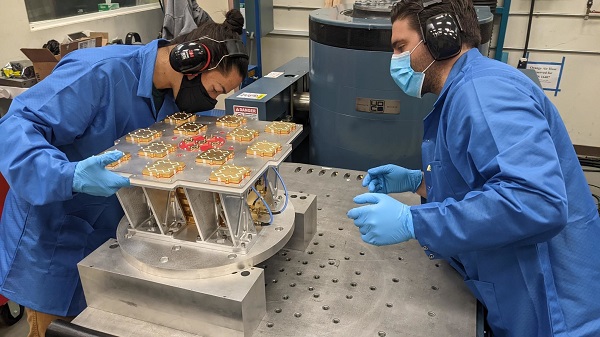
Xona’s first demonstration mission successfully completed testing at Experior Laboratories and prepares for launch on a Falcon 9 in May. (Photo: Xona)
TAKING GNSS PRIVATE
At press time, Xona Space Systems’ first in-space demonstrator satellite, named Huginn, was ready to launch on May 25 aboard Space X’s Transporter 5 mission. Xona said the launch is a significant step toward realizing its high-performance commercial navigation system, a constellation of small, powerful satellites in low Earth orbit that will meet the navigation and timing needs of intelligent systems.
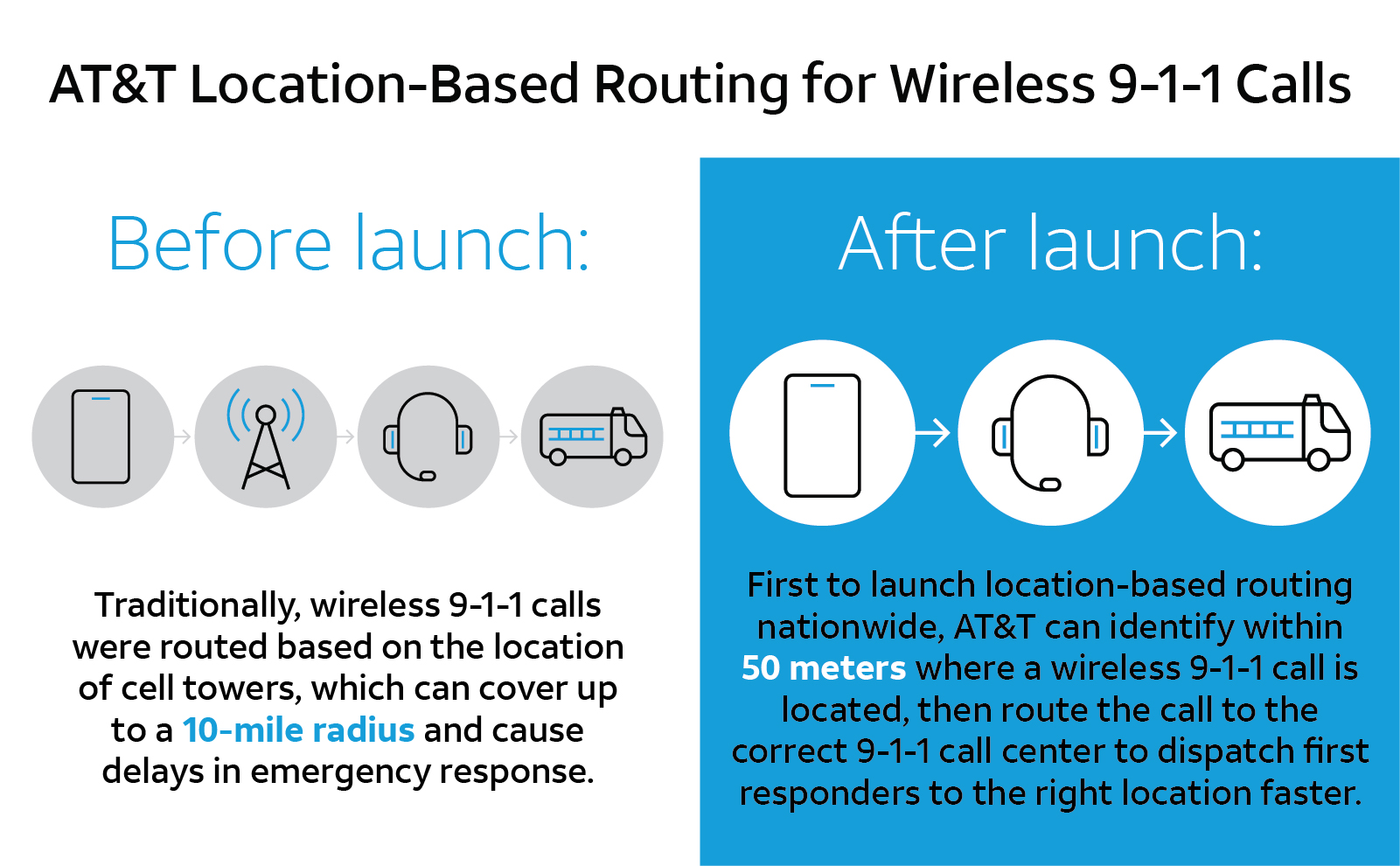
U.S. cellular carrier AT&T is rolling out location-based routing to automatically transmit wireless 9-1-1 calls to the appropriate call centers, rather than relying on which cell tower handles the call. Cell towers can cover a 10-mile radius, and overlap with more than one call-center boundary. With location-based routing, a device can be located and routed within 50 meters of the device location. The “Locate Before Route” feature from Intrado enables AT&T to use device GNSS and hybrid information to route the call to the right call center.
Russian jets have been found using GPS receivers, while ground vehicles use paper maps, according to the UK Express. The GPS receivers were found taped to the dashboards of Russian SU-34s downed in Ukraine because of “the poor quality of their own systems,” UK Defense Secretary Ben Wallace said in a speech. With many reports of maintenance and aging issues for the Russian military, most likely the jets did not have quality GNSS receivers rather than the fault lying with GLONASS.
A Russian short-range ballistic missile, believed to be an unexploded Iskander missile, was found near Kramatorsk, Ukraine, in this photo released March 9 by Ukrainian authorities. (Photo: National Guard of Ukraine handout via Reuters)
UNEXPLODED BOMBS MAPPED
The HALO Trust is partnering with Esri to map unexploded ordnance in an immediate humanitarian response to the war in Ukraine. More than 10 million Ukrainians have been displaced by the war and many are forced to move across a landscape littered with unexploded rockets, bombs and landmines. In response, Esri has committed its cutting-edge geographic information system (GIS) software resources, expertise and staffing in support of HALO’s mission in Ukraine. HALO already is using GIS to map the heaviest conflict zones, and the partnership with HALO will support planning for future clearance operations.
U.S. cellular carrier AT&T is rolling out location-based routing to automatically transmit wireless 9-1-1 calls to the appropriate call centers.
Traditionally, wireless 9-1-1 calls were routed based on the location of cell towers, which can cover up to a 10-mile radius. This can cause delays in emergency response, especially when a call is made where state, county or city boundaries overlap.
With location-based routing, a device can be located and routed within 50 meters of the device location. Through a new “Locate Before Route” feature from Intrado, AT&T can quickly and more accurately identify where a wireless 9-1-1 call is coming from using device GNSS and hybrid information to route the call to the correct 9-1-1 call center.
Graphic: 911
The nationwide rollout has started and is available in Alaska, Colorado, Hawaii, Idaho, Montana, Oregon, Washington, Wyoming, Kansas, Illinois, Iowa, Minnesota, North Dakota, Missouri, Nebraska, South Dakota and Guam. Additional regions will be rolled out over the next several weeks. The nationwide rollout is scheduled to be completed by the end of June.
On Aug. 19, the U.S. Federal Communications Commission (FCC) granted a request for authorization from AT&T Services to use Galileo for emergency location purposes.
AT&T plans to use Galileo in conjunction with GPS to improve the accuracy of its E9-1-1 location services on mobile devices, and facilitate faster response from emergency services when wireless callers dial 9-1-1.
The request was approved by the FCC’s Public Safety and Homeland Security Bureau .
The FCC found that AT&T had satisfied the conditions for commercial mobile radio service (CMRS) providers to integrate foreign satellite signals into E9-1-1 services.
Under E9-1-1 requirements established in 2015, CMRS providers seeking to use foreign signals for E9-1-1 services must meet several conditions, including ensuring that integrating non-U.S. signals won’t cause interference with the E9-1-1 system.
Carriers also need to submit a signal integration plan including a mechanism to detect, mitigate and disable Galileo signals if they cause harmful interference.
Digital Matter’s Oyster2 4G battery-powered GPS receives PTCRB approval, AT&T certification and redesigned housing
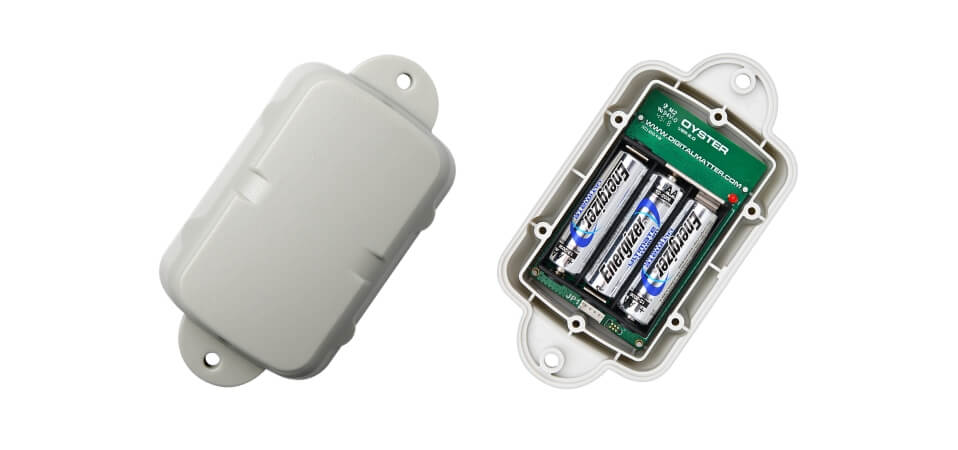
Digital Matter’sOyster2 is now PTCRB approved and certified for use on the AT&T Network in the United States. With PTCRB certification, operators and device manufacturers are confident of a device’s interoperability with mobile networks.
Designed for tracking non-powered assets for extended periods of time, common applications of the Oyster2 include tracking trailers, bins, hire and rental equipment, shipping containers, boats, bikes, scooters and more.
The Oyster2’s u-blox SARA-R410M modem operates on all major global LTE-Cat-M1 and NB-IoT bands. The device uses concurrent GPS and GLONASS tracking with a 72-channel high sensitivity receiver, and features a 3D accelerometer for G-force detection.
Configurable adaptive-tracking parameters allow the device to sleep when stationary, resulting in industry-leading battery life: up to seven years of life at once daily updates; one year of life at once hourly updates.
The versatile asset tracker can be powered by three off-the-shelf AA lithium batteries, or lithium thionyl chloride (LTC) batteries for enhanced performance and temperature tolerance.
The Oyster2 is now also available in redesigned ultra-rugged housing. Engineered with nylon glass, the IP67 housing is considerably tougher and thicker in key areas, providing increased durability, thermal resistance (the device can reach temperatures up to 185º F/85º C without compromising performance) and chemical resistance.
The device’s mounting tabs and screw holes have also been fortified and repositioned, improving resistance to cracking.
Digital Matter is an original equipment manufacturer of award-winning GPS and internet of things (IoT) devices and tracking software. Digital Matter devices are resold through 500 channel partners across the world and deployed in more than 110 countries.
Daimler Trucks to connect with AT&T. (Photo: Daimler)
AT&T provides connectivity for DTNA’s Detroit Connect platform across the U.S. and Canada. The Detroit Connect platform is installed on all new DTNA’s Freightliner Cascadia trucks built for customers in those countries. The relationship will now expand to cover trucks built for the Australian and European markets for 2018 model year Freightliners and newer.
The new Cascadia sets new standards in fuel efficiency, safety technologies and the latest connectivity solutions, DTNA said. Detroit Connect, connected by AT&T, enables enhanced safety reporting, powertrain diagnostics and software, and features over-the-air updates and fuel efficiency analytics capabilities for vehicles across North America.
New multi-year agreements cover Australia, Austria, Belgium, Bulgaria, Czech Republic, Denmark, Finland, France, Germany, Greece, Hungary, Ireland, Italy, Latvia, Lithuania, Netherlands, Norway, Poland, Portugal, Romania, Spain, Sweden, Switzerland and the United Kingdom.
AT&T has reached other milestones in the connected car space. According to the company, it has accomplished the following:
It has 24 million connected cars on the AT&T network, and added 2 million this year.
AT&T connects more than 3 million fleet vehicles, specifically supporting small business, enterprise and government customers.
The company has relationships with 29 global brands including Airstream, Audi, BMW, Ford, Mercedes-Benz, GMC, Honda, Volvo and much more. AT&T has worked with its partners on 4G LTE connectivity, enhanced infotainment services and greater Wi-Fi accessibility.
The company’s global SIM provides internet of things (IoT) connectivity across 500 carriers and 200+ countries and territories. AT&T also connects cars in 57 countries, including 12 where infotainment is enabled through Wi-Fi hotspots.
“We’ve had tremendous success in launching our proprietary connected vehicle platform with AT&T” said Jason Krajewski, director of connectivity at Daimler Trucks North America. “Working with AT&T, we will expand our connectivity services and connected vehicle portfolio to more vehicles and more regions.”
“Daimler Trucks North America is the industry leader in bringing IoT connectivity and innovative solutions to long-haul trucking industry,” said Chris Penrose, president, internet of things (IoT) Solutions at AT&T. “Broadening our collaboration outside North America for the first time will bring the benefits of efficiency, safety and performance to customers on a global scale.”
Telit’s 300-Mbps LE940B6-NA LTE Cat 6 module has received AT&T certification for use on the carrier’s North American LTE wireless networks. The smart module is the first 300 Mbps Cat 6 automotive-grade solution certified by AT&T, Telit announced in a press release.
With advanced security features, the LE940B6 aligns with automakers’ vehicle roadmaps which include requirements for secure, high-speed mobile data that support next generation applications such as advanced diagnostics, infotainment and remote software updates.
“The automotive industry is continuously raising the bar on internet connection speeds to the car,” said Yossi Moscovitz, CEO of Telit Automotive Solutions. “Along with higher speeds, there are increasing requirements for security, quality and environmental performance which Telit has achieved with the LE940B6. With certification of the North American LTE-Advanced LE940B6-NA module variant, auto makers can immediately start delivering car models in the United States with these new modules.”
The LE940B6 powers the entire connected-car platform, supporting current needs while including advanced features that enable future integration of up-coming value-added, telematics and managed services.
The module can run in-vehicle applications inside a secure processing environment from the built-in 64-bit application processor, storage and memory. Automotive application programs can run entirely and securely on the module itself protected by advanced cyber-security capabilities.
Qualcomm Technologies Inc. and AT&T will test unmanned aircraft systems (UAS) on commercial 4G LTE networks.
The trials will analyze how UAS can operate safely and more securely on commercial 4G LTE and networks of the future, including 5G. The research will look at elements that would impact future drone operations.
CTIA Super Mobility 2016 attendees can catch a video demonstration at Qualcomm’s booth in the 5G Zone. Matt Grob will showcase the benefits of LTE-based drone operation during his keynote at 9 a.m. PDT on Sept. 8.
The team will look at coverage, signal strength and mobility across network cells and how they function in flight. The goal of the trials and ongoing research is to help enable future drone operations, such as beyond visual line of sight (BVLOS), as regulations evolve to permit them.
The trials will begin later this month at Qualcomm Technologies’ San Diego Campus, with testing to take place at its FAA-authorized UAS Flight Center and test environment. The center contains real-world conditions including commercial, residential, uninhabited areas and FAA controlled airspace. The facility permits testing of the use of commercial cellular networks for drones without affecting AT&T’s everyday network operations.
In April, Qualcomm Technologies’ San Diego Campus received an FAA certificate of authorization to perform outdoor testing of drones.
The ability to fly beyond an operator’s visual range could enable successful delivery, remote inspection and exploration. Wireless technology can bring many advantages to drones such as ubiquitous coverage, high-speed mobile support, robust security, high reliability and quality of service (QoS), Qualcomm said in a press release.
“The trial with a carrier with the reach and technology of AT&T is a significant step in the development of connectivity technologies for small unmanned aircraft systems (SUAS), including optimization of LTE networks and advancement of 5G technology for drones,” said Matt Grob, executive vice president and chief technology officer, Qualcomm Technologies. “Not only do we aim to analyze wide-scalable LTE optimization for safe, legal commercial SUAS use cases with beyond line-of-sight connectivity, but the results can help inform positive developments in drone regulations and 5G specifications as they pertain to wide-scale deployment of numerous drone use cases.”
“Many of the anticipated benefits of drones, including delivery, inspections and search and rescue will require a highly secure and reliable connection,” said Chris Penrose, senior vice president, IoT Solutions, AT&T. “With a focus on both regulatory and commercial needs, LTE connectivity has the potential to deliver optimal flight plans, transmit flight clearances, track drone location and adjust flight routes in near real-time. Solving for the connectivity challenges of complex flight operations is an essential first step to enabling how drones will work in the future.”
The UAS trials will be based on the Qualcomm Snapdragon Flight drone development platform, which is designed to offer superior control and navigation capabilities. Already in use in some commercially available drones, the platform offers high fidelity sensor processing, precise localization, autonomous visual navigation and 4K videography all in an integrated, light-weight model suitable for consumers and enterprises.
AT&T’s Fleet Complete, a North American provider of fleet telematics and mobile workforce technology, has upgraded its browser-based mapping to Google Maps.
Fleet Complete with Google Maps includes the ability to visualize real-time asset locations and deliver pertinent vehicle data such as speed, idle time and start/stop times.
The addition of Google Maps allows businesses to track vehicles, assets and mobile workforce with detailed hybrid satellite/street name views, improved traffic reports, terrain views and a powerful zoom feature, helping users make intelligent location-based decisions and maximize efficiencies.
LAS VEGAS — About 30,000 attendees sweltered in Las Vegas for CTIA’s Super Mobility show this past week. Attendance was flat from last year, but the exhibit floor and meeting rooms bustled. The energy of the show focused on M2M and Internet of Things (IoT). In past years, the connected vehicle was a highlight, but not so this year. Wearable technology was scant. Those looking for the big product introductions of the past were disappointed. However, CTIA’s keynote speakers added focus and vision into the show, reminding us of the drive and vigor that built the industry.
In the past, the network operators (we once called them carriers) and device manufacturers owned the CTIA show, where they made their biggest product reveals. This year, AT&T had a flurry of announcements, including a partnership with car manufacturer Jaguar Land Rover North America. AT&T will supply connectivity to the cars for features such as Wi-Fi hotspots, connected navigation and a suite of apps. Customers will be able to share wireless data between phones, tablets and vehicles on its Mobile Share Value plan for an additional 10 dollars per month access fee. AT&T previously signed agreements with Audi, BMW, GM, Ford, Tesla, Nissan, Volvo and Subaru.
AT&T and Telogis announced a collaboration to offer solutions for companies with mobile workforces, a combination of AT&T’s network and Telogis’ telematics, compliance and navigation fleet solutions. AT&T was showing off ZTE Mobley, AT&T’s first plug-in vehicle Wi-Fi hotspot, which has just appeared in stores. Smaller announcements from AT&T included the formation of a dedicated smart city organization and a personal security app that provides live, OnStar-type professional monitoring (video and audio).
Verizon unveiled Go90, a streaming-video, social media service that works across carriers. Go90 is a free, ad-based service accessed only on a mobile phone and focused on short clips, viral videos and a social element, with crowdsourced recommendations and the ability to join groups. Go90 is targeted at Millennials, people younger than 30 years old. Although this seems like a minor announcement, obtaining the loyalty of Millennials and Generation Z (those still in their teens) is critical. With two-thirds of Millennials considering smartphones as their most important device for video, the strategy behind Go90 makes sense.
New Sprint CEO Marcelo Claure is never boring and used his time at the podium to continue trash- talking the competition. With cocky confidence, he pronounced that under his leadership, Sprint will enjoy “one of the biggest turnarounds in telecom history.” In July, Claure used Twitter to declare T-Mobile’s aggressive “uncarrrier” promotion to be “bullshit and a fake show.” He continued his rant at CTIA. “We spent the first year cutting AT&T or Verizon’s bills in half, which was fun. We’ve moved on today to offering all the DirecTV customers the choice to not be stuck with AT&T.”
One of the most pressing industry issues is spectrum. With wireless data forecast to grow ten-fold by the end of 2020, the industry is concerned that the 2016 spectrum auction will not be sufficient. Keynotes appealed for more spectrum to enable the U.S. to lead in 5G, just as it led in 4G. U.S. company-run operating systems are currently on nine out of ten smartphones, worldwide. FCC Chief Tom Wheeler was at CTIA to give assurances that the spectrum auction slated for March 2016 will be successful and occur as scheduled. He countered CTIA’s CEO Meredith Baker’s assertion that the FCC has no added plans beyond this auction for freeing up spectrum.
Freetel mobile products of Japan was one of several international companies participating in CTIA this year.
Location Players, M2M, IoT
TeleCommunication Systems (TCS), a stalwart of location-based services, beefed up its indoor location capabilities with the purchase of Loctronix. The platform, Sensorvision, aggregates and integrates location-positioning technologies, like Bluetooth, beacons and Wi-Fi, as well as content, such as mapping. Sensorvision is currently in beta testing and is aimed at wireless operators. With more stringent rules for 911, including indoor location requirements, TCS is positioned for both public safety and commercial needs. What’s next? In five years, Michael Mathews of TCS predicts, “We’ll be talking about the huge amount of information available from the road and the great impact on apps, including vehicles that are informing other cars of their actions, such as when they initiate traction control or start windshield wipers.”
u-blox, the maker of wireless and positioning modules and chips, announced a portfolio of new LTE low data rate cellular modules for IoT and M2M applications in the industrial and automotive markets. The portfolio consists of multi mode, multi carrier and of LTE only modules specific for large North American carriers. u-blox expects LTE Cat. 1 technology to become the future norm for M2M applications. And when asked about long-term success, Sven Etzold of u-box says, “The challenge for our industry is picking the right partners and being part of successful consortia. We need to partner with the right network operators and play with sensors’ companies.”
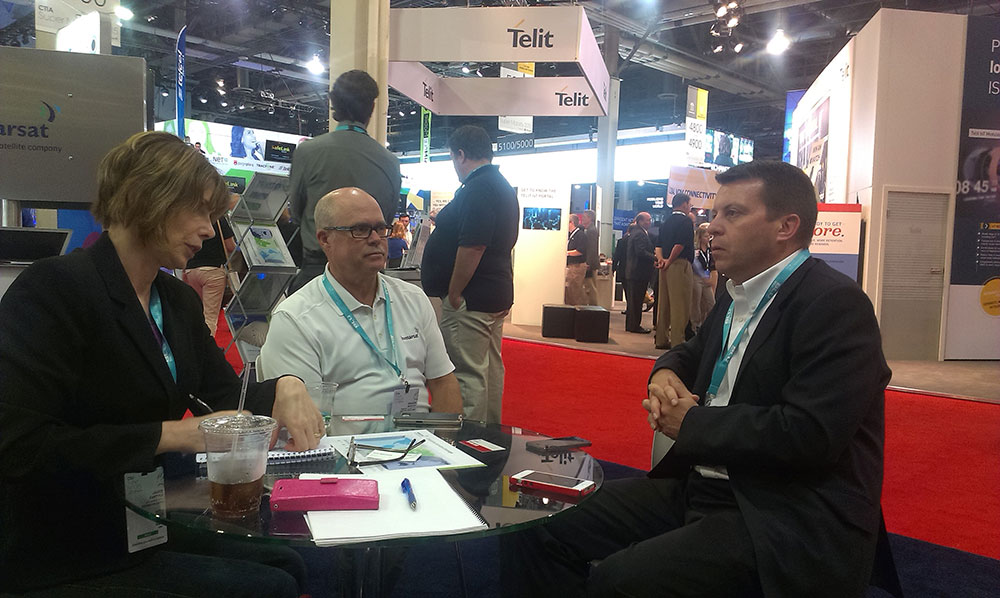
Janice visits with Chuck Moseley (center) and Don Wigglesworth (right) of Inmarsat.
Inmarsat unveiled its new machine-to-machine (M2M) and its IoT strategy, the “Internet of Everywhere.” The company is increasing use of VARs and OEMs to enable solutions that will provide more visibility and control of mobile assets throughout the world. “We are empowering existing and prospective VAR partners to offer unparalleled worldwide connectivity to their M2M and IoT customers through a single network and a single SIM,” said David Wigglesworth of Inmarsat. The company’s dedicated M2M services are IsatData Pro, a low-data-rate messaging service, and BGAN M2M, a two-way IP data service for monitoring and control of assets that require higher bandwidth capabilities.
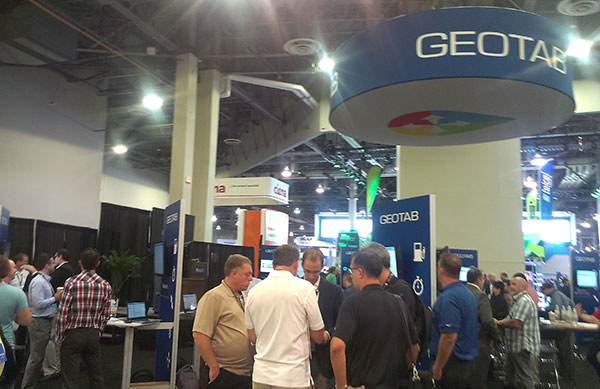
Geotab, with one of the exhibit floor’s most crowded booths, showcased the development platform of a small form-factor GPS tracking device. The Geotab GO7 device plugs directly into a vehicle’s OBDII port. Developers create applications that are available on the Geotab Marketplace. The booth was crammed with developers who offer M2M and IoT solutions.
Geotab’s booth was crowded with developers interested in the Geotab Marketplace for M2M and IoT solutions.
Microsoft’s Start-Up Alley contained interesting ventures from the Microsoft Accelerator. One young company, Parknav, offered an app for finding parking spaces based on predictive modeling, and not sensors. Users are guided to street blocks with the highest probability of available parking spaces. The app uses a number of sources, including number of parking spaces, traffic flow and undisclosed data. Parknav enables searches for free, paid and permit parking in 30 cities in Germany and a few cities in the U.S.
On a charitable note, Jimmy Whales of Wikipedia fame was at CTIA to promote his phone business, a Sprint-based MVNO cellular service. Like Wikipedia, The People’s Operator (TPO) is not a profit driven enterprise. Ten percent of a subscriber’s monthly bill goes to a charity of her choosing, and 25 percent of the company’s profits are donated to non-profits. In talking about Wikipedia, Whales cited China’s current ban of the website. Wikipedia has recently made changes to its website that make it impossible for censors to ban specific Wikipedia pages, although the entire site can be blocked, as it currently is in China.
I have parting advice for the organizers of CTIA. This year’s show was disrupted by competing events that included the iPhone 6 announcement in Cupertino. Shame on Apple, who is a member of the CTIA board. Also, CTIA had organized a virtual co-conferencing with Internationale Funkausstellung Berlin (IFA), one of the largest trade shows for consumer electronics and home appliances. The IFA event was held in Berlin the prior week and stole attention from CTIA. It isn’t all about location. Timing matters.
AT&T and Telogis, a SaaS-based connected vehicle technology provider, have announced a collaboration to offer solutions for companies with mobile workforces. Connecting vehicles of all sizes from small trucks to 18-wheelers and heavy equipment, the combination of AT&T’s global network and Telogis’ telematics, compliance, and mobile and navigation software creates full-fleet solutions for businesses around the world.
The announcement was made at CTIA Super Mobility, being held this week in Las Vegas.
Telogis works with some of the world’s largest mobile companies to provide the critical data they need for more informed decisions relating to operational efficiency, reducing costs and improving safety. Telogis is the exclusive connected commercial vehicle technology provider for Ford Motor Company, powering its factory-installed Ford Telematics solution. Telogis also works with General Motors, Hino, Volvo, Mack, Manitowoc Cranes and Isuzu to build its solutions into vehicles and equipment in the factory.
Working with AT&T, Telogis is implementing a network solution to deliver a reliable, highly secure stream of data nearly anywhere in the world. The AT&T service management platform allows Telogis to easily manage the data, devices and services that support its customers. AT&T also is working with Telogis to help with over the air updates and provide unique split billing capabilities.
“We’re offering Telogis a complete wireless network that enables two-way, real-time data communication between the vehicle and office,” said Chris Penrose, senior vice president, AT&T Internet of Things (IoT) Solutions. “We look forward to driving new innovative services together in the fleet marketplace and offering true global solutions to our mutual customers.”
“Telogis provides mission-critical intelligence for some of the world’s largest mobile businesses and automotive manufacturers, and our customers demand the quality and reliability that only a provider like AT&T can deliver,” said David Cozzens, CEO, Telogis. “As we continue to capitalize on a rapidly growing, multi-billion dollar global market for connected vehicle and equipment technologies, AT&T provides the scalable infrastructure and backbone Telogis requires.”
It wasn’t enough for AT&T Mobility President & CEO Glenn Lurie to make just one major announcement during his keynote address at CTIA Super Mobility 2015 Thursday.
He had to make several.
Most significantly, AT&T used the stage in front of a packed crowd, including their biggest competitors, to introduce new personal security, fleet tracking and connected car solutions.
On the personal security front, Lurie announced the Digital Life Personal Security app, essentially a panic button for your smartphone that’s fully monitored and connected to emergency services much like home security and automation components of the Digital Life portfolio. The innovation came from customer feedback that “Digital Life is terrific, but you can’t take it with you.”
Lurie said this technology was personal to him as the father of a 19-year-old daughter.
“Imagine the opportunity of a 24/7 monitoring facility taking care of her, the ability for her to hit a button and instantly know where she is and instantly have the police come,” he said. “We’re going to offer to digital life customers and offer to anybody who wants to add this to their smartphone.”
AT&T also announced major collaborations with connected vehicle technology provider Telogis and automaker Jaguar Land Rover North America. Telogis’ software-as-a-service-based telematics software will allow AT&T to offer full-fleet solutions for business. Telogis is already the commercial vehicle telematics provider used by Ford, General Motors, Volvo, Mack and Isuzu. Meanwhile The AT&T service management platform allows Telogis to “manage the data, devices and services that support its customers,” according to a press release on the AT&T and Telogis announcement.
AT&T Mobility CEO Glenn Lurie thanks CTIA CEO Meredith Atwell-Baker for the association’s support.
New Jaguar and Land Rover models will be equipped with AT&T Wi-Fi and infotainment systems.
New Range Rover models already feature AT&T connectivity.
With Jaguar and Land Rover, AT&T connectivity will power the infotainment features, including Wi-Fi hotspot, navigation and apps. AT&T had already begun equipping Range Rover models with the technology earlier this month; this announcement is an expansion of that to other Jaguar and Land Rover models, which will come later this year. AT&T customers will be able to share one data plan for their smartphone and car with a Mobile Share Value plan, which is $10 per month.
“We view the connected car as the next great device in your life,” said Lurie, who also gave a keynote at last year’s CTIA conference. “About half of the cars this year will be connected by AT&T.”