Tag: BeiDou III

  • Trimble boosts RTX correction services for geospatial users

    Trimble boosts RTX correction services for geospatial users

    GNSS signal convergence means significant time savings for surveyors

    Photo: Trimble
    Photo: Trimble

    Trimble has announced enhancements to its Trimble RTX correction services, tailored to meet the evolving needs of geospatial professionals and part of an ongoing strategy to deliver high-accuracy correction services to users worldwide.

    Enhancements are designed to reduce convergence times, provide more reliable and robust signals, and make the workflow for surveyors easier. The enhancements further enable geospatial professionals to untether from the cost and complexities of GNSS base stations and complete fieldwork faster.

    Surveyors in many regions worldwide can now spend less time in the field with CenterPoint RTX correction service, converging in typically three minutes compared with up to 15 minutes in the past. The breakthrough convergence-time reduction is available on Trimble GNSS receivers with ProPoint technology and will benefit land surveyors working around the globe by enabling them to start surveying faster.

    In addition, CenterPoint RTX now supports the BeiDou III (BDS-III) constellation, which contributes to convergence time improvements. Support for BDS-III and convergence time improvements is available globally via IP/cellular and regionally via satellite delivery. Convergence times for the CenterPoint RTX Fast regions remain unchanged at less than one minute. CenterPoint RTX Fast coverage is available coast-to-coast in the U.S. and Western Europe.

    Geospatial professionals will be able to work more reliably in challenging GNSS environments, such as urban multipath or under tree canopy, due to the addition of BDS III and GPS III satellite signals into the Trimble RTX solution. Even as GNSS satellites are retired and new ones become operational, Trimble RTX will consistently track and deliver robust and reliable corrections.

    Using a Trimble receiver with ProPoint technology with Trimble Access field software and CenterPoint RTX correction service, surveyors will benefit from a streamlined workflow that simplifies how they work in their local coordinate systems. Surveyors can collect data using CenterPoint RTX correction service without the need for a site calibration or an offset.

    “Our teams collaborate to continually improve the Trimble RTX-based real-time correction services integration with our geospatial solutions,” said Ron Bisio, senior vice president of Trimble Geospatial. “Surveyors worldwide rely on Trimble to develop products and services that help them get their work done quicker and easier, and this Trimble RTX update is another example of how we continue to deliver surveyors the tools they need to do their jobs even more efficiently.”

    “We are celebrating 10 years of providing Trimble RTX-based correction services and each year our services outperform the year before,” said Lisa Wetherbee, general manager of Trimble Advanced Positioning. “We continue to enhance the performance and overall customer experience to help geospatial professionals increase their productivity and provide them peace of mind that our services and people will be there for them around the clock.”

    Trimble RTX subscriptions for Trimble RTX-compatible GNSS receivers are available through Trimble’s Authorized Business Partners or Trimble’s online store.


  • RxNetworks extends Location.io service with BeiDou III support

    RxNetworks extends Location.io service with BeiDou III support

    Logo: Rx Networks

    Rx Networks Inc., as part of its continued reference network expansion and vendor diversity initiative, has added BeiDou III B1C and B2a signals and messages to Location.io, its feature-rich, modular location platform.

    BDS III is available via Location.io in a variety of data formats including regionally optimized, NTRIP, LPP and RRLP, as well as proprietary real-time and predicted formats.

    With the addition of BDS III, Location.io is positioned to support mobile devices globally in any configuration, including dual-band or single-band GNSS receivers, and in single or multi-constellation configurations.

    “Rx Networks continues to follow up on our promise to deliver Location. Enlightened. products and services,” said Peter Mueller, head of innovation at Rx Networks. “BDS will play a major role in the years to come with the uptake of multiband GNSS in mobile devices including smartphones and internet of things (IoT) devices.”

    “The upgrade and expansion of our private global reference network can now offer legacy BDS II signal B1I right up to PRN 63, in addition to the new BDS III B1C and B2a signals, as well as GPS/QZSS/Galileo/GLONASS/NavIC support in L1, L2c and L5/E5. Plus, our network is ready for Galileo E6. This makes Location.io one of the most complete data services available, all with a great Service Level Agreement.”

    BDS III will be part of the Location.io software client in early 2020.

    Location.io technologies are in use by more than 2 billion smartphones, laptops and wearables worldwide. All Location.io services are delivered from Rx Networks’ geo-redundant and cloud-based service delivery network, ensuring 99.999% service-level availability.

  • China adds two more satellites to BeiDou constellation

    China adds two more satellites to BeiDou constellation

    Photo: Xinhua News Agency
    Photo: Xinhua News Agency

    China has launched two more BeiDou III satellites. The launch took place on Sunday, Sept. 22, using a Long March 3B rocket which lifted off from the Xichang space center at 2110 GMT (5:10 p.m. EDT), according to the Xinhua News Agency.

    The satellites have been confirmed as MEO23 and MEO24.

    About four hours after liftoff, the upper stage delivered the Beidou satellites into a nearly circular orbit with an average altitude of 13,500 miles (21,800 kilometers) and an inclination of 55 degrees.

    The satellites were produced by the China Academy of Space Technology, a government-owned satellite builder.

    With Sunday’s launch, China has added five new satellites to the Beidou network this year, halfway to its stated goal of 10 Beidou satellites this year.

    The satellites are the 47th and 48th spacecraft launched in the Beidou navigation program.


    Feature photo: Xinhua News Agency

  • Trimble Pivot, Alloy GNSS receiver now support BDS-3 signals

    Trimble Pivot, Alloy GNSS receiver now support BDS-3 signals

    Photo: Trimble
    Photo: Trimble

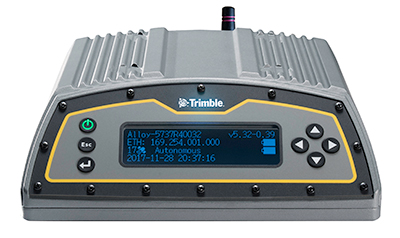
    Trimble has added capabilities to its real-time network (RTN) portfolio, including the Trimble Pivot Platform and the Trimble Alloy GNSS reference receiver.

    The new capabilities will enable operators to continue to meet the ongoing demand from surveyors, mapping professionals and precision farmers for accurate, reliable corrections derived from real-time networks.

    The announcement was made at Intergeo 2019, the world’s largest conference on geodesy, geoinformatics and land management, taking place Sept. 17-19 in Stuttgart, Germany.

    Boosting RTN performance. A well-established network software, the Pivot Platform manages and controls small, mid-size and countrywide GNSS networks. By applying sophisticated atmospheric models to reduce systematic errors, highly accurate GNSS corrections are generated and made available for a wide range of field applications.

    BDS-3 now supported

    Both Pivot and Alloy now access BeiDou Generation III (BDS-3) signals.
    Trimble Pivot version 4.3 has been enhanced to track and store BDS-3 — RTN operators worldwide now have the ability to provide their customers with additional satellite signals to offer even more robust and reliable positioning for their applications. This update also includes a simplified Chinese user interface, providing easy-to-use software operations for Chinese RTN operators.

    Released in 2018, the Alloy GNSS reference receiver was designed with the processing power needed to deliver high-quality data from multiple GNSS constellations. Alloy version 5.42 firmware tracks all available and planned GPS Block IIIA L1C and BDS-3 signals, empowering operators with a full GNSS constellation dataset.

    “These updates keep the Trimble Pivot Platform and Alloy on a future driven path,” said Mark Richter, strategic marketing director, Real-Time Networks and Services portfolio for Trimble’s Advanced Positioning Division. “Our focus is to continue to deliver enhancements influenced by market demands and advancements in technology, which deliver next-generation RTN hardware and software to our customers.”

    The Trimble Pivot Platform and Trimble Alloy GNSS reference receiver updates work in conjunction to provide quality GNSS corrections to network operators and end users.

    Trimble real-time networks and services

    Trimble RTN networks and services are a widely used GNSS infrastructure solution. Spanning a variety of applications and industries worldwide, Trimble’s hardware is specifically developed for RTN real-world environments while the software integrates seamlessly into the RTN solution for exceptional real-time performance.

    The flexibility of Trimble’s solution enables users to collect, manage and analyze complex information faster and easier, improving productivity and efficiency.

  • Dual-frequency GNSS smartphone supports BDS phase III signal

    Dual-frequency GNSS smartphone supports BDS phase III signal

    The latest Lenovo smartphone offers dual-frequency GNSS capable of tracking the latest BDS phase III signal, the Z6 SE, using an Allystar chipset.

    The company says this is the first time a smartphone supports the new BeiDou signal.

    HD8040 series SoC. (Photo: Allystar)
    HD8040 series SoC. (Photo: Allystar)

    Fitted with a Allystar HD8040 series chipset, the Lenovo Z6 youth edition provides position accuracy up to sub-meter, according to Allystar.

    The HD8040 series chipset supports all civil signals on the L5 band. Besides GPS/QZS L5 and GAL E5a, the latest BDS phase III signal B2a has already been implemented to maximize the visible satellites in L5 band.

    Dual-frequency GNSS means that the receiver tracks more than one radio signal from each satellite on different frequencies  —  GPS L1 and L5, Galileo E1 and E5a, and Beidou B1 and B2a.

    B2a will replace B2I and broadcast on MEO and IGSO satellites. The code lengths are 10230, which have better anti-cross-correlation performance and are designed separated pilot component and data component to improve tracking sensitivity.

    In general navigation scenarios, multipath error lead to positioning inaccuracy of up to several meters, caused by to signals bouncing off of higher buildings. The error caused by multipath can be nullified and mitigated by using two frequencies instead of one in urban areas. Under a relatively open-sky environment, measurement error caused by the ionosphere is usually eliminated by a linear combination of dual frequencies to easily achieve sub-meter accuracy.

    “Allystar is glad to boost the smartphones and Internet of Things (IoT) applications with the latest multi-frequency GNSS SoC (system on chip) technology,” said Shi Xian Yang, the product and marketing manager in Allystar.

    Lenovo smartphone Z6 SE has Allystar inside. (Photo: Lenovo/Allystar)
    Lenovo smartphone Z6 SE has Allystar inside. (Photo: Lenovo/Allystar)
  • RINEX 3.04 supports new BeiDou, GLONASS and QZSS signals

    RINEX 3.04 supports new BeiDou, GLONASS and QZSS signals

    IGS logoRINEX 3.04 contains updates to support planned GLONASS CDMA signals, as well as new BeiDou III and QZSS II signals.

    The International GNSS Service (IGS) and Radio Technical Commission Maritime Service, Special Committee -104 (RTCM SC-104) RINEX Working Group, announced the availability of RINEX 3.04.

    RINEX 3.04 supports all publicly available signals from existing GNSS constellations: the U.S. GPS, Russia’s GLONASS, Europe’s Galileo, China’s BeiDou, Japan’s Quasi Zenith Satellite System (QZSS) and the Indian Regional Navigation Satellite System (IRNSS).

    In addition to the new signals, the RINEX 3.04 text has been edited to improve the description of messages, fields and overall readability.

    The RINEX 3.04 data standard documentation is available here:

    ftp://igs.org/pub/data/format/rinex304.pdf

    http://www.rtcm.org/differential-global-navigation-satellite–dgnss–standards.html

    RINEX 3.04 Updates and Changes

    1. Added new signals to the GLONASS (Table 5), QZSS II (Table 8) and BeiDou III (Table 9) signal tables and updated Table A23
    2. Added section 9.12 to describe new signals from the GLONASS, QZSS II and BeiDou III constellations and to describe the differences between QZSS I and QZSS II
    3. Updated Appendix Table A2 SYS/#/OBS TYPES to show new signal codes for: GLONASS, QZSS II and BeiDou III
    4. Modified Appendix Table A5 TIME SYSTEM CORR section to clarify the GNSS time system and UTC difference fields
    5. Added numerous small corrections and text improvements as listed in the RINEX 3.04 Revision History section.
  • Javad GNSS tracks new BeiDou AltBoC signals

    Javad GNSS tracks new BeiDou AltBoC signals

    Recently launched satellites of BeiDou Phase 3 program have started broadcasting new signals. Javad GNSS announced successful tracking of these signals and provided the adjacent figures.

    Interface control documents (ICDs) for B1C and B2A signals are available, while an ICD for the other signal, called B2B, has not yet been published. The company tracked the signal on the 1207.14 Mhz frequency on BeiDou’s satellites 32, 33 and 34, and subsequently saw that this signal is available on all recently launched BeiDou Phase 3 satellites, and tracked it successfully.

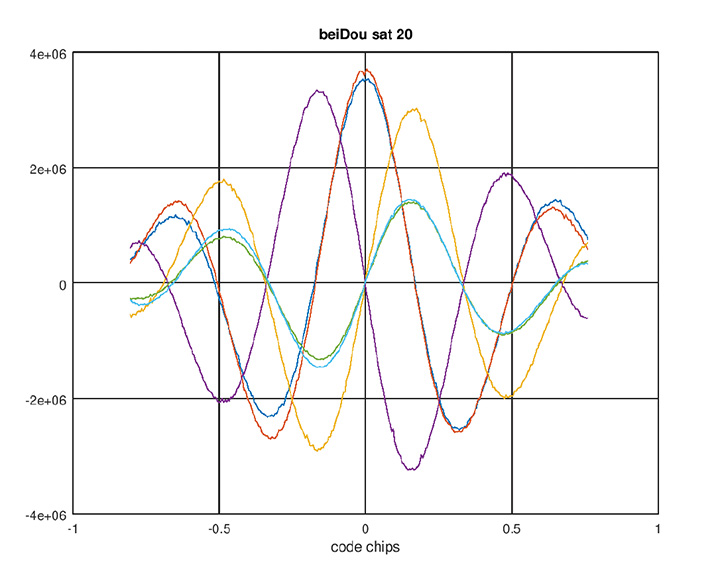
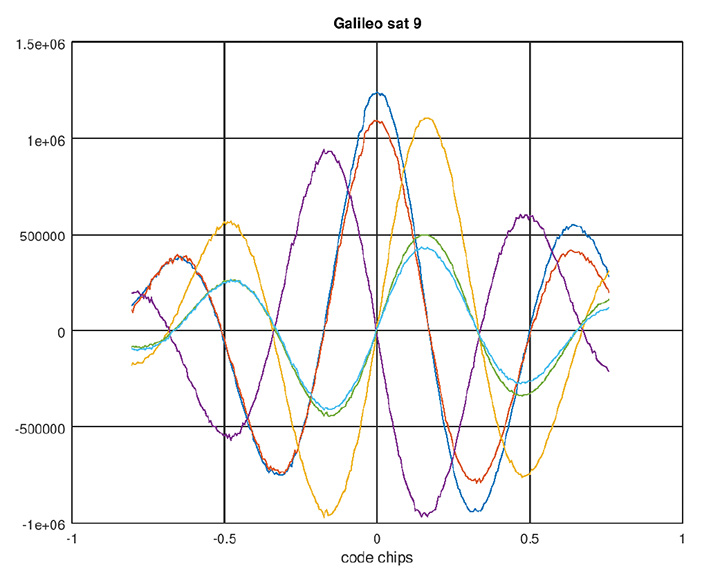
    This B2B signal plus B2A signal together form an AltBOC(10,15) signal on 1191.795 MHz — JAVAD GNSS calls it BaltBOC. Assuming that BOC parameters of this signal are similar to Galileo’s, the company tracked this. Figures 1 and 2 show BeiDou andGalileo (BaltBOC and altBOC) discriminator curves; they appear identical.

    Figure 1. BeiDou AltBoC signal. Red and blue: I of B2A(E5A) and B2B(E5b) sub-signals; purple and yellow: Q of B2A(E5A) and B2B(E5b) sub-signals (their sum is zero); green and aqua: I (early-minus-late) of B2A(E5A) and B2B(E5b) sub-signals.
    Figure 1. BeiDou AltBoC signal. Red and blue: I of B2A(E5A) and B2B(E5b) sub-signals; purple and yellow: Q of B2A(E5A) and B2B(E5b) sub-signals (their sum is zero); green and aqua: I (early-minus-late) of B2A(E5A) and B2B(E5b) sub-signals. (Chart: Javad GNSS)
    Figure 2. Galileo AltBoC signal. Colors same as Figure 1.
    Figure 2. Galileo AltBoC signal. Colors same as Figure 1. (Chart: Javad GNSS)

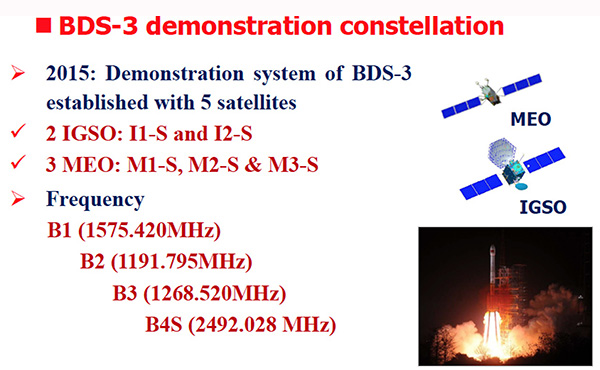
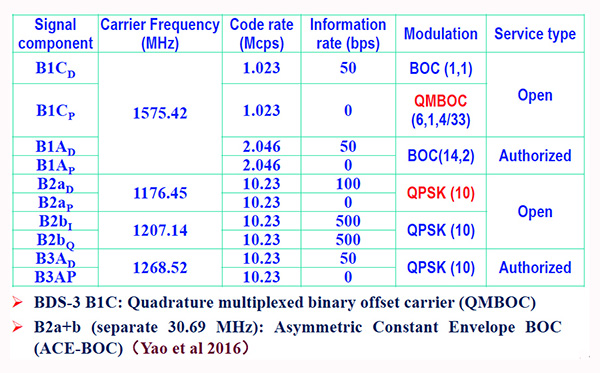
    According to another source, the signals are mentioned in some publications (Figure 3, 4 and 5 from an official Chinese government presentation at the International GNSS Service Workshop, Oct. 2018) and intended to be open signals, but an ICD is presently missing. However there appears to be some clarity now, that the modulation of B2a+b is an “ACE-BOC” modulation, which is similar to but formally different from “AltBOC.”

    Figure 3. BDS-3 demonstration constellation.
    Figure 3. BDS-3 demonstration constellation. (Chart: Javad GNSS)
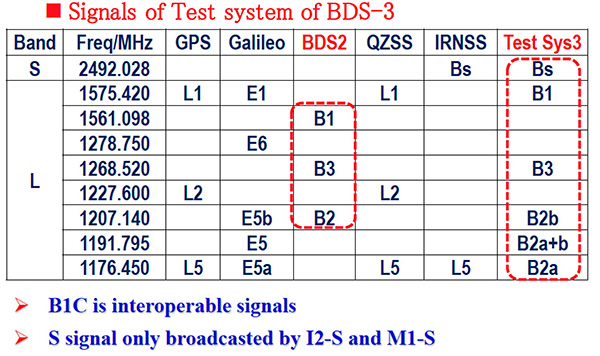
    Figure 4. Signals of test system BDS-3.
    Figure 4. Signals of test system BDS-3. (Chart: Javad GNSS)
    Figure 5. BDS-3 signal modulations.
    Figure 5. BDS-3 signal modulations. (Chart: Javad GNSS)
  • BeiDou launches delayed pair of satellites

    BeiDou launches delayed pair of satellites

    China successfully launched a new pair of BeiDou navigation satellites on Sunday, Nov. 5, reports NASAspaceflight.com.

    Beidou-3M1 (Beidou-24) and Beidou-3M2 (Beidou-25) went aloft aboard a Long March-3B/YZ-1 rocket at around 11:45 UTC from the LC2 Launch Complex of the Xichang Satellite Launch Center, Sichuan province.

    The launch, previously scheduled for July, was delayed until now due to a partial launch failure with the previous launch of this rocket during the Zhongxing-9A (ChinaSat-9A) mission, which resulted in the satellite being lofted to a lower than planned orbit.

    The satellites are using a new bus that features a phased array antenna for navigation signals and a laser retroreflector.

    The Beidou Phase III system includes the migration of its civil Beidou 1 or B1 signal from 1561.098 MHz to a frequency centered at 1575.42 MHz — the same as the GPS L1 and Galileo E1 civil signals — and its transformation from a quadrature phase shift keying (QPSK) modulation to a multiplexed binary offset carrier (MBOC) modulation similar to the future GPS L1C and Galileo’s E1.

    Credit: Xinhua