Tag: Buyers Guide

  • Coming soon: GPS World Buyers Guide

    Coming soon: GPS World Buyers Guide

    The GPS World Buyers Guide is the only comprehensive, continuously updated directory of leading providers across several industry segments. Watch for the latest version in the May/June issue.

    Adding your listing has never been easier, with over 40 businesses already listed and available for contact.

    Why should you be in our Buyer’s Guide?

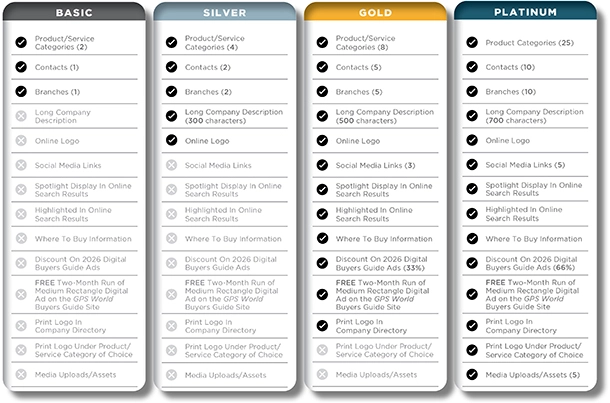
    • Basic Listings are free
    • Year-round online visibility
    • Comprehensive and continuously updated 

    Deemed “a must-read, keeper issue” with our more than 30,000 loyal monthly magazine readers — verified annually by a third-party auditing firm as GNSS/PNT buyers, integrators, and specifiers

    Questions about the online or print Buyers Guide? Contact Petra Turko via email, [email protected]

  • 2019 Simulator Buyers Guide

    2019 Simulator Buyers Guide

    GPS World’s 8th annual Simulator Buyers Guide features tools, devices and software from leading providers.


    CAST NAVIGATION JACKSON LABS TECHNOLOGY INC. OROLIA
    QASCOM RACELOGIC ROHDE & SCHWARZ
    SKYDEL SPIRENT FEDERAL SYSTEMS TALEN-X

    CAST NAVIGATION

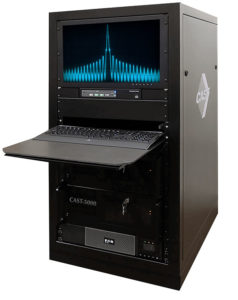
    CAST-5000 GPS wavefront generator

    Photo: CAST Navigation
    Photo: CAST Navigation

    The CAST-5000 produces a single coherent wavefront of GPS RF signals to provide repeatable testing in the laboratory environment or anechoic chamber. The basic system generates four independent, coherent simulations that reference a single point and is upgradeable to support seven elements for CRPA testing. With an intercard carrier- phase error of less than 1 millimeter, the CAST-5000 is extremely accurate.

    The system generates a wavefront of GPS when its GPS RF generator cards are operated in a ganged configuration. Each generator card provides a set of GPS satellites coherent with the overall configuration. Several RF generator cards may be utilized together, ensuring phase coherence among the bank of signal generator cards.

    The CAST-5000 Controlled Reception Pattern Antenna (CRPA) tester allows a full end-to-end test of the antenna system. The CRPA antenna, antenna electronics and the GPS receiver can be tested as a unit with or without radiating signals.

    The CAST-8000 is a new simulator that merges both the CAST-5000 CRPA tester with a CAST-3000 EGI tester.

    CAST-5000 Features

    • Generates single coherent wavefront of GPS
    • 6-DOF motion generation capability
    • Complete SV constellation editing
    • Post-mission processing via ICD-GPS-150/153
    • Differential/relative navigation
    • Antenna pattern modeling
    • Waypoint navigation
    • RAIM events
    • Multipath modeling
    • Spoofer simulation
    • Satellite clock errors
    • External trajectory input
    • External ephemeris and almanac
    • Several iono and tropo models
    • Modifiable navigation message
    • Modeled selective availability
    • Time-tagged satellite events
    • Selectable host vehicle parameters
    • Directional jamming

    www.castnav.com
    [email protected]
    (978) 858-0130

    [Back to top]

    JACKSON LABS TECHNOLOGY INC.

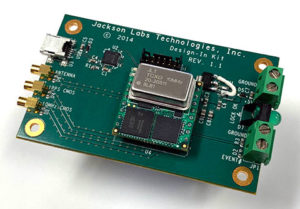
    Micro-Transcoder GPS Simulator/RF-Modulator

    Photo: Jackson Labs
    Photo: Jackson Labs

    The tiny 1-inch square Micro-Transcoder module allows glueless retrofitting of existing GPS equipment with secure and Assured-PNT (A-PNT) capability. It is the smallest, full-constellation, stand-alone, real-time 10-channel GPS simulator available from JLT. The unit is useful in upgrading existing legacy GPS receivers with external position, navigation and timing references such as INS, CSAC, SAASM, M-code, GNSS, eLoran or other alternative positioning and timing sources by simply replacing the legacy GPS antenna from an existing GPS system with the Micro-Transcoder RF output.

    The unit is based on the JLT CLAW GPS Simulator and RSR Transcoder technologies, and includes a general-purpose, stand-alone, full-constellation, 10-channel, real-time GPS simulator with integrated high-stability timing reference, as well as an internal GNSS receiver for monitoring the RF output signal for quality and accuracy. The unit will transmit a standard UTC time, position, velocity and heading GPS L1 C/A RF signal by simply applying 3.3V power to it.

    The Micro-Transcoder can also be operated as a generic GPS simulator with built-in GPS Disciplined Oscillator (GPSDO), and is supported by a free Windows application downloadable from the JLT website. The Windows application allows control of all the simulation aspects, creating and storing simulation vector commands and testing user equipment for leap-second and GPS week rollover event compatibility to identify weaknesses in user equipment. The unit does not require a connected PC to function. The Micro-Transcoder is also available mounted onto an evaluation board for easy evaluation. The unit transcodes baseband PNT NMEA signals into a GPS L1 RF signal with typically less than 100-ms latency. UTC 1PPS timing-transfer accuracy to the GPS RF output is typically better than 5 ns. The unit requires only 3.3V to operate, and setup, location and simulation vector file information can optionally be stored in its internal NV memory.

    [email protected]
    www.jackson-labs.com
    (702) 233-1334

    OROLIA

    GSG-5/6 Series

    All Constellations, All Frequencies

    Photo: Orolia
    Photo: Orolia

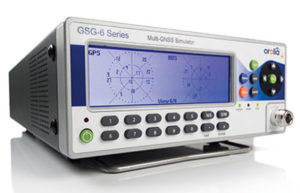
    For those responsible for mission-critical PNT applications, the Orolia GSG series of GPS/GNSS simulators is an important tool to evaluate risk for jamming, spoofing or any other threat. Orolia GSG-5/6 series simulators are easy to use, feature-rich and affordable, offering a way to harden GPS-based systems without the limitations of testing from “live sky” signals. The Orolia platform approach allows customers to buy only what they need today and upgrade later. The adaptability of the GNSS RF generation platform can extend to applications for intelligent repeating.

    Test Solutions

    • Position accuracy and dynamic range/sensitivity
    • Simulate movements/trajectories anywhere on or above Earth
    • Sensitivity to GPS impairments: loss of satellites, multipath, atmospheric conditions, interference, jamming and spoofing
    • Conducted or over-the-air RF
    • GPS time-transfer accuracy
    • Effect of leap-second transition
    • Multi-constellation testing
    • Modernization signals/frequencies
    • Keyless military SAASM, dual-frequency and survey-grade receiver testing
    • Application packages for real-time kinematic (RTK), controlled radiation pattern antennas (CRPA)
    • Hardware-in-the-loop (HIL) integration
    • Test solutions for eCall and ERA-GLONASS

    Infrastructure possibilities include zone-based indoor location (intelligent repeating) and pseudolite applications.

    GSG-6 Series 64-channel multi-frequency, advanced GNSS simulator is powerful enough for any cutting-edge test program. GPS, GLONASS, Galileo, Beidou, QZSS and NAVIC (IRNSS) signals are available across multiple frequencies. The GSG-6 is designed for military, research and professional applications.

    GSG-5 Series 16-channel multi-constellation L1-band GNSS simulator is designed for commercial development/integration programs. It is for developing commercial products with GNSS capability, and will shorten test programs with confidence.

    GSG-51 single-channel signal generator is designed for one purpose — fast, simple go/no-go manufacturing test and validation, ensuring the manufacturing line is operating at full capacity with confidence in quality.

    www.orolia.com
    [email protected]
    +1-585-321-5800

    [Back to top]

    QASCOM

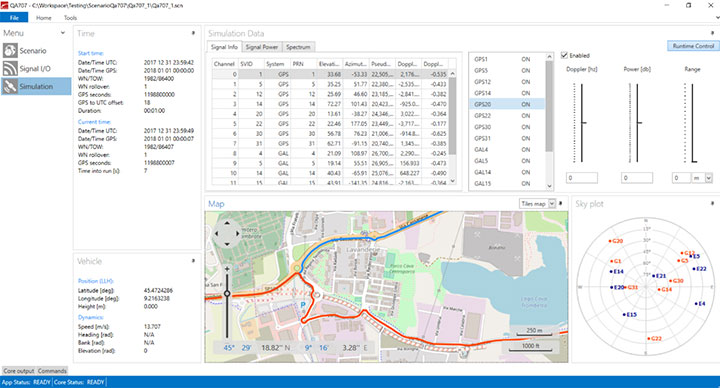
    QA707 GNSS and Interference Software Simulator

    Photo: Qascom
    Photo: Qascom

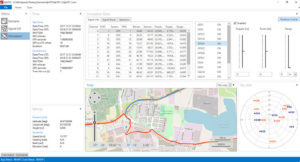
    Specifically designed for testing GNSS interferences and cyber-attacks. QA707 has been designed to test robustness against emerging cyber-threats beyond jamming and spoofing. It allows the creation of scenarios with signal and code jamming, data-level cyber-attacks, denial of service threats, low-level spoofing channels control, and trajectory-controlled spoofing.

    Optimal for signal modernization design. Being a flexible software defined radio (SDR) solution, QA707 is also suitable for testing of signal modernization and for the simulation of new signal components. An open API is provided to create specific signals simulation. Particularly, the tool is ready to support the upcoming Galileo Open Service Authentication (OSNMA).

    Runs on a standard PC or laptop with USRP or other hardware. QA707 is compatible with several third-party hardware RF up-converters, including National Instruments’ USRP. It also can support customer’s specific hardware through the hardware API interface. Qascom introduces the new frontier of GNSS security testing. QA707 is supported from back office with custom services as well as jamming and spoofing mitigation solutions for receivers and applications. This covers 100% of customer GNSS security needs.

    QA707 Main Features

    • Multi-constellation (GPS L1, Galileo E1, SBAS L1)
    • Galileo OSNMA ready
    • RF simulation, binary file dump, signal record and replay
    • Support to SDR platforms and open API for custom RF upconverters
    • Runtime scenario data UDP stream: motion, channel data, simulated inertial sensor
    • Data-level cyber attacks
    • Low-level spoofing signals control, trajectory spoofing, signal replay attacks
    • Narrowband, wideband, frequency modulated jamming
    • Integrity threats: evil waveform, erroneous ephemerides, code/carrier divergence, low satellite signal power, excessive range acceleration
    • Built-in editing tools: RF output calibration, RINEX editor, trajectory editor

    www.qascom.it
    [email protected]

    [Back to top]

    RACELOGIC

    LabSat 3 Wideband and Satgen Software

    LabSat 3 Wideband

    Photo: Racelogic
    Photo: Racelogic

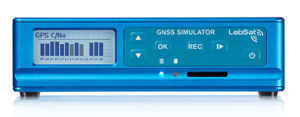
    The LabSat 3 Wideband is easy to use, cost-effective and produces extremely low noise, accurate and repeatable signals. Users can record and replay up to three different channels at 56 MHz with a bit depth of up to 3 bits I and 3 bits Q.

    The following signals can be recorded and replayed:

    • GPS: L1 / L2 / L5
    • GLONASS: L1 / L2 / L3
    • BeiDou: B1 / B2 / B3
    • QZSS: L1 / L2 / L5
    • Galileo: E1 / E1a / E5a / E5b / E6
    • IRNSS: L5
    • SBAS: WAAS, EGNOS, GAGAN, MSAS, SDCM
    • L-band GNSS correction services: Terrastar, Veripos, OmniSTAR, StarFire
    • 2X CAN, RS232, and digital inputs recorded and replayed tightly synchronized with GNSS data

    Small, battery or mains powered and with a removable SSD (up to 4 Tb), LabSat 3 Wideband allows detailed, real-world satellite data to be recorded then replayed on the bench. The rugged enclosure measures a compact 167 x 128 x 46 millimeters and weighs 1.2 kilograms, meaning it can be placed in a backpack and used to reliably record real-world signals in almost any situation.

    SatGen Signal Simulation Software

    If a user wants to simulate the signals from scratch, Racelogic’s latest SatGen signal simulation software can produce synthesized scenarios containing the full complement of popular GNSS signals: GPS L1, L2C, L5, GLONASS L1, L2, Galileo E1, E5, E6 and BeiDou B1, B2.

    SatGen software allows users to quickly create accurate scenarios with their own time, place and trajectory, with any combination of constellation and signal that is currently available or will become available in the near future.

    Mark Sampson, LabSat Product Manager
    [email protected]
    www.labsat.co.uk

    ROHDE & SCHWARZ

    R&S SMW200A and R&S SMBV100B simulators

    Photo: Rohde & Schwarz
    Photo: Rohde & Schwarz

    Precision-sensitive applications such as autonomous driving, control of unmanned aerial vehicles (UAV), or positioning of aircrafts during landing procedures in coordination with ground-based augmentation systems (GBAS) require that modern GNSS receivers undergo detailed tests before implementation.

    Designed to generate highly realistic test scenarios, Rohde & Schwarz signal generators like the R&S SMW200A and the R&S SMBV100B offer a unique approach to generating complex and highly realistic scenarios for testing of GNSS receivers that are able to work with diverse navigational systems such as GPS, GLONASS, Galileo, BeiDou and QZSS/SBAS signals. The R&S SMW200A and the R&S SMBV100B can emulate them all for testing.

    R&S SMW200A

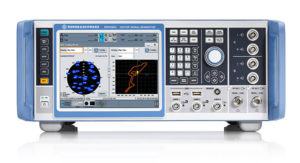
    The R&S SMW200A GNSS simulator (pictured above) can be used to produce complex interference scenarios with multiple interferers — all generated within the instrument itself. It can emulate up to 144 GNSS channels and can be equipped with up to four RF outputs. With its ability to simulate multi-constellation, multi-frequency, multi-antenna and multi-vehicle scenarios, the R&S SMW200A is able to cover a variety of high-end GNSS applications.

    R&S SMBV100B

    The R&S SMBV100B supports the same navigational systems, with access to 24 GNSS channels and one RF output, with the same ability to configure realistic scenarios including obscuration, multipath and atmospheric effects, as well as the specific characteristics of the antenna and the simulated vehicle. An integrated noise and CW interference generator can also be added.

    Since the devices do not require an external PC for scenario configuration, all the tests can be created quickly through the user-friendly GUI. Due to all-encompassing instrument options available, both simulators can be set up to fit unique user requirements.

    For testing GNSS receivers under controlled and repeatable conditions, the R&S SMW200A and the R&S SMBV100B provide extensive and cost-effective solutions. The platforms are ready to adapt to future requirements and testing of newly implemented GNSS signals.

    www.rohde-schwarz.com
    [email protected]
    +49 89 4129 12345

    [Back to top]

    SKYDEL

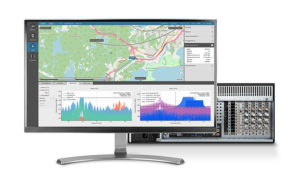
    Photo: Skydel
    Photo: Skydel

    SDX is a proven and advanced GNSS simulator based on GPU-accelerated computing and software-defined radio (SDR).

    It is available as a complete turnkey system suitable for all GNSS simulation needs, including everything from compact test benches to complete CRPA test systems, such as SDX wavefront and SDX anechoic. Moreover, its software-defined roots enable the selection of cost-effective hardware into configurations that can be repurposed for different projects.

    The architecture behind SDX provides real-time simulation of uncompromising accuracy. It features advanced signal customization and supports configurable outputs. IQ data can be generated in, or imported back into, the simulator as well. The API is embedded in the simulator core, enabling deep automation with a few simple clicks, as well as complex scripts developed with popular programming languages.

    SDX simulates multiple constellations on multiple frequencies (GPS, Galileo, GLONASS, BeiDou and SBAS) on a large number of channels. Encrypted codes are supported for GPS and Galileo.

    The Advanced Jammer module in SDX gives users complete control over interference creation. It is integrated directly into simulation scenarios to enable dynamic jammers (up to 120dB J/S) to interact with GNSS signals.

    SDX also allows users to create advanced scenarios suitable for any type of vehicle: antenna patterns (receiver and GNSS SV), LEO/GEO/HEO orbits, multipath, hardware-in-the-loop (HIL), additive pseudorange errors, message modification and corruption, raw logging and more.

    It is suitable for the design and validation of GNSS receivers, complex integration, academic research, NAVWAR and test engineering.

    SDX is developed and actively supported by Skydel’s engineering teams and worldwide distributors. Skydel offers direct support to clients to ensure prompt deployment and integration, or to review advanced customization requirements.

    www.skydelsolutions.com
    [email protected]
    1-438-239-7924

    [Back to top]

    SPIRENT FEDERAL SYSTEMS

    GSS9000, SIMMNSA, CRPA Test System, anechoic chamber testing, mid-range testing

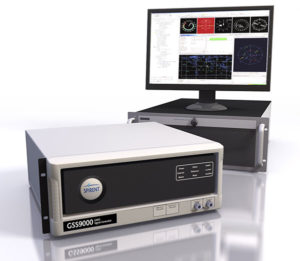
    Photo: Spirent
    Photo: Spirent

    Spirent Federal provides GPS/GNSS test equipment that covers all applications, including research and development, integration/verification, and production testing.

    GSS9000. The Spirent GSS9000 Multi-Frequency, Multi-GNSS RF Constellation Simulator is Spirent’s most comprehensive simulation solution. It can simulate signals from all GNSS and regional navigation systems and has a system iteration rate (SIR) of 1000 Hz (1 ms), enabling higher dynamic simulations with more accuracy and fidelity. The GSS9000 supports restricted/classified signals. Users can evaluate the resilience of navigation systems to interference and spoofing attacks, and have the flexibility to reconfigure constellations, channels, and frequencies between test runs or test cases.

    SimMNSA. SimMNSA allows authorized users to simulate true M-code for the first time ever. SimMNSA has been successfully delivered to users of the GSS9000 series simulator. SimMNSA has been granted Security Approval by the Global Positioning System Directorate.

    CRPA Test System. Spirent’s Controlled Reception Pattern Antenna (CRPA) Test System generates both GNSS and interference signals. Users can control multiple antenna elements. Null-steering and space/time adaptive CRPA testing are both supported by this comprehensive approach.

    Anechoic Chamber Testing. Spirent’s GSS9790 Multi-Output, Multi-GNSS RF Constellation Wave-Front Simulator System is a development of the GSS9000. The GSS9790 is a unique solution providing the core element for GNSS applications that require a test system that can be used in both conducted (lab) and radiated (chamber) conditions.

    Mid-Range Solutions. Spirent also offers solutions that cater to intermediate GPS/GNSS testing needs. The GSS7000 multi-constellation simulator provides an easy-to-use solution for GNSS testing that can grow with users’ requirements. The GSS6450 RF record & playback system enables replay of a real-world GNSS/GPS test repeatedly in the lab.

    Jeff Martin, [email protected]
    Kalani Needham, [email protected]
    Tyson Gurney, [email protected]

    www.spirentfederal.com
    (801) 785-1448
    [email protected]

    [Back to top]

    TALEN-X

    BroadSim

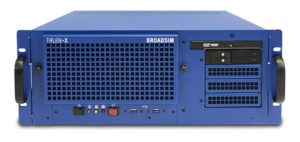
    Photo: Talen-X
    Photo: Talen-X

    A scalable software-defined simulation platform powered by Skydel’s SDX, capable of generating high-fidelity GNSS and jamming signals simultaneously across multiple constellations and vehicles. Simultaneously simulate every signal below:

    • GPS Open Codes: L1 C/A, L1C, L1P, L2P, L2C, L5
    • GPS Encrypted Codes: L1/L2 P(Y)-Code, L1/L2 AES M-code, L1/L2 MNSA (Coming soon)
    • GLONASS: G1, G2
    • Galileo: E1, E5a, E5b
    • BeiDou: B1, B2
    • SBAS: L1, L5
    • Jamming

    BroadSim’s software-defined platform includes intuitive user control and APIs; fast development cycles; flexible licensing and upgradability; and no additional hardware needed to maintain.

    Forms

    Original (4U)

    • Rack-mounted 4U simulator used for lab or field testing
    • 4 RF outputs (unlimited jamming signals generated on 1)
    • 1000-Hz simulation iteration rate
    • High-performance processor, GPUs and memory

    Anechoic

    • Simulation system used for anechoic chamber testing
    • 32 RF outputs and 16 dual-frequency antennas
    • Automatic antenna mapping
    • Automatic time delay and power loss calibration

    Wavefront

    • Phase coherent simulation system
    • Real-time automated phase calibration
    • Scalable from 4 to 16 elements
    • Supports CRPA and multi-element receiver testing
    • Supports jamming and spoofing

    Panacea

    An automated PNT performance and vulnerability test suite that supports up to 32 UUTs (units under test) in real time, from test plan creation to post-test evaluation.

    • Time synchronization to live sky
    • Compatible with 100+ different GNSS receiver brands
    • Create dynamic scenarios with parameters such as jamming patterns, motions, power loss, delays and more.
    • Manages receiver communication and standardizes data output for easy analysis, visualization and reporting

    www.talen-x.com
    [email protected]

  • Mining the magic ‘More’ menu

    Mining the magic ‘More’ menu

    laptop_site-W

    By Tracy Cozzens
    Managing Editor

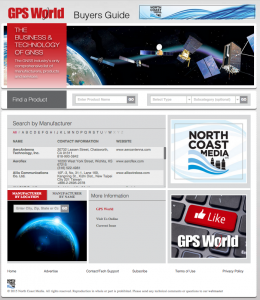
    In our redesign of the GPS World website, which coincided with our magazine redesign in November 2015, we endeavored to make the website even easier to use. Part of that effort consolidated some of our most popular features under the More dropdown menu. The little word appears at the far right of the menu row under our logo. Within it is a world of data and information to explore.

    For those seeking current and historical data on the satellites in the various GNSS constellations, we have a full Almanac, which we update at least twice a year for the print magazine. If you want to stay on top of Upcoming GNSS Satellites Launches, we provide a handy table that is updated frequently by the one and only Richard Langley, our GNSS guru. Richard also oversees the numerous and informative Innovation columns, all of which are available under the Innovation tab — right there under More.

    Our most current issue can be accessed through the words Digital Edition at the bottom of the page. Or, again under More, go to Magazine Archive for a full collection of every digital issue that reaches back a decade to 2005.

    Other great resources under More are our annual Receiver Survey and Antenna Survey. Both of these products are time intensive to produce, pulling together data and specs from almost 100 companies in an effort to provide a full picture of the products available and their capabilities.

    Similarly, the Buyers Guide link will take you to a special section on our website, allowing you to search manufacturers by product category and subcategory. Our next major update of the Buyers Guide will appear in print in June, but our gathering of the data now takes place year round as companies sign up to take part. If your company isn’t in our Buyers Guide, click on the “Add My Listing” link in the top right corner of the Buyers Guide page.

  • GPS World Unveils Industry-Exclusive Online Buyers Guide

    gps_world_buyers_guideGPS World, the leading publication serving the GNSS Industry, is pleased to announce the industry’s first online buyers guide — gpsworldbuyersguide.com — featuring access to information on hundreds of manufacturers, products and services.
    “We’ve taken the GPS World Buyers Guide in print, which we’ve been publishing for 20+ years, to an entirely new level,” said Alan Cameron, editorial director and group publisher of GPS World. “Adding a robust online version offers many benefits to the industry.”

    Engineers, integrators, professional end-users and others in search of products and services will continue to have two resources available to them — the print Buyers Guide publishing in June — and the cutting-edge, robust version accessible 24/7 at: gpsworldbuyersguide.com.

    Visitors can search for manufacturers by name or location. Products and services are searchable by name or via the following categories:

    • Accessories
    • Antennas
    • Differential GPS
    • Digital compasses
    • Electronic charts/maps
    • GLONASS hardware/software
    • Integrated navigation equipment
    • Integrated instrumentation with GPS
    • Mapping
    • Photgrammetry/GPS integrated systems
    • Precise ephemeris information
    • Publications, guides, videos, training software
    • Receive components
    • Receiver-performance analysis
    • Receivers
    • Satellite signal simulators/pseudolites
    • Security code decryption devices
    • Seminars/training
    • Software
    • Surveying-related equipment
    • System design/integration
    • Timing
    • Tracking services (mobile assets, roadside assistance, E-911, etc.)
    • Vehicle location/tracing workstations and systems (computer-aided dispatch)

    These categories are also searchable by sub-categories.

    Manufacturers and suppliers are now in control of their listings year-round by having the ability to make listing updates in real time. Listings are free and numerous upgrades are available. Listings found at gpsworldbuyersguide.com will automatically be used to create the print version of the directory.

    GPS World’s new online product offers many economical ways for a manufacturer or supplier to enhance their exposure,” said Steve Copley, GPS World publisher. “We’re excited to offer an online element to our print product and provide a positive experience for users.”

    Manufacturers and suppliers are encouraged to review their current listings by using the search functionality found on the directory’s home page. Manufacturers and suppliers not listed in directory are encouraged to create a new listing. All questions relating to the online directory should be directed to Chloe Kalin, Buyers Guide Marketing & Sales Manager, at 216-363-7929.

  • 2012 Simulator Buyers Guide

    Graphic: GPS World
    Graphic: GPS World


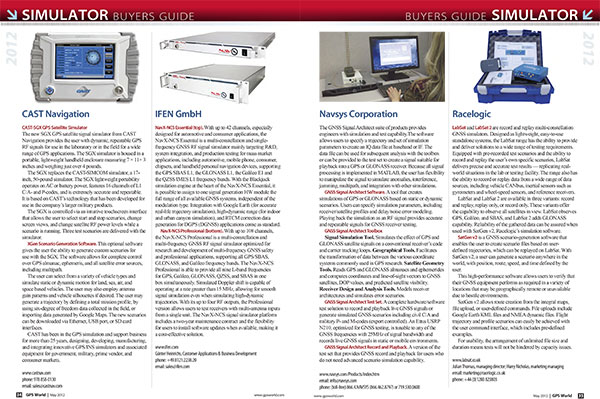
    In GPS World’s first-ever Simulator Buyers Guide, we feature simulator tools, devices, and software from eight prominent companies.

    Download the PDF.

  • Survey Perspectives: Follow up on the GPS/GNSS Buyer’s Guide Webinar

    Thanks to those who attended my webinar last month entitled A Buyer’s Guide to GPS/GNSS Survey Equipment. I received many questions during the webinar and answered a few during the event. As with my webinar last October , I’ll post the questions and my comments here.

    Question #1: When using GPS/GLONASS I understand you need at least two GLONASS SVs in order to gain any benefit from the GLONASS SVs, because one SV is required to compute the time difference between GLONASS and GPS time. However, I have heard that if you have an L2C-enabled receiver, then only one GLONASS SV is required as the L2C message has facility for the time difference. Can you (or any of the members) confirm this?

    I just checked with (a colleague) who is an electrical engineer. We quickly Googled GGTO (I think) which is a message format contained within the new L2C signal, and it turns out that what I have suggested is true! I wish I had a good reference for you (and me). So if you have an L2C-enabled Rx and you are tracking at least one GPS L2C signal, then the time-offset message should be there and only one extra GLONASS satellite would contribute to the solution. Of course, this time offset would drift, but given that we are talking about atomic time standards, the time offset should be valid for at least a few hours, probably more. This is a pretty complicated reason for getting an L2C-capable receiver for now, but will become increasingly advantageous in the future as more L2C SVs go up.

    Gakstatter: Craig actually asked this question right before the webinar (and also during the webinar) and we swapped a few e-mails. I have to check further into this but I don’t think it’s the case at this point because there are no L2C codes (messages) being broadcast now. The benefit of L2C now is the just pilot carrier. Last time I checked with the GPS Wing, they weren’t going to begin broadcasting the code on L2C until 2011 or so.

    Question #2: 1) If you use OPUS and one receiver on site, how do you get redundancy between the on-site control points? 2) What software is available to convert epoch dates that actually works?

    Gakstatter: Well, I consulted with my geodesist friend Michael Dennis, an Arizona PLS. He was presenting at the Alaska Surveying & Mapping Conference as well.

    My first inclination was to suggest to use OPUS (assuming you have a L1/L2 GPS receiver) to establish the on-site control. Then, all of your control will be tied to the same reference frame…albeit no active baselines between the on-site control points.

    I would occupy each monument twice at different times of the day. This should be sufficient to flush out blunders. If two of the sessions differ surprisingly or if the quality indicators on one are poor, I’d occupy a third time.

    I ran my suggestion by Michael and he added some valuable insight and details that I glossed over (or downright omitted):

    “I agree with your answer that a minimum of two occupations (of sufficient duration) be used to provide redundancy (but more occupations are, of course, better).  “Sufficient duration” depends on whether OPUS Static (S) or Rapid Static (RS) was used. I usually work in areas far from CORS, so I cannot make reliable use of OPUS-RS, and so I typically want at least three hours (for OPUS-S).  But for either type of OPUS, I recommend that the maximum peak-to-peak errors be less than the desired accuracies for the project.  The peak-to-peak errors can also be used to compute a weighted mean final OPUS position.  Waiting the ~two weeks for final IGS orbits is also recommended, if possible, but be sure to wait at least for the rapid orbits, which are supposed to be available in 17 hours. If three OPUS occupations are made, a sufficiently motivated individual could actually calculate the horizontal error ellipse and height error (scaled, of course, to 95% confidence).”

    Michael had great comments on OPUS-S vs. OPUS-RS. If you’ve got gobs of CORS near you, then OPUS-RS might work, but I’d prefer to use 2+-hour (Michael suggests 3-hour) occupation times and run it through OPUS-S.

    Some details on orbits. There are three grades of orbits used by OPUS.

    1. Broadcast orbits (available immediately).
    2. IGS rapid orbits (available the day after collection).
    3. IGS precise orbits (available 10-14 days after collection).

    Which orbits to use is a bit of a challenge due to the time lag. Two weeks can be a long time to wait for a solution depending on the reason for setting the control. Submitting your data from the job site wouldn’t be the best move for a couple of reasons. The first is that you’d be using the least precise orbits, but more importantly data from many CORS aren’t posted until the next day. If you attempt to process the immediately after the data collection session, the selection of available CORS data might be limited. If you really require processing the data immediately, you should also process a day later and then again two weeks later to benefit from improved orbits.

    Michael had a further comment about the lack of on-site ties in the example above.

    “Having said all that, I must confess I’m not completely comfortable with the idea of using OPUS alone for establishing control.  Maybe I’m being old-fashioned, but I would much prefer to have ties between all the stations on the project.  Despite that, I must admit that OPUS has always given me good results (as long as I paid attention to the peak errors and minimum 3 hour occupation times for OPUS-S).”

    Regarding software that converts epoch dates, I’d refer you to HTDP (Horizontal Time Dependent Positioning) offered by the National Geodetic Survey (NGS). You can use it to convert between reference frames and epoch dates. I think some manufacturers may have incorporated this into their software, but I would still do a spot check to make sure they both provide the same answer.

    Question #3: Please comment on the limitations of GPS survey in challenging environments (canopy, terrain, etc).

    Gakstatter: GPS will always be challenged by tree canopy and terrain due to the nature of the technology. Terrain is easier to deal with than tree canopy. With terrain, it’s just a matter of tracking enough satellites. You either track them or you don’t. An open-pit mine is a good example of that. Even when combined with GLONASS satellites, an open-pit mine of sufficient depth and steep enough slopes will prevent a receiver from tracking a sufficient number of satellites for a good-quality position. This environment is one of the reasons why pseudolite technology was developed. However, over time this will change as more GLONASS and other satellite systems (such as Galileo and Compass) are deployed. A fully populated dual constellation (GPS, GLONASS) will result in an average of ~20 satellites in view as opposed to half that (or less) with only GPS. If you add a fully populated Galileo constellation into the mix, now you have 90 satellites to choose from.

    Tree canopy is a different story because it’s not a &ldq
    uo;hit or miss” proposition.

    The receiver will pick-up and drop a satellite dynamically when tracking under tree canopy. For centimeter-level positioning, your receiver needs to consistently track the satellites it is using in order to provide a reliable position. The temptation is to push a receiver into an environment where it can’t provide a reliable solution to “just get the last shot.” The risk is that the receiver will report good quality indicators (fixed solution with low RMS values) but record a poor position. Even worse are the scenarios where the position is reasonably close to the actual position (within a few feet), but it’s not easy to detect the blunder since the quality indicators are good. You’d rather the position be grossly incorrect so the blunder is obvious.

    I think the long-term solution to precise positioning in that environment is the integration of several technologies like GNSS, inertial navigation, laser rangefinding, and other technologies. All of these technologies exist today, but they aren’t integrated into a small enough and user-friendly enough package at reasonable enough prices. That problem will be solved with time.

    One thing I believe for sure is that GPS/GNSS will not solve that problem completely even with the modernized GPS signals (L2C, L5, L1C) and the addition of other satellites from systems like GLONASS, Galileo, and Compass. Yes, there will be a marked improvement in that environment, but not completely solved.

    Question #4: Is the survey GPS industry responding to the challenges of the oncoming solar maximum event? If so, how are they responding?

    Gakstatter: I think you’ve got to define which GPS technology is most venerable. That would be the users who are trying to optimize the accuracy of single-frequency GPS (L1) by modeling the Total Electron Count (TEC) — particularly, real-time correction systems like DGPS, SBAS (WAAS, EGNOS, MSAS, GAGAN), and commercial DGPS services. Dual-frequency receivers, although not immune to the effects of an extreme event, are much better equipped to deal with dynamically changing TEC within the ionosphere due to the known frequency dependence of the delay.

    This subject is worthy of another article by itself (I published one last fall), so I won’t go into much detail here but rather save most of the detail for another day.

    The GPS industry isn’t doing anything at this point except keeping an eye on sunspot activity. Keep in mind that extreme solar events typically happen on the downside of the solar cycle, which is 11 years long. The first four years of the solar cycle are the ramp up. We are starting the ramp up so the solar maximum will be in the 2012 timeframe. The last extreme solar events occurred about two years after the solar maximum, so if we use similar timing, the extreme events of the next cycle will occur five to seven years from now. There’s much debate though. Some experts are suggesting that maybe this cycle will be a dud, and so far it has been tame.

    Everyone seems to be in monitoring mode, and experts don’t even agree on how severe this cycle will be. The National Geodetic Survey says, “We’ll know when we get there.” In essence, nothing is being done to prepare and I’m not sure there is anything to do.

    In the October 2003 extreme event, DGPS accuracy blew out to 15-20 meters and WAAS accuracy blew out to 25 meters. Commercial DGPS users complained about accuracy blowouts also. WAAS is the only system that actually monitors and warns users of the accuracy blowouts (if the receiver is designed to utilize the warning that WAAS provides).

    The good news is that this should be the last solar cycle where we have to worry about this as much as we are. By the time the next solar events might happen (2025), we will have all the GPS modernized signals deployed to mitigate it (primarily L5 and L1C).

    Question #5: I’m a surveying engineer from Romania. What can you tell us about VRS?  Recommendations?

    Gakstatter: Briefly, RTK networks are experiencing explosive growth around the world. It’s a topic one cannot avoid when discussing GPS/GNSS today.

    I’ve used various GPS/GNSS equipment on networks operated by Trimble, Topcon, and Leica software and receivers. They are very, very convenient.

    It’s a complex subject. Look forward to my next column that will delve into RTK networks.

    Question #6: Do you know of any studies of real time accuracy obtained using CORS base-station networks (with the cell-phone data link)?

    Gakstatter: I assume you are referring to RTK networks. I’ll write more about this next month, but I’ll say a little here.

    Like I mentioned above, I’ve used several different receivers on several different RTK networks. My general feeling is that traditional base/rover configuration gives you better control over accuracy (especially vertical) than RTK networks, primarily due to control over the baseline distance. Of course, if you are using a traditional base/rover configuration and start roving 10-12 km from your base, you’ll run into the same problem. The idea is that you have control over the baseline when you operate your own base station and you don’t when you’re tied into an RTK network.

    But one can’t dismiss the robustness of the RTK network solution using many reference stations versus the vulnerability of a single baseline base/rover configuration. More later on this…

    Question #7: I’ve read somewhere L1 receivers will not be usable after 2020. Is this true?

    Gakstatter: Not at all. I’ve written quite a bit about the Department of Defense’s intent to discontinue supporting semicodeless techniques after December 31, 2020.

    It only affects L1/L2 receivers that use semicodeless techniques (about 300,000 of them). If your receiver can utilize L2C, then it is fine.

    L1 receivers will not be affected at all.

    Question #8: Is cycle slip a problem when trying to use an L1 RTK system in a real-time application?

    Gakstatter: My experience with L1 RTK says that it’s a useful tool for clear-sky environments when there are enough satellites available and you use a base/rover configuration of the same brand. It performs especially well when you have SBAS satellites (WAAS, EGNOS, MSAS) within view because it uses them like another GPS observable.

    When used in the environment it was designed for (as described above), cycle slips aren’t an issue in my opinion.

    Question #9: Are you guys planning any webinars on using RTK networks? That would be a good topic!

    Gakstatter: In fact, my next webinar (in April) will cover this very topic.

    Question #10: When do you plan to retire your Ashtech system?

    Gakstatter: When it stops working J. I think no one will be able to fix it when it does.
    Interestingly enough, I’ve been able to utilize it as a base station with the new Magellan PM-500 (without GLONASS).

    Question #11: What are typical price ranges of each class of receivers?

    Gakstatter: Here are my guesstimates based on U.S. prices. My prices are the entry level for the category:

    • GPS L1: US$7,000 and up for a pair of receivers and post-processing software. L1 survey units really work together the best in pairs due to l
      imited baseline distance.
    • GPS L1 RTK: US$12,000 and up for a pair of receivers, spread-spectrum radios, and data collector.
    • GPS L1/L2: US$8,000 for a single receiver with internal memory and without post-processing software. The assumption is that the user would utilize an online positioning service such as OPUS, PPP, or AUSPOS.
    • GPS L1/L2 RTK: US$19,000 and up for a pair of receivers, narrow-band radios, and data collector.
    • GPS/GNSS L1/L2/GLONASS RTK: US$27,000 and up for a pair of receivers, narrow-band radios, and data collector. US$15,000 and up for a single receiver and data collector configured for RTK network operations.

    Question #12: If they are semi-codeless and will not work after the sunset, does this mean that the modulation scheme will be changing for L2?

    Gakstatter: First of all, the GPS Wing has made it clear that the sunset isn’t a hard date, so receivers may work after that date. They just won’t guarantee it.

    My understanding is that there will be no change to the modulation scheme for L2. The GPS Wing recommends that civilian receivers utilize the new L2C signal.

    Question #13: L5 will improve the precision of positioning in high covered areas? Thank you!

    Gakstatter: I sort of covered this in Question #3. L5 will really benefit the civilian high-precision user in a few ways:

    • mitigatingthe effects of the ionosphere.
    • four times more power than L2C.
    • enhanced code structure for more robust positioning.
    • resides in the highly protected aeronautical frequency band (1176.45 MHz).

    I wouldn’t expect that just because the broadcast power is four times greater than L2C that one can expect L5 to “punch through the trees,” although it will help contribute to a more robust position solution.

    Question #14: Any thoughts about L1 GPS/GLONASS/WAAS RTK receivers? The product can do L1 RTK, support network RTK, use online free positioning service, and utilize wireless service for base/rover communication, price is 1/3 to 1/2 of those of GPS L1/L2 RTK systems.

    Gakstatter: Honestly, I don’t have any experience with that type of receiver. I’ve used L1/WAAS RTK in a base/rover configuration and on a network. The base/rover configuration worked well within its limits. The RTK network configuration wasn’t so good. I think most of the problem was due to the baseline distance. The nearest reference station in the network was nearly 20 km away.

    However, I can only assume that if L1/WAAS RTK works well within its specifications, that L1/WAAS/GLONASS RTK would work that much better with the additional observables in a base/configuration.

    Lastly, my experience is that most networks (if not all) don’t support broadcasting SBAS data and some do not even support GLONASS. Maybe this will change in the future.

    Question #15: Why do GPS users still think that LI RTK is “high-precision GIS”? A centimeter in a surveying app is still a centimeter in a GIS app. Do you agree that most GIS users expect more than 0.5-meter results?

    Gakstatter: Well, I hope I didn’t lead people to think that is the only use for it. I think L1 RTK can be applied to construction staking and topography surveys similar to L1/L2 RTK as long as it’s operated within its stated limits.

    I think the value proposition of L1 RTK puts it in a price range that GIS users can afford RTK where they couldn’t before. Just think that 10 years ago, the price tag of a sub-meter GIS receiver was about US$10,000.

    Question #16: How soon do you think inertial navigation will be a marketable solution?

    Gakstatter: There are some out there now, but not at the right packaging/integration/price-point level. I think we’ll start to see mainstream products in the 3- to 5-year timeframe.

    Question #17: Is it worth it to pay more at this time for an L1/L2 RTK GPS system capable of receiving signals that will be available only after 2 or 3 years?

    Gakstatter: If you buy a GPS L1/L2 receiver (no L2C) today, there is only one system you need to consider and that is the semicodeless sunset date of December 31, 2020…12 years from now. GPS L1/L2 RTK systems are getting cheaper and cheaper.

    Just because new signals are being broadcast in the future (L5 and L1C), it doesn’t mean that your GPS L1/L2 system won’t work any longer.

    Question #18: A recent article in Geomatics World (Jan/Feb 2009) suggested that the inclusion of GLONASS signals marginally worsens an RTK position in areas of variable sky view (robust intercomparisons were undertaken it was carried out in the football stadium of Old Trafford in England).

    Gakstatter: I haven’t read the article. I would be interested in reading the details.

    To me, users select GLONASS to work in environments where using only GPS lacks sufficient satellites. It’s all about productivity and not as much about accuracy. Of course, one would prefer it not to degrade accuracy. This is a good subject to look at in more detail. My experience with GLONASS hasn’t demonstrated this, but I can’t say that I took a scientific approach in comparing the two. It was on a couple of projects where using only GPS was cutting into my efficiency due to GPS “brownouts” because of the terrain. I ended up using a GPS/GLONASS receiver and was pleased with the productivity. There wasn’t a noticeable degradation in accuracy either.

    Question #19: What do you know about the quality of Altus receivers?

    Gakstatter: I haven’t used the Altus product, although I’ve spoken with them and I know some of the guys who started the company…very experienced GPS people who used to work at Leica and Magnavox. They use a Septentrio OEM receiver. Septentrio has developed a reputation for very good receiver technology.

    Question #20: I hear rumors about how different manufacturers of GLONASS receivers process the data differently. I understand that some process, or “handle,” the data significantly differently, and that some don’t handle the data very well. Can you talk about this a little?

    Gakstatter: I have some experience with GPS/GLONASS receivers from a couple of different manufacturers. In my experience, the receivers performed in accordance with the product specifications inasmuch as I was using them for RTK.

    I wouldn’t doubt that manufacturers are handling GLONASS differently, but it’s difficult to determine who is doing it “better” than other manufacturers.

    I think the best way to make the determination is to try it yourself in your environment remembering that the benefit of GLONASS is to increase productivity, not increase accuracy. When there are plenty of GPS satellites in view (6+ with a low PDOP), there is no need to use GLONASS.

    Question #21 Considering cost/performance, L1 is the most expensive. What do you think? If a fully loaded state-of-the-art receiver costs $5K more than a simple L1, what is the economic impact over the lifetime of the receiver (5 years) considering all other expenses of a survey company?

    Gakstatter: I understand your point. I think it depends on what kind of projects a survey company is participating in. If they are doing large scale topo and construction staking work, then I would agree that they should seri
    ously consider a state-of-the-art RTK receiver. In that environment, an L1 receiver would hinder productivity.

    However, if it’s a small, low-overhead shop performing residential lot surveys, then an L1 receiver might deliver the maximum efficiency. It’s simple to operate and simple to maintain.


    Keep the dialogue going on these comments. I think it’s a great discussion and I’m open for comments and criticisms.

    Story filed from 65o 3’ 11’’ north latitude, 146 o 3’ 20’’ west longitude. This is the furthest north I’ve been in North America.


    Also in the March newsletter: About Alaska