Tag: Chronos

  • Syntony GNSS, Chronos Technology partner on GNSS underground coverage

    Syntony GNSS, Chronos Technology partner on GNSS underground coverage

    GNSS Underground Coverage for Tunnels, Stations, Car Parks, Bus Stations and Airports in the U.K.

    Syntony GNSS and Chronos Technology have formed a partnership to deliver underground GNSS positioning, navigation and timing (PNT) solutions for critical infrastructure applications in the United Kingdom.

    Syntony GNSS is a leader and expert in the design and manufacture of GNSS systems, and Chronos Technology is a resilient GNSS system integrator.

    GNSS coverage has become fundamental to many services from emergency services to asset tracking for example. Yet when entering an underground area such as a metro/subway, tunnel, car park, airport, or bus station for example, the GNSS signal is lost.

    Syntony’s SubWAVE solution expands the GNSS coverage to underground areas, enabling the localization of any equipment with a standard GNSS chipset. Examples include standard smartphones and the TETRA  Emergency Services Network handset used for security and services. Security and services applications include locating emergency calls, keeping track of staff, locating faults in tunnels, managing assets, locating trains and providing guidance.

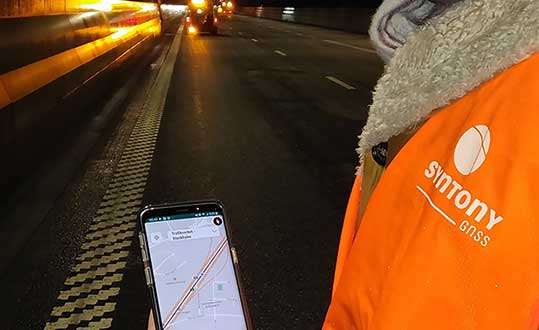
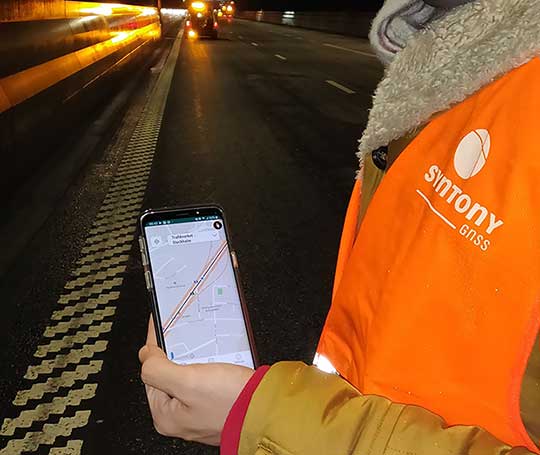
    A Syntony team member in a Swedish road tunnel during SubWAVE testing shows the positioning in an underground environment on a smartphone. (Photo: Syntony GNSS)
    A Syntony team member in a Swedish road tunnel during SubWAVE testing shows the positioning in an underground environment on a smartphone. (Photo: Syntony GNSS)

    By emitting a perfect emulation of the “real” GNSS signal, SubWAVE offers underground operators, their staff, emergency services and the general public the benefit of full GNSS coverage in all underground areas for both operational and safety reasons.

    One fundamental aspect is the user only needs a standard GNSS receiver (a smartphone or TETRA radio) — no new handsets, receivers or apps are required. The system operates by broadcasting synthetic location specific GNSS signals through existing or new leaky feeder cables in the tunnels.

    Accuracy levels vary with leaky feeder and system complexity options; however, 2-meter accuracy is possible with a standard smartphone. The system is widely installed in the Stockholm metro and is in active trials throughout Europe and America.

    “We are pleased to form a partnership with GNSS specialists Chronos,” said Joel Korsakissok, president of Syntony GNSS. “Their knowledge and experience, together with their dedicated installation, commissioning and support teams complement our sophisticated solutions.”

    “Since its first general availability, one of the well-known shortcomings of the GPS system was lack of indoor or underground coverage,” said Charles Curry, managing director with Chronos. “Many have tried to solve this with various technologies over the years. Syntony’s innovative technology offers underground GNSS coverage for PNT applications. We are very excited by the possibilities and pleased to be partnering with them to offer their solution for critical infrastructure applications in the UK.”

    In addition, Chronos will also supply Syntony’s sophisticated GNSS simulators used in the aerospace and defence industries for product testing.

  • PNT Roundup: Taviga collaboration, leap second reconsidered and drone rules

    eLoran

    New joint venture to ensure, assure secure PNT

    The founders of Chronos and UrsaNav have formed a new collaboration, named Taviga, that will focus on preserving and establishing low-frequency (LF) positioning, navigation and timing (PNT) networks in the United Kingdom, Europe and the U.S., using repurposed Loran-C or purpose-built eLoran technology.

    Taviga aims to ensure timing and navigation for critical infrastructure, protecting it from cyber and other threats, and addressing the concern that over-dependence on single systems for PNT increases vulnerability.

    According to a joint press release, “Taviga combines the founders’ decades of experience specializing in low-frequency (LF) PNT technology and industrial timing applications at national and international levels. Its objective is to provide a commercially operated assured LF PNT service.”

    Partner with Government. Charles Curry of Chronos Technology Ltd. in the UK and Charles Schue of UrsaNav Inc. in the U.S. joined forces to launch Taviga Ltd. and Taviga LLC. Taviga anticipates working in partnership with government agencies and other entities that have a vested interest in reducing the vulnerability and improving the resilience of critical national infrastructure with a dependency on the GPS and other GNSS sources of PNT.

    “We have been researching the precise timing capability of eLoran transmissions for over 10 years,” Curry said. “During that time, the system has never failed, and most impressively it has continued to deliver sub-microsecond time accuracy traceable to UTC in very challenging locations, including deep inside buildings.

    “Our research program was supported by the UK’s Innovation Agency — Innovate UK through two flagship projects, GAARDIAN and SENTINEL,” Curry continued. “These two projects highlighted the vulnerabilities that threaten GPS signals (and in the future, Galileo) such as jamming, interference and spoofing. They also demonstrated how eLoran is a technically dissimilar source of PNT and not vulnerable to the same types of interference. eLoran is a truly complementary source of PNT, ideal for use in critical infrastructure applications such as telecoms, broadcasting, financial services and power utilities.

    “Every government, academic and industrial study has resulted in the selection of the LF technology known as Enhanced Loran, or eLoran, as the best wide-area complement to GNSS,” UrsaNav’s Schue added. “There is no doubt that the combination of GNSS and eLoran provides the PNT resilience that most users require.

    “Integrated GNSS-eLoran solutions can provide the proof-of-time and proof-of-position necessary to safeguard national infrastructure and for business continuity of operations,” Schue said. “Adding eLoran to the PNT mix enables or enhances capabilities of regional and purpose-built solutions. Overreliance on a single solution is neither prudent nor safe.”

    Tests led by Chronos and using UrsaNav’s eLoran receiver engine have consistently demonstrated positioning accuracies of better than 10 m and timing accuracies of less than 100 nanoseconds in the area of differential eLoran reference sites.

    Taviga’s goal is the long-term operation of an eLoran system for at least 10 years, a period that provides the necessary service assurance continuity to enable industrial users to invest with confidence in an eLoran-based timing and navigation service that complements their GNSS solutions. As users become accustomed to the capabilities and resilience of a combined GNSS-eLoran solution, Taviga expects to expand the service footprint worldwide.

    Timing

    Leap second lives on

    The International Telecommunication Union (ITU) World Radiocommunication Conference (WRC-15) decided that further studies are required on the impact and application of a future reference time-scale, including the modification of Coordinated Universal Time (UTC) and suppressing the so-called “leap second.”

    Leap seconds are added periodically to adjust to irregularities in the Earth’s rotation in relation to UTC, the current reference for measuring time, in order to remain close to mean solar time (UT1). A leap second was added most recently on June 30 at 23:59:60 UTC. The proposal to suppress the leap second would have made continuous reference timescale available for all modern electronic navigation and computerized systems to operate while eliminating the need for specialized ad hoc time systems.

    A report will be considered by the World Radiocommunication Conference in 2023. Until then, UTC shall continue to be applied as described in Recommendation ITU‑R TF.460‑6.

    Disconnect from the Sun? As a representative of the Lick Observatory of the University of California stated, “a problem is that simply omitting leap seconds would redefine the meaning of the word “day” so that it is not related to the sun in the sky, nor connected with the rotation of the Earth.”

    “Modern society is increasingly dependent on accurate timekeeping,” said ITU Secretary-General Houlin Zhao.“ITU is responsible for disseminating time signals by both wired communications and by different radiocommunication services, both space and terrestrial, which are critical for all areas of human activity.”

    Further studies will be coordinated by ITU along with several other international organizations.

    Inertial/GNSS

    Drone rules, registry

    The Federal Aviation Administration announced in December an official rule and registration process for hobbyists who own small unmanned aircraft weighing more than 0.55 pounds and less than 55 pounds, including payloads such as on-board cameras.

    The online registration system does not yet support registration of small UAS used for any purpose other than hobby or recreation — for example, using an unmanned aircraft in connection with a business. The FAA is developing enhancements that will allow such online registrations by spring of 2016.

    The registration procedure is a statutory requirement that applies to all hobby aircraft. Under this rule, any owner of a small UAS who has previously operated an unmanned aircraft exclusively as a model aircraft prior to Dec. 21, 2015, must register no later than Feb. 19, 2016. Owners of any other UAS purchased for use as a model aircraft after Dec. 21, 2015, must register before the first flight outdoors.

    Owners may register through a web-based system or paper-based process. There is a $5 registration fee, but the FAA is offering a full rebate for those who register before Jan. 20, 2016.

    Under the rule, each aircraft must be marked with a unique number, although not necessarily the serial number. The goal is to help authorities track down an owner if a drone collides with another aircraft, flies too high or encroaches on an airport.

    Owners using the model aircraft for hobby or recreation will only have to register once and may use the same identification number for all of their model UAS. The registration is valid for three years.

    “We expect hundreds of thousands of model unmanned aircraft will be purchased this holiday season,” FAA Administrator Michael Huerta said. “Registration gives us the opportunity to educate these new airspace users before they fly so they know the airspace rules and understand they are accountable to the public for flying responsibly.”
  • Chronos and UrsaNav partner on Loran PNT networks

    Chronos and UrsaNav partner on Loran PNT networks

    Taviga-logoThe founders of Chronos and UrsaNav have formed a new collaboration, named Taviga, that will focus on preserving and establishing low-frequency (LF) positioning, navigation and timing (PNT) networks the United Kingdom, Europe and the United States, using repurposed Loran-C or purpose-built eLoran technology.

    Taviga — named for timing and navigation — aims to ensure timing and navigation for critical infrastructure from cyber and other threats, and address the concern that over-dependence on single systems for PNT increases vulnerability.

    According to a joint press release, “Taviga combines the founders’ decades of experience specializing in low-frequency (LF) PNT technology and industrial timing applications at national and international levels. Its objective is to provide a commercially operated assured LF PNT service.”

    Charles Curry, founder of Chronos Technology Ltd. in the UK, and Charles Schue, founder of UrsaNav Inc. in the United States, joined forces to launch Taviga Ltd. and Taviga LLC. Taviga anticipates working in partnership with government agencies and other entities that have a vested interest in reducing the vulnerability and improving the resilience of critical national infrastructure with a dependency on the GPS and other GNSS sources of PNT.

    “We have been researching the precise timing capability of eLoran transmissions for over 10 years,” Curry said. “During that time, the system has never failed and most impressively it has continued to deliver sub-microsecond time accuracy traceable to UTC in some very challenging locations including deep inside buildings.

    “Our research program was supported by the UK’s Innovation Agency – Innovate UK through two flagship projects, GAARDIAN and SENTINEL,” Curry continued. These two projects highlighted the vulnerabilities that threaten GPS signals (and in the future, Galileo) such as jamming, interference and spoofing. They also demonstrated how eLoran is a technically dissimilar source of PNT and not vulnerable to the same types of interference. eLoran is a truly complementary source of PNT ideal for use in critical infrastructure applications that demand precise time and timing such as telecoms, broadcasting, financial services and power utilities.

    “Every government, academic and industrial study has resulted in the selection of the LF technology known as Enhanced Loran, or eLoran, as the best wide-area complement to GNSS,” Schue said. “There is no doubt that the combination of GNSS and eLoran provides the PNT resilience that most users require.

    “Whether the application is timing/frequency, aviation, maritime, land-mobile, or location based, integrated GNSS-eLoran solutions can provide the proof-of-time and proof-of-position necessary to safeguard national infrastructure and for business continuity of operations,” Schue said. “Additionally, adding eLoran into the PNT mix enables or enhances the capabilities of regional and purpose-built solutions. PNT resilience results from an eco-system made up of layered solutions. Over reliance on a single solution is neither prudent nor safe. It’s time for Taviga.”

    Tests have been conducted as part of Innovate UK supported research projects GAARDIAN and SENTINEL, which were led by Chronos Technology Ltd and included UrsaNav’s eLoran receiver engine. eLoran transmissions from the UK, Denmark, Germany, France and Norway have consistently demonstrated positioning accuracies of better than ten meters and timing accuracies of less than 100 nanoseconds in the area of differential eLoran reference sites. Taviga will now seek to engage those governments and others in discussions as to how to transition their Loran stations to commercial operation.

    Taviga’s goal is the long-term operation of an eLoran system for at least 10 years. This length of time provides the necessary service assurance continuity to enable industrial users to invest with confidence in an eLoran-based timing and navigation service that complements their GNSS solutions. As users become accustomed to the additional capabilities and resilience provided with a combined GNSS-eLoran solution, Taviga expects to expand the service footprint into other countries worldwide.

  • Chronos Technology to Exhibit Anti-Jam Tech at ION GNSS+

    Chronos Technology, global timing and synchronization company, is exhibiting its anti-jamming technology at ION GNSS+ 2013 in Nashville, Tennessee, September 18-20.

    Exhibiting at Stand 723, Chronos will be demonstrating the Chronos Sentinel system, which enables a light-touch deployment of GPS jamming detection for a short period of time and allows a GPS jamming report to be created to enable management to assess the threat.

    The CTL3520 handheld GPS jamming detector by Chronos Technology.
    The CTL3520 handheld GPS jamming detector by Chronos Technology.

    Chronos will also be displaying various GPS products, including the new CTL3520 handheld GPS jamming detector and locator system aimed specifically at detecting GPS jammers hidden in vehicles.  The unit can pinpoint even the weakest jammer and identify the vehicle in which the jammer is hidden, even in a busy multi-storey car park. Other applications include detecting vehicles with jammers at ports, fleet depots, airport car parks and taxi ranks.

    In addition, Professor Charles Curry, managing director with Chronos Technology, is presenting a technical paper “GPS Jamming -Threat Scenarios” on Monday, September 16, at CGSIC, which precedes ION GNSS+ 2013.

    For more information about ION GNSS+ 2013, visit www.ion.org

  • Chronos Releases Handheld GPS Jamming Detector

    ctl3520-handheldU.K. firm Chronos Technology has released the CTL3520 handheld GPS Jamming Detector and Locator System. Aimed specifically at detecting GPS jammers hidden in vehicles, the unit can pinpoint even the weakest jammer and identify the vehicle in which the jammer is hidden, even in a busy multi-storey car park, Chronos said.  Other applications include detecting vehicles with jammers at ports, fleet depots, airport car parks and taxi ranks.

    The CTL3520 device was recently tested by representatives of law enforcement and security agencies in screened rooms at the MIRA test facility in Warwickshire and successfully identified hidden jammers both in vehicles and people’s pockets.

    The CTL3520 was developed from research undertaken by the University of Bath and is a significant commercial outcome of the Sentinel research project, which was partly funded by the Technology Strategy Board.

    “Previous jamming detecting products have been unable to identify which vehicle is hosting the jammer,” said Charles Curry, founder and managing director of Chronos Technology Ltd. “This has been a particular limitation and a major challenge for people wishing to protect critical infrastructure if faced with GPS jamming emanating from a nearby vehicle. Most websites currently selling GPS jammers maintain that the operating distance of a jammer is just a few meters. This is simply not true. We have tested GPS jammers in controlled trials and their range is easily 250/300 meters which makes specific vehicle identification extremely difficult, particularly in a multi-storey car park. The CTL3520 solves this problem and can pick out one vehicle in a thousand which has the jammer installed.”

    “This product contains advanced technology which is the culmination of more than two-years of research and development at the University of Bath, funded by the Engineering and Physical Sciences Research Council (EPSRC) within the Sentinel project. We are delighted that our collaboration with Chronos has led to a commercial product,” said Robert Watson, University of Bath Electronic & Electrical Engineering Department.

    In addition to UK users, Chronos is seeking international resellers and distributors to take the product into critical infrastructure protection and law enforcement markets where there is a recogniszd concern about the proliferation of low cost GPS jammers used by criminals to cover their tracks or vehicle drivers for personal privacy purposes.

  • Chronos Welcomes Ofcom Licensing for GPS/GNSS Repeaters in the UK

    Chronos Technology, supplier of GNSS (GPS, GLONASS, and Galileo) products and services, welcomes the decision by the UK regulator Ofcom on June 20 to implement a licensing regime for the use of GNSS repeaters in the UK. Chronos Technology has been at the forefront of GNSS repeater technology for many years and is one of the largest suppliers of this technology to the military in Europe.

    GNSS repeaters provide coverage for the use and testing of GNSS technology inside buildings where the GNSS signals do not normally reach. Until the recent decision by Ofcom, the use of this repeater technology in the UK was not permitted except in specialized (normally military) situations.  Large numbers of consumer and industrial products use GNSS technology for positioning and timing applications including smartphones, telematics equipment, avionics and emergency service applications. GNSS technology can also be used for resource management, civil engineering and military applications.

    The Ofcom consultation prior to this decision highlighted concerns about potential interference to applications by the use of GNSS repeaters; however, the conclusion was that a properly installed repeater system, conforming to the ETSI harmonized Standard for GNSS repeaters, should have no impact beyond 10 meters. This decision enables the use of GNSS repeaters in many applications and will provide significant benefits and cost savings to organizations wanting to develop, test, integrate and manufacture products and systems that use GNSS technology, Chronos said.

    Chronos has installed repeater and other general GNSS infrastructure in more than 50 countries over 15 years.

  • ITT Exelis, Chronos Team on Offerings for Interference, Detection and Mitigation

    ITT Exelis and Chronos Technology Ltd. have agreed to jointly pursue and develop product offerings for the GNSS interference, detection and mitigation (IDM) market.

    Satellite-based positioning, navigation and timing (PNT) systems are vulnerable to many factors, such as signals jamming, resulting in potentially devastating system failures. The collaboration between ITT Exelis and Chronos Technology will allow both companies to respond to the IDM market by offering a set of complementary products and solutions.

    “The IDM threat is real and the risks are increasing,” said Charles Curry, founder and managing director, Chronos Technology Ltd. “ITT Exelis has recognized the technological innovation driven by the GAARDIAN research project into GPS jamming and interference detection, and will bring cutting-edge innovations to enhance the GAARDIAN platform.”

    GAARDIAN has largely concluded its three-year run to deliver prototype sensors and probes to detect interference and give alarms, as well as detailed analyses of the GNSS environment.
    The British, European, U.S., and global economies are vulnerable, by their dependence on GPS/GNSS, to interruption of the energy supply, breakdown of communications, transport, and financial services, and potential loss of life  — all with no operational monitoring, detection, recourse, or back-up, prior to GAARDIAN and SENTINEL.

    The follow-on SENTINEL is mid-way through its two-year life to take the next requisite steps:

    • Actually locating the interference;
    • categorizing it;
    • determining its extent;
    • giving a determination of trust in GNSS,
    • and addressing spoofing.

    The project has a large user base in law enforcement and government.

    For more than 37 years, ITT Exelis payloads and payload components have been on board every GPS satellite and have accumulated in excess of 500 years of on-orbit life without a single mission-related failure due to ITT Exelis equipment.

    ITT Exelis Geospatial Systems, headquartered in Rochester, N.Y., is a global supplier of innovative night vision, remote sensing and navigation solutions that provide sight and situational awareness at the space, airborne, ground and soldier levels. Key applications include image intensification and thermal imaging; advanced power supplies; multi-spectral image systems; weather and climate monitoring; space science; intelligence, surveillance and reconnaissance; GPS-based positioning, navigation and timing systems; and image exploitation software.

    Chronos Technology Limited is a world leader in timing synchronization solutions and GNSS jamming and interference detection, and is currently the lead for the UK Government sponsored SENTINEL research program, which followed on from the GAARDIAN GNSS interference detection project to research the location of GNSS jammers. Established in 1986, Chronos is a leading provider of technical solutions including time and timing for wireline and wireless telecom operators; highly versatile telecoms sync testing and monitoring systems and quality of service applications. Chronos also supplies GNSS (GPS) products from receivers for all application types including covert tracking, avionics and embedded systems, to test equipment (simulators) and GNSS infrastructure (antennas, splitters, repeaters) for the distribution of GNSS RF signals into sensitive environments. Chronos has developed a range of bespoke GPS timing products for time and frequency synchronization in power and communication systems.


  • Chronos Introduces GAARDIAN Project at ION GNSS 2009

    Chronos Technology is introducing the academic and business research consortium working on the GAARDIAN Project at its booth (#728) at the ION GNSS conference taking place this week in Savannah, Georgia. Chronos is leading the consortium, which over the course of 2009 – 2011 will be researching the data-gathering necessary to develop a system for mission and safety critical applications that will certify the accuracy, reliability, integrity, and continuity of Positioning, Navigation and Timing (PNT) systems: GPS, the new enhanced LORAN (eLORAN), GALILEO and GLONASS.

    GAARDIAN is the acronym for “GNSS Availability, Accuracy, Reliability anD Integrity Assessment for Timing and Navigation” and the Consortium includes University of Bath, General Lighthouse Authorities, BT, Ordnance Survey, National Physical Laboratory, and Imperial College London.

    The project will create a mesh of remote PNT (Positioning, Navigation & Timing) interference detection & mitigation sensors (IDMs) which will be deployed in the vicinity of PNT dependent infrastructure & applications. These probes will monitor the integrity, reliability, continuity and accuracy of the locally received GPS (or other GNSS) and eLoran signals on a 24×7 basis and report back to a central server. The user will be alerted in real time to any anomalous behavior in either of the two PNT signals.

    IDM sensors, which can be configured by the user to be personalized to a specific deployed location, permanently monitor the PNT signals and on detection of an anomaly warn of a potentially critical situation.

    Users access the data over the internet from a secure server environment, enabling continuous monitoring from any internet enabled terminal – effectively providing access to detailed knowledge about local PNT health and pinpointing interference phenomena from anywhere in the world.

    Likely phenomena or threats to PNT services which would cause an alarm include jamming, general interference, multipath from local reflections, space environment or weather related events and satellite or transmitter malfunction.

    Traditionally it has been very difficult to analyze the specific nature of interference to a PNT signal, when monitoring one signal alone, e.g. GPS. By using the technically dissimilar eLoran signal and continually analyzing key data, the integrity, reliability, continuity and accuracy of either signal can be recorded with high confidence.

    Likely applications will include homeland security, transport users such as harbors, airports, roads and railways, emergency services, military, utilities, scientific community, telecom infrastructure and any safety or mission critical application leveraging PNT signals.

  • GAARDIAN Consortium Wins GPS/eLoran Integrity Research Project

    A business and academic consortium led by Chronos Technology has received a major grant from the U.K. government sponsored Technology Strategy Board for a £2.2 million (approximately $3.3 million) research project to improve the safety and security of location-based applications such as marine navigation and road transportation.

    The consortium has dubbed the project GAARDIAN, or GNSS Availability, Accuracy, Reliability and Integrity Assessment for Timing and Navigation. Over the next 30 months, the consortium will be developing a system for mission and safety critical applications that will certify the accuracy, reliability, and integrity of positioning, navigation and timing systems, namely GPS, enhanced Loran (eLoran), and GLONASS.

    “GPS is fast becoming an unseen, embedded and low cost commodity. The challenge to the user community is that it may not appreciate the fact that subtle failures of the GPS signal could have disastrous or expensive consequences in mission or safety critical applications,” said Charles Curry, managing director of Chronos Technology. “The impact on GPS from threats such as jamming, spoofing, space-weather, multipath and other types of interference is likely to increase over the coming years due for example to easier availability of jamming technology or more esoteric phenomena such as increased sun-spot activity. The GAARDIAN project aims to create a data gathering system that will enable any user to monitor the health of the GPS signal in the vicinity of use on a 24-7 basis in real time.”

    GAARDIAN will use the Universal Time Coordinate-traceable timing signal from the GLAs’ eLoran station at Anthorn in Cumbria, United Kingdom, along with analysis of the GPS signal data to authenticate GPS reception wherever it is needed for mission and safety critical applications. The challenge is to gather and filter large volumes of GPS and eLoran data continuously in multiple, complex and disparate environments without losing content, according to Chronos.

    “This is an exciting project that will exploit the complementary benefits of satellite and terrestrial systems to reduce risk and so improve safety and security at sea and protection of the marine environment,” said Sally Basker, director of research and radionavigation for the General Lighthouse Authorities.

    The consortium brings together seven private, public, and academic organizations: Chronos Technology, BT Design, the General Lighthouse Authorities of the United Kingdom and Ireland, the Imperial College London, the (U.K.) National Physical Laboratory, the Ordnance Survey of Great Britain, and the University of Bath