Tag: conservation

  • Northrop Grumman partners with San Diego Zoo for polar bear conservation project

    Northrop Grumman partners with San Diego Zoo for polar bear conservation project

    In late 2017, Northrop Grumman and San Diego Zoo Global planned and carried out a research mission to map Arctic sea ice formations to learn more about polar bear habitats — proving autonomous technology is making a name for itself as a key tool in conservation projects.

    The project began as a competition between teams of Northrop Grumman employees who aimed to find a way to map Artic sea ice formations, and the winning team — Team Polar Eye from Melbourne, Florida — earned the privilege of using its technology to map the area.

    “The project name is Wildlife Challenge,” said Charlie Welch, materials and process engineer at Northrop Grumman and technical lead of the Wildlife Challenge. “It’s a collaboration between San Diego Zoo Global and Northrop Grumman to help bring really high-level technology to the San Diego Zoo’s conservation efforts — specifically unmanned technology.”


    Polar bears have to wait for the ice to freeze to hunt, and the zoo wanted to repeatedly map the same area in the Artic to learn more about the ice, including how it’s freezing, where a polar bear is on the ice and what the ice looks like, such as its thickness. The zoo then planned to use this data to predict how changes in the ice — and overall climate change — will affect the polar bears.

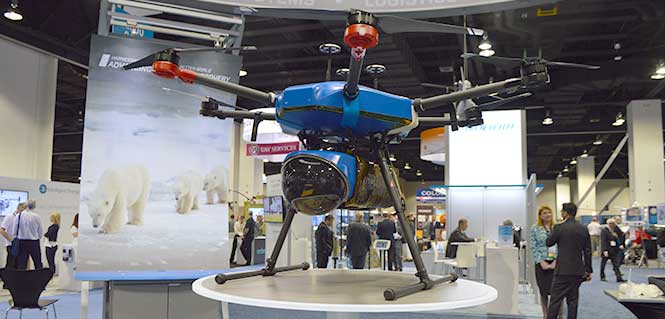
    To carry out the project, the Northrop Grumman team developed a drone that could handle the freezing temperatures. The team then flew to Northern Canada to gather the ice data.

    “We had to take the drone out to the middle of nowhere, basically, and be confident that this could work and collect critical data on a really key, iconic species,” Welch said. “Half the engineering was designing the logistics of getting our team out there, getting every spare part we could think of and making sure that we could survive out there, along with the system.”


    Click on the icon in the top left hand corner to choose the video you’d like to watch.


    During the 10-day mission, the team used its modified DJI M600 hexacopter drone to capture the data, as well as ground equipment to process the data and ensure the drone was operating correctly. According to the company, the hexacopter platform consisted of six rotors, a triple-redundant navigation system, high-voltage battery packs and a custom payload bay to hold a range of integrated sensors. It was also equipped with a ruggedized thermal shell, designed to withstand temperatures as low as minus-20 degrees Fahrenheit.

    “We had to make a few adjustments in the field, as we kind of anticipated,” Welch said. “So we designed the drone to be reconfigurable really easily.”

    The Northrop Grumman team used its modified DJI M600 hexacopter drone to capture the ice data. Photo by Allison Barwacz

    The team conducted several successful sea ice mapping missions and collected an array of habitat data, including 3D sea ice maps and multispectral data, both collected at sub-centimeter resolution, the company said. Northrop Grumman sent the data to zoo scientists, who are still closely working with the company. Northrop Grumman also donated its hexacopter drone to the zoo so that it be used for other conservation projects.

    “We’re keeping in collaboration [with the zoo] to try and figure out what they want to do next from a scientific perspective, and how the data we collected is working out for what their goals were,” Welch said. “We see these innovative projects as a good way to engage our employees and give them the ability to work on projects that are very science-based. We also want to make a positive impact toward STEM (science, technology, engineering and mathematics) and be able to show students how engineering and science fields can be applied in a variety of ways.”

  • Esri UC: Audubon Society Honored for Application of GIS in Conservation

    The National Audubon Society, the century-old conservation group devoted to protecting bird populations and habitats throughout the Americas, accepted the Esri President’s Award for revolutionizing its data collection and management approach with GIS technology. Esri presented the award Monday, July 20, at the 2015 Esri User Conference in San Diego, Calif.

    Esri equipped Audubon with $11.2 million worth of GIS software, which has helped, among other initiatives, to preserve one of the world’s most important bird breeding grounds — 11 million acres in Alaska that attract birds from all seven continents.

    “Esri’s technology improves our conservation results and provides a common enterprise solution that helps glue together our distributed network of state offices, local chapters and international partners,” said Audubon president and CEO David Yarnold. “Esri is a very special company in the technology world, and it has built a truly unique global community of users. We’re humbled and honored to receive Esri’s highest honor.”

    In 2010, Audubon overhauled its organizational alignment based on four North American flyways, the north-south paths traveled by migratory birds each spring and fall. Under this new approach, the society adopted an enterprise GIS using Esri’s ArcGIS platform to build a comprehensive new picture of large-scale conservation projects.

    The organization’s transformation shifted Audubon to an intelligence-centric culture with more than 1,000 network members using the ArcGIS platform on a widespread basis to gain ownership of authoritative data. Adopting an enterprise GIS strategy made it easier for the Audubon network to access and use spatial data about species populations, habitat locations, migration patterns, and more.

    “At Esri, we are extremely passionate about making a difference in the world with geography and helping our customers and partners do amazing things, such as the National Audubon Society,” said Esri president Jack Dangermond. “It has been a fantastic experience supporting Audubon to help people visualize and understand why we need to preserve Earth’s species and ecosystems.”

    Recent projects reflect the opportunity for the nonprofit to tell compelling stories grounded in geography. One example is Audubon’s application of GIS to tell the story of how climate change poses an incredible challenge to the preservation of bird species. Utilizing the ArcGIS platform, the organization created maps that show how up to half of bird species in North America will be disrupted over the next century due to climate change.

    The National Audubon Society’s network includes 22 state offices, 41 nature centers, 23 sanctuaries, and 464 local chapters throughout the United States and numerous partners throughout the Western Hemisphere. The organization awarded Esri’s founders, Jack and Laura Dangermond, with the 2015 Audubon Medal for their accomplishments in technology and conservation innovation, as well as their support for research institutes, schools, and nonprofits.