Tag: constellation

  • China adds to BeiDou as satnav service helps fight coronavirus

    China adds to BeiDou as satnav service helps fight coronavirus

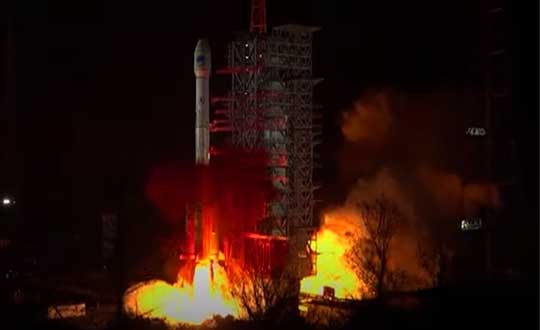
    China successfully launched the penultimate Beidou navigation satellite on March 9. An official Xinhuanet news release has not yet been issued, but CGTN — a television station partially funded by the Chinese government — posted a video of the launch.

    China launched the new satellite from the Xichang Satellite Launch Center in southwest China’s Sichuan Province at 19:55 Monday (Beijing Time), paving the way for its completion and full global coverage in May.

    The Long March 3B/E rocket lifted off from Xichang Satellite Launch Center at 7:55 a.m. ET. The Beidou GEO-2 satellite was sent into a geosynchronous transfer orbit.

    Coronavirus Fight

    China has touted the BeiDou constellation’s role in helping the country fight the novel coronavirus (COVID-19) epidemic with high precision from space.

    “When China was building the two makeshift hospitals — Huoshenshan (Fire God Mountain) and Leishenshan (Thunder God Mountain) in Wuhan, the epicenter of the epidemic — equipment based on the BeiDou Navigation Satellite System (BDS) provided high-precision positioning service and accelerated the construction,” stated a press release from the China Aerospace Science and Technology Corp. (CASC).

    Drones based on the BDS have been utilized to spray disinfectant, according to the press release. Police in Ruichang, east China’s Jiangxi Province, used BDS-based drones to patrol crowded places to prevent intensive contact between people.

    China’s Ministry of Transport sent epidemic prevention and transportation service information to more than 6 million vehicles via the BDS terminals, and provided services for the transportation of emergency materials to the areas most affected by the epidemic.

    China Post Group Co. Ltd. has installed 5,000 BDS terminals on its trunk line vehicles, and used the vehicle positioning information to conduct real-time supervision and allocation, so as to ensure timely delivery of epidemic prevention materials.

    In Wuhan, the BDS-based robots of the e-commerce and logistics company JD.com delivered medical materials to hospital isolation areas with high speed.

    China began to construct its navigation system, named after the Chinese term for the Big Dipper constellation, in the 1990s and started serving the Asia-Pacific Region in 2012.

    Over the past two years, China has successfully sent 28 BDS-3 satellites and two BDS-2 satellites into orbit.

    With the system’s upgraded intelligent operation and maintenance capabilities, the BDS-3 has provided stable and accurate services, boasting a positioning accuracy of better than five meters.

    China plans to launch more BDS satellites in March and May to complete the global network.
  • An overview of the latest PNT satellite launches

    An overview of the latest PNT satellite launches

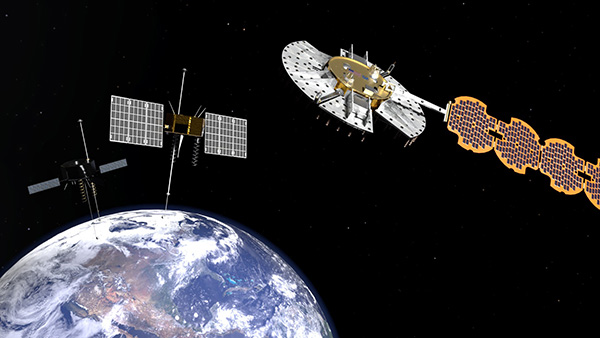
    History of the program: NTS-1, 2 and 3. (Illustration: Lt. Jacob Lutz, AFRL Space Vehicles Directorate)
    Satellites NTS-1, 2 and 3. (Illustration: Lt. Jacob Lutz, AFRL Space Vehicles Directorate)

    Just last month we celebrated the kickoff of the GPS III campaign, reporting on the launch of the first space vehicle of that generation in the closing days of 2018. A new era had begun, heralded by a rocket’s blazing path, bearing aloft a new “lighthouse in the sky serving all humankind.”

    Turn around and­ — whoa! Where did all these other new PNT satellites come from?

    We attempt to chronicle them all in this issue, though I’m not sure we haven’t still missed some.

    For years we’ve been talking about the Iridium constellation, a low-Earth orbit telecommunication network that can also deliver timing services to improve accuracy, and signal acquisition in urban environments. Were it not for the fact that 10 more of its satellites just launched in January, bringing the total of its second-generation NEXT constellation to 75, this would practically qualify as old news.

    But let’s move on to the real new news. NTS-3 is the new kid on the block most closely related to the GPS family. In fact, integrally a part of it. This third Navigation Technology Satellite will go even beyond GPS III —­ whose capabilities, mark you, are not yet online — to investigate new experimental antennas, flexible and secure signals, increased automation and use of commercial ground assets.

    Learn about 72 nanosatellites of the Spire constellation piggybacking on Galileo signals to offer GNSS radio occultation products for the weather community. This may not be exactly direct-to-user PNT, but it’s a derivative.

    Finally, absorb the latest on Hawkeye 360 formation-flying Pathfinders, designed to detect and geolocate radio frequency (RF) signals, and use the data in search-and-rescue as well as commercial maritime operations.

    Don’t stop there! Read about Planet, the breadloaf satellites, current population 300 with more coming, beaming down 1.2 million high-resolution Earthly images per day, useful for agriculture, defense, mapping and GIS, and a few other industries.

    If a group of satellites is a constellation, what do you call a group of constellations? If we are to follow astronomy’s lead, I’ve just learned that the proper technical term is an asterism. However, I think galaxy will be easier to handle.

  • GNSS Constellation Update

    Original Broadcast Date: 10/25/12

    Summary: This month, a new GPS satellite was launched, India launched a new SBAS satellite, and two Galileo satellites are scheduled to launch. Last month, China launched two more BeiDou satellites. There’s a lot of activity of the satellite navigation industry. In the webinar, I will discuss what these new developments mean to the surveying/mapping user, as well as other current events.

    Speaker:
    Eric Gakstatter
    Contributing editor for survey and GIS

  • GLONASS 743 Set Healthy, Constellation Back to Full Strength

    News courtesy of CANSPACE Listserv.

    GLONASS 743, recently moved from orbital slot 2 to orbital slot 8, was set healthy on March 5 at 07:28 Moscow Time according to NAGU 017-130305. Although the NAGU states that Moscow Time is three hours ahead of UTC (and this is the time difference normally used for GLONASS as stipulated in the GLONASS ICD), officially, it is actually four hours and has been since the switch to year-round daylight saving time on 27 March 2011. In this case, the NAGU appears to be in error since GLONASS 743 was actually set healthy at 03:28 UTC and not at 04:28 UTC. This is confirmed by Roscomos monitoring and by the navigation data collected by stations of the International GNSS Service (IGS).

    There are once again 24 healthy GLONASS satellites on orbit.

    For those keeping track of frequency channel changes, GLONASS 743 was switched from frequency channel 6 to channel -6 on 1 March some minutes before 10:45 UTC and back to channel 6 on 2 March, again some minutes before 10:45 UTC as determined from IGS navigation files. Although a NAGU was issued for the first frequency change (stating that it occurred at “1344 MT (UTC+0300)”), no NAGU has been issued to document the second frequency shift although the set-healthy NAGU does give the frequency channel as 6.

    Meanwhile, in other GLONASS news, a single GLONASS-M satellite (Block 47s) is to be launched from the Plesetsk Cosmodrome on April 26 at 05:23:41 UTC according to the NASA Forum blog.

  • GLONASS 743 Maneuvers toward New Position

    News courtesy of CANSPACE Listserv.

    According to tracking data from NORAD/JSpOC, GLONASS 743 experienced a delta-V maneuver on or about February 12 as it approached its new orbital position at Slot 8 in Plane 1.

    Note that GLONASS 743 is not currently in service but will likely rejoin the active constellation once the move is completed, replacing GLONASS 701K in the broadcast almanac.

    Although GLONASS 701K, the test GLONASS K1 satellite, is currently transmitting on frequency channel -5, it continues to be set unhealthy in the almanac.

  • Manufacture of 37 GLONASS Satellites Planned

    News courtesy of CANSPACE listserv:


    The internal newspaper of ISS Reshetnev, Siberian Satellite, has reported on the status of current and future manufacturing of GLONASS satellites (loosely translated):

    “A federal target program, approved by the Russian Government, has provided measures to maintain and develop the GLONASS system. The Reshetnev Company from 2012 to 2020 will manufacture 15 “Glonass-M” satellites and 22 “Glonass-K”. The work in this direction is taking place at ISS at full speed. Now the company is making space apparatus “Glonass-M” No. 50 [likely to be known as 750 once launched] and has signed contracts with related enterprises for the supply of equipment for a few more satellites in this series. [ISS] has already completed the manufacture of satellites “Glonass-M” No. 47, No. 48, No. 49. Routine tests confirmed compliance characteristics of their design and with operational documentation. The space vehicles have been put in the assembly shop for safekeeping. [ISS] has sent a next-generation navigation satellite “Glonass-K” No. 12L to the spaceport. A decision on the launch date of the navigation satellites will be made by Roscosmos after an analysis of the [state of the] GLONASS constellation.”

    Note that there is a reserved launch slot for the GLONASS-K satellite at the Plesetsk Cosmodrome on 14 November.