Tag: contract award

  • Emcore SDI500/505 IMU receives non-ITAR status, company gets defense nods

    Emcore SDI500/505 IMU receives non-ITAR status, company gets defense nods

    The non-ITAR status greatly increases the marketability of the SDI500/SDI505 IMUs to international customers. Plus, Emcore releases new SDI170 IMU and is awarded defense contract.

    Emcore’s dual-use SDI500/SDI505 Revision F inertial measurement units (IMUs) have received a determination that they are not subject to the International Traffic in Arms Regulations (ITAR) administered by the U.S. Department of State. Emcore has likewise determined that its SDN500 inertial navigation system (INS) is not subject to ITAR.

    The determination of non-ITAR status is expected to dramatically increase the size of the market that Emcore can address with its quartz micro-electro-mechanical systems (QMEMs) IMU and INS devices.

    Photo: Emcore
    Photo: Emcore

    Ranked Top in Trade Study. The SDI500/505 IMU was ranked first in overall accuracy, reported Emcore, in a U.S. military-commissioned trade study of 19 IMUs being evaluated as an alternative to the Honeywell HG1700 for various weapons systems.

    The objective of the third-party independent study was to deliver a comprehensive report to the government and make a recommendation supported by clear and compelling technical, financial, and other relevant data collected regarding the most advantageous IMU products and services available in the market today. 19 IMUs of various technologies, complexity, cost, and developmental status, from leading manufacturers, were evaluated in short and long flyout simulations against the HG1700.

    The dual-use non-ITAR SDI500/505 IMUs are designed to achieve the demanding performance levels required in sophisticated systems, including weapons guidance and targeting, commercial and defense fixed-wing aircraft and helicopters, unmanned autonomous vehicles (UAVs), and a wide variety of other high-precision commercial, industrial, marine, defense and space applications. They leverage quartz MEMS technology to deliver angle random walk (ARW) values of 0.02°/√hr with 1°/hr bias stability.

    Defense Contract Award. In March, Emcore was awarded a development contract valued at $1.1 million by a major U.S. prime contractor to design and manufacture a high-end IMU for tactical intelligence and reconnaissance systems. The prototype phase has been successfully completed and as part of the contract in this follow-on phase, Emcore will deliver initial production units that will be used for proof of manufacturing and system level qualification.

    The custom IMU will be based on Emcore’s proprietary closed-loop fiber-optic gyro (FOG) technology that delivers proven CSWaP (cost, size, weight and power) and performance advantages over other FOGs and competing technologies. It is designed to deliver the highest level of performance in Emcore’s tactical IMU product line, exceeding Emcore’s EN-300. Emcore’s FOG IMU technology delivers ten times the bias performance of legacy systems in compact form-, fit- and function-compatible packages.

    New SDI170 IMU. Emcore also launched a replacement IMU. The new SDI170 quartz MEMS tactical-grade IMU is designed as a form-, fit- and function-compatible replacement for the HG1700-AG58 ring-laser gyroscope (RLG) IMU, but with superior overall performance, versatility and a significantly higher mean time between failures (MTBF) rating over ruggedized environments.

    The SDI170 IMU is suitable for continuous-use applications with no wear-out components and delivers highly linear accelerometer performance and longer life compared to the HG1700 IMU. It is not ITAR controlled and has completed extensive internal and external customer testing to confirm compatibility to replace legacy products.

    The unit is designed for a wide range of high-precision, integrated commercial and defense applications including aircraft Attitude Heading Reference Systems (AHRS), GPS-aided navigation, ground surveying, mobile mapping, ROVs, autonomous vehicles, tactical weapons, and stabilization platforms.

    Non-ITAR Determination. As a result of this Commodity Jurisdiction (CJ) determination concluded by the U.S. Department of State, EMCORE’s SDI500/SDI505 Revision F commercial off-the-shelf (COTS) offerings were confirmed to be subject to the Export Administration Regulations (EAR) administered by the Department of Commerce (DOC). EAR classification typically results in fewer export-related restrictions and requirements. For this reason, this CJ determination for the SDI500/SDI505 will greatly increase the marketability of these IMUs to international customers.

    The SDN500 is Emcore’s most advanced QMEMS INS/GPS tactical-grade system, combining the latest generation quartz gyros and accelerometers from the SDI500/SDI505, with high-speed signal processing and a 48-channel coarse/acquisition code GPS receiver into a powerful, tightly coupled guidance and navigation system.

    “We would like to thank the U.S. Department of State for its evaluation of our commodity jurisdiction request and conclusion that our dual-use SDI500/SDI505 IMUs are not subject to ITAR,” said David Hoyh, Emcore’s director of sales and marketing for navigation products. “The determination of EAR status under the DOC enables more customers worldwide to benefit from these important, high-precision Emcore products.”
  • SpaceX wins second US Air Force contract to launch GPS III

    SpaceX wins second US Air Force contract to launch GPS III

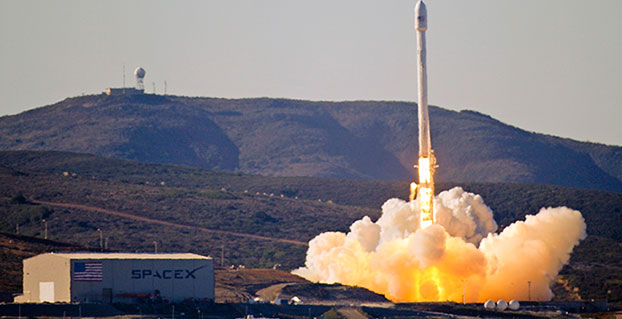
    A SpaceX Falcon 9 stands ready for launch from Cape Canaveral Air Force Station, Fla. The Air Force awarded a contract for GPS III Launch Services to SpaceX.
    A SpaceX Falcon 9 stands ready for launch from Cape Canaveral Air Force Station, Fla. The Air Force awarded a second contract for GPS III Launch Services to SpaceX.

    SpaceX has won a second contract from the U.S. Air Force for launch services to deliver a GPS III satellite to its intended orbit.

    SpaceX was awarded the $96,500,490 firm-fixed-price contract over the United Launch Alliance. ULA — a joint venture of Lockheed Martin Space Systems and Boeing Defense, Space & Security — did not compete for the first GPS III launch contract. That contract, worth $82.7 million, is expected to orbit a GPS satellite aboard a Falcon 9 rocket in May 2018.

    According to the contract announcement, SpaceX will provide launch vehicle production, mission integration, launch operations, spaceflight worthiness and mission unique activities for a GPS III mission. The contract is being overseen by the Air Force’s Space and Missile Systems Center (SMC), Los Angeles Air Force Base, California.

    Work will be performed at Hawthorne, California; Cape Canaveral Air Force Station, Florida; and McGregor, Texas. It is expected to be complete by April 30, 2019.

    “The competitive award of the GPS III Launch Services contract to SpaceX directly supports SMC’s mission of delivering resilient and affordable space capabilities to our nation,” said Lt. Gen. Samuel Greaves, leader of SMC.

  • SpaceX awarded GPS III satellite launch contract

    SpaceX awarded GPS III satellite launch contract

    A SpaceX Falcon 9 stands ready for launch from Cape Canaveral Air Force Station, Fla. The Air Force awarded a contract for GPS III Launch Services to SpaceX.
    A SpaceX Falcon 9 stands ready for launch from Cape Canaveral Air Force Station, Fla. The Air Force awarded a contract for GPS III Launch Services to SpaceX.

    The U.S. Air Force has awarded SpaceX the first competitively sourced National Security Space (NSS) launch services contract in more than a decade.

    Space Exploration Technologies Corporation (SpaceX) was awarded a contract for GPS III Launch Services. This is a firm-fixed price, standalone contract with a total value of $82,700,000.

    SpaceX will provide the government with a total launch solution for the GPS-III satellite, which includes launch vehicle production, mission integration and launch operations and spaceflight certification. The launch will be the second GPS III launch and is scheduled to launch from Cape Canaveral Air Force Station, Florida, in May 2018.

    “This GPS III Launch Services contract award achieves a balance between mission success, meeting operational needs, lowering launch costs, and reintroducing competition for National Security Space missions,” said Lt. Gen. Samuel Greaves, Air Force Program Executive Officer for Space and SMC commander.

    Another launch service provider, United Launch Alliance (ULA), chose not to compete for the contract.

    GPS III is the next generation of GPS satellites that will introduce new capabilities to meet the higher demands of both military and civilian users. The satellite is expected to provide improved anti-jamming capabilities as well as improved accuracy for precision navigation and timing. It will incorporate the common L1C signal, which is compatible with the European Space Agency’s Galileo global navigation satellite system and compliment current services with the addition of new civil and military signals.

    This is the first of nine competitive launch services planned in the FY 2016 President’s Budget Request under the current Phase 1A procurement strategy, which covers awards with FY 2015-2018 funding. The next solicitation for launch services will be for a second GPS III satellite. This award marks a milestone in the Air Force’s ongoing efforts to reintroduce a competitive procurement environment into the Evolved Expendable Launch Vehicle (EELV) program as directed by Frank Kendall, Under Secretary of Defense for Acquisition, Technology and Logistics.

    The Phase 1A procurement strategy reintroduces competition for national security space launch services. Under the Phase 1 strategy, United Launch Alliance (ULA) was the only certified launch provider. In 2013, ULA was awarded a sole-source contract for launch services as part of an Air Force “block buy” of 36 rocket cores that resulted in significant savings for the government through FY 2017.

    In May 2015, Space Exploration Technologies (SpaceX) was certified for EELV launches resulting in two launch service providers that are capable to design, produce, qualify, and deliver a launch capability and provide the mission assurance support required to deliver national security space satellites to orbit. The certified baseline configuration of SpaceX’s Falcon 9 Launch System to Falcon 9 Upgrade was recently updated for use in National Security Space (NSS) missions.

    The Air Force Space Command’s Space and Missile Systems Center, located at the Los Angeles Air Force Base, Calif., is the U.S. Air Force’s center of excellence for acquiring and developing military space systems. Its portfolio includes the Global Positioning System, military satellite communications, defense meteorological satellites, space launch and range systems, satellite control networks, space based infrared systems and space situational awareness capabilities.

  • Air Force awards contract to support GPS modernization

    Northrop Grumman Corporation has been awarded an order to support embedded GPS/inertial navigation system (INS) pre-Phase 1 modernization efforts.

    The Military GPS User Equipment (MGUE) program is developing M-code-capable GPS receivers, which are mandated by Congress after fiscal year 2017 and will help to ensure the secure transmission of accurate military signals.

    Under the cost-plus-fixed-fee order valued at $4.8 million from the Joint Service Systems Management Office, Northrop Grumman will evaluate new GPS receivers’ modes of performance, including M-code and Selective Availability Anti-spoofing Module (SAASM).

    Additionally, the company will perform trade studies, assess the state of development of MGUE for upcoming applications, and contribute to architecture development for next-generation GPS/inertial navigation systems.

    “We are honored to help shape the next generation of navigation systems that will modernize the GPS infrastructure and keep our warfighters safer,” said Bob Mehltretter, vice president, navigation and positioning systems business unit, Northrop Grumman Mission Systems. “We are committed to using our navigation systems expertise to develop a solution that offers dependable and accurate positioning, navigation and timing information.”

    The updated GPS/inertial navigation system will also comply with the Federal Aviation Administration’s NextGen air traffic control requirements that aircraft flying at higher altitudes be equipped with Automatic Dependence Surveillance-Broadcast (ADS-B) Out by January 2020.

    ADS-B Out transmits information about an aircraft’s altitude, speed and location to ground stations and to other equipped aircraft in the vicinity.

    The modernized system is expected to be available for platform integration starting in 2018.

  • Rockwell wins DARPA Contract for GPS Backup Tech

    Rockwell Collins has been selected by the Defense Advanced Research Projects Agency (DARPA) to develop technologies that could serve as a backup to GPS. The research, being conducted as part of DARPA’s Spatial, Temporal and Orientation Information in Contested Environments (STOIC) program, aims to reduce warfighter dependence on GPS for modern military operations.

    Under the terms of the agreement, Rockwell Collins will develop innovative architectures and techniques to enable communication systems that will support time transfer and positioning between moving platforms independent of GPS, with no impact on primary communications functionality.

    “STOIC technology could augment GPS, or it may act as a substitute for GPS in contested environments where GPS is degraded or denied,” said John Borghese, vice president of the Rockwell Collins Advanced Technology Center. “The time-transfer and ranging capabilities we are developing seek to enable distributed platforms to cooperatively locate targets, employ jamming in a surgical fashion, and serve as a backup to GPS for relative navigation.”

    Borghese added that the goal of the STOIC program is to develop positioning, navigation, and timing (PNT) systems that provide GPS-independent PNT, achieving timing that far surpasses GPS levels of performance. The program is comprised of three primary elements that, when integrated, have the potential to provide global PNT independent of GPS, including long-range robust reference signals, ultra-stable tactical clocks, and multifunctional systems that provide PNT information between cooperative users in contested environments.

    For this third technical element, Rockwell Collins is tasked with developing multifunction communication system solutions that yield DARPA STOIC objective picosecond-accurate time transfer and enable GPS-levels of relative positioning accuracy in contested environments.

    “Future applications of STOIC technology could include a variety of precision relative navigation operations, such as autonomous aerial refueling and cooperative navigation and collision avoidance within unmanned aerial vehicle swarms,” said Borghese. “It also could support precise time transfer for networking operations in contested environments.”

  • U.S. Air Force Awards Contract to Lockheed Martin for GPS III Launch, Checkout

    The U.S. Air Force has awarded Lockheed Martin a $21.5 million contract to provide a Launch and Checkout Capability (LCC) to command and control all GPS III satellites from launch through early on-orbit testing.

    The LCC, which will be integrated into the Raytheon-developed Next Generation Operational Control System (OCX), will ensure launch availability for the first GPS III satellite in 2014. The LCC includes trained satellite operators and engineering solutions in partnership with OCX to support launch, early orbit operations and checkout of all GPS III satellites before the spacecraft are turned over to Air Force Space Command for operations.

    “Achieving initial launch capability in 2014 is critical to introducing new GPS capabilities on time and will  enable the GPS III program to continue its production pace, maximize efficiencies and reduce long term costs for the GPS enterprise as a whole,” said Colonel Bernard Gruber, director of the U.S. Air Force’s Global Positioning Systems Directorate. “The Launch and Checkout Capability will ensure we can launch in 2014, effectively closing the time gap between GPS III and the Next Generation Operational Control System.”

    The GPS III program will replace aging GPS satellites while improving capability to meet the evolving needs of military, commercial and civilian users worldwide. The satellites will deliver better accuracy and improved anti-jamming power while enhancing the spacecraft’s design life and adding a new civil signal designed to be interoperable with international global navigation satellite systems, according to Lockheed Martin.

    The GPS III team is led by the Global Positioning Systems Directorate at the U.S. Air Force Space and Missile Systems Center. Lockheed Martin is the GPS III prime contractor with teammates ITT Exelis, General Dynamics, Infinity Systems Engineering, Honeywell, ATK and other subcontractors. Air Force Space Command’s 2nd Space Operations Squadron (2SOPS), based at Schriever Air Force Base, Colo., manages and operates the GPS constellation for both civil and military users.

  • Lockheed Gets the Nod for GPS III

    The U.S. Air Force finally made it official and confirmed the rumor mill: Lockheed Martin has beat out rival satellite contractor Boeing for the contract to build the first eight GPS III satellites.

    Secretary of the Air Force Michael Wynne and the Global Positioning Systems Wing, Space and Missile Systems Center, Los Angeles Air Force Base, Calif. made the announcement regarding the GPS III development and production contract late Thursday, May 15. In retrospect it was not exactly a well-kept secret; rumors had swirled for at least a month if not longer that Lockheed would get the nod, and two days earlier on May 13 the Wall Street Journal reported as fact that Lockheed had won, citing unnamed sources.

    Under the $1.4 billion contract, the team of Lockheed Martin Space Systems Co., ITT Corp., and General Dynamics will produce eight GPS IIIA satellites, with the first launch projected for 2014, Lockheed said. The development contract will result in approximately 500 new jobs for Lockheed Martin.

    Eight GPS IIIB and 16 GPS IIIC satellites are planned for later increments, with each increment including additional capabilities based on technical maturity. Taken as a whole, all of the GPS III contracts could be worth more than approximately $3.5 billion. When fully deployed, the GPS III constellation will feature a cross-linked command and control architecture, allowing the entire GPS constellation to be updated simultaneously from a single ground station, according to Lockheed. Additionally, a new spot beam capability for enhanced military (M-Code) coverage and increased resistance to hostile jamming, as well as new civilian signals, will be incorporated.

    Lockheed Martin of course isn’t new to the GPS program; it designed and built 21 GPS IIR satellites for the Air Force and subsequently modernized eight of those spacecraft, designated GPS IIR-M. For GPS III, Lockheed Martin’s program management and spacecraft development effort will occur at its facilities in Newtown, Penn., with final assembly, integration and test located in Denver, according to the company. Its Sunnyvale, Calif., operations will provide various spacecraft components and a launch support team will be based at Cape Canaveral, Fla. Lockheed Martin’s flight-proven A2100 bus will serve as the GPS III spacecraft platform.

    ITT, based in Clifton, N.J. will provide the navigation payload, and General Dynamics Advanced Information Systems, Gilbert, Ariz., will provide the Network Communications Element (NCE) which includes the UHF Crosslink and Tracking Telemetry & Command (TT&C) subsystems.

  • GPS Contract Awarded to SAIC for Systems Engineering

    The Air Force Space and Missiles Systems Center’s GPS Wing has announced a new contract to the Science Applications International Corporation (SAIC) team for systems engineering and integration (SE&I). Contract value is $217 million if all options and maximum award fee are exercised over the five-year contract period of performance.

    “This is an important shift in how the Air Force manages space acquisition programs,” said Lt. Gen. Michael Hamel, SMC commander. The announcement cited increased modernization activity in virtually every element of  the GPS enterprise as a driving force for the change.

    The Air Force continues to serve as the responsible program authority “systems integrator,” with full responsibility, authority and accountability for the system-wide engineering and integration of the entire GPS enterprise — space, ground, and user equipment. The new SE&I contract will have specific deliverable products using documented work plans and product-oriented focus which will ensure engineering process discipline, interface, and configuration control as well as rigor and consistency across the entire GPS organization, according to the announcement.

    The SAIC team for SE&I includes: LinQuest, Booz Allen Hamilton, Harris, General Dynamics, Raytheon, Loral Space Systems, Ducom Inc, Epsilon Systems Solutions, Inc, Integrity Applications Inc, MacAulay Brown Inc, MCR Federal Inc, Munoz Engineering Inc (MEI) Technologies, Overlook Systems Technologies Inc, Saalex Solutions Inc, and Teledyne Brown Engineering.

  • L5 Contract Awarded to Lockheed Martin

    The U.S. Air Force has awarded Lockheed Martin a $6 million contract to develop and demonstrate a payload that will temporarily transmit a third civil signal, on the L5 frequency at 1176MHz, from a  Block IIR-M satellite.

    Previous plans called for the L5 civil signal, aimed principally at safety requirements in civil aviation, to appear on the Block IIF satellites. Early speculation posits that the Air Force may want to conduct some signal testing before the IIFs are launched, or secure the frequency according to ITU requirements, as GIOVE-A did for Galileo.

    Lockheed Martin and its navigation payload supplier ITT will provide an in-orbit demonstration of the new civil signal.