Tag: data

  • Seen & Heard: GM sued over data collection; archaeologists uncover hidden empire and more

    Seen & Heard: GM sued over data collection; archaeologists uncover hidden empire and more

    “Seen & Heard” is a monthly feature of GPS World magazine, traveling the world to capture interesting and unusual news stories involving the GNSS/PNT industry.


    Texas Sues GM for Allegedly Selling Drivers’ Data

    Photo: baona / iStock / Getty Images Plus / Getty Images
    Photo: baona / iStock / Getty Images Plus / Getty Images

    The Texas Attorney General’s Office has filed a lawsuit against General Motors (GM), alleging that the company unlawfully collected and sold driving data from more than 1.5 million Texas drivers. The lawsuit claims that GM gathered detailed information from vehicles manufactured since 2015. Additionally, the lawsuit alleges that GM deceived customers by compelling them to enroll in data collection services during the vehicle “onboarding” process, without fully disclosing how their information would be used. The collected data was reportedly used by third-party companies to generate “driving scores” which were then sold to insurance providers.

    3D Scans Reveal Medieval Secrets

    Photo: Stichting Grote Kerk Naarden
    Photo: Stichting Grote Kerk Naarden

    The Grote Kerk in Naarden, Netherlands, known as the “Sistine Chapel of the North,” is undergoing a 3D scanning project to uncover the secrets of its medieval ceiling murals. A team of researchers from various Dutch universities are collaborating to create a detailed digital 3D model of the church’s barrel vault, covering 700 square meters of painted planks and beams. The project aims to shed light on long-standing mysteries surrounding the artwork’s origins, including the identities of the artists and the precise timeframe of their creation. Researchers will use advanced 3D scanning technology to produce high-resolution digital replicas of the murals, allowing researchers to examine the artwork in extraordinary detail.

    Archaeologists Unearth Hidden Empire
    Photo: University of Cádiz
    Photo: University of Cádiz

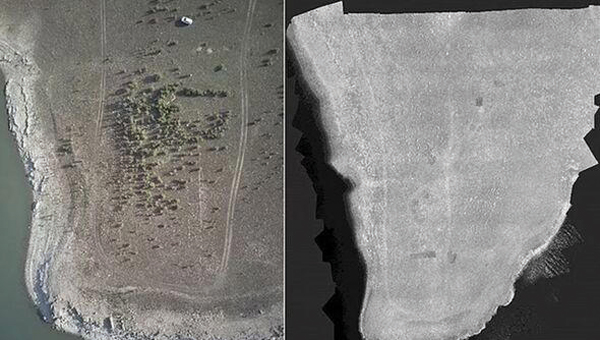
    Archaeologists from the University of Cádiz in Spain have discovered 57 Roman Empire-era sites in the Sierra de Cádiz regions, revealed what researchers believe to be an undiscovered part of the Roman empire. The team used multispectral cameras and lidar to detect these hidden sites. The team has begun on-site excavations, including work at the Roman villa of El Canuelo in Bornos, and plans to continue its research to gain a more comprehensive view of Roman settlement in the region.

    Mapping Secrets of the Seafloor
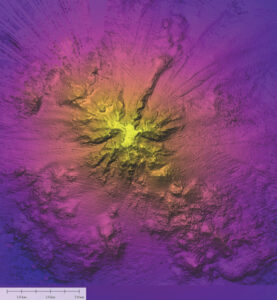
    Photo: SuBastian/Schmidt Ocean Institute via CNN
    Photo: SuBastian/Schmidt Ocean Institute via CNN

    Oceanographers from the Schmidt Ocean Institute used advanced sonar technology to map a massive underwater mountain in Nazca Ridge, 900 miles off the coast of Chile. The team employed a hull-mounted sonar system on their research vessel, R/V Falkor, to create detailed maps of the seafloor. In addition to sonar mapping, the team used an underwater robot to explore the mountain and surrounding areas. This robotic technology allowed them to document rare marine life, including the ghostly white Casper octopus and unusual siphonophores nicknamed “flying spaghetti monsters”.

  • Here there be dragons: GIS explores the unknown

    Here there be dragons. That phrase (or a variation of it) was used by early mapmakers to designate the unknown — and alert sailors to the danger of traveling into uncharted waters.

    I’ve always admired explorers who dared to push the boundaries of the known world. We’ve moved from the Age of Exploration to the Age of Information, but exploration continues on frontiers big and small.

    Today, of course, most people think of the world as having been mapped. They can simply call up Google maps on their smartphone and see not only the world, but their town, their street and their house — in representational cartography (traditional map), satellite imagery, or even street-view imagery.

    Professionals in geographic information systems (GIS) know better. The world is still a mystery in uncounted areas. For one thing, it’s not static: Volcanoes form new land masses, storms change coastlines, the sea-level is rising. For another, there’s more to exploration than a basic map.

    That’s where the GIS professional takes center stage, assessing an area beyond what is already known, using a variety of tools to collect and analyze data. As Esri defines it, a GIS lets us “visualize, question, analyze and interpret data to understand relationships, patterns and trends. GIS benefits organizations of all sizes and in almost every industry.” A software-based profession, GIS experts use GPS, GNSS and inertial to gather data, which is where this magazine comes in.

    At GPS World, we share GIS developments in our Mapping Market Watch, Mapping Launchpad and at geospatial-solutions.com.

  • Respect the facts: March for Science

    Respect the facts: March for Science

    Photo: Petr Kratochvil
    Photo: Petr Kratochvil

    In life, few things are certain. In family, love and friendship, fewer. Add more people — workplace, groups, associations, government, society, nations, war — and the complications multiply, the certainties become more scarce.

    Some things, however, remain fixed, and true. We call them facts. They are not subject to denial or claims of fakery. They can sometimes be distorted, or their interpretation disputed, but at the end of the day they remain what they were at the beginning. Facts. True.

    They do not require a majority to believe in them, nor even a powerful minority. They exist outside belief, heedless of the powers of persuasion, cajolery, hucksterism.

    The facts do not always, to their detriment, speak for themselves. Reason does not always prevail. But the facts continue to exist, ruling the operations of the universe.

    It has been said that journalism’s duty is to print the facts and raise hell (Chicago Times, 1861). I submit to you that it is a scientist’s duty — and an engineer is a scientist — to live and practice by the facts, to preserve the facts if necessary. To raise hell? That may be a matter of taste or personal style. But to see that the facts are known, shared, publicly available — that can be undertaken without uncomfortable or unpleasant hell-raising.

    Guerrilla archiving and data rescues have mushroomed across the U.S., in response to fear that the U.S. government will remove facts it dislikes from its own websites. All-day hackathons are organized by volunteers; the events focus on downloading federal science data sets, particularly those related to climate change, from government websites and uploading them to a new site, datarefuge.org, an alternative source for data. They’re also feeding tens of thousands of government web pages into the Internet Archive, a nonprofit digital library with the mission of “universal access to all knowledge.” And of course someone has devised a custom-built app specifically for this purpose.

    Climate-change data has a geospatial aspect, and much of it was collected with GPS equipment. Positioning coordinates lie at the heart of so much key information. So an attack on carefully assembled, scientifically overseen data can be interpreted as an attack on the validity of global positioning technology. Whether or not we take it personally, we should be wary of any attempt to deny or abolish any facts, anywhere.

    We’ve seen this before, in other forms. The LightSquared episode in 2011–12 produced blatant denials of the physics of radio-frequency waveforms, for personal and institutional profit. We don’t yet know if this is happening again, whether government data has been erased or simply moved elsewhere.

    Whether or wherever they appear or disappear, the facts continue to exist, and perhaps they deserve more respect than they’ve been getting.

    MarchforScience.com, April 22.

  • Esri Releases Free Business Analyst Online Mobile App for Android Smartphones

    Esri announced the release of a free Business Analyst Android app for retail and commercial real estate professionals, allowing them to access demographic data anywhere with the Esri Business Analyst Online (BAO) application. The application is designed for anyone who needs access to population and consumer marketing data on the go.

    According to the announcement, the BAO application enables users to access up-to-date facts on demographics, lifestyle, and consumer spending for any region in the United States. With it, users can compare any address with another or with the county, state, or United States and analyze an area within one mile of a prospective location. Unlike traditional market research, users can quickly compare and contrast regional information with the regional average and show that data to clients in the field. Reports created in the mobile BAO application can also be e-mailed to share with a broader audience. More extensive data, capabilities, and reports are available through the application with a subscription to the BAO web application.

    The BAO application is free and can be downloaded directly from Android Marketplace.

    To learn more, visit esri.com/BAOapp.