Tag: defense department

  • SandboxAQ, Defense Innovation Unit advance quantum navigation for GPS-denied operations

    SandboxAQ, Defense Innovation Unit advance quantum navigation for GPS-denied operations

    SandboxAQ has entered an agreement with the Defense Department’s Defense Innovation Unit (DIU) to join its Transition of Quantum Sensing (TQS) program, focusing on developing and testing advanced magnetic anomaly navigation technologies for the U.S. military’s autonomous systems.

    The program, managed under DIU’s Emerging Technologies portfolio, accelerates adoption of commercial quantum sensing technologies to ensure positioning, navigation and timing resilience in environments where Global Navigation Satellite Systems signals are unreliable or denied. SandboxAQ will deploy its dual-use AQNav software to enable robust navigation capabilities without reliance on external signals, demonstrating the technology’s utility in real-world scenarios and generating a comprehensive dataset to benchmark results against relevant Defense Department use cases.

    “AQNav represents a vital, non-GPS-reliant path for PNT and has proven its readiness for expanded military demonstrations and evaluation across mission-critical platforms,” said Luca Ferrara, general manager of AQNav at SandboxAQ. “We’re demonstrating AQNav’s performance capabilities across DIU-relevant use cases to empower the DOD to solve complex PNT challenges with best-in-class technologies at its disposal.”

    About the Transition of Quantum Sensing Program

    The program is a strategic effort to accelerate adoption of advanced quantum sensors from the laboratory into real-world military applications. Its primary goal is to address critical joint force needs, particularly for resilient positioning, navigation and timing in GPS-denied environments and for next-generation anomaly detection.

    More on Magnetic Navigation

    DIU is addressing the DOD’s urgent need for jam-resistant navigation for aerial platforms operating in challenging environments. The effort focuses on prototyping magnetic navigation systems, which use advanced quantum magnetic sensors to navigate using Earth’s natural geomagnetic variations. The technique provides a resilient source of position data even in GPS-denied scenarios, such as over-ocean operations, reduced visibility and electronic jamming.


  • Editorial Advisory Board Q&A: The fate of the SAASM P(Y) code

    Editorial Advisory Board Q&A: The fate of the SAASM P(Y) code

    Photo: Editorial Advisory Board

    The U.S. military is transitioning to M-code. When the transition is complete, what will become of the SAASM P(Y) code? What should be done with it? Should the U.S. government use it as a public authenticated service?


    Jules McNeff
    Jules McNeff

    “In my opinion (not speaking on behalf of the Defense Department), eventual use of the P(Y) code as a public authenticated service is not feasible based on both time and accessibility. Even with the transition to M-code, the legacy P(Y) code will continue to be used by the U.S. military and by U.S. allies and partner nations as long as there are military requirements for it. More importantly, public access to the encrypted P(Y) code would require general distribution of classified cryptographic keys and associated hardware/software by the DOD. That will not happen, even if the P(Y) code use is discontinued.”
    Jules McNeff
    Overlook Systems Technologies


    Bernard Gruber
    Bernard Gruber

    “Broadly speaking, GPS user equipment security architectures transition every 10 years (such as PPS-SM/AOCs to SAASM to Modernized CGM/MSI.) It can be argued that implementation of these security measures generally takes 10 years or longer to implement. SAASM P(Y) receivers will be around for a long time, implementation can be expensive, backwards compatibility is critical. Personally, I would like to see SAASM architectures evolve to support critical services within other U.S. government departments first, and then determine a path that supports a public service as threats, unfortunately, move forward.”
    Bernard Gruber
    Northrop Grumman


    Photo: Orolia
    John Fischer

    “Why not? Authentication protects against spoofing. I don’t know all the obstacles involved, but even if an internet connection is required to overcome the one-way limitation of GPS, that isn’t a problem for most applications. Our credit card transactions are secured this way, why not our PNT information? Decades ago, the U.S. Air Force gave the world a gift with the open GPS signal; they could do it again with a secure signal. The world would be a better place.”
    John Fischer
    Orolia


    F. Michael Swiek
    F. Michael Swiek

    “It’s premature to forecast when military operations will transition from P(Y) code even after M-code operations achieve Initial and Final Operating Capability (IOC and FOC). SAASM P(Y) code will continue to support military operations for an extended period since all MGUE receivers (both increments 1 and 2) are YMCA capable, meaning they support P(Y) code, M-code and C/A code operations. As a military-encrypted signal with military utility, military leaders must carefully weigh any potential P(Y) code transition and its impact on military operations.”
    Michael Swiek
    GPS Alliance


    Ellen Hall
    Ellen Hall

    “If P(Y) code is offered as a new service to the public, it will have to be maintained. This carries a great cost. This is a legacy product that had a specific military need, which has been replaced and improved upon by M-code. In today’s uncertain times, we need to be wise with our tax dollars. The cost to continue both SAASM and M-code is greater than the benefit to the public, in my opinion.”
    Ellen Hall
    Spirent Federal Systems


    Feature photo: U.S. Marine Corps/Capt. Joshua Hays

  • DroneShield releases body-worn drone detector

    DroneShield releases body-worn drone detector

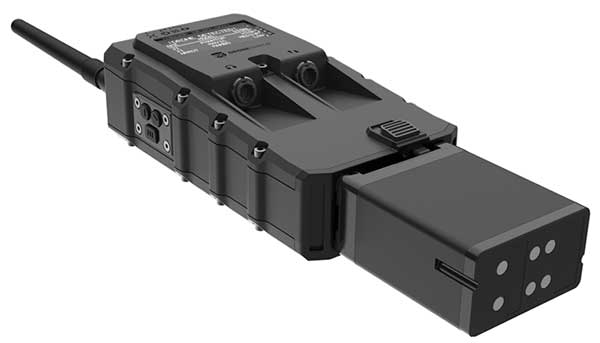
    RfPatrol. (Photo: DroneShield)
    RfPatrol. (Photo: DroneShield)

    DroneShield Ltd. has released a body-worn drone detection product, RfPatrol. Weighing under 1 kilogram, the mobile unit is expected to be of significant interest to a range of DroneShield’s customer base globally, across military, law enforcement, security and VIP markets.

    DroneShield made the announcement at AUVSI Exponential 2019, being held this week in Chicago.

    RfPatrol is a passive (non-emitting) product, which substantially broadens the range of customers to whom the product is lawfully available. It was developed in response to customer interest.

    Already, a small quantity of the RfPatrol units has been ordered by a western country’s defense department, for evaluation with a potential larger order in the future.

    “We are excited to launch RfPatrol,” said DroneShield CEO Oleg Vornik. “Due to its miniaturized/body-worn nature, substantially larger customer universe due to its non-emitting nature, and a relatively lower price point compared to fixed-site products, we expect it to have substantial appeal. In addition to being able to be used as a stand-alone, it is a perfect companion to our DroneGun product.”