Tag: design and test

  • D-COAX offers reconfigurable probe station for chip testing


    D-COAX Inc. has introduced a reconfigurable probe station (Model W4.0 x L6.5) for design engineers and technicians. It’s used to test a chip or small circuit board for the project that cannot wait for local lab probe station availability. The probe station has a small footprint (X = 22 in, Y = 9 in, Z = 8 inch) and can be used at the desk or a lab. It is transportable at 9 pounds.

    The probe station is fully manual with the following features:

    • 4.0 inch x 6.5 inch test plate with vacuum holes
    • wide probe holder plates on each positioner with multiple holes for probe mounting
    • both positioners can slide back and forth in the X and Y directions and can be moved toward the DUT at the angle
    • the height positioning is accomplished via digital micrometers
    • each positioner can be locked independently.
    • Magnetic plates attach to the normal probe mounting holes to allow additional magnetic XYZ positioners with fine adjustment
    • probe arms are adjustable in the X, Y, Z, and theta.

    The probe station is compatible with all standard wafer probes and many DC needle set-ups. See a video at the company’s website. All D-COAX products are made in the USA.

    For more information, e-mail [email protected].

  • Spirent Issues Ebook on Testing Drones, UAVs

    Photo: Spirent

    Spirent has issued a free new 28-page ebook designed to provide An Introduction to Testing Navigation and Positioning Performance in Drones, UAS and UAVs.

    According to Spirent, “The use of unmanned aerial vehicles (UAVs) is starting to take off in commercial and military sectors. The potential applications of UAVs are many – including survey, mapping, media reporting, delivery, reconnaissance, conservation and search & rescue. What’s more, in some cases the cost of using UAVs has been found to be up to 98.8% cheaper than manned aircraft.

    “But it is still early days, and for designers and developers of UAVs, there are many challenges in bringing viable models to market and putting them to work.”

    The ebook looks at those challenges and sets out the main positioning and navigation considerations that UAV test teams should incorporate into their test regime, Spirent said. It covers:

    • GNSS/GPS performance considerations — how to evaluate positioning capabilities of UAVs
    • UAV design considerations, including where GNSS receivers should be placed, the type of antenna needed and more
    • Which environmental/external factors need to be considered, such as wind, temperature and multipath effects
    • Compliance considerations.

    The ebook can be ordered through Spirent.

  • Rohde & Schwarz Offers Fast Production Testing for GNSS Receivers

    Rohde & Schwarz Offers Fast Production Testing for GNSS Receivers

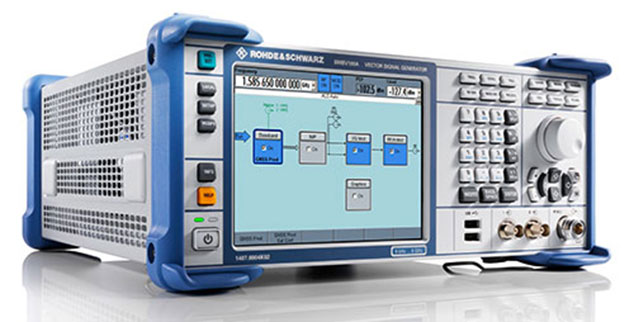
    Rohde & Schwarz designed its GNSS simulator for the R&S SMBV100A with a focus on production testing of GNSS receivers.
    Rohde & Schwarz designed its GNSS simulator for the R&S SMBV100A with a focus on production testing of GNSS receivers.

    Rohde & Schwarz now offers a new, speed-optimized production tester — the R&S SMBV100A vector signal generator equipped with the R&S SMBV-P101 package.

    During production testing of modules and receivers for satellite-based communications, the basic GNSS signal reception and the connection between the antenna and GNSS chipset need to be checked. The GNSS production tester simulates separate satellites for the GPS, GLONASS, BeiDou and Galileo navigation standards in the L1/E1 band specifically for these production tests.

    The four satellite constellations can be activated individually, each with a high dynamic range of 34 dB. Level changes can be made on the fly without interrupting the signal, enabling users to simultaneously perform independent sensitivity tests for each navigation system. The 1 pps or 10 pps GNSS marker allows exact time synchronization between the tester and the DUT. Pure, level-stable CW signals can also be generated to calibrate the test setup or to simulate interferers.

    The R&S SMBV-P101 option additionally offers test functions for efficient characterization of GNSS chipsets, Rohde & Schwarz said. As a result, a receiver’s ability to handle high-movement dynamics can be verified quickly and cost-effectively. To do this, users can access both predefined and user-defined Doppler profiles, from which the R&S SMBV100A automatically generates the appropriate satellite signal.

    The R&S SMBV-P101 GNSS production tester package for the R&S SMBV100A is now available from Rohde & Schwarz.