Tag: developer

  • STMicroelectronics GNSS module targets mass-market navigation

    STMicroelectronics GNSS module targets mass-market navigation

    Image: STMicroelectronics
    Image: STMicroelectronics

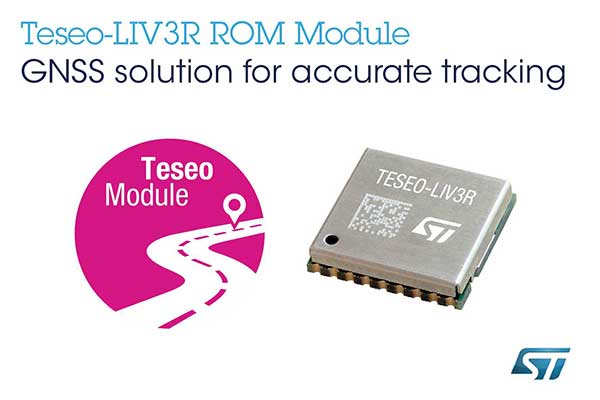
    STMicroelectronics has grown its GNSS product offering with the Teseo-LIV3R ROM-based module. The module provides ST’s full GNSS algorithm capability for cost-conscious tracking and navigation devices.

    ST’s new GNSS module provides odometer functionality with three trip counters and reached-distance alert, along with geofencing capabilities with up to eight configurable circles and crossing-circles alarm. Support for real-time assisted GNSS with free server access ensures uninterrupted positioning data for dependable navigation.

    Simultaneous tracking of GPS, GLONASS, BeiDou and QZSS constellations, with satellite-based augmentation system (S-BAS) and Radio Technical Commission for Maritime Services (RTCM) V3.1 differential positioning ensures excellent accuracy to within 1.5 meters (50% circular error probability, CEP).

    Tracking sensitivity of -163 dBm and time-to-first-fix faster than one second ensure high performance for demanding applications. The module is easy to use and responds to proprietary National Marine Electronics Association (NMEA) commands.

    With scalable power consumption according to accuracy, average current, and frequency of fixes, a sub-15µA standby mode with RTC backup, and support for multiple low-power modes, Teseo-LIV3R is an ideal choice for battery-sensitive applications. The low-power modes include continuous-fix with adaptive and power-saving cycled modes, periodic-fix with GPS only, and fix-on-demand with the device in permanent standby.

    To simplify and accelerate new-product development, the module is FCC certified and is supported by the STM32 Open Development Environment. STM32 applications for advanced geolocation, smart tracking, and server-assisted GNSS are available, while the EVB-LIV3x evaluation board and X-NUCLEO-GNSS1A1 expansion board provide a head-start with hardware. The Teseo Suite PC tool helps easily configure settings and fine-tune performance. Developers can also join the ST GNSS community to share information and increase their understanding of the field.

    The Teseo-LIV3R is in volume production. The 9.7mm x 10.1mm LCC18 module is priced from $7.3 for orders of 1,000 pieces.
  • TomTom and STMicroelectronics to offer geolocation tools and services

    TomTom and STMicroelectronics to offer geolocation tools and services

    STMicroelectronics and TomTom are offering a package of development geolocation tools in the STM32 Open Development Environment.

    The tools connect directly to TomTom Maps APIs (Application Programming Interfaces) for location, tracking and mapping data services, accelerating product development, and reducing time-to-market and development costs for developers, the companies said.

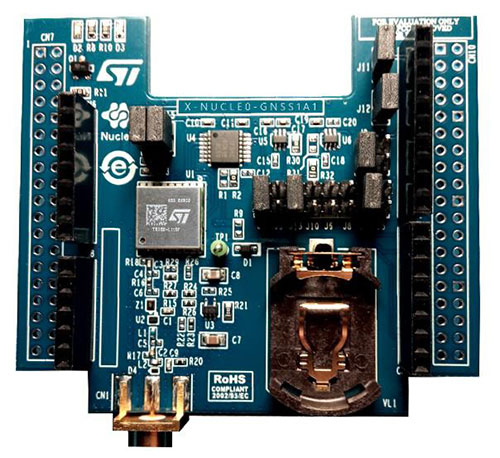
    The X-NUCLEO-GNSS1A1 expansion board is based on the Teseo-LIV3F tiny GNSS module. (Photo: STMicroelectronics)

    The development package consists of an STM32 Discovery host board for 2G/3G cellular-to-cloud connectivity, a GNSS expansion board based on ST’s Teseo satellite navigation technology, and a software Function Pack that connects an internet-of-things (IoT) node via a cellular network to a range of TomTom Maps APIs.

    With this hardware and software package and a TomTom developer account, developers can quickly add location-based services to their IoT and smart city applications.

    Among these services are the translation of GPS coordinates into a street address inside a map (Reverse Geocoding), retrieval of nearby point of interests, and the production of accurate navigation directions.

    “We have combined TomTom’s industry-leading location-based and mapmaking technologies with ST’s unrivaled combination of silicon and system expertise to create a unique offering that provides easy access to TomTom’s Maps APIs to empower developers to create groundbreaking, location-aware applications faster and more efficiently,” said Anders Truelsen, managing director of TomTom’s Enterprise Business Unit.

    “Supporting our efforts to facilitate location-based product development, our collaboration with TomTom has built on each company’s strengths to assemble a tailored package of hardware and software tools that is already fully integrated with TomTom cloud services, around the popular STM32 development ecosystem,” said Alessandro Cremonesi, group vice president at STMicroelectronics. “These tools enable native STM32-based location services to accelerate application development of Geo-IoT solutions for fleet management, item tracking, and many other services that depend on fast, accurate location detection.”

    In addition to the STM32 family of Arm Cortex-M core microcontrollers, the development tools leverage ST’s market-proven multi-constellation Teseo positioning-receiver technology to perform all positioning operations including tracking, acquisition, navigation and data output.

  • Mobile Means Business

    Sponsored by: Hemisphere GNSS
    Broadcast Date: Thursday, July 18, 2013
    Moderator: Alan Cameron, Editor & Publisher, GPS World
    Speakers: Cary Kiest, director of engineering, Trimble Mobile Computing Solutions; David Krebs, vice president, VDC Research & author of a market research study on mobile computing adoption and use by large enterprise and small-to-medium businesses.
    Summary: Organizations across business and public sectors, and including the military, now expect a high degree and broad range of functionality in the palms of workers’ hands, wherever those workers may go, under any kind of hazardous, chaotic, demanding environments. Requirements for location accuracy rise consistently across the board. In the future — in other words, now — developers will be asked to write mobile software applications first, and desktop applications second. Find out what this means for you, whether you are involved in GPS/GNSS product design, integration, marketing, sales, disribution, workforce management, or field use.
    Webinar Transcript: Mobile Means Business

  • Facebook Extends Status Update Features to Third-Party Apps


    Facebook is opening new APIs and documentation to developers, enabling the creation of third-party applications that allow consumers to add friends and location data directly from whichever app they’re currently using. “We’re introducing several improvements to the Facebook Platform that allow people to do all of the things they can do in a status update,” software engineer Alex Wyler writes on the Facebook Developer Blog.

    Location and friends information can now be added as properties to any photo, link, or status written from an app, which Wyler calls “similar to the functionality a user has when they add a photo or updates their status.” To enable the new features, Facebook is issuing APIs and documentation to set location and tag friends on posts via Open Graph social discovery loop actions or with stream publish stories; apps can also leverage improved search for places, including optional latitude, longitude and distance parameters as well as support for finding posts from friends around a place.

    “We have added familiar controls for managing tags,” Wyler adds. “New users select the audience they would like to share their app activity within the app permissions dialog. Users can choose to feature, hide, or route these stories for tag review.”

    In addition, developers working with Facebook Open Graph can now build apps that display large, user-generated photos and playback video in a user’s Newsfeed and Timeline.

    Since the Facebook Platform developer toolset expanded to mobile devices late last year, recommendation tools and Newsfeed updates are responsible for sending more than 60 million visitors every month to apps and games. Mobile visitors were responsible for more than 320 million visits to mobile apps in January 2012, Facebook adds. At February’s Mobile World Congress 2012 event, Facebook CTO Bret Taylor announced the social networking giant is now partnering with mobile operators across the globe to introduce streamlined billing practices enabling users to charge mobile web application transactions to their monthly wireless bill.

    “Facebook and mobile phones were made for each other,” Taylor said. “At Facebook, we don’t think of our mobile products as an alternative interface. We think of [mobile] as the natural Facebook experience.” Taylor added that Facebook’s mobile experience is “the platform [co-founder and CEO] Mark Zuckerberg would have built” if today’s devices and networks had been available when Zuckerberg began constructing the social network in his Harvard University dorm room eight years ago.