Tag: Dragonfly

  • Qualinx launches reconfigurable GNSS chip and developer kit

    Qualinx launches reconfigurable GNSS chip and developer kit

    Qualinx will showcase its market-ready 1 mW QLX3Gx Series GNSS chip with its dynamic reconfigurable architecture, along with a developer evaluation kit (EVK), at Embedded World 2026 taking place March 10-12 in Nuremberg.

    The QLX3Gx EVK enables OEMs to directly validate Qualinx’s power-to-performance leadership and integration readiness in real-world device environments across IoT, UAVs, wearables, asset tracking, mobility and infrastructure applications. Additional demos include ultra-low-power GNSS powered by Dragonfly Digital RF, on-chip Galileo authentication with EUSPA’s OSNMA, QLX3AX AFE flexibility, beacon-to-beacon communication and sustainable smartwatch integration.

    1 mW GNSS Powered by Dragonfly

    Qualinx’s patented Dragonfly Digital Radio Frequency (DRF) architecture is at the core of the QLX3GX chip and shifts traditionally analog RF functions into the digital domain, an approach that brings RF back in line with Moore’s Law and, as such, significantly reduces power consumption without compromising performance.

    Market-ready and built for scale, the highly integrated chip combines an ultra-low-power digital RF front end with an advanced GNSS digital baseband engine, ready for high-volume production and OEM deployment.

    Additionally, the Dragonfly architecture enables dynamic, over-the-air (OTA) reconfiguration of the device throughout its lifecycle, eliminating substantial cost and complexity from customers’ supply chains and sparking new cycles of downstream product innovation, all from a single chip.

    Supported by a European-designed GNSS architecture engineered for industry-leading power-to-performance versatility, hardware-level security and resilience, tracking is performed natively on-chip rather than in the cloud, further improving resilience to spoofing, jamming and interference.

    Live demonstrations planned

    Live demos at Embedded World 2026 highlight Qualinx’s performance and agility, and reinforce the company’s strategy to redefine connectivity by ensuring ultra-low-power, secure, and reconfigurable GNSS is accessible at scale:

    • QLX3Gx developer evaluation kit (EVK). Hands-on validation of real-world power consumption, reconfigurability and integration readiness.
    • Ultra-low-power GNSS powered by Dragonfly Digital RF. The 1 mW operating mode reduces one of the largest energy drains in connected systems, enabling longer battery life, smaller form factors and lower carbon footprint.
    • Qualinx Transmit. Qualinx will demonstrate that the same chip used for beacon-to-beacon collaboration can enable a range of new applications in which devices work together as an intelligent swarm, accelerating the deployment of ambient IoT.
    • Galileo OSNMA authentication with EUSPA. With more than 4 billion devices connected to Galileo, Qualinx on-chip navigation message authentication strengthens protection against spoofing among connected devices while reinforcing alignment with Europe’s sovereign Galileo infrastructure.
    • QLX3AX analog front end (AFE). A dynamic OTA reconfigurable AFE supporting multiple radio technologies for specialized receivers and custom systems.
    • Wearable integration display. Smartwatch-class form-factor readiness, validating compact footprint and suitability for IoT and wearable devices.

    The availability of the QLX3Gx GNSS chip and EVK follows the recent announcement of a €20M investment round to support and accelerate Qualinx’s growth and international expansion. As governments and enterprises reassess their exposure to fragile, globally concentrated semiconductor supply chains, Qualinx stands out as a European deep-tech company that combines European IP and manufacturing, with hardware-level security that delivers resilient, ultra-low-power connectivity and does not rely on cloud-based processing.

    All Qualinx chips, including the QLX3Gx GNSS chip, are designed and manufactured in Europe, anchoring production within the EU and reducing supply chain risk.

    OEMs are invited to register their interest in the Qualinx developer EVK at Embedded World, from 10-12 March at the Exhibition Centre Nuremberg, Hall 3, Booth 2211, to secure hands-on evaluation of the QLX3Gx GNSS chip for upcoming consumer, industrial, and mobility applications ahead of mass production this year. Contact [email protected] to schedule a media interview.
  • Helicopter and space UAVs pave the way for autonomous systems

    Helicopter and space UAVs pave the way for autonomous systems

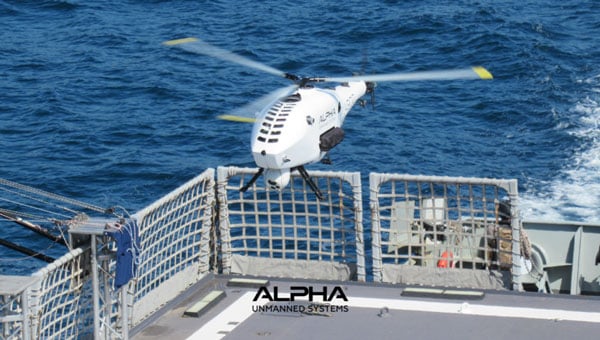
    Alpha Unmanned Systems (Alpha) in Madrid, Spain, has been developing and building helicopter UAVs for 10 years and has successfully employed them with defense departments in 10 countries. Its UAVs are ruggedized and qualified for the harsh conditions encountered at sea. The fully autonomous A800 and more recent A900 model UAVs have been used in military applications such as border patrol, situation awareness, intelligence gathering, coast guard support and aerial helicopter target simulation. Commercial applications include fishing fleets and oil rig support.

    Alpha A900 approaches for deck landing. (Credit: Alpha)
    Alpha A900 approaches for deck landing. (Credit: Alpha)

    The helicopter UAVs are equipped with a GNSS/MEMS autopilot system that maintains navigation if GNSS is jammed. MEMS sensors, however, can experience significant drift over time. The Alpha model offers two additional backup solutions. With an advanced air data system and pitot sensors, the aircraft can estimate airspeed and wind velocity to help maintain its flight path. If attitude estimation degrades further, remote pilot judgment may be required to recover control. For ground operations, a visual navigation system with a downward-looking camera can record terrain during overflights, building a database that enables navigation in GNSS-denied environments.

    One of the newer capabilities Alpha has added includes an Automatic Identification System (AIS) receiver. AIS is a primary radar transponder system used by ships around the world to provide each other with tracking information on other ships that are within about a 30-mile range. With an AIS receiver onboard the UAS surveillance helicopter, ships that are out of visual range, maybe out close to the horizon, now become trackable.

    Alpha is a small company that has been in operation since 2014, and it is one of the first to design helicopter UAVs for rough weather and at-sea environments. It’s good to see a focused, supportive outfit gradually succeed, not only with European defense organizations, but also in the U.S. and around the world.


    Meanwhile, in a universe that’s not far, far away — in fact, in our solar system — plans are moving forward at NASA to visit Titan with a UAV. Titan is a moon of Saturn that is most favored to have the capability to start, and maybe support, life. Numerous organic compounds have been detected during earlier satellite visits. But this is no ordinary UAV, quite unlike Ingenuity, the solar-powered hopper that NASA flew 72 times on Mars.

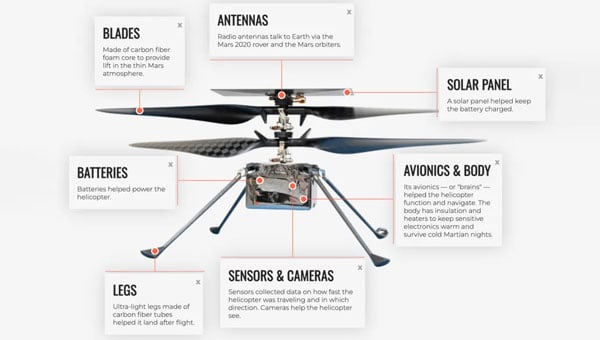
    Ingenuity, a UAV that flew 72 times on Mars. (Credit: NASA)
    Ingenuity, a UAV that flew 72 times on Mars. (Credit: NASA)

    NASA’s Ingenuity helicopter, which traveled to Mars attached to the Perseverance rover, was designed to demonstrate powered flight in the Red Planet’s thin atmosphere. Ingenuity featured oversized rotor blades to generate enough lift and was built to be as lightweight as possible. Its only equipment was a camera and speed sensors, with no scientific instruments aboard.

    The helicopter performed flights over Jezero Crater, ultimately spending about 130 minutes aloft and covering 11 miles during 72 flights. Ingenuity’s mission came to an end after it sustained damage to a rotor during a hard landing, grounding the aircraft and concluding its operations on Mars.

    The next interplanetary unmanned flying system is significantly more complex, replacing the lander and drone approach used on the Red Planet with a complete vehicle capable of flying and conducting the necessary investigative science. With a budget of $3.35 billion, NASA’s work has been underway since 2024, led by John Hopkins Applied Physics Lab, and a host of main and supporting organizations, including Lockheed Martin Space, Malin Space Science Systems (cameras), Honeybee Robotics (Blue Origin subsidiary, moon lander development) and participation by agencies in France, Germany and Japan. While Ingenuity was developed and built by UAV manufacturer AeroVironment with management/support from NASA/Jet Propulsion Labs (JPL), the team for Dragonfly appears to have a few industrial partners and extensive government support – hopefully, this works out!

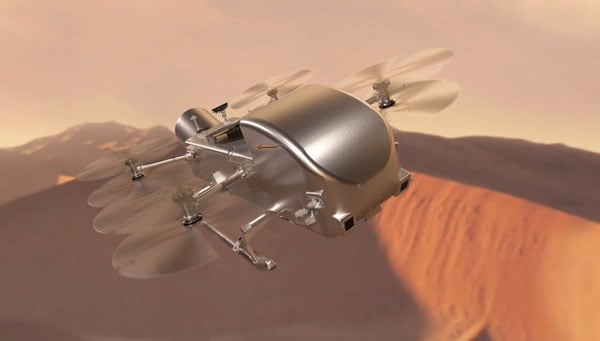
    Powered by a Radioisotope Thermoelectric Generator (RTG), Dragonfly has four sets of double rotors, landing skids, and, of course, has to be fully autonomous – the radio transit time between Titan and Earth is between 1 hour 10 minutes and 1 hour 40 minutes. Titan’s night is eight Earth days long, so the idea is to fly during the day (throughout 15 Earth days), then land and recharge batteries, and receive NASA’s instructions for the following day’s activities during the long night. The atmosphere is thought to be substantially composed of nitrogen and methane, four times thicker than Earth’s, and gravity is about 1/7, so 4 ft props with enough lift and power could carry the 880 lb to 990 lb UAV up to 10 miles for each flight at altitudes of up to 12,000 ft. But when observing and imaging the terrain, we might guess it would probably mean mostly low-level flights.

    Dragonfly Titan UAV explorer (Credit: NASA/Johns Hopkins APL/Steve Gribben)
    Dragonfly Titan UAV explorer (Credit: NASA/Johns Hopkins APL/Steve Gribben)

    At this weight, we are looking at something quite substantial to be flying around the anticipated sand dunes and frozen methane surface of Titan. Autonomous operations will need to be tight and safe for this big vehicle to operate and survive; it’s not exactly a small car, but quite substantial. Not to mention that landing will need to be somewhat delicate to protect the sensitive onboard instrumentation. 

    A spacecraft is scheduled to launch aboard a SpaceX Falcon Heavy in 2028, embarking on a complex journey that includes a flyby of Venus and a gravity-assist maneuver past Earth to set a direct course for Saturn’s moon Titan. The probe is set to enter Titan’s dense atmosphere directly, protected by a heat shield. After initial deceleration from atmospheric drag, two drogue parachutes will deploy, followed by a powered descent to the equatorial region known as the Shangri-La dune fields.

    The voyage is expected to take six years, with arrival at Titan in 2038. Once on the surface, the Dragonfly mission will begin a 2.7-year exploration of the moon.


    An interesting initial glimpse into a future, really advanced drone are undertaking. Hopefully, NASA will keep to its schedule, the budget holds up, and we start to see hardware in the next few years. Meanwhile, Alpha could be on version 16 of its UAV helicopter by then and achieve massive success with its multi-mission UAV applications.

  • New CEVA Dragonfly platform designed for M2M systems

    CEVA Inc. has introduced the Dragonfly reference platform to accelerate the design of low-data-rate machine-to-machine (M2M) and Internet of Things (IoT) communication applications, including standalone wearables, smart grid, surveillance systems, asset tracking, remote monitoring systems, connected cars and smart utilities.

    The Dragonfly multifunction platform is enabled by the recently announced CEVA-XC5 and CEVA-XC8 digital signal processor (DSP) cores and accompanied by the hardware and software components required to rapidly design machine-type communications (MTC) systems.

    The platform supports GPS, Wi-Fi and other IoT-related communications standard set to be deployed for M2M communication as well as existing and emerging LTE MTC releases and LPWAN standards such as LoRa, SiGFox and Ingenu. LTE MTC — LTE Advanced for machine-type communications — significantly increases battery life, reduces device complexity, and enhances coverage for low data rate machine-type communications.

    At Mobile World Congress 2016, CEVA will demonstrate the Dragonfly reference platform running LTE Cat-0 and GPS concurrently on its silicon-based development platform together with test and measurement equipment from Keysight Technologies and a GNSS simulator from Galileo Satellite Navigation. Mobile World Congress takes place in Barcelona, Spain, Feb. 22-25. CEVA is located in Hall 6, Stand A50.

    Dragonfly offers system developers a flexible platform that allows for optimal hardware/software system partitioning, combining a low-power vector communication DSP with a range of hardware co-processors. Such partitioning enables the software flexibility essential for upgradability and long service life of typical M2M devices, while delivering the power efficiency required to support extended battery life of up to 10 years.

    As an example, for CEVA licensees developing M2M systems incorporating LTE Cat-1 or Cat-0 today, these systems can be easily upgraded to support LTE Cat-M or other future standards when available. The DSP can also be used to implement proprietary features for specific device use cases, such as seamless indoor and outdoor positioning concurrently with Wi-Fi 802.11n or LTE Cat-0, in a highly efficient manner.

    “Our Dragonfly reference platform brings together all of the essential hardware, software and system integration components required by customers developing low-power machine-type communication solutions, in a highly cost and power efficient manner,” said Michael Boukaya, vice president and general manager, Wireless Business Unit at CEVA. “We have leveraged our deep expertise in low-power baseband processing and complemented it with a range of software offerings to deliver a platform that is highly customizable and flexible for developing a broad range of IoT and M2M products, quickly and efficiently.”

    The Dragonfly reference platform includes the vector communications DSP and all the required co-processors and interfaces, together with software application layers and libraries, RTOS and drivers for MTC systems design. These hardware and software components are available for LTE MTC, Wi-Fi and GNSS standards. Also included is a 500-MHz silicon-based development system that includes all of these components together with RF front ends and a host interface.