Tag: driverless

  • DeepRoute.ai completes L4 driverless test in busy Shenzhen, China

    DeepRoute.ai completes L4 driverless test in busy Shenzhen, China

    The company tested Driver 2.0, a Level 4 production-ready autonomous driving solution

    New video highlights navigating heavy traffic safely and efficiently
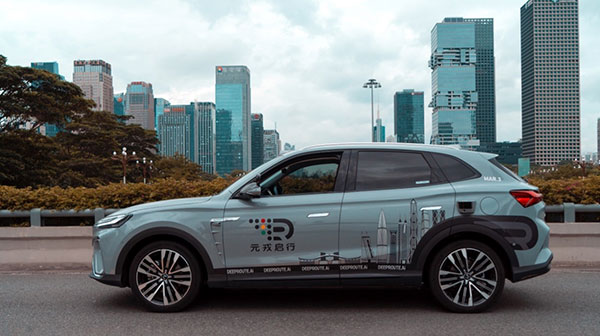
    Photo: DeepRoute.ai
    Photo: DeepRoute.ai

    DeepRoute.ai, an international autonomous driving technology company, has announced the results of its latest fully driverless test of its Driver 2.0 Level 4 production-ready autonomous driving solution.

    DeepRoute.ai released a video exhibiting a driverless vehicle retrofitted with the solution on Central Business District roads in Shenzhen, demonstrating its advanced capacity in complex and challenging traffic environments. It was the first legal driverless test in China — Shenzhen unveiled China’s first regulation on intelligent connected vehicles on July 6.

    The fully driverless vehicle drove just under 14 miles in one hour, navigating through significant traffic and narrow lanes safely and efficiently. The vehicle:

    • intelligently maneuvered around double-parked cars and counterflow e-scooters and pedestrians
    • negotiated with oncoming vehicles to calculate the right timing and trajectory to pass busy intersections
    • conducted multiple lane changes and unprotected left turns.

    “The recent legislation permitting driverless robotaxis in Shenzhen is the first of its kind, a major milestone in advancing autonomous driving technology to wider and faster adoption,” said Maxwell Zhou, CEO of DeepRoute.ai. “As we advance our mission for commercial deployment of autonomous driving vehicles, we will collaborate with automakers to refine our L4 solution to make it as safe and efficient as possible.”

    DeepRoute.ai has made significant improvements to achieve driverless capability, with both software and hardware meeting auto-grade standards. The safety mechanism was also upgraded to guarantee driverless safety on the road. In the case of long tail scenarios, the system will alert the remote monitoring center to intervene or take other safety measures.

    The Driver 2.0 System

    Driver 2.0 includes five solid-state lidar units, eight cameras and other sensors, and a computing platform integrated with its proprietary inference engine. The perception algorithm with sensor fusion can achieve precise object detection up to nearly 220 yards. The planning and control algorithm based on game theory can choose optimal routes and make decisions based on real-time situations when negotiating with oncoming vehicles and other road agents.

    With its deep learning approach, the inference engine optimizes compute resources, allowing the algorithm to run on its low-cost and power-efficient computing platform effectively and stably. As a result, Driver 2.0 can be priced at $3,000 for automakers in mass production and the algorithm can work with 2 to 5 solid-state lidars for automakers’ customization needs.

    The latest legal and regulatory framework is aligned with autonomous-driving industry developments and is considered the prelude to mass production and commercialization of autonomous-driving vehicles. DeepRoute.ai is working with automakers to mass produce consumer vehicles integrated with Driver 2.0, expected to be available for consumer purchase in 2025. It is also being integrated into robotaxi operations.
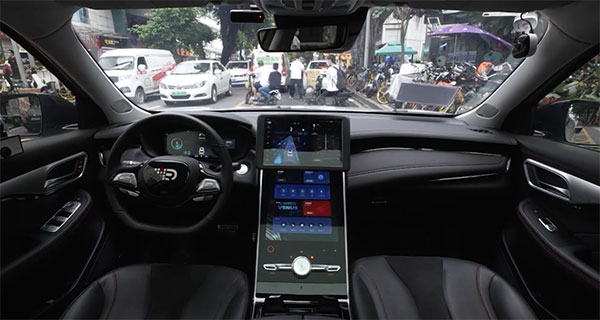
    Photo: DeepRoute.ai
    Photo: DeepRoute.ai
  • How soon a driverless car? You be the judge

    How soon will driverless cars achieve 20 percent market share in the United States?

    This is the question in GPS World’s Readers Poll for May.

    In 2020? 2022? 2025?

    Or 2028? Maybe 2030.

    Road-Driverless-WHow about 2032?  2035 or after?

    Finally, the ever-popular “Other (please specify).”

    Go to gpsworld.com/17maypoll and fill in your answer by May 12.

    See results in the June issue.

    All poll takers will be entered in a drawing for a $50 gift card.

    ____________

    Meanwhile, here’s a preview of the V2V Countdown article from the May issue, introduced by Chaminda Basnyake, an engineer at Locata Corporation:

    The U.S. Department of Transportation (USDOT) released a Notice of Proposed Rulemaking (NPRM) in December 2016 for the deployment of Dedicated Short Range Communications (DSRC)-based vehicle-to-vehicle (V2V) safety applications as part of the connected vehicles (CV) and automated vehicles (AV) initiative. If all goes well, this mean a V2V deployment mandate for new passenger vehicles likely starting in 2021 and reaching all new vehicles within 2–3 years.

    Standards required for V2V deployment were published in 2016 or before, including the V2V Minimum Performance Requirements SAE 2945/1, leading the way for commercial product development. The USDOT, which has been the catalyst behind V2V industry R&D starting from the automaker collaboration CAMP (Crash Avoidance Metrix Partnership) in 2001, is conducting CV Pilot programs in New York, Wyoming and Florida. These offer the opportunity for state DOTs, vendors and all other stakeholders to test the technology in real-life scenarios.

    Automotive OEMs have been developing this technology for more than a decade, and the NPRM is the beginning of a race toward integrating V2V to production vehicles. Deploying V2V technology requires the close cooperation of OEMs, their suppliers and many other stakeholders.

    This article captures the views of major players in the CV marketplace on expected deployment timelines, remaining challenges such as reliable positioning technology, integration with existing systems, and the implications on AV technology.

  • The Road to Driverless: Autonomous Vehicle Platforms, Sensors and Requirements

    Sponsored by: NavCom
    Broadcast date: Thursday, June 18, 2015
    On-Demand Available Until: Friday, June 17, 2016
    Moderator: Alan Cameron, Editor-In-Chief and Publisher, GPS World
    Speakers: John Fischer, Chief Technology Officer, Spectracom; Lisa Perdue, Applications Engineer, Spectracom; Hironori Sasaki
    Director of Solutions Architecture, Spectracom
    Summary: Advanced driver-assistance systems (ADAS) are now integrated in all luxury cars and moving into mainstream models. Although no driverless car is expected to operate freely on public roads for the next 10 years, some open test drives have already taken place, including one 100-mile highway cruise by a driverless Mercedes. This technology is currently restrained by legal issues and the lack of reliable nationwide mapping data — but the platforms are nearly ready to go. Join us as we explore the current state of affairs and the likely near-term future developments.

  • New engineering team at NovAtel to deliver safe positioning technology for autonomous vehicles

    New engineering team at NovAtel to deliver safe positioning technology for autonomous vehicles

    NovAtel Inc. announced a new initiative and engineering team to develop functionally safe GNSS positioning technology for fully autonomous applications. The company leverages its extensive experience developing safety-critical systems for the aviation industry to meet the future safety thresholds required for driverless cars and autonomous applications in agriculture, mining, and other government, military and commercial markets.

    In early 2015, NovAtel formed a specialized Safety Critical Systems Group of engineers with backgrounds in functional safety as well as all aspects of GNSS and inertial navigation systems (INS) technology. The Safety Critical Systems Group is focused on creating positioning products that will meet the exceptional performance and safety requirements of autonomous vehicles at the necessary production volumes and at the required price point.

    The company has extensive background working within safety critical requirements. Michael Ritter, president & CEO stated, “Aviation in North America relies on NovAtel technology to ensure safe navigation and landing.” Ritter added, “The Federal Aviation Administration’s WAAS, and other global Space Based Augmentation Systems (SBAS), have relied on certified NovAtel GNSS receivers for many years as the foundation of their systems. With full GNSS signal and constellation support needed to solve the performance criteria of autonomous driving, NovAtel is uniquely qualified to deliver the optimal solution that will keep us all safe as we drive the autonomous highways of the future.”

    Jonathan Auld, Novatel's director of Safety Critical Systems.
    Jonathan Auld, Novatel’s director of Safety Critical Systems.

    NovAtel manufactures high-precision GNSS receivers, antennas and subsystems, with expertise in sensor integration, specifically that of GNSS and INS. Through its TerraStar correction service, NovAtel also offers a global Precise Point Positioning (PPP) correction solution that is already designed for safety-of-life applications.

    With work underway for more than a year, NovAtel plans to achieve ISO/TS 16949 compliance by the end of 2016. This is an early key milestone in the Safety Critical Systems Group’s path, to be followed by an ISO 26262 compliant product.

    Jonathan Auld is director of Safety Critical Systems at NovAtel. He first joined the company in 2000 and has held positions as a GNSS test engineer, test group manager, director of technology development, and director of portfolio management.

  • Driverless conference focuses on strategies for autonomous car

    With automakers and Silicon Valley technology companies rolling out their strategies for the autonomous car, keeping on top of the latest technology, worldwide markets and regulation will be critical. Enter Driverless, a conference that will be held March 22-23, 2016, at the Crowne Plaza Hotel, San Francisco Airport.

    Attendees at the conference can find out what technology and markets will prevail from both Detroit and Silicon Valley perspectives from some of the most important executives in the business, explains event organizer and GPS World LBS Editor Kevin Dennehy.

    Driverless will feature more than 30 executive speakers covering the most important issues facing the autonomous vehicle industry. Driverless is an exclusive one-day conference that features an early bird reception on the evening before, a hosted luncheon, and an industry-best two-and-a-half hour reception with more than 15 exhibits from prominent companies.

    Those attending can learn the answers to these questions:

    • What technological, social and legal issues face ADAS and autonomous vehicle progression?
    • What technologies are solving the high cost of rolling out autonomous systems?
    • How can companies adequately test vehicles?
    • How will car sharing revolutionize the autonomous vehicle industry?
    • Who are the most innovative players and what are their intentions?
    • What are consumer expectations?
    • What systems are evolving… and for what markets?
    • Who owns this market? The technology companies or traditional automakers?

    Learn more at the conference website.

  • Why Data from Automated Vehicles Needs Serious Protection

    Concerns about data privacy aren’t going away and, in fact, are growing. Many retailers that have adopted in-store tracking technology to enhance shopping experiences and gather information on customer behavior have met with backlash. Increasingly, people are turning to a new crop of apps to safeguard how personal information is used in other apps. We have apps to guard other apps. The world is getting more confused and scary. The Heartbleed bug and other threats have heightened concern about an even more threatening vulnerability of our connected world. So how will drivers feel about increasingly automated vehicles that generate huge masses of data of an exceedingly personal nature? What happens when it is hacked?

    Automated vehicles require multiple types of sensors to obtain information about the vehicle, its movement, and the surrounding environment, which includes the roadway, other vehicles, obstacles and infrastructure. All sorts of ambient information may be captured. Perhaps activity outside of your house, or your kids on their way to school, or the licenses of cars in your driveway will be caught on camera.

    The massive amount of data collected needs to be crunched, and only some of it will be processed within the vehicle. Other captured data will be sent off-board to the cloud for handling, with results then returned to the vehicle. The amount of data that will be created by automated vehicles is uncertain, but I’ve seen estimates of 1 GB per second. Whatever it is, it will be immense.

    What’s collecting data in a driverless vehicle? Lidar, a laser technology that uses reflected light, is identifying everything around the vehicle with great precision. Cameras are taking pictures to detect phases of traffic lights, identify stop signs, and map road lane markings. GPS is tracking the location of the vehicles and helping with navigation. Sonar is detecting objects and measuring their distance, speed and direction. And each vehicle is exchanging positioning, braking, heading and speed data with other vehicles on the road to prevent collisions.

    The data generated is both of a critical and personal nature. And data that is moving in and out of the vehicle to be processed elsewhere or to communicate with other vehicles is particularly vulnerable. The consequences are far greater than a violation of privacy or a stolen identity. The operation of vehicles is at risk to be maliciously disrupted to disastrous outcome. This isn’t an issue we can put off until driverless vehicles are closer in reach. Vehicles today are increasingly equipped with safety and entertainment features that capture critical or sensitive data, any of which could present a threat in the wrong hands.