Tag: drone hobbyists

  • FAA Releases B4UFLY App Beta Test for UAS Users

    FAA Releases B4UFLY App Beta Test for UAS Users

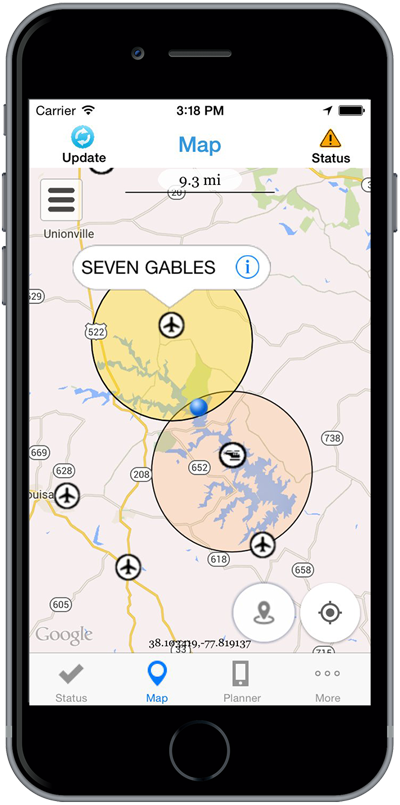
    B4UFly is now in beta testing.
    B4UFly is now in beta testing.

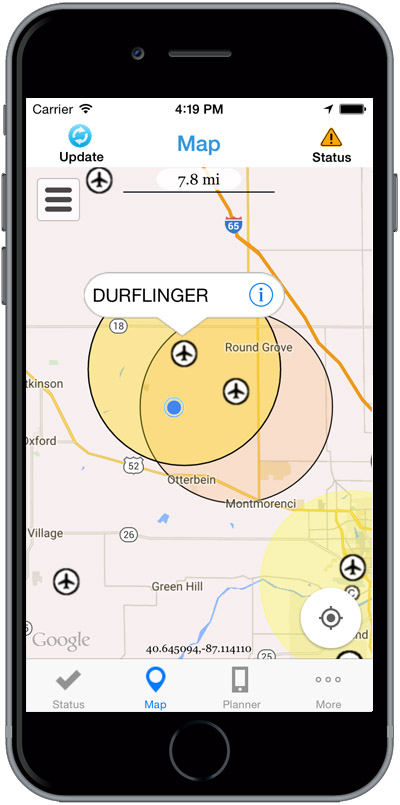
    The Federal Aviation Administration (FAA) has released the beta version of a new smartphone application called B4UFLY for testing by up to 1,000 unmanned aircraft users.

    The B4UFLY app, aimed primarily at model aircraft enthusiasts, is designed to give users information about restrictions or requirements in effect at their current or planned flight location. The FAA expects the beta test will yield valuable data on how well B4UFLY functions, as well as uncovering any software bugs.

    FAA Administrator Michael Huerta first announced the initiative in May, asking for volunteers to test the app. The FAA has notified those who previously signed up and will be pushing the app to them directly in the coming days.

    Many unmanned aircraft users today have little or no aviation experience, and some of them are flying where they could endanger manned aircraft. B4UFLY will give these flyers the tools and knowledge they need to operate safely.

    Key features of the B4UFLY app include:

    • A clear “status” indicator that immediately informs operators about their current or planned location.
    • Information on the parameters that drive the status indicator.
    • A “Planner Mode” for future flights in different locations.
    • Informative, interactive maps with filtering options.
    • Links to other FAA UAS resources and regulatory information.

    B4UFLY complements the Know Before You Fly educational campaign, which provides prospective UAS operators with information and guidance they need to fly safely and responsibly. The FAA is a partner in the effort with the Association for Unmanned Vehicle Systems International (AUVSI), Academy of Model Aeronautics (AMA), and the Small UAV Coalition.

    Using the location services feature of a user’s smartphone, the app quickly determines restrictions or requirements in effect where they want to fly and gives the user a clear status icon. The status indicator function considers airspace, proximity to airports, temporary flight restrictions, current law and other FAA guidance and procedures.

    Model aircraft operators who fly within five miles of an airport are required by law to notify the airport and the air traffic control tower — if there is one at the airport — prior to operating. The FAA is working on an electronic notification process to satisfy this requirement that will become part of a future version of B4UFLY. During the beta test, the FAA will collect user feedback and operational data and use it to develop this electronic notification process.

    The beta test is expected to run for several months, after which the FAA plans to make B4UFLY available to the general public. The beta test will be for iOS devices only, but the FAA is working to ensure the full version will be compatible with Android devices as well.
  • UAV Interference with Aircraft Much Higher in 2015

    UAV Interference with Aircraft Much Higher in 2015

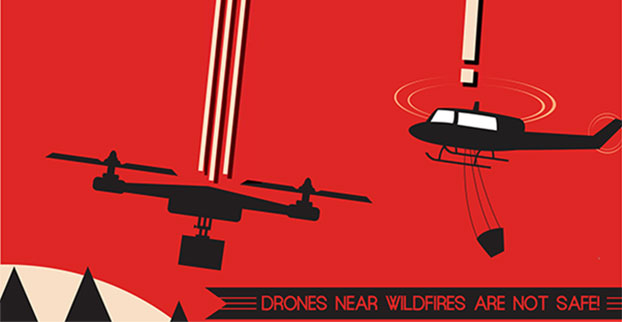
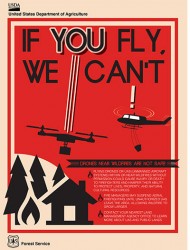
    Cover: National Interagency Fire CenterThe Federal Aviation Administration (FAA) wants to send out a clear message that operating drones around airplanes and helicopters is dangerous and illegal. Pilot reports of unmanned aircraft have increased dramatically over the past year, from a total of 238 sightings in all of 2014, to more than 650 by Aug. 9 of this year. Unauthorized operators may be subject to stiff fines and criminal charges, including possible jail time.

    Pilots of a variety of different types of aircraft — including many large, commercial air carriers — reported spotting 16 unmanned aircraft in June 2014, and 36 the following month. This year, 138 pilots reported seeing drones at altitudes of up to 10,000 feet during the month of June, and another 137 in July.

    Meanwhile, firefighters battling wildfire blazes in the western part of the country have been forced to ground their operations on several occasions for safety reasons when they spotted one or more unmanned aircraft in their immediate vicinity.

    The FAA says it will continue to work closely with industry partners through the “Know Before You Fly” campaign to educate unmanned aircraft users about where they can operate within the rules. The agency is also supporting the National Interagency Fire Center’s “If You Fly, We Can’t” efforts to help reduce interference with firefighting operations.

    However, the FAA also is working closely with the law enforcement community to identify and investigate unauthorized unmanned aircraft operations. The FAA has levied civil penalties for a number of unauthorized flights in various parts of the country, and has dozens of open enforcement cases.

    The FAA encourages the public to report unauthorized drone operations to local law enforcement and to help discourage this dangerous, illegal activity.

  • Model Plane Fliers to Get Real-Time, Location-Based Flight Safety Info

    Model Plane Fliers to Get Real-Time, Location-Based Flight Safety Info

    Photo: B4UFLY iOS appToday’s second announcement of a new UAV-related initiative by the Federal Aviation Administration (FAA) was directed at private citizens: model airplane enthusiasts and hobbyists, also called modelers — not at industry or commercial use. See this story for information on the Pathfinder program for commercial drone use.

    A soon-to-be released smartphone app will proved users with real-time information on flight regulations, and restrictions for the user’s actual location; alternately, for a location to which the user is planning to travel to for a model plane flight. Named B4UFly, the app is designed to answer for users, “Is it safe and is it legal to fly my model aircraft based on where I am right now?” The overall goal is to encourage responsible use of model aircraft.

    The B4UFLY iOS app will be made available to 1,000 iPhone beta testers this summer. The first 700 emails received by [email protected] will make up the initial limited beta test group. The email is for model aircraft hobbyists only, who want to sign up for beta test. B4UFLY Version 1 for iOS will go out to the general public later this year. An Android app will come later.

    “Someone who got their first UAV as a gift probably does not know [the rules governing flight and airspace operation],” said Jim Williams, the manager of the FAA’s Unmanned Aircraft Integration office. “It’s a knowledge gap that is very very important that we fill. Hobbyists and modelers need to know that there are very real consequences if you don’t have that knowledge. The recent Incident on the White House lawn provides a perfect case in point.”  

    The app was developed in cooperation with the MITRE Corporation. Key features of the B4UFLY app include:

    • A clear “status” indicator that immediately informs operators about their current or planned location.
      Information on the parameters that drive the status indicator.
    • A “Planner Mode” for future flights in different locations.
    • Informative, interactive maps with filtering options.
    • Contact information for nearby airports.
    • Links to other FAA UAS resources and regulatory information.

    The FAA’s Know Before You Fly campaign launched just prior to Christmas last year was a preliminary step in this effort.

    Williams prefaced his remarks with, “These model planes and copters are ready to go, right out of the box.  I know, I have one.” He then guided press through a brief look a clips and demo of the app’s key features. The app will provide real-time access to rules, requirements and restrictions based on location, and suggests specific actions to take if the user is:

    • within five miles of an airport 
    • within a national park
    • within a restricted airspace (such as Washington, D.C.); and so.  

    The app will access the user’s location to automatically furnish this information. There is also a planning mode to see what data is available for a planned location to which you are preparing to go, although you are not there yet.

    “Unmanned aircraft should always yeild the right of way to manned aircraft,” Williams stressed. “This is not the be-all and end-all of when and where you can fly. It does not alleviate the user’s responsibility to operate safely.”

    In response to questions, FAA Administrator Michael Huerta clarified that the FAA currently issues flight restriction covering large public events, such as the Master’s golf tournament.

  • FAA Warns Drone Hobbyist and YouTuber

    So, you know it’s illegal to fly drones in the United States for commercial purposes unless you have a Federal Aviation Administration (FAA) exemption and Certificate of Authorization and Waiver (CoA), right?

    That means you can’t fly drones if it’s related to business, no matter if you charge a fee or not. But, you can fly drones in the United States as a “hobbyist” as long as you adhere to certain rules (such as flying lower than 400 feet above the ground).

    In a new twist, the FAA has cracked down on at least one person who posted a drone video on YouTube because YouTube generates revenue, reports the website Motherboard. Even though it appears the drone was being flown by a hobbyist for recreational purposes, it smells to the FAA like a commercial use of drone. Even though the hobbyist isn’t generating revenue from it, Google is.

    Jason Hanes' Youtube Channel
    Jason Hanes’ YouTube channel.

    While it appears the U.S. drone community is going nuts using drones for all kinds of non-commercial and commercial purposes, despite the FAA rules, it appears there are too many violators for the FAA to chase after since enforcement notices sent by the FAA have been few and far between. In this case, safety concerns may have been the prompt. The FAA says it’s now looking further into how its safety inspectors send letters like this. Read more about the case at the Motherboard website.

    Geospatial Data Interest Crosses Political Party Lines

    Senator’s Mark Warner (D-Va.) and Orrin Hatch (R-Utah) introduced the Geospatial Reform Act, targeted at leveraging geospatial data acquired by the U.S. federal government. This bill argues that the federal government is the largest purchaser of geospatial data, yet agencies aren’t required to report details of geospatial data purchased. The bill aims to change that.

    “Geospatial data has endless possibilities for transforming both the private and public sectors — from helping local governments develop emergency preparedness plans to fueling the creation of apps that let you find parking spots, restaurants, and even homes for sale based on where you’re standing,” said Sen. Warner. “The federal government is the largest purchaser of geospatial data but some very basic questions about how and where agencies are already investing in this data can’t be answered. Our bill would bring transparency and accountability to the collection of this data and ensure that taxpayer dollars are not being wasted on duplicative efforts.”

    Sen. Warner and Hatch issued a joint statement about the bill.

    DigitalGlobe Offers Commercial 30-cm Resolution Satellite Imagery

    In what DigitalGlobe claims is a world’s first, the company began offering commercial 30-cm satellite imagery via its WorldView-3 satellite, which was launched August 13, 2014. DigitalGlobe announced that the imagery is available worldwide (with some restrictions). As part of its press release, DigitalGlobe offered the following quote from PhotoSat, a consumer of imagery.

    “DigitalGlobe’s WorldView-3 satellite data is the highest quality satellite photo data that PhotoSat has ever processed,” said Gerry Mitchell, President of PhotoSat, a leading satellite elevation mapping provider for energy, mining, and engineering firms. “In one test, an elevation mapping grid extracted from stereo WorldView-3 satellite photos matched a highly accurate LiDAR elevation grid to better than 15 cm in elevation. This result takes satellite elevation mapping into the engineering design and construction markets and directly competes with LiDAR and high resolution air photo mapping for applications like flood plain monitoring.”

    According to DigitalGlobe, WorldView-3 is the first and only commercial imaging satellite capable of collecting imagery with 30-cm ground sample distance, and claims it is five times the detail of the company’s nearest competitor. See a sample by clicking here.

    Satellite imagery is approaching aerial photogrammetry quality. I recall Lawrie Jordan, founder of ERDAS (sold to Leica) and now director of imagery at Esri, saying that eventually every square inch of the earth will be imaged constantly by satellite.

    Esri and Drone Data Up until now, you haven’t heard the words “Esri” and “drone” mentioned in the same sentence very often. Last week at the Esri Developer Summit in Palm Springs, Esri provided a live map-creation demo using a small quadcopter.

    Look for a follow-up article, data example and possibly a video of the event.

    Thanks, and see you next month.

    Follow me on Twitter at https://twitter.com/GPSGIS_Eric