Tag: drone software

  • Red Cat proves drone software for GPS-denied navigation

    Red Cat proves drone software for GPS-denied navigation

    Red Cat Holdings, a U.S.-based provider of advanced all-domain drone and robotic solutions for defense and national security, has successfully flight tested its Black Widow drone equipped with Palantir Technologies Visual Navigation (VNav) Software.

    The test demonstrated that the Black Widow drone — part of the U.S. Army’s Short Range Reconnaissance (SRR) program of record — can navigate in GPS-denied conditions using Palantir’s visual-based navigation software. This marks the first known commercial demonstration of visual navigation software on a drone already accepted into a U.S. Army program.

    “This is a breakthrough moment not just for Red Cat, but for the tactical needs of the Department of War,” said Jeff Thompson, CEO of Red Cat. “Every battlefield is a GPS-denied environment, and this successful test shows that Red Cat and Palantir are delivering a software-driven solution the Army can rely on. It requires no new hardware, is ready to deploy today, and gives warfighters the edge in contested environments. It also signals our evolution into a full-stack defense technology platform, with expected margin expansion and strong revenue potential in 2026.”

    VNav uses edge-based sensor fusion to generate real-time position estimates from visual cues and inertial data, enabling navigation in denied or degraded environments. Over a multi-day series of tests, Red Cat and Palantir engineers evaluated VNav across nominal and GPS-denied conditions, including high-speed and low-altitude flights.

    Read more about how VNav works in this Palantir blog.

    The testing sequence validated:

    • Full integration of VNav with the Black Widow flight controller, including compatibility with GPS-assisted operation
    • Accurate navigation in simulated GPS-denied environments
    • Reliable operation at altitudes as low as 150 feet AGL and speeds up to 16 mph
    • Robust performance in twilight and extremely low-light conditions
    • A simulated reconnaissance mission with dynamic flight parameters, completed successfully without GPS or human input

    The results helped define a preliminary performance envelope for VNav on the Black Widow system. The final mission demonstrated VNav’s ability to navigate a complete ISR mission profile, including cruising to a target, descending for surveillance, flying local waypoints, and returning, all without GPS and with continuous positional awareness.

    Palantir engineers reported that VNav achieved a mean positional error of approximately 7 meters over a 2.7-kilometer route. No additional hardware was required for any of the flights, as VNav runs entirely on the Black Widow’s existing onboard sensors.

    “Palantir Visual Navigation performed well in real-world conditions,” said Akash Jain, president and CTO, Palantir USG. “This demonstrates our approach to visual navigation in disrupted environments –– delivering intelligent software that adapts, scales across platforms like Black Widow, and supports the Army’s integrated operating systems.”

    Red Cat and Palantir are working toward a formal Army demonstration and full productized VNav capability for all fielded Black Widow systems.
  • Auterion delivers new high-precision UAV mapping capabilities

    Auterion delivers new high-precision UAV mapping capabilities

    Screenshot: Auterion
    Screenshot: Auterion

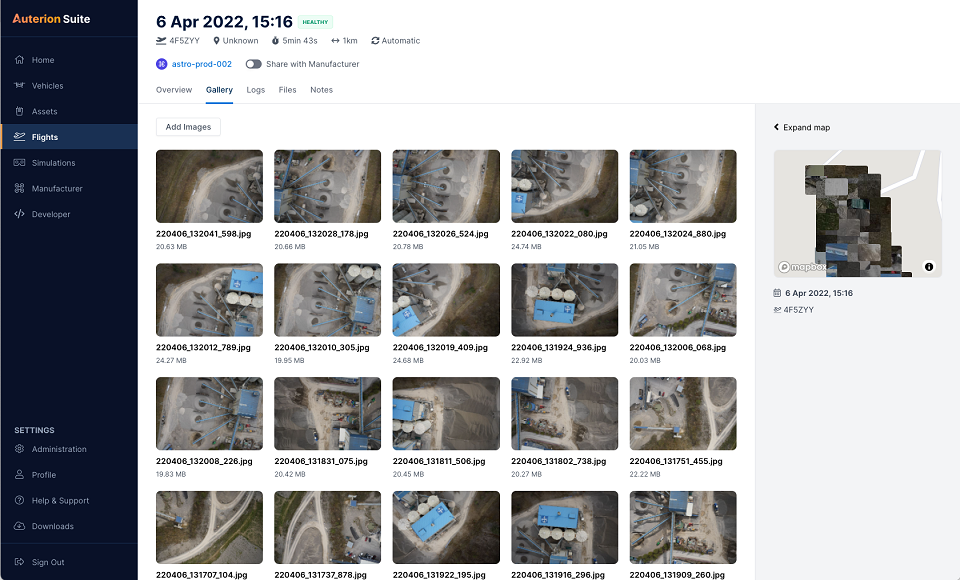
    Auterion has introduced new capabilities for high-precision mapping missions and automated, end-to-end data workflows to make mapping more efficient, reliable and powerful across industries.

    Unveiled at AUVSI Xponential 2022, updates to the Auterion OS serve enterprises with diverse use cases that need component and payload flexibility, alongside a centralized and streamlined software workflow.

    Advantages for customers include:

    • Availability of precise mapping data in real time and automated processing that enables fast decision-making, saving time, ensuring consistency and reducing human errors.
    • Standardized process across any Auterion-powered vehicles, bringing an improved user experience, reducing training time, and affording easy scaling of operations.
    • Connectivity that enables automated end-to-end workflows with no need for manual data transfer, and integration with third-party data-processing software such as Esri Site Scan or Propeller.

    “The mapping and workflow features included in this latest release of Auterion’s software focus on use cases from our enterprise customers,” said Markus Achtelik, vice president of engineering at Auterion. “We’re making sure that workflows are thoughtfully designed to meet customer needs and that the data they require is collected, automatically processed and streamlined through Auterion’s software platform for immediate use and longer term analysis.”

    Auterion’s new platform capabilities are achieved through the enhancement of tightly integrated components. For example, the ground control app provides precise mission execution with fully integrated control of payloads, such as the Sony α7R IV camera. Then, capture and storage of geotagged images on the drone occur in real time.

    Next, image data correction and processing happen seamlessly. This kind of automated workflow illustrates Auterion’s commitment to building efficient operational solutions for enterprise-ready drones, the company said.

    “Auterion’s software is updated with its expanding open ecosystem in mind,” added Achtelik. “That gives customers the best options on the market, offering greater flexibility and choice to meet enterprise quality, scale, and regulatory needs.”

  • Parrot and High Lander enhance drone fleet automation

    Parrot and High Lander enhance drone fleet automation

    Photo: Parrot
    Photo: Parrot

    Parrot drones professional users benefit from an advanced control during complex fleet operations

    Drone company Parrot is partnering with High Lander, which provides drone fleets with autonomous flight, intelligent airspace control, and coordinated air continuity through its Mission Control platform.

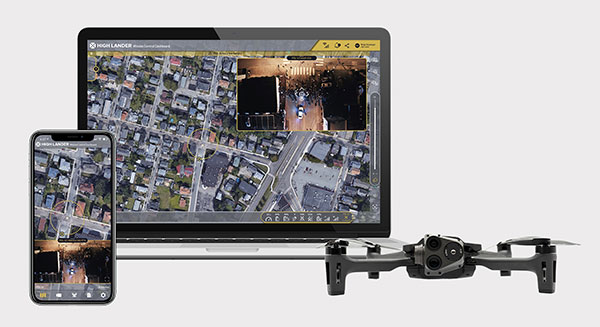
    Combining Parrot ANAFI USA and ANAFI platform drones with High Lander’s Mission Control software, professionals can now access drone features through an easy-to-use dashboard.

    “Parrot is continuously striving to provide our professional users with extended capabilities — allowing them to rapidly adapt their drone operations to fit their changing and urgent needs,” said Jerome Bouvard, Parrot director of strategic partnerships. “Drone automation and intelligence are at the heart of our product and software developments. This new partnership with High Lander represents another step towards enhanced automation and control capability of our drones.”

    Using real-time device reporting and telemetry, first responders can autonomously manage their drone fleets while performing takeoff and landing, route-planning, and other crucial tasks — all from the intuitive comfort of the Mission Control Operations Center dashboard. The software’s seamless interface paired with the ANAFI USA’s ease-of-operation and rapid deployment provide more safety for responders and allow faster intervention during critical moments. Mission Control’s customized live link generation can also provide team-members onsite with an instant view of a drone’s video feed for fast assistance during search-and-rescue missions.

    For surveying and mapping missions, operators can use improved control modes including Path (which sets an automated plan including multiple waypoints, telemetric, gimbal and payload settings) and Modeling & Mapping (which allows operators to survey an area in detail) as they efficiently create 2D maps and 3D models using Parrot ANAFI’s precise GPS coordinates capabilities.

    Operators can also benefit from Mission Control’s Payload Sidebar, which enables switching instantly to thermal imaging, an invaluable tool for missions in search and rescue, police pursuits, or solar panel inspections. Parrot ANAFI USA’s integrated FLIR Boson Thermal sensor and 32x zoom make it easy to identify thermal anomalies and centimetric hot spots from an altitude of up to 40 meters.

    “As a hardware-free system, Mission Control is compatible with leading drone manufacturers’ solutions, now including Parrot, to provide our customers with the freedom of customizing their drone fleets with best-in-class UAVs,” said High Lander CTO Ido Yahalomi.

    High Lander is working with a number of prominent organizations including police departments, sheriff’s offices, fire stations, and forestry services, and has 12 active clients who will now be able to use Parrot’s ANAFI USA and ANAFI drones in their fleets.

    The High Lander Pilot app is available for download on Android and iOS systems for use with ANAFI and ANAFI USA platform drones.

    For more information about ANAFI USA, contact Parrot through the ANAFI USA contact form.

  • NXP and Auterion join on hardware/software integration for drones

    NXP and Auterion join on hardware/software integration for drones

    NXP and Auterion join forces to enable next-generation secure drone fleets with automotive certified solutions, high-reliability networking, and a scalable and open software platform.

    Photo: narvikk/ iStock / Getty Images Plus/Getty Images
    Photo: narvikk/ iStock / Getty Images Plus/Getty Images

    On July 6 at the PX4 Developer Summit 2020, NXP Semiconductors and Auterion announced a collaboration to develop integrated hardware and software solutions for the unmanned aerial systems industry.

    Working together, the companies aim to develop highly reliable and advanced hardware and software solutions deployable in an unmanned aerial vehicle.

    With the development of regulations and the increasing number of autonomous systems in the field, the requirement for components and software that are certifiable and the ability to deploy intelligence on the edge is becoming more and more important.

    NXP provides semiconductor components and expertise leading to certifiable electronics solutions, including computational horsepower, secure element for encryption and authentication, and high reliability automotive networking.

    Auterion is offering the hardware reference design and Auterion Enterprise PX4, the software for the flight controller and the mission computer to make drone fleets safe and fully integrated into workflows. Auterion is the largest contributor to PX4 and builds its software platform on open standards, ensuring that enterprises have access to a managed and tested distribution of the open source technology.

    The partnership addresses the needs of the unmanned aerial vehicles industry for compatible hardware and software solutions that will help drone manufactures bring state-of-the-art products to market. The aim is to ensure that manufacturers have a streamlined path to certification and are connected to existing workflows.

    “This partnership will enable the mobile robotics community with the components meeting quality specifications needed to ensure functional safety and security in drones and rovers based on reliable long life industrial and automotive parts and reference designs,” said Iain Galloway, Drone Program Lead, Systems Innovation, NXP. “We have been participating in the open source PX4 community for several years now and with this close relationship with Auterion, and Auterion Enterprise PX4, we are excited to work together to ensure these vehicles are prepared to meet current and future regulations and standards governing modular safe drone architectures.”

    “Safety is the number one priority in commercial drone operations. NXP’s leading position as a semiconductor provider for safety-critical automotive applications is the perfect pairing for Auterion’s enterprise-grade drone software platform,” said Lorenz Meier, co-founder and CEO, Auterion. “Together, we will be able to provide integrated hardware and software solutions to the drone industry that combine high-performance compute with safety-first engineering.”

    NXP and Auterion will collaborate on the core hardware and software components of an autonomous system, this includes, but is not limited to, the following topics:

    Developing the next generation Auterion Skynode avionics module reference design, based on the latest Pixhawk autopilot Reference Standards and on the NXP i.MX 8M Mini as a companion computer, and on future components in this family.

    • Integrating navigation modules incorporating NXP Ultra-Wideband (UWB), automotive MCU, NFC and authentication for precision landing applications.
    • Developing Battery Management System (BMS) solutions based on the latest Pixhawk Smart Battery Standards.
    • Developing Automotive CAN and CAN-FD node solutions supporting popular software protocols such as UAVCAN and MRCAN for mobile robotics peripherals.
    • Collaborate in the data cybersecurity and drone regulatory space to help shape and meet future regulations.

    Both parties will continue to support the PX4 open source community and upstream PX4 development, in an effort to enable the whole industry.

  • Auterion showcases product portfolio at Xponential 2019

    Auterion, an open-source software company, showcased its product portfolio, which includes Enterprise PX4, at Xponential 2019. According to the company, Enterprise PX4 is a software that powers the drone, keeps it away from obstacles and collects the data you need.

  • Virtual Surveyor eliminates need for third-party apps for data processing

    Image: Virtual Surveyor
    Image: Virtual Surveyor

    Drone surveying software Virtual Surveyor now eliminates the need for clients to use third-party applications to prepare data for processing. Released this week, Virtual Surveyor 6.1 now handles on-the-fly projections that previously required a separate software package to set the data in the proper coordinate system.

    “We have developed a completely new project experience for users of UAV data,” said Tom Op ‘t Eyndt, managing director of Virtual Surveyor in Belgium. “Version 6.1 will save our customers time and money once spent converting their drone data for processing in Virtual Surveyor.”

    Virtual Surveyor bridges the gap between UAV photogrammetric processing applications and engineering computer-aided design (CAD) packages. The software generates an interactive onscreen environment with UAV orthophotos and digital surface models where the surveyor selects survey points and breaklines to define the topography, creating highly accurate topographic products for CAD input up to five times faster than otherwise possible.

    “Our value proposition has always been to enable surveyors to derive topographic information from drone data and deliver the light-weight meaningful CAD model that engineers need,” said Op ‘t Eyndt.

    Prior to Version 6.1, users always had to start from an orthophoto and digital surface model (DSM). Now, surveyors can drag and drop all kinds of files into Virtual Surveyor: points, raster, vectors and point clouds. The point clouds are converted to a DSM for manipulation and processing, dramatically accelerating the time required to generate the CAD model.

    “Not only is this faster, but it eliminates the expense of purchasing additional software,” said Op ‘t Eyndt.

    Some customers asked to work only with a CAD file, he explained. Although they work with drone data most of the time, they occasionally had to create a surface or contours from a traditional survey. They asked if this could be done in Virtual Surveyor as it would save them from paying for a subscription to a CAD software.

    Long-time Virtual Surveyor clients will find the entire project experience has been streamlined and improved with new capabilities in V6.1:

    • Start from any data set. Projects can now be initiated from Orthophotos, DSMs, Point Cloud or CAD files.
    • Convert coordinates on the fly. Users can input data in any coordinate system and convert it during processing to another system after the project has begun.

    Developers of Virtual Surveyor have also added these features to V6.1:

    • Automatic creation of section lines. V6.1 automatically generates sections from road surfaces to survey transportation routes in minutes.
    • Transparent layers. Users can add topographic or cadastral data to their project and view it through the orthophoto layer to annotate or draw boundaries.

    “Overall, users will experience a faster processing environment in Virtual Surveyor 6.1 especially during complex tasks, such as making terrain modifications or calculating volumes,” said Op ‘t Eyndt. “Our goal with this version has been to make professional land surveyors more efficient.”

    Current subscribers to Virtual Surveyor will see their software being updated automatically.