Tag: DSRC

  • Autotalks and Marben join on live V2X demo

    Graphic: Autotalks
    Graphic: Autotalks

    Autotalks, a vehicle-to-everything (V2X) communications company, has teamed up with Marben for a live V2X demo based on Marben V2X software running on Autotalks’ chipset.

    The first live end-to-end global V2X demo will take place at the Autotalks booth (C198) at TU-Automotive Detroit, being held June 5-6 in Novi, Michigan.

    The joint demonstration will show V2V applications running using both DSRC and C-V2X standards and leverages the ability of the Autotalks’ chipset to support both.

    Autotalks has been cooperating for several years with Marben, a global leader in embedded software solutions for the telecommunication and automotive industries. The joint effort led to the successful integration of Marben’s stack and software application on Autotalks chipset using the C-V2X standard.

    The Autotalks solution minimizes development, testing and certification efforts for a V2X system to be deployed anywhere, using a software toggle between V2X technologies. This translates into a huge advantage for OEMs and Tier 1 automakers who benefit from the shortest time to market for a global V2X platform.

    The chipset isolates V2X from the non-safety domains, thus providing domain separation and security, scalability and ability to optimize the cost structure of telematic control units (TCUs). The isolation of V2X combined with Autotalks’ recognized cyber security technology enables a secure platform.

    “Our agility in maturing the C-V2X solution simultaneously with leveraging our V2X ecosystem partners for this purpose has yielded fast results and offers a clear deployment path for OEMs and Tier 1s alike. We appreciate Marben’s long-standing cooperation and are pleased to demonstrate the first end-to-end dual-mode V2X demo with them,” said Yaniv Sulkes, Autotalks’ VP of business development and marketing in North America and Europe.

    Global software communications company Marben has developed a complete ready-to-use V2X software solution including security and several applications that are deployed worldwide. The company’s solution significantly increases road safety, optimizes traffic and contributes to greener mobility.

    “We are glad to partner with Autotalks, and showcase this first of a kind demonstration, after our straightforward and quick C-V2X integration,” said Devang Naik, director of software engineering.

    The live demo can be seen at the Autotalks booth C198 at TU-Automotive Detroit.

  • Autotalks launches vehicle-to-everything chipset

    Graphic: Autotalks
    Graphic: Autotalks

    Israel-based Autotalks has launched what it calls a global V2X (vehicle-to-everything) chipset.

    The chipset supports both dedicated short-range communications (DSRC) and cellular vehicle-to-everything (C-V2X) technology — both allow vehicles to share their location and speed to help prevent accidents and improve the safety of autonomous driving systems, the company said.

    The chipset’s processor also could allow customers to switch between the two standards. It minimizes development, testing and certification efforts for a V2X system to be deployed anywhere via a software-defined toggle between the two V2X technologies.

    Two competing standards

    Automakers have announced intentions to equip their new car models with V2X technology. In recent years, V2X has diverged into two different solutions, DSRC and C-V2X.

    While DSRC-based V2X is deployed in the U.S., Europe and Japan, C-V2X is gaining momentum in other regions. Its fundamentally different architectures have made it difficult to harmonize a single global solution.

    Autotalks’ response is to equip its second-generation chipsets with C-V2X in addition to native support of DSRC.

    Autotalks’ deployment-ready, second-generation V2X chipset supports both DSRC and C-V2X direct communications (PC5 protocol) at the highest security level. According to the company, the chipset supports DSRC based on 802.11p/ITS-G5 standards and C-V2X based on 3GPP specifications.

    Autotalks said its chipsets were designed to meet V2X market requirements and standards, including security, environmental, quality, thermal and other requirements.

  • Singapore to test camera, location system for traffic

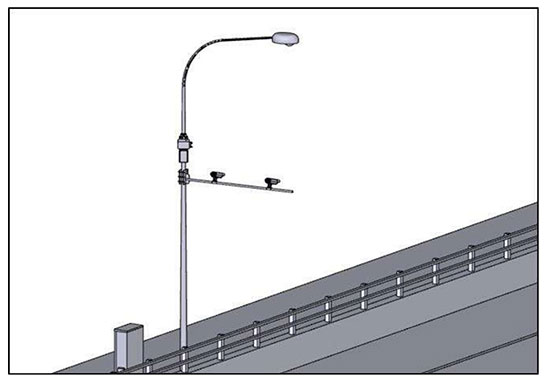
    The Singapore Land Transport Authority (LTA) has begun testing an Automatic Number Plate Recognition (ANPR) camera system with Dedicated Short Range Communications (DSRC) beacons at various locations along expressways and major thoroughfares.

    The testing started March 26 and will conclude in 2019.

    An example of the equipment that will be mounted on existing roadside infrastructure. (Image: LTA)
    An example of the equipment that will be mounted on existing roadside infrastructure. (Image: LTA)

    The use of ANPR technology will facilitate enforcement, while DSRC beacons will also be installed in some areas to enhance positioning accuracy in Singapore’s highly urbanized environment.

    The tests will enable LTA to determine the performance and reliability of such technologies under various real-life environmental and traffic conditions for future traffic management systems that will leverage GNSS technology.

    The technologies being tested do not require heavy physical infrastructure and will be mounted on existing roadside infrastructure such as overhead bridges, overhead gantry signages and lamp posts, as well as EMAS gantries.

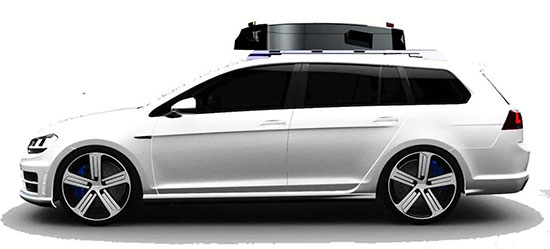
    Testing equipment will also be mounted onto vehicles, which will be deployed at localized areas such as Tuas South from April 2018, before expanding island-wide for testing.

    In 2016, LTA awarded a S$556 million contract to the consortium of NCS and Mitsubishi Heavy Industries Engine System Asia to build a next-generation electronic road pricing system based on GNSS technology, reports Channel NewsAsia.

    The new system will allow motorists to be charged according to distance traveled on congested roads, removing the need for physical gantries.

    An example of the equipment that will be mounted onto vehicles. (Image: LTA)
    An example of the equipment that will be mounted onto vehicles. (Image: LTA)
  • Danlaw releases through-glass integrated V2X antenna

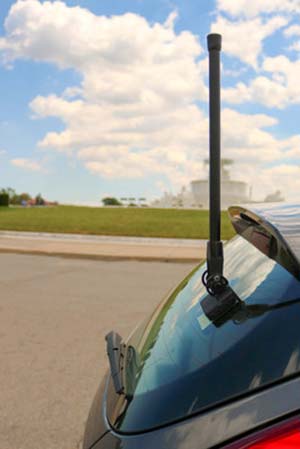
    Danlaw Inc. has released its Through Glass Integrated V2X Antenna for vehicle-to-vehicle and vehicle-to-everything (V2X) communications.

    The design incorporates an integrated GNSS antenna on the interior coupler. Optional cellular, Wi-Fi, and other antennas are also available on request.

    The antenna pairs with dedicated short-range communications (DSRC) devices to enable vehicle-to-vehicle, and vehicle-to-infrastructure communications.

    Traditional aftermarket antennas require drilling holes or passing cables through window and door openings, which risks damaging vehicle seals.

    Danlaw’s dual-radio, glass-mounted antenna eliminates the risk of damaging the vehicle by using a coupling pair-to-pass DSRC signals between the vehicle’s interior and exterior.

    The easy-to-install antenna can be mounted on the rear, front or side windows using automotive grade glass adhesive. This flexible installation allows the shortest cable route to the V2X device, reducing signal losses due to cable length, the company said.

    “Our customers running pilot programs want to install V2X DSRC systems on vehicles with best-in-class RF performance without modifying their cars,” said Scott Morell, Danlaw’s vice president of engineering. “Combined with our Aftermarket V2X Safety Device, this enables V2X capabilities to be installed on vehicles simply and easily.”

    The antenna enhances Danlaw’s Connected Vehicle portfolio which includes an aftermarket safety device (ASD) and V2X development tools.

    The ASD has been selected by pilot programs supporting multiple applications, including critical safety advice, driver access solutions, and real-time road condition and congestion information.

    Danlaw development tools include the OmniAir-certified Mx-DSRC Conformance Test System and Mx-Drive Mobility Simulator.

    Detailed specifications for the antenna are available.

  • Connected car considerations: Industry viewpoints on standardization, safety and more

    Connected car considerations: Industry viewpoints on standardization, safety and more

    This article presents short segments from each of the four speakers on GPS World’s June Connected Car webinar, sponsored by u-blox. The one-hour webinar with presentation slides is now available on demand.

    Chaminda Basnayake, Principal Engineer, V2X Systems, Renesas Electronics

    In the basic V2X concept of operation, everybody will be talking to each other, will be aware of each other. Any car will be broadcasting BSMs, pedestrian or personal devices will be broadcasting an equivalent message, called personal safety messages (PSM), and then all the control devices like traffic control will broadcast signal-based timing information, SPAT messages, intersection maps and GPS correction data.

    The expectation in the system design is that all vehicles will provide position information and location accuracy, and the vehicle should be able to get this from itself and from others.
    The idea is that every vehicle should be able to relatively position everyone else, and then with the onboard device, the vehicle should be able to position itself with respect to the roadway.

    A lot of applications are out there. A good source of further information on these is put together by the Connected Vehicle Reference Implementation Architecture, a U.S. Department of Transportation initiative.

    Connected Car Gateway for applications such as emergency calling, telematics, infotainment data distribution and usage-based insurance. (Image: u-blox)
    Connected Car Gateway for applications such as emergency calling, telematics, infotainment data distribution and usage-based insurance. (Image: u-blox)

    John Kenney, Director and Principal Researcher, Network Division, Toyota InfoTechnology Center

    A couple of issues are hot today with regard to spectrum and how we’re going to use it: what kinds of technology to use to support V2X, in the United States and around the world, and also whether that spectrum can be shared by other technologies for other purposes.

    V2X is an inherently ad hoc network, and that makes evolution across generations a much more challenging task than we are used to seeing in the cellular environment.

    Dedicated Short-Range Communication (DSRC) technology is now mature, and it’s entering the deployment phase. The cellular V2X technology that’s in the initial standardization is interesting; it offers benefits by complementing DSRC, but we don’t want to see it positioned as a competitor. The auto industry wants to remove uncertainty (regarding spectrum sharing) but only in a way that does not threaten DSRC’s safety-of-life mission.

    Nikolaos Papadopoulos, President, u-blox America

    The adjacent figure shows an in-vehicle module for emergency calling, other positioning applications and infotainment. The blue boxes show the components that we supply: the GNSS with three-dimensional dead reckoning, and in the future with lane-level accuracy, the TOBY 4000 with the customer application, as well as Wi-Fi, Bluetooth and near-field communications.

    I have shown examples in this webinar where we can clearly identify lane changes with a combination of GNSS technologies.

    We very much encourage both Tier Ones and OEMs to keep the cellular technology, the short-range communication technology, and the GNSS positioning technology separate. The advances in GNSS and positioning for autonomous vehicles are truly extraordinary, and can only be done in the separate GNSS technology.

    How to Put the Car on a Map? Positioning technology options. (Image: Renesas Electronics)
    How to put the car on a nap? Positioning technology options. (Image: Renesas Electronics)

    Roger Berg, Vice President, Wireless Technologies, DENSO North American R&D Laboratories

    The video example that I showed here, of advance warning of a braking car hidden from your line of sight ahead of you, used a Toyota vehicle, a u-blox positional element, and a Renesas V2V component.

    We’ve learned through experience that one company can’t do it all. This is an ecosystem that requires connectivity and cooperation. No longer is a vehicle its own entity; it does not operate separate from infrastructure and other road users. And finally, we can’t necessarily predict how connected and automated drivers interact with so-called regular vehicles, those controlled by human drivers. It’s going to take a lot of collaboration between industry, academia and government to be effective.