Tag: early warning

  • US West Coast now has access to GNSS-powered ShakeAlert app

    US West Coast now has access to GNSS-powered ShakeAlert app

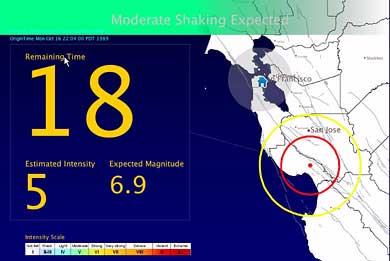
    After 15 years of planning and development, the ShakeAlert earthquake early warning system is now available to more than 50 million people in California, Oregon and Washington, the most earthquake-prone region in the conterminous U.S.

    ShakeAlert provides alerts to the general public through public alert systems such as TV, radio and mobile phones. It also slows down trains, opens firehouse doors, closing water and gas valves and

    May’s addition of Washington State to the system completes the U.S. Geological Survey and partners’ West Coast rollout of ShakeAlert.

    ShakeAlert first launched in California in 2019 and expanded to Oregon in March of this year. People in all three states can now receive alerts from FEMA’s Wireless Emergency Alert system, third-party phone apps, and other technologies.

    The ShakeAlert system relies on sensor data from the USGS Advanced National Seismic System. ANSS is a USGS-facilitated collection of regional earthquake monitoring networks operated by partner universities and state geological surveys on the West Coast and throughout the nation.

    Part of that data comes from GPS, which the USGS uses to measure crustal deformations over time. The USGS measures the precise position (within 5 mm or less) of GNSS stations near active faults relative to each other.

    USGS works closely with ANSS partners and state emergency management agencies on the system’s development as well as public communication, education and outreach.  “USGS science is the backbone of hazard assessment, notification, and response capabilities for communities nationwide so they can plan for, and bounce back from, natural disasters,” said David Applegate, associate director for Natural Hazards Exercising the Delegated Authority of the USGS Director.


    See also:

    Early earthquake warnings: GNSS could enable 10-second alerts


    “Systems powered by ShakeAlert can turn mere seconds into opportunities for people to take life-saving protective actions or for applications to trigger automated actions that protect critical infrastructure,” Applegate said. “An effort like this takes the dedication, ingenuity and hard work of dozens of partners with the same vision, and the USGS is proud to have been part of a collaborative team that made this robust public safety system available for millions of citizens on the West Coast.”

    The ShakeAlert earthquake early warning system can save lives and reduce injuries by giving people time to take protective actions like drop, cover and hold on before potentially dangerous earthquake shaking arrives at their location.

    In addition to supporting public alerts to mobile phones, ShakeAlert system data has, since late 2018, been used to develop applications that trigger automated actions. Automatic actions can be used to slow down trains to prevent derailments, open firehouse doors so they don’t jam shut and close valves to protect water and gas systems.

    The technology will continue to improve over time with the addition of more seismometers to the network, by expanding alert delivery area and by improving messaging speeds.
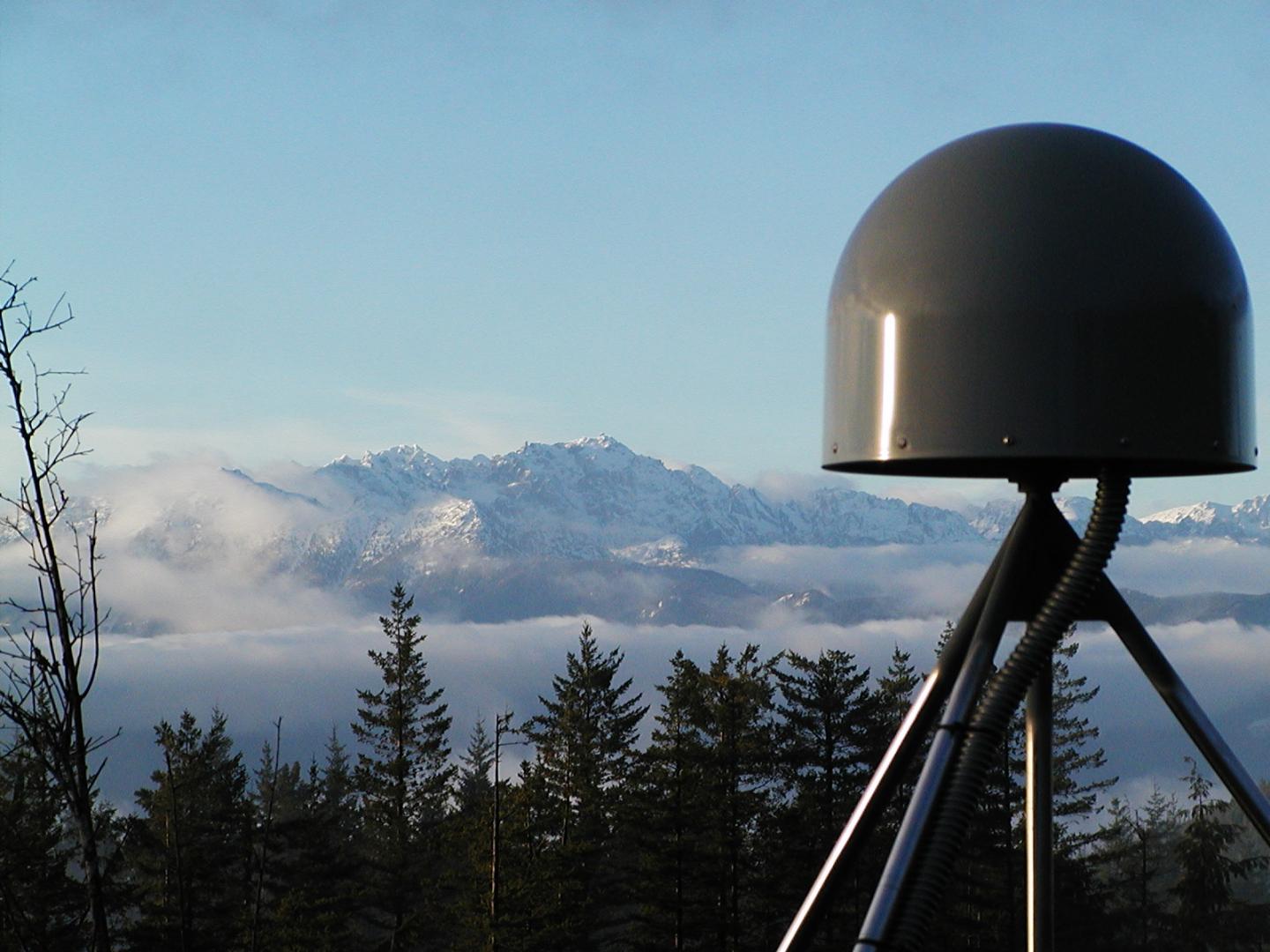
    A GNSS station in the Pacific Northwest geodetic array. (Photo: Central Washington University)
    A GNSS station in the Pacific Northwest geodetic array. (Photo: Central Washington University)
  • GPS data help warn of rare tsunamis

    GPS data help warn of rare tsunamis

    Using data from GPS receivers and seismographs, three seismologists may have found a way to identify tsunami earthquakes in time to warn people

    A few times a century, a medium-sized earthquake causes a large and devastating tsunami. The most recent occurrence was in 2010, when a magnitude 7.8 earthquake off the Mentawai Islands in Indonesia set off a tsunami that was more than 50 feet high in some places, killing 509 people and displacing 15,000.

    While rare, these tsunami earthquakes are particularly dangerous because they can hit coastal communities within five to 15 minutes, before officials can issue a warning. Now, however, using data from GPS receivers and seismographs near the 2010 Mentawai event, three seismologists — Valerie Sahakian and Diego Melgar at the University of Oregon and Muzli Muzli at the Earth Observatory of Singapore — may have found a way to identify tsunami earthquakes in time to warn people.

    Very large earthquakes under an ocean break both the deeper part of a subduction zone, where one tectonic plate is sinking beneath another, as well as its shallow part, in a rapid motion that creates a tsunami. Tsunami earthquakes, on the other hand, happen almost entirely in the soft, weak section of a fault, moving slower and creating much more movement on or near the sea floor compared to earthquakes of the same size that happen in rigid rock. This creates much larger tsunamis than expected. A tsunami earthquake might have the same magnitude as an earthquake that occurs in rigid rock but produces much less of what seismologists call high-frequency energy.

    Currently, officials issue tsunami warnings within tens of minutes of detecting an earthquake above a certain magnitude within a certain distance of a coastal area. This method, however, fails in the case of tsunami earthquakes, which produce tsunamis that are disproportionate to their magnitude.

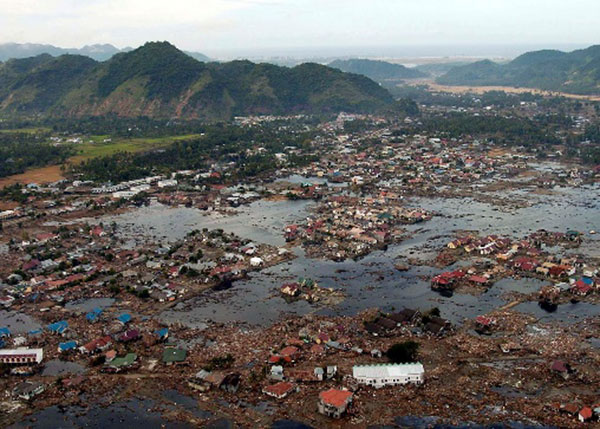
    Indian Ocean (Jan. 2, 2005): A village near the coast of Sumatra lays in ruin after the Tsunami that struck South East Asia. (Photo: U.S. Navy/Photographer's Mate 2nd Class Philip A. McDaniel)
    Indian Ocean (Jan. 2, 2005): A village near the coast of Sumatra lays in ruin after a tsunami struck South East Asia. (Photo: U.S. Navy/Photographer’s Mate 2nd Class Philip A. McDaniel)

    Traditionally, scientists have detected tsunami earthquakes by comparing their seismic magnitude with the amount of high-frequency energy they radiate, both recorded by distant stations. Tsunami earthquakes have a very low ratio of energy to magnitude; their energy, instead of strong shaking, produces a large slow movement of the seafloor.

    In the past, scientists had to measure this ratio using seismic waves that had traveled from the earthquake’s epicenter to seismographs hundreds or thousands of miles away. This did not give them enough time to identify tsunami earthquakes and warn people before the tsunami’s wave hit the coast.

    The recent analysis, however, enabled scientists to figure out a faster way to identify these rare tsunami earthquakes by using two proxies:

    • data from seismic stations onshore near the epicenters of 16 earthquakes that measured directly how much the ground shook in each case, to determine the amount of high frequency energy in each earthquake, and
    • data from GPS stations close to the earthquakes, to measure the magnitude of each one on the basis of how much it moved the ground.

    The GPS stations used in this study were from the Badan Informasi Geospasial (BIG) network from Indonesia. The data were acquired in real-time but processed with final orbits and clocks using precise point positioning (PPP). The scientists averaged the 3-component displacement, using centimeter-level solutions, and saw 3-10 centimeter vertical displacement.

    This methodology, using data available during and immediately after an earthquake, enables scientists to compare the amount of energy in each earthquake with its magnitude, without waiting for their seismic waves to travel to distant measuring stations. Seismologists will be able to use this approach to identify tsunami earthquakes immediately and warn nearby coastal communities before a tsunami wave reaches them.

    Citation. Sahakian, V. J., Melgar, D., & Muzli, M. (2019). “Weak near-field behavior of a tsunami earthquake: Toward real-time identification for local warning.” Geophysical Research Letters, 46(16), 9519–9528.

  • GNSS earthquake early-warning tested in Chile

    Researchers testing a satellite-based earthquake early warning system developed for the U.S. West Coast found that the system performed well in a “replay” of three large earthquakes that occurred in Chile between 2010 and 2015, reports the Seismological Society of America.

    The results, reported in the journal Seismological Research Letters (SRL), suggest that such a system could provide early warnings of ground shaking and tsunamis for Chile’s coastal communities in the future.

    The early warning module, called G-FAST, uses ground motion data measured by GNSS to estimate the magnitude and epicenter for large earthquakes — those magnitude 8 and greater. These great quakes often take place at subducting tectonic plate boundaries, where one plate thrusts beneath another plate, as is the case off the coast of Chile and the U.S. Pacific Northwest.

    Using data collected by Chile’s more than 150 GNSS stations, Brendan Crowell of the University of Washington and his colleagues tested G-FAST’s performance against three large megathrust earthquakes in the country: the 2010 magnitude 8.8 Maule, the 2014 magnitude 8.2 Iquique, and the 2015 magnitude 8.3 Illapel earthquakes.

    G-FAST was able to provide magnitude estimates between 40 to 60 seconds after the origin time of all three quakes, providing magnitude estimates that were within 0.3 units of the known magnitudes. The system also provided estimates of the epicenter and fault slip for each earthquake that agreed with the actual measurements, and were available 60 to 90 seconds after each earthquake’s origin time.

    “We were surprised at how fast G-FAST was able to converge to the correct answers and how accurately we were able to characterize all three earthquakes,” Crowell said.

    Most earthquake early warning systems measure properties of seismic waves to quickly characterize an earthquake. These systems often cannot collect enough information to determine how a large earthquake will grow and as a result may underestimate the earthquake magnitude—a problem that can be avoided with satellite-based systems such as G-FAST.

    It’s difficult to test these types of early warning systems, Crowell noted, because magnitude 8+ earthquakes are relatively rare. “We decided to look at the Chilean earthquakes because they included several greater than magnitude 8 earthquakes, recorded with an excellent and consistent GNSS network. In doing so, we would be able to better categorize the strengths and weaknesses in G-FAST.”

    ShakeAlert

    The Chilean tests will play a part in furthering developing G-FAST for use in the U.S., where Crowell and colleagues have been working to include it in the prototype earthquake early warning system called ShakeAlert, now operating in California, Oregon and Washington. The Chilean earthquakes, Crowell said, represent about half of magnitude 8 events in the recorded catalog of earthquakes that are used to test G-FAST and other geodetic algorithms for inclusion in ShakeAlert.

    Ten magnitude 8 or greater earthquakes have occurred along the Chilean coast in the past 100 years, including the 1960 magnitude 9.5 Valdivia earthquake, which is the largest earthquake recorded by instruments. “The hazard due to these large events is well recognized and understood,” in Chile, wrote Sergio Eduardo Barrientos of the Universidad de Chile, in a second paper published this week in SRL. “Return periods for magnitude 8 and above events are of the order of 80 to 130 years for any given region in Chile, but about a dozen years when the country is considered as a whole.”

    After the 2010 Maule earthquake, the country began installing a network of digital broadband seismic and ground motion stations, GPS stations, and GNSS stations to provide accurate information for tsunami warnings and damage assessment. Since 2012, the Centro Sismológico Nacional at the Universidad de Chile has operated more than 100 stations, and has recently begun to operate almost 300 strong-motion accelerometers that measure ground shaking.

    In a third paper published in SRL, Felipe Leyton of the Universidad de Chile and colleagues analyze data collected from 163 of these strong-motion stations to learn more about the local site conditions of underlying rock and soil in these areas. Site conditions can modify the shaking of large earthquakes and control the damage to buildings and other infrastructure caused by the shaking.

    The new study “gives us a unique opportunity to improve our knowledge of the behavior of soil deposits during earthquakes, especially in urbanized areas,” write Leyton and colleagues, who say the data could be used to help improve building designs and codes.

  • JPL Team Uses GPS for Tsunami Early Warning


    Led by Dr. Attila Komjathy, who received his Ph.D. from the University of New Brunswick in 1997, a team from NASA’s Jet Propulsion Laboratory has demonstrated a technique that has the potential to significantly improve tsunami monitoring and warning.

    The technique uses data from multiple Global Positioning System receivers on the ground to measure small perturbations in the ionosphere’s electron density caused by a tsunami.

    The changing sea level of a tsunami, even far from a coast, generates waves in the atmosphere that make it all the way up to the ionosphere, some 350 kilometres or so above the sea surface. Here, they disturb the electrons that affect the propagation of GPS signals. The disturbance is so small that ordinary GPS receivers do not notice the passage of the waves. However, with advanced software processing of the data collected by specialized receivers used, for example, by surveyors and geodesists, the waves can be visualized and used to track the progress of the tsunami.

    The JPL team has dramatically demonstrated their technique for the devastating tsunami associated with last year’s massive offshore Japanese earthquake. They used data from the more than 1,000 receivers of Japan’s permanent GPS monitoring network. The propagating ionospheric waves can be clearly seen in a video the team has posted to YouTube.

    The video can also be downloaded from the GGE website.

    An earlier report on NASA’s tsunami-detection work can be found here.

    NASA is investing in research to obtain real-time GPS measurements from around the world so that researchers can integrate this technology into a global tsunami warning system. Additional potential applications might include the remote sensing of ionospheric perturbations generated by other natural hazards such as earthquakes and volcanic eruptions and human-made events such as nuclear tests.

    Dr. Komjathy was one of the first to investigate the use of GPS signals to study the ionosphere. His pioneering Ph.D. research under Prof. Richard Langley was awarded a Gold Medal from the Governor General of Canada.