The U.S. Department of Transportation on Wednesday released updated guidelines for autonomous vehicles.
“Ensuring American Leadership in Automated Vehicle Technologies: Automated Vehicles 4.0” (AV 4.0) was announced by U.S. Transportation Secretary Elaine L. Chao in a keynote speech at CES 2020 in Las Vegas.
AV 4.0 unifies efforts in automated vehicles across 38 federal departments, independent agencies, commissions and executive offices, providing high-level guidance to state and local governments, innovators and stakeholders on the U.S. government’s approach toward autonomous vehicles.
“AV 4.0 will ensure American leadership in AV technology development and integration by providing unified guidance for the first time across the federal government for innovators and stakeholders,” Chao said.
AV 4.0 establishes federal principles for the development and integration of automated vehicles, consisting of three core focus areas: prioritize safety and security, promote innovation, and ensure a consistent regulatory approach.
It also outlines ongoing administration efforts supporting autonomous vehicle technology growth and leadership, as well as opportunities for collaboration including federal investments in the sector and resources for innovators, researchers and the public.
“AV 4.0 brings all of the important work happening on automated vehicle technologies across the federal government under one unified approach. The federal principles released today help foster an environment for innovators to advance safe AV technologies, and put the U.S. in a position of continued leadership in the future of transportation,” said U.S. Chief Technology Officer Michael Kratsios.
The USDOT is preparing for emerging technologies by engaging with new technologies to address legitimate public concerns about safety, security and privacy without hampering innovation, the department said in a press release.
With the release of “Automated Driving Systems 2.0: A Vision for Safety” (ADS 2.0) in September 2017, the USDOT provided voluntary guidance to industry, as well as technical assistance and best practices to states, offering a path forward for the safe testing and integration of Automated Driving Systems.
In October 2018, “Preparing for the Future of Transportation: Automated Vehicles 3.0” (AV 3.0) introduced guiding principles for autonomous vehicle innovation for all surface transportation modes, and described the USDOT’s strategy to address existing barriers to potential safety benefits and progress.
“AV 4.0 builds on these efforts by presenting a unifying posture to inform collaborative efforts in automated vehicles for all stakeholders and outlines past and current federal government efforts to ensure the United States leads the world in AV technology development and integration while prioritizing safety, security, and privacy and safeguarding the freedoms enjoyed by Americans,” the press release stated.
AV 4.0 will be published in the Federal Register for public review and comment. More information on the USDOT’s work on automated vehicles can be found at https://www.transportation.gov/av/4.
The Federal Railroad Administration (FRA) has awarded $46,301,702 in grant funding for 11 projects in 10 states to assist with deploying positive train control (PTC) systems.
This marks the second selection of PTC systems deployment projects under the Fiscal Year (FY) 2018 Consolidated Appropriations Act and via the Consolidated Rail Infrastructure and Safety Improvements (CRISI) Program, collectively totaling $250 million in funding.
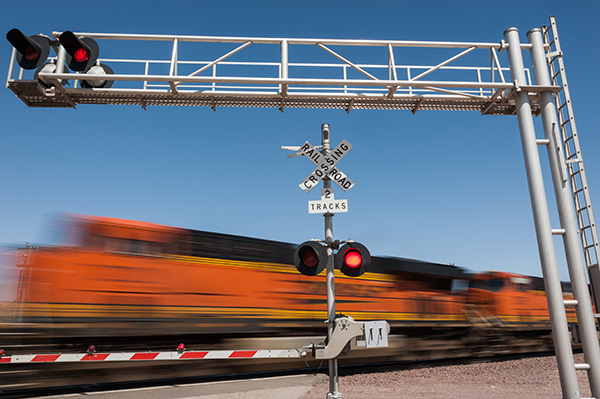
Photo: gabriel12/Shutterstock.com
“These $46 million in grants will speed up the deployment of positive train control systems, a key element in strengthening safety for both passenger and freight railroads,” U.S. Transportation Secretary Elaine L. Chao said. “Each recipient will be held accountable for achieving specific, measurable outcomes.”
The CRISI Program was authorized by the Fixing America’s Surface Transportation (FAST) Act to provide funding to improve the safety, efficiency, and reliability of intercity passenger rail and freight rail transportation systems. The FY 2018 Consolidated Appropriations Act provided $592,547,000 for the CRISI Program, with $250,000,000 to be made available for PTC system deployment. On August 24, 2018, FRA announced $203.7 million in grant awards for PTC implementation to 28 projects in 15 states.
“These grants not only help railroads continue to make progress implementing positive train control, but they also show that we’re steadfast in our commitment to make investments in passenger rail and rural communities,” said FRA Administrator Ronald L. Batory.
In this second round of FY 2018 PTC CRISI grants, 100 percent of the funds will benefit passenger rail, with about 31 percent — or $14 million — benefiting rural projects. The CRISI grant program directs much-needed critical investment — at least 25 percent of available funds — to rural America.
The awards will fund many aspects of PTC system implementation for intercity passenger or commuter rail and freight rail transportation, including back office PTC systems; wayside, communications, and onboard PTC system equipment; personnel training; PTC system testing; and interoperability.
In 2008, Congress mandated implementation of PTC systems on the main lines of Class I railroads and entities providing regularly scheduled intercity or commuter rail passenger transportation over which hazardous materials are transported, or over which intercity or commuter rail passenger transportation is regularly provided.
In October 2015, Congress extended the original PTC system implementation deadline from Dec. 31, 2015, to Dec. 31, 2018. In addition, Congress requires FRA to approve a railroad’s request for an “alternative schedule” with a deadline for full implementation beyond Dec. 31, 2018, but not later than Dec. 31, 2020, if the railroad demonstrates it has met the congressionally mandated criteria for an alternative schedule.
FRA awarded grants in the approximate amounts below to the following programs and entities:
AK – GPS Precision Upgrade for PTC (Up to $2,530,618) Alaska Railroad Corporation (ARRC)
For this rural project, ARRC will procure a platform with software to improve the accuracy and functionality of the global positioning system (GPS) in ARRC’s locomotives and on-track equipment, and implement the vital functions for its Interoperable Electronic Train Management System (I-ETMS).
CA – PTC Configuration Management and Office Segment Failover (Up to $3,976,560) Peninsula Corridor Joint Powers Board (Caltrain)
To implement Caltrain’s I-ETMS PTC system, this grant will fund the completion of a Caltrain PTC Configuration Management (CM) Plan and PTC Data Management Procedure; development of a CM tool that generates an audit trail for changes to configuration data and CM training on the configuration control and CM process; completion of the backup central control facility (BCCF) and Central Control Facility Failover Design and Test Plan; and completion of the design, test results, and as-built system for an Emergency Operation Center at the existing BCCF in Menlo Park, Calif.
CA – Leveraging PTC to Increase Capacity and Reduce Headways and Alternative Vendor Analysis (Up to $3,150,000) Southern California Regional Rail Authority (SCRRA or Metrolink)
This project will include a study for leveraging PTC to increase capacity and reduce headways, software development, PTC component upgrades, and/or corridor infrastructure upgrades to support the future implementation of Higher Reliability and Capacity Train Control (HRCTC) along Metrolink’s congested Orange County Line from Los Angeles Union Station to Oceanside, Calif.
CO – PTC Installation for the Amtrak Southwest Chief on BNSF Railway Through Colorado and Kansas (Up to $9,157,600) Colorado Department of Transportation (CDOT)
This rural project from CDOT, in collaboration with the Kansas Department of Transportation (KDOT) and BNSF, includes the design, installation, and testing of I-ETMS PTC wayside technology on approximately 179 miles of a predominantly single-track route between Dodge City, Kan., and Las Animas, Colo.
IL – PTC Kits and Spare Parts for 24 Additional Locomotives at Metra (Up to $2,058,163) Commuter Rail Division of the Regional Transportation Authority (Metra)
The project includes purchasing and installing onboard I-ETMS PTC equipment on Metra’s 24 recently purchased locomotives.
MA – MBTA PTC Implementation (Up to $7,548,335) Massachusetts Bay Transportation Authority (MBTA)
This project on the Needham Branch, Franklin Branch, and Worcester Line, includes two components: 1) Testing of Automatic Train Control (ATC), where the previously installed PTC/ATC equipment on each line is already wired, and the software is loaded, connected to the signal system, and activated. The testing is intended to confirm the equipment functions as designed and is ready for testing with a test train. 2) “Completion of Commissioning for the ATC Lines,” where final acceptance testing is performed, including interoperability and ATC system testing.
NC – NCDOT Rolling Stock PTC Commissioning (Up to $584,080) North Carolina Department of Transportation (NCDOT)
The project includes installing, testing, commissioning, and certifying I-ETMS PTC onboard technology on three NCDOT locomotives for operation in the Piedmont intercity passenger rail service, which operates between Raleigh and Charlotte, N.C.
NJ – PTC Installation on Multi-level Cab Cars (Up to $6,542,353) New Jersey Transit Corporation (NJT)
This project will install and test Advanced Speed Enforcement System II (ASES II) PTC onboard equipment on 33 new NJT multilevel cab cars for deployment along the Northeast Corridor, Montclair-Boonton, and Morris & Essex Lines in New Jersey.
NM – New Mexico Rail Runner Express PTC/Wi-Fi Integration Project (Up to $2,496,842) Rio Metro Regional Transit District (Rio Metro)
This rural project will restore the New Mexico Rail Runner Express (NMRX) system’s Wi-Fi network from an end-of-life, proprietary WiMAX system to a cross-compatible Long-Term Evolution (LTE) system, providing a redundant path of communication for its I-ETMS PTC system. The project will install 26 towers along the 96 miles of the NMRX system between Belen, N.M. and Santa Fe, N.M., including approximately 74 miles of the Albuquerque Subdivision and 22 miles of the Santa Fe Subdivision. Nine NMRX cab cars, 13 coach cars, and 15 NMRX stations will be equipped with the Wi-Fi technology necessary for its PTC system.
NY – MTA Metro-North Railroad PTC Communications Testing (Up to $2,300,000) NY Metropolitan Transportation Authority (MTA)
This project will involve PTC system testing to measure communications system performance to predict, identify, and replicate communications issues affecting MTA’s Metro-North Railroad’s operations, as well as develop and validate mitigation approaches to address communications challenges along the Northeast Corridor.
TX – Capital Metro E-ATC PTC Wayside Installation Project (Up to $5,957,151) Capital Metropolitan Transportation Authority (Capital Metro)
This project includes the design, installation, and verification of the Enhanced Automatic Train Control PTC wayside system on the new tracks along Capital Metro’s Red Line in the cities of Austin, Cedar Park, Leander, and the surrounding Texas communities. The new project spans a 21-mile section along the Red Line on Capital Metro’s commuter rail corridor.
The Federal Railroad Administration (FRA) awarded $203,698,298 in grant funding for 28 projects in 15 states to assist with the deployment of positive train control (PTC) systems.
The $203 million in grants is part of the total $250 million specifically appropriated under the Consolidated Appropriations Act of 2018 for the implementation of PTC systems, via the Consolidated Rail Infrastructure and Safety Improvements (CRISI) program.
“These $200 million in grants will help the railroads continue to implement positive train control, a technology that could help reduce accidents and save lives,” said U.S. Transportation Secretary Elaine Chao.
The awards fund many aspects of PTC system implementation for intercity passenger or commuter rail and freight rail transportation, including back office PTC systems; wayside, communications, and onboard PTC system equipment; personnel training; PTC system testing; and interoperability.
Second-quarter PTC data
In addition, FRA released its second-quarter update on railroads’ self-reported progress toward implementing PCT systems. As of June 30, 15 railroads have installed 100 percent of the PCT system hardware that must be installed for implementation, based on a review of the railroads’ PTC Implementation Plans and quarterly progress reports for the second quarter of 2018. Twelve other ailroads have installed between 95 and 99 percent of the PTC system hardware identified in their PTC Implementation Plans.
According to FRA, this marks improvement from December 2016, where freight railroads had PTC active on just 16 percent of required tracks, while passenger railroads were at 24 percent.
In addition, second quarter data shows a 25 percent drop in the number of “at risk” railroads from 12 to nine. FRA considers any railroad that installed less than 90 percent of its PTC system hardware as of June 30 to be at risk.
“The railroads have achieved some significant improvements over the past year implementing this safety technology,” said FRA Administrator Ronald Batory. “While we are seeing progress among a majority of railroads, we want to see everyone meet their requirements.”
Awards Granted
When choosing the recipients of the grants, the FRA considered a number of factors, including supporting economic vitality; leveraging federal funding; using innovative approaches to improve safety and expedite project delivery; and holding grant recipients accountable for achieving specific, measurable outcomes.
Under the CRISI Program, at least 25 percent of funds are available for rural projects, the FRA said. In addition, federal funds awarded for CRISI grants must not exceed 80 percent of the total cost of a project, and the required 20 percent non-federal share may be composed of public sector (state or local) or private-sector funding, or both.
Agencies that received grants are:
Alaska Railroad Corporation
California Department of Transportation
Peninsula Corridor Joint Powers Board
Sonoma-Marin Area Rail Transit
Southern California Regional Rail Authority
Florida Department of Transportation
Iowa Interstate Railroad
Iowa Northern Railway Company
Belt Railway Company of Chicago
Chicago Rail Link
Commuter Rail Division of the Regional Transportation Authority
Chicago South Shore & South Bend Railroad
Northern Indiana Commuter Transportation District
Massachusetts Bay Transportation Authority
Springfield Terminal Railway Company (ST)/Pan Am Railways
U.S. Secretary of Transportation Elaine Chao has launched an initiative to safely test and validate advanced drone operations in partnership with state and local governments in select jurisdictions.
Prospective local government participants are asked to partner with the private sector to develop pilot proposals. After evaluating all of the applications, USDOT will invite a minimum of five partnerships.
The department also will publish a Federal Register Notice with more details about how applications will be evaluated and how the program will work.
More about the program is available on the DOT website.
The program will help tackle the most significant challenges in integrating drones into the national airspace while reducing risks to public safety and security, USDOT said. The program is designed to provide regulatory certainty and stability to local governments and communities, UAS owners and operators who are accepted into the program.
In less than a decade, the potential economic benefit of integrated unmanned aerial systems into the nation’s airspace is estimated to equal up to $82 billion and create up to 100,000 jobs, according to an economic report by the Association for Unmanned Vehicle Systems International (AUVSI).
The program will help the USDOT and Federal Aviation Administration (FAA) develop a regulatory framework to:
allow more complex low-altitude operations;
identify ways to balance local and national interests;
improve communications with local, state and tribal jurisdictions;
address security and privacy risks; and
accelerate the approval of operations that currently require special authorizations.
“This program supports the president’s commitment to foster technological innovation that will be a catalyst for ideas that have the potential to change our day-to-day lives,” Chao said. “Drones are proving to be especially valuable in emergency situations, including assessing damage from natural disasters such as the recent hurricanes and the wildfires in California.”
The pilot program will evaluate a variety of operational concepts, including night operations, flights over people, flights beyond the pilot’s line of sight, package delivery, detect-and-avoid technologies, counter-UAS security operations, and the reliability and security of data links between pilot and aircraft.
Industries that could see immediate opportunities from the program include commerce, photography, emergency management, precision agriculture and infrastructure inspections and monitoring.
“Stakeholders will have the opportunity through this program to demonstrate how their innovative technological and operational solutions can address complex unmanned aircraft integration challenges,” said FAA Administrator Michael Huerta. “At the same time, the program recognizes the importance of community participation in meaningful discussions about balancing local and national interests related to integrating unmanned aircraft.”