Tag: elevation data

  • Hexagon releases platform for defense mobile apps

    Hexagon releases platform for defense mobile apps

    Image: Hexagon
    Image: Hexagon

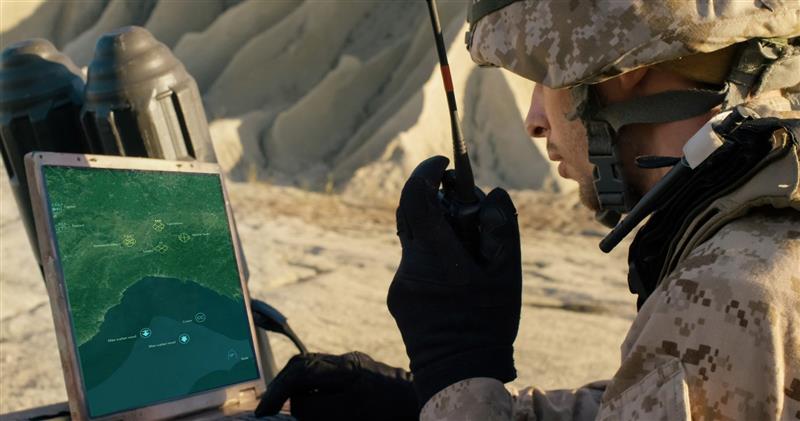
    Hexagon’s Safety, Infrastructure & Geospatial division has released for Android defense applications. The platform is designed for the development of mobile applications for dismounted soldiers in the field. 

    With LuciadCPillar, developers can build applications with 2D and 3D views. It features military symbology and supports many geospatial data types including vector data, raster data, elevation data, point clouds and 3D meshes. It has the same capabilities found in desktops, in-vehicle and browser applications built with LuciadLightspeed, LuciadCPillar and LuciadRIA. 

    The platform offers capabilities to match high-resolution screens, graphic processing units and multi-core processors including the ability to display 3D data in mobile applications. LuciadCPillar supports ARM processors and an application programming interface, which aligns with the Android developer experience. 

    Impact, a French system integrator, partnered with Hexagon to test LuciadCPillar and will integrate it into its Delta Suite product, which is used by the French Special Operations Command.  

    LuciadCPillar is part of Luciad 2022.1, which is available now globally.  

  • Open Geospatial Consortium Seeks Participants for Elevation-Data Experiment

    The Open Geospatial Consortium (OGC) announces a Call for Participation in the OGC GeoPackage Elevation Extension Interoperability Experiment (GPKG-EE IE).

    The OGC GeoPackage Standards Working Group (SWG) has identified a need to store tiled gridded elevation data in a GeoPackage. GeoPackage is an open, standards-based, platform-independent, portable, self-describing, compact format for transferring geospatial information. The SWG has developed a candidate extension to the GeoPackage Encoding Standard to support elevation data.

    This capability will be used to support use cases such as the following:

    • Visualization
      • 2D (hillshade, color relief, slope)
      • 3D (supporting changing view angles and level of detail)
    • Analysis
      • Viewshed and line-of-sight
      • Cross-country mobility (off-road routing)
      • Site suitability and planning (slope analysis such as helicopter landing zones)
      • 3D geometry representations of features (ground-based, airspace)
      • Terrain association (associating images to mapped locations)
      • Augmented reality based training

    The SWG proposes validating the extension by running an Open Geospatial Consortium Interoperability Experiment. An OGC Interoperability Experiment is a rapid, low overhead, formally structured OGC-facilitated activity in which members achieve specific technical objectives that further the OGC Standards Baseline. The GPKG-EE IE will test and refine the elevation extension. To do this, the SWG needs the international support and acceptance of a globally representative community that provides both domain and technical expertise to this project. While the OGC is a member-driven organization and the SWG needs a core of OGC members to support and initiate this work, non-members can participate as “observers.”

    The GPKG-EE IE will perform the following experiments:

    • Experiment #1: produce GeoPackages containing tiled gridded elevation data in accordance with the proposed extension.
    • Experiment #2: use the GeoPackages to perform visualization and/or analysis operations as described above.

    The results of the Interoperability Experiment will be documented in an OGC Engineering Report. In addition to the Engineering Report, a demonstration is tentatively scheduled for the OGC Technical Committee meeting in Washington, D.C., in March 2016.

    The OGC asks interested organizations to indicate their support and commitment to be involved in this Interoperability Experiment. A summary of the activity plan, requirements for participation, schedule, and kick-off meeting details are available. Contact details are included in the activity plan.

    Participants in the GPKG-EE IE, which will run until March 31, 2016, will test implementations and provide constructive comments on the exchange data model and resulting trial documentation. Experience has shown that those working in these initiatives gain valuable insights that can be used to improve existing information systems or fast-track the development of new systems. Participants gain sufficient expertise to start deploying working services for their existing data and local situations.

    The following OGC members proposed the GeoPackage Elevation Extension Interoperability Experiment:

    • Luciad, Belgium
    • Image Matters LLC
    • Compusult, Canada
    • U.S. Army Geospatial Center

    The OGC is an international geospatial standards consortium of more than 515 companies, government agencies, research organizations and universities participating in a consensus process to develop publicly available standards. OGC standards support interoperable solutions that “geo-enable” the Web, wireless and location-based services and mainstream IT.
  • Story Map: Mapping Liquid Water on Mars

    Mars-water-map-O2

    With NASA’s announcement on Monday that liquid water has been discovered on Mars, Esri has put together an interactive story map showing the craters and canyons on Mars that show evidence of water.

    Watch animations of the recurring slope lineae (water stains) across four different craters and explore satellite imagery and elevation data for the Red Planet.

    Below is an animation from the Jet Propulsion Laboratory showing seasonal flows in Hale Crater.

  • Highest Peak in North America to be Surveyed

    Highest Peak in North America to be Surveyed

    At 20, 320 feet, Mount McKinley is North America’s highest peak. (Photo courtesy of Todd Paris, UAF).
    At 20, 320 feet, Mount McKinley is North America’s highest peak. (Photo courtesy of Todd Paris, UAF).

    A new GPS survey of Mount McKinley, the highest point in North America, will update the commonly accepted elevation of McKinley’s peak, 20,320 feet. The last survey was completed in 1953.

    The USGS, along with NOAA’s National Geodetic Survey (NGS) and the University of Alaska Fairbanks (UAF), are supporting a GPS survey of the Mount McKinley apex. Surveying technology and processes have improved greatly since the last survey and the ability to establish a much more accurate height now exists, the USGS said.

    The Mount McKinley survey team, and their equipment, are expected to face temperatures well below zero, high winds and frequent snow. Current forecast, courtesy of NOAA. (Photo courtesy of Todd Paris, UAF).
    The Mount McKinley survey team, and their equipment, are expected to face temperatures well below zero, high winds and frequent snow. Current forecast, courtesy of NOAA. (Photo courtesy of Todd Paris, UAF).

    An experienced team of four climbers, one from UAF and three from CompassData, will start the precarious trek to the summit with the needed scientific instruments in tow, in the middle of June. They plan to return on or before July 7 and begin work with the University of Alaska Fairbanks and NGS processing the data to arrive at the new summit elevation.

    With the acquisition of new elevation (ifsar) data in Alaska as part of the 3D Elevation Program, there have been inquiries about the height of the summit. The survey party is being led by CompassData, a subcontractor for Dewberry on a task awarded under the USGS’ Geospatial Products and Services Contract (GPSC).

    Using modern GPS survey equipment and techniques, along with better gravity data to improve the geoid model in Alaska, the partners will be able to report the summit elevation with a much higher level of confidence than has been possible in the past.

    According to CompassData, the survey equipment includes two Trimble R10 antennas and one Trimble Net-R9 with a Zephyr-2 antenna. Also being taken up the mountain is a 10-meter specialized glacier avalanche probe and a Ground Penetrating Radar (GPR), courtesy of the University of Alaska Fairbanks.

    It is anticipated the newly surveyed elevation will be published by the National Geodetic Survey in late August.

    Climbing Mount McKinley, North America’s highest peak, is a daunting task for even the most experienced mountaineers at Denali National Park in Alaska. (Photo courtesy of National Geographic).
    Climbing Mount McKinley, North America’s highest peak, is a daunting task for even the most experienced mountaineers at Denali National Park in Alaska. (Photo courtesy of National Geographic).

  • DigitalGlobe, Saab Join on Vricon to Create the Globe in 3D

    Defense and security company Saab and DigitalGlobe Inc., a global provider of high-resolution earth imagery solutions, have created the joint venture Vricon Inc. to produce photo-realistic 3D products and digital elevation models for enterprise and government geospatial markets.

    Vricon combines Saab’s 3D technology and know-how with DigitalGlobe’s archive, which contains billions of square kilometers of high-quality commercial satellite imagery. Together, the Vricon joint venture will establish high-scale production capabilities that will make highly accurate photo-realistic 3D products and elevation data of the earth accessible via its visualization platform and standard- based data formats.

    Vricon serves the entire professional geospatial market, with an initial focus on defense, security, and infrastructure. Vricon’s technology enables imagery content to accurately represent all visible objects on the earth in 3D, and its products provide customers with value and utility, superior coverage relative to aerial-derived elevation models, and superior fidelity and availability relative to other satellite-derived models.

    DigitalGlobe and Saab will combine their strengths to both support and own Vricon. Under the agreement, Vricon will be headquartered in Reston, Va., with ownership set up as 50 percent DigitalGlobe and 50 percent Saab. “Our customers will benefit from global access to geospatial data of unprecedented quality. It is a win-win situation with long-term value creation for both parent companies, which will give us a market position ahead of competition,” said Magnus Brege, Vricon CEO.

    “By combining DigitalGlobe’s unrivaled imagery archive with Saab’s leading edge technology, we will deliver the globe in 3D at a scale never before possible,” said Jeffrey R. Tarr, DigitalGlobe President and Chief Executive Officer. “By delivering this breakthrough product to our customers, this collaboration will drive growth and shareowner value creation.”

    “The establishment of Vricon is another great example of Saab’s ability to leverage innovation and transform it into business value,” said Dan Jangblad, head of Saab business area Industrial Products and Services. “Together with DigitalGlobe, we are taking our revolutionary new 3D technology and applying it to benefit our global customer base. At the same time, we also take another step forward on our long-term path for growth in the United States.”