Tag: Esri Story Maps

  • Remembering U.S. history by mapping internment camp with UAV

    Remembering U.S. history by mapping internment camp with UAV

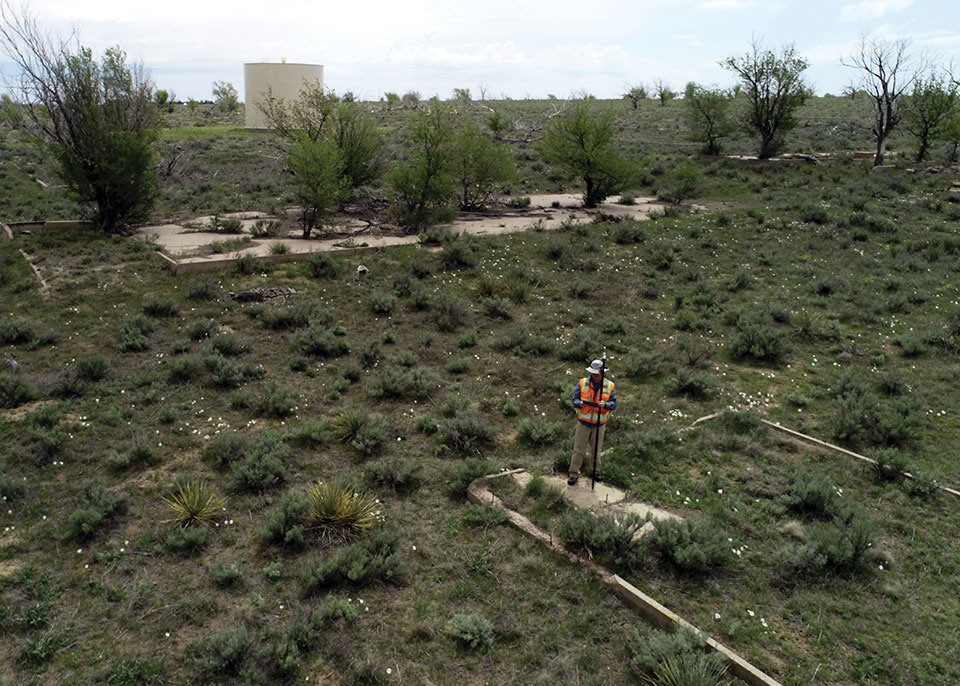
    Photo: Eos Positioning
    Photo: Eos Positioning

    It has been 78 years since 110,000 Japanese-Americans were forcibly interned in 10 camps across the United States.
    In 1942, President Franklin Roosevelt signed an executive order announcing their internment. When World War II ended in 1945, the 10 camps were unceremoniously abandoned. The people interned there, their descendants, and historical groups are now trying to preserve memory of the camps.

    A new Esri StoryMap from Eos Positioning Systems explores the stories of two men whose lives were connected by Amache Internment Camp in southeastern Colorado.

    In the first chapters, we meet Dennis Otsuji, a renowned landscape architect who was born at Amache in 1943. Then we meet Jim Casey, GIS user and philanthropist on a quest to preserve Amache. Besides using Esri ArcGIS Online tools, Casey used the Arrow Gold GNSS receiver from Eos Positioning Systems for ground control points.

    In an unlikely story twist, Otsuji and Casey happened to meet when Otsuji went searching for his past, just as Casey was working to preserve the past. The StoryMap ends with the first augmented-reality look at Amache.

    The project — selected for Esri Favorite Stories of 2020 — was 10 years in the making. Learn more at Mapping Amache.

  • US wildfires mapped and placed in context

    US wildfires mapped and placed in context

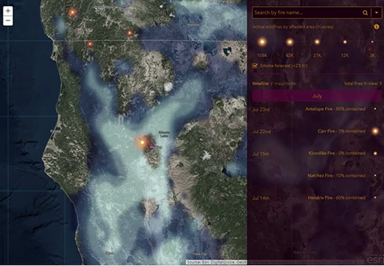
    An Esri Storymap provides a quick snapshot of the raging fires across the United States and provides context to the severity of the California fires.

    The interactive map can be explored by panning and zooming. Click on a fire and information about that particular fire is displayed including the start date, containment and links to the latest news and social information.

    Esri Story Maps let users combine authoritative maps with text, images and multimedia content. It harnesses the power of maps and geography to tell a story in an easy and understandable format, the company said.

    The Story Map uses the ArcGIS Javascript API and is linked to interactive timelines and magnitude displays. The cartography uses AGOL Firefly symbology — radial gradients — and a dark basemap.

    The fires and perimeters are a service of the GeoMAC community that uses the Geospatial Multi-Agency Coordination, an internet-based mapping application that is designed for fire managers to access online maps of current fire locations and perimeters in the United States.

    Members of GeoMAC include:

    • U.S. Geological Survey
    • National Interagency Fire Center
    • National Weather Service
    • Bureau of Land Management
    • Remote Sensing Application Center
    • National Geophysical Data Center.

    The data is updated manually based on information from a host of sources including those on the ground. Typically, the data is fresh to about 24 hours, but there is variability because it is a carefully curated process.

    Diving deeper for information

    Esri has updated the app based on feedback from many different groups including firefighting professionals, those directly affected by fires, and those concerned about loved ones affected by fires. Some of the updates include the addition of the National Weather Service (NWS) animated smoke risk forecast, visualized to more directly represent smoke (see below).

    The NWS animated smoke risk forecast is now integrated into Esri's Story Map app. (Screenshot: Esri)
    The NWS animated smoke risk forecast is now integrated into Esri’s Story Map app. (Screenshot: Esri)

    Another is the addition at finer scales of satellite-detected hot spots to indicate fire direction — sensors. Many Earth-observing satellites contain sensors capable of detecting the infrared energy released by fires. Not only can the hotspots be located, but areas of burned land can also be identified based both on their thermal characteristics and visible appearance. In Esri’s ArcGIS Living Atlas of the World, the MODIS Thermal Activity layer provides daily updated global hotspot locations.

    In the U.S., the USA Wildfire Activity layer in the Living Atlas provides a more quality controlled version of the data. It shows only wildfires submitted to the USGS by fire agencies, as opposed to all of the other events that can cause an automated satellite-based hotspot detection. However, since this layer relies on human analysis, sometimes it doesn’t update as frequently as the MODIS hotspots. The layer also contains the perimeter of the fire area. Both current (active) and older (inactive) fires are included.

    While the weather-focused satellites from NOAA and NASA provide high temporal resolution fire data, really detailed analysis of the fire impact is often left to moderate resolution multispectral imaging satellites such as Landsat 8 and Sentinel-2, or commercial high-resolution satellites. That is the benefit of the multispectral capabilities of the Sentinel-2 satellite, now available in the Living Atlas. Sentinel-2’s infrared sensitivity (Channel 12; 2.19 micron band) provides the ability to identify areas of active fires, much like NOAA-20 or Aqua/Terra, but at 20m resolution.

    In addition to visualizing active fire areas, multispectral imagery is also effective at assessing burn scars. Besides the ecosystem impact, denuded vegetation along sloped areas can lead to landslides, especially when combined with heavy rains.

  • 6 story maps show how data can illustrate the world

    Story maps combine geographic data with  multimedia to tell a story and present information in a useful, interesting way. 

    While many story maps are designed for general, non-technical audiences, some story maps can also serve highly specialized audiences. They use the tools of GIS, and often present the results of spatial analysis, but don’t require their users to have any special knowledge or skills in GIS.

    This has resulted in a veritable explosion of story maps.

    “Story maps use geography as a means of organizing and presenting information. They tell the story of a place, event, issue, trend or pattern in a geographic context,” explains Esri’s press staff in a blog. “They combine interactive maps with other rich content — text, photos, illustrations, video and audio — within intuitive user experiences.”

    Haven’t yet dipped your toe into Story Maps? This Esri blog takes users through story map creation step by step.

    Below are six visual narratives that provide timely information using Esri’s Story Map creation tools.

    Faces Show Personal Impact of Opioid Epidemic

    The National Safety Council is adopting the Celebrating Lost Loved Ones map, which allows family and friends of those lost to the opioid epidemic to place an image and description of their late loved one on an interactive map. The project helps raise awareness of the broad impact of the opioid crisis and advances the council’s mission of ending opioid deaths. Unintentional opioid overdose deaths totaled 37,814 in 2016.

    Jeremiah Lindemann, a solution engineer for Esri, created the map in 2016 following the death of his younger brother. Since its launch, the map has gathered more than 1,300 memorials from people across the U.S.

    The map has been a crowdsourced effort, allowing grieving friends and family members to honor their loved ones, share their stories with others and find a supportive community in return.

    Communities Potentially Affected by DACA Policy Changes

    When elected officials talk about changing our immigration system, just who and where are people affected? That’s the question Esri is trying to help answer with a new interactive story map that explores communities with the highest shares of non-citizen residents and DACA (Deferred Action for Childhood Arrivals) recipients.

    The map shows estimates on DACA eligible, recipients, and annual GDP loss from removing DACA workers by congressional district. Data comes from USC’s Dornsife Center for Immigrant Integration.

    The size of the symbol shows the estimate of DACA recipients, and the color of the symbol shows the estimated GDP loss from removing DACA workers. This map shows that the economies of many states in the Southwest and several major urban cities could be substantially disrupted if DACA recipients are no longer permitted to work.

    The Ever-Changing Minimum Wage

    National, state and local government policies toward the minimum wage vary widely and are continually changing. On Jan. 1, new or adjusted minimum wage policies took effect in 18 states and territories. Varying rates, policies, and impacts across the nation make it challenging to understand the minimum wage landscape.

    This Esri story map provides an overview of the the nation’s changing minimum wage policies. A few notable findings:

    • At the highest level, the variability of minimum wage policies from state to state is striking — this ranges from some states in the South that don’t even require a minimum wage, to places like D.C. that have a $12.50 minimum wage (currently the highest for a state or territory).
    • Similarly, the number of cities and counties that have taken it upon themselves to raise wages locally is impressive; these cities and counties have robust plans for raising minimum wages over the next few years.

    Regardless of an area’s minimum wage, all states fail to guarantee minimum wages that actually match up to the cost of living for their respective areas. As such, there is a growing divide between states that have raised minimum wages and are at least bringing minimum wages closer to the cost of living, versus those states that are slower to raise minimum wages (or don’t raise wages at all) and fall much further below the local cost of living.

    Even while minimum wages have nominally increased, inflation has devalued the dollar in such a way that even in 2018 some wages today have less purchasing ability than nominally lesser wages in the 1970s.

    Ireland Encourages Emmigrees to Come Home

    Like much of Ireland, the history of County Donegal is inextricably wedded to the geography of migration. Now county officials are using a story map to try and woo émigrés back to the Emerald Isle.

    The Irish government views the loss of its citizens so seriously that a minister for diaspora affairs was appointed to the Irish cabinet in 2014.

    Ireland’s Call — To Return Its Global Diaspora Home” displays key factors to assist those in contemplating returning. The story map launches the Global Skills Locator to link its global diaspora with job opportunities back home.

    Smart City 3.0 Book Explained

    Esri China (Hong Kong) Limited uses the story map tools in a unique way — to highlight its new book Smart City 3.0. The book and map discuss artificial intelligence, the internet of things, robotics and the sharing economy, and how all of them are shaping a new phase of development for the smart city.

    Hurricane Harvey’s Lasting Effects

    Within cities, poor communities often live in segregated neighborhoods with higher flood risks. This is especially true in Houston, where Hurricane Harvey hit this past August.

    As in previous disasters like Katrina and Sandy, the heaviest cost of Harvey’s destruction is likely going to be borne by the most vulnerable communities in its path.

    Humanitarian aid organization Direct Relief’s  interactive Esri maps used the Centers for Disease Control and Prevention’s social vulnerability index to show the geographic distribution of households with elderly or disabled members (in orange), immigrant and limited English-speaking populations (in purple), and pockets of poverty (in green). The darker the color, the higher the concentration of these factors in each region.

    Learn more about story maps and how to create them here.
  • Esri publishes textbook on how to use ArcGIS Pro

    esri-publishes-a-textbook-on-how-to-use-arcgis-pro-WEsri has released GIS Tutorial 1 for ArcGIS Pro: A Platform Workbook, which teaches all the elements of creating and managing data; designing maps; performing spatial analysis; creating 3D scenes; and sharing projects using ArcGIS Pro, Esri’s professional desktop geographic information system (GIS) application.

    The textbook primarily focuses on working with ArcGIS Pro but also offers instruction on using ArcGIS Online and apps such as Collector for ArcGIS, Esri Story Maps, and Operations Dashboard for ArcGIS. The book teaches students how to do the following:

    • Use, design, and share maps
    • Work with file geodatabases, spatial data, and geoprocessing tools plus learn digitizing skills and geocoding
    • Conduct spatial analysis using tools such as ArcGIS Network Analyst; work with raster datasets; and use 3D GIS technology to create scenes, buildings, and bridges
    • Manage operational systems using GIS, and complete a real-world project that provides hands-on experience in setting up and managing graffiti mapping and graffiti removal systems

    Designed for use in a university classroom setting, this workbook includes step-by-step instructions, On Your Own exercises, and in-depth assignments. Instructors can access teaching materials. Self-learners will find this textbook to be an excellent introduction in how to use ArcGIS Pro. Each tutorial includes easy-to follow, step-by-step instructions.

    GIS Tutorial 1 for ArcGIS Pro: A Platform Workbook was written by Wilpen L. Gorr and Kristen S. Kurland, the authors of other highly regarded tutorials including GIS Tutorial 1: Basic Workbook, GIS Tutorial for Health and GIS Tutorial for Crime Analysis.

    Gorr is a professor of public policy and management information systems at the School of Public Policy and Management, H. John Heinz III College, Carnegie Mellon University, where he teaches and researches GIS applications.

    Kurland is a professor of architecture, information systems, and public policy at Carnegie Mellon University’s H. John Heinz III College and School of Architecture. There, she teaches GIS, computer-aided design (CAD), building information modeling (BIM), 3D visualization, and infrastructure management.

    GIS Tutorial 1 for ArcGIS Pro: A Platform Workbook is available in print (ISBN: 9781589484665, 480 pages, US$99.99) and as an e-book (ISBN: 9781589484931, 480 pages, US$99.99). The print and e-book editions of the book can be obtained from online retailers worldwide, at esri.com/esripress, or by calling 1-800-447-9778.

    Outside the United States, visit esri.com/esripressorders for complete ordering options, or visit esri.com/distributors to contact your local Esri distributor. Interested retailers can contact Esri Press book distributor Ingram Publisher Services.

  • Esri book details Native American perspective on GIS

    esri-tribal-GIS-bookA new book from Esri, “Tribal GIS: Supporting Native American Decision-Making,” tells the stories of how Native American tribes use geographic information system (GIS) technology to help manage and govern their sovereign nations.

    According to Esri, the book, in its second edition, details how dozens of tribal governments have used GIS for a number of projects, including conserving and protecting the environment, monitoring and managing infrastructure and natural resources, preserving history and culture, studying health issues and planning how to use ancestral lands. Tribes have also used GIS to conduct road inventories, manage and protect archaeological sites, plan economic development projects, and analyze and visualize health data.

    “GIS has become a common platform for problem solving by helping tribes organize and analyze data, as well as collaborate and communicate on countless issues,” said Esri President Jack Dangermond in the book’s foreword.

    The book also contains a chapter on new applications of GIS, which describes how tribal governments are taking advantage of the latest geospatial technology, including Web GIS, 3D GIS, Esri Story Maps apps and ready-to-use field data collection apps.

    Most of the stories are told by the Chickasaw Nation, the Navajo Nation, the Confederated Tribes of Siletz Indians, the Seminole Tribe of Florida, the Agua Caliente Band of Cahuilla Indians and Fond du Lac Band of Lake Superior Chippewa.

  • Esri Story Maps update from Esri FedGIS

    Allen Carroll of Esri describes Esri Story Maps. He was interviewed by GeoIntelligence Insider columnist Art Kalinski for geospatial-solutions.com at the Esri Federal GIS Conference, held Feb. 24-25 in Washington, D.C.