Tag: European Global Navigation Satellite System Agency

  • Galileo positioning aids with COVID-19 tracking apps

    Galileo positioning aids with COVID-19 tracking apps

    Image: ESA
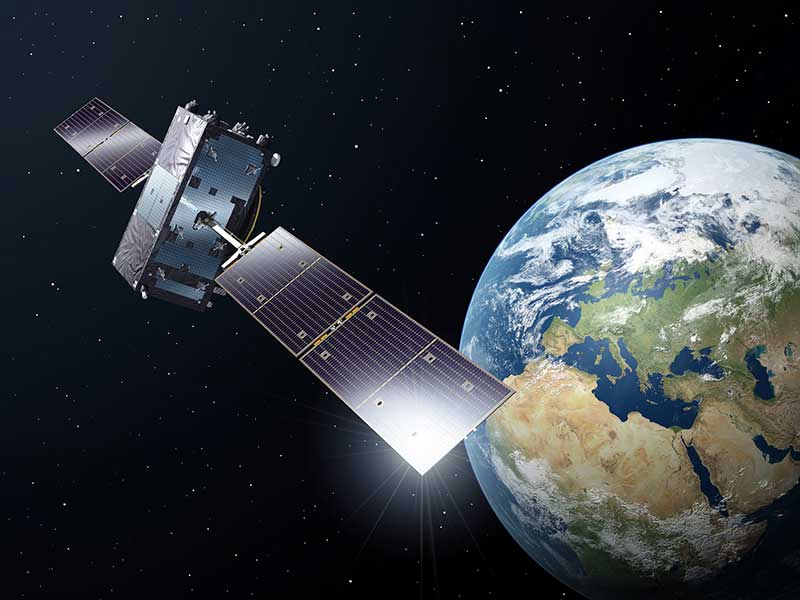
    An artist’s rendering of a Galileo satellite in orbit (Image: ESA)

    News from the European Space Agency

    As European governments plan their phased recoveries from the lockdown states triggered by the COVID-19 pandemic, the positioning delivered through satellite navigation is becoming more important than ever before, said the European Space Agency (ESA). Location is a key requirement when attempting to monitor and map the spread of a disease and satnav is one of the main tools supporting this, the agency added.

    Since the outbreak of the coronavirus, many applications have been developed that use satnav-based location data to monitor the global spread of the virus and map outbreaks.

    For example, Romanian company RISE developed an app called CovTrack, which monitors people in a user’s vicinity made identifiable via Bluetooth connections to the user’s mobile phone and stores the identification data of these devices.

    By pressing a button, users can access the database in which the unique identifiers of the mobile phones are registered (without having access to any personal data of these mobile phone users), to verify whether the persons with whom users came in contact have subsequently been confirmed with COVID-19, ESA said. If users have identified a potential contact, they can refer to the relevant authorities whether that contact requires inclusion among the monitored persons, or even testing for COVID-19.

    According to ESA, CovTrack, developed on a pro-bono basis, is a spin-off from the existing AGORA project for festival management, supported through ESA’s Navigation Innovation and Support Programme, focused on future navigation technologies.

    ESA, along with the European Global Navigation Satellite System Agency (GSA) and European Commission, put together a repository of these apps. The list, based on apps that are already working and available in app stores, includes practical apps that facilitate the daily lives of citizens. Check out the list here.

    Europe’s Galileo, currently embedded in over 1.3 billion smartphones and devices worldwide, is helping to increase satnav accuracy and availability, especially in urban areas, ESA added.

    In addition, GSA is developing its own Galileo-enabled application, Galileo for Green Lane, to monitor and ease the circulation of goods between European Union (EU) Member States while identifying potential congestion at Green Lane border crossings, thus ensuring EU citizens can access the needed supplies of critical goods.


    Check out more of GPS World’s coronavirus coverage here.

  • SES provides managed services for Galileo navigation system

    SES provides managed services for Galileo navigation system

    From left: Ruy Pinto, chief information officer, deputy chief technology officer of SES; André Bauerhin, COO, Spaceopal; Nicole Robinson, SVP Global Government at SES Networks; Etienne Schneider, Luxembourg Deputy Prime Minister, Minister of the Economy. (Photo: SES)

    SES will provide a series of services for the Galileo European navigation system under a long-term agreement with Spaceopal, a joint venture between Telespazio and DLR GfR mbH. According to SES, the contract is part of the Galileo Service Operator framework agreement between Spaceopal and the European Global Navigation Satellite System Agency.

    Under the agreement, SES will provide Spaceopal with services to support the maintenance and operations of the Galileo Global Navigation Satellite System. Further, SES will be responsible for in-orbit measurements for the Galileo satellite constellation and provide VSAT managed services to Telespazio for the Galileo Data Dissemination Network.

    “We are delighted to extend our partnership with SES in the framework of the Galileo Service Operator contract with the European Global Navigation Satellite Systems Agency,” said André Bauerhin, COO of Spaceopal. “SES’s previous success with the Galileo project in delivering and managing services for both in-orbit testing and the Galileo Data Dissemination Network has made SES the clear choice for this operational contract.”

    SES also looks forward to the partnership.

    “We are proud that we can continue to draw on the experience that we have accumulated while working on Galileo over the years, and continue to be part of the team in ensuring the reliability of the GNSS system and accommodating its shifting demands in the next decade,” said Nicole Robinson, SVP Global Government at SES Networks.

    Previously, SES has provided infrastructure and services for the Galileo program, as well as ground stations and in-orbit testing during the In-Orbit Validation Phase.

  • GSA contracts with Eutelsat on next-gen EGNOS payload

    GSA contracts with Eutelsat on next-gen EGNOS payload

    The European Global Navigation Satellite Systems Agency (GSA) has selected Eutelsat Communications for the development, integration and operation of the next-generation EGNOS payload on a future Eutelsat satellite.

    Credit and copyright: GSA.
    Credit and copyright: GSA.

    Eutelsat and GSA have concluded a long-term contract valued at €102 million covering the preparation and service provision phases for the EGNOS GEO-3 payload that will be hosted on the Eutelsat 5 West B satellite that is due for launch end of 2018.

    The new payload marks a replenishment of current EGNOS capacity and is scheduled to start service in 2019 for a duration of 15 years.

    With the addition of the EGNOS payload, Eutelsat is further optimizing the Eutelsat 5 West B satellite that was commissioned in October 2016 on a design-to-cost basis from Airbus Defence and Space and Orbital ATK. Airbus Defence and Space is building the satellite’s commercial Ku-band payload and the EGNOS payload while the platform is being manufactured by Orbital ATK.

    The EGNOS GEO-3 payload on Eutelsat 5 West B will comprise two L-band transponders that will act as an augmentation, or overlay to GNSS messages. Data from GNSS measurements received by an interconnected ground network of positioning stations across Europe will be transferred to a central computing centre where differential corrections and integrity messages will be calculated and then broadcast by Eutelsat 5 West B to users.

    The new payload will be the first step towards the deployment of the EGNOS next generation, EGNOS V3. This new generation of EGNOS will augment both Galileo and GPS and is planned to be qualified by 2022. EGNOS V3 will provide a higher level of performance and robustness than the current EGNOS legacy services, as required by the growing use and reliance on such services.

    Established in 1977, Eutelsat Communications specializes in communications satellites. The company provides capacity on 39 satellites to clients that include broadcasters and broadcasting associations, pay-TV operators, video, data and internet service providers, enterprises and government agencies.