Tag: Extended Kalman Filter

  • Gladiator Technologies introduces small, high-performance GNSS/INS

    Gladiator Technologies introduces small, high-performance GNSS/INS

    Gladiator Technologies’ low-noise inertial sensor and systems technology coupled with Velox high-speed processing are now integrated with a 72-channel GNSS receiver to provide compact GNSS/inertial navigation systems (INS) for accurate position, velocity and attitude.
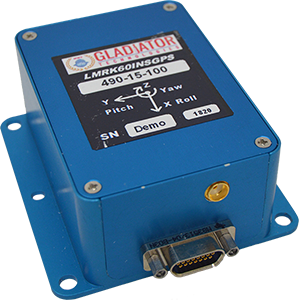
    Landmark 60 GNSS/INS. (Photo: Gladiator Technologies)
    Landmark 60 GNSS/INS. (Photo: Gladiator Technologies)

    The feature set was carefully selected to suit several positioning, navigation and timing (PNT) applications including flight control, navigation and stabilization for imaging, platforms and antennas.

    The high-performance LandMark 60 INS/GPS and compact LandMark 005 INS/GPS both feature advanced sensor-fusion technology, combining GNSS position data with Gladiator Technologies’ low-noise, high output inertial sensors as well as barometric pressure and magnetometers.

    Both products feature Gladiator Technologies’ proprietary Velox  processing technology and extended Kalman filter (EKF), enabling precision position information during short-term GPS outages.

    Velox  Technology combined with the new EKF enable the LandMark  INS/GPS products to have accuracy of less than 2 nautical miles per hour during short-term GPS outages.
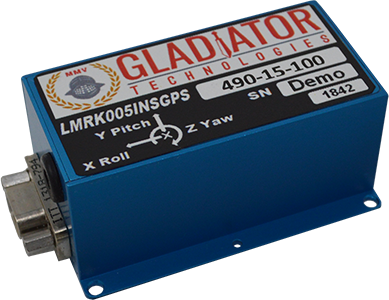
    Landmark 005 GNSS/INS. (Photo: Gladiator Technologies)
    Landmark 005 GNSS/INS. (Photo: Gladiator Technologies)

    The LandMark 60 INS/GPS is the top performing unit with +/- 0.3° heading accuracy and pitch/roll angle measurements of 0.1°. It is also available with an option for a real-time kinematic (RTK) GPS receiver.

    The small and robust LandMark 005 INS/GPS is less than 35 square centimeters and is suitable for space-constrained applications that require a high standard of INS/GPS performance.

    “Our low-noise sensor inputs to the EKF are enhanced by an adaptive estimation algorithm,” said Lee Dunbar, chief software architect. “This, along with extended precision for the nonlinear solution integrator, maximizes the accuracy of position, velocity and attitude. Customer configurable EKF parameters are present to allow optimization for their applications.”

    “Leveraging our inertial capability into a complete INS/GPS package was a natural progression for our product line,” said Eric Yates, Gladiator Technologies’ new business development manager. “With the LandMark 005 INS/GPS and LandMark 60 INS/GPS we’re offering an exceptional MEMS-based INS/GPS that fits in the palm of your hand.”

    A development kit is available for set-up, configuration and data collection.

  • Research Online: Robust tightly coupled GNSS/INS estimation for navigation

    By Omar Garcia Crespillo, Daniel Medina, Anja Grosch, Jan Skaloud and Michael Meurer / Presented at the European Navigation Conference, Lausanne, Switzerland, May 2017


    Simulation Comparison: Classical GNSS/INS EKF and robust Huber EKF. Click to enlarge.

    We designed a tightly-coupled integration between GNSS and inertial navigation systems (INS) where we modify the update step of a classical Extended Kalman Filter (EKF) to consider different robust estimators (such as M-estimators). We consider different faulty scenarios where the pseudoranges contain one or several non-modeled biases. The tightly-coupled GNSS/INS robust Kalman filter performance in the presence of biases is compared with the classical EKF and with a loosely-coupled Robust-GNSS/INS approach. The robust tightly-coupled version is able to minimize more efficiently the biases effect thanks to the direct redundancy of the inertial sensor within the robust estimator.

    We set a simulated scenario based on a realistic trajectory and generate both GNSS and inertial measurements following state-of-the-art error models. We analyze the filter behavior under the presence of pseudorange measurement faults. For that purpose, we have run 100 Monte Carlo simulations over the given trajectory, and we have generated synthetic pseudorange biases of 40 meters in satellites PRN 18 and PRN 24 every 20 seconds. The filter error performance in the position domain is shown for the classical EKF and for a robust EKF based on Huber estimation criteria, the mean simulation error as well as the 95 error confidence interval. The classical EKF is highly affected by the sudden biases, and their effect influences for some seconds the estimation, while the robust Huber EKF is less sensitive to the presence of these biases because it is able to better adjust the estimation to minimize their effect in the final position estimation error.