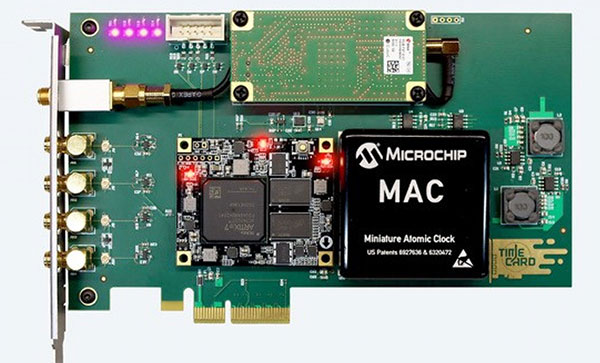
Facebook has open-sourced the design of its time card, which features the ultra-precise u‑blox ZED-F9T timing module, providing easy access to nanosecond-level timing
Photo: u-blox
Facebook has chosen the u‑bloxZED-F9T GNSS receiver module for timekeeping, according to u-blox. By improving the synchronization of networked computers, Facebook’s time card can significantly speed up the performance of its data centers and distributed databases.
By open-sourcing their designs, Facebook has bolstered the adoption of highly accurate timing solutions based on u‑blox technology. These solutions can be adopted by other industries requiring nanosecond-level timing, such as 5G cellular networks or smart power grids.
Facebook set out to create a precise timing solution that reduces the computational overhead required when synchronizing the timing between different computers in a network, u-blox said. The social media company used a u‑blox ZED-F9T multi-band GNSS receiver to sync up its solution with the highly accurate GNSS atomic clocks. To bridge possible gaps in GNSS coverage and keep clock drift to a minimum, the time card contains a backup timing source: a miniaturized atomic clock continuously synchronized with GNSS time.
To maximize the impact of the solution, Facebook decided to open-source the design of its time card, which fits onto a PCIe form factor. Anyone with experience working with microelectronics can turn any PC built on an x86 architecture and featuring a network interface controller into a nanosecond-level-accurate timing and synchronization solution, u-blox said.
Easy access to nanosecond-level timing accuracy — based on the u‑blox RCB-F9T timing board, which hosts the u‑blox ZED-F9T GNSS receiver — opens new avenues in industry segments that rely on highly synchronized signals, such as 5G network base stations that require tighter synchronization than those of previous generations, u-blox said.
As power-distribution networks become more complex to accommodate a growing share of decentralized renewable energy, they are becoming more reliant on reliable and accurate timing solutions. Data centers and computer networks will be able to modernize infrastructure management to speed up performance and reduce latencies.
Facebook has shared the GitHub repository including the specs, the schematics, the mechanics, the bill of material, and the source code in partnership with the Open Compute Project (OCP) under the Time Appliance Project (TAP).
The World Health Organization (WHO) has launched a messaging service with partners WhatsApp and Facebook to keep people safe from coronavirus.
The messaging service has the potential to reach 2 billion people and enables WHO to get information directly into the hands of the people that need it.
From government leaders to health workers and family and friends, this messaging service will provide the latest news and information on coronavirus including details on symptoms and how people can protect themselves and others. It also provides the latest situation reports and numbers in real time to help government decision-makers protect the health of their populations.
The service can be accessed through a link that opens a conversation on WhatsApp. Users can type “hi” to activate the conversation, prompting a menu of options that can help answer their questions about COVID-19.
The WHO Health Alert was developed in collaboration with Praekelt.Org, using Turn machine learning technology.
Facebook’s Open Cellular group is developing a cost-effective, software-defined, wireless-access platform to improve connectivity in remote areas of the world, the company said.
The TW2643POC employs Tallysman’s Accutenna technology in a magnet mount, passive right-hand circularly polarized antenna for the reception of all of the GNSS constellations (GPS L1/GLONASS G1/ Galileo E1/ BeiDou B1) plus Iridum: 1559 to 1626.5 MHz frequency band.
According to Tallysman, it is certified and specially designed to maximize the performance of Iridium Voice and Data Modems plus the upper GNSS band (1559–1606 MHz).
The TW2643POC is housed in an IP67 compliant housing and is REACH and RoHS compliant.
Let’s look through the other end of the telescope this month. The satellites are nattering along, lining up in orderly fashion at the rocket pad, extending their solar arms smoothly in space once they arrive on orbit. The constellations accrue and new signals inch closer to maturity.
The only blips on the horizon come from Ligado’s terrestrial impulse and a looming gap in GPS ground control. Just possibly, the latter might coincide with activation of the full European constellation and Galileo could come to the rescue of suitably equipped users who hunger for greater accuracy. This has been Galileo’s raison d’etre for two decades now, and it may actually be on the cusp of coming true.
At any rate, back to the telescope’s other end. What might that be? Facebook.
“When you think back to the beginning of online advertising, this is what advertisers have been waiting for.” That is Facebook’s director of monetization product marketing — an actual job title, and a powerful one in time to come.
All this — what advertisers have been waiting for — is made possible by GPS. Soon, by all GNSS. And by your smartphone.
From a GNSS Design & Test point of view, this means we are about to see some real money come available for constellations. Fast-multiplying applications of position, navigation and timing data have always shaped GNSS evolution, to some degree. Making this latest development different by a degree of magnitude is its potential to alter the way GNSS policy is shaped and the way GNSS funding is provided.
Facebook will soon roll out a new Store Visits metric for business clients: location data and purchases correlated to Facebook ad performance. Partnerships with point-of-sale systems like Square and Marketo will “prove” (let’s use that word loosely for now) who bought what after seeing Facebook ads.
The way the company tells it, “While people use mobile in 45 percent of all shopping journeys, more than 90% of sales still happen in brick-and-mortar businesses.”
Even if you don’t buy something, Facebook will know that you — assuming, and this is a big jump, that you are a Facebook user — visited a store by aligning GPS, beacon, Wi-Fi and other radio-frequency signals and cell-tower locations with brick-and-mortar coordinates. You may not be a Facebook user, but I’ll bet one of your loved ones is.
With the new feature, instead of having to (gasp!) leave Facebook to visit an unfamiliar website for a store locator, users can view the address, hours, phone number and estimated travel time without exiting the social network.
I know people who rarely or never leave Facebook. Do you? This is a plus for them.
Facebook, one of the new corporate mega-giants, duels with Google, Apple and Microsoft over various pieces of digital turf. One of the most hotly contested treasures — the Holy Grail, in marketing execs’ terms — is the capture and use of user data. It is getting more than a little bit creepy.
To date, the even-bigger giant that is advertising has used metrics such as ad views and clicks to measure effectiveness: how much an ad actually inspires purchase or response to other calls to action. I know this because I use these metrics, or someone in my organization does. Such metrics are now deemed “flimsy” by the standards of aligning GPS, beacon, Wi-Fi data and so on as outlined above.
Facebook is not alone in exploring the fertile ground. Google recently launched ads that show maps of nearby locations, and the others surely do not lag far behind. For the moment, these massive integrators aggregate and anonymize the data to protect privacy, but that’s not to guarantee they would always do so. Currently, there’s no specific opt-out other than turning off location services for the app on the user’s device, which people might be reluctant to do if it degrades other app functionality.
Let’s shield our eyes from the dark side for the moment, and consider what this means for GNSS.
We, you and I, those of us in the PNT industry, have known for some time how integral to critical infrastructure GPS is and GNSS soon will be. But the vast public does not. And lawmakers, bless their little hearts, largely do not either. That will change when the desperate craving of large companies to reach billions of buyers enters the PNT arena.
We can envision mega-marketing bolstered by alliance with the transportation industry, both ground and air, as driverless vehicles and drones become more commonplace. With powerful lobbying interests behind it, GPS might finally get some respect, and other systems around the world with it. Modernization might proceed more smoothly and quickly, without funding hiccups and capability gaps. That’s the bright side of all this.
It reminds me of nothing so much as an old rock’n’roll song. In “Top of the Pops,” the Kinks sang:
Now my agent called me on the telephone He said, son your record’s just got to number 1 And you know what this means?
A number of large companies are making bids to acquire Nokia’s HERE digital mapping company. At least one analyst believes the interest is fueled by future autonomous ambitions. In other location industry news, a new location-based analytics product hits the market.
Signaling the need to control a major location industry segment, Nokia’s HERE digital mapping company is attracting big-name suitors for as much as $3 billion. According to published reports, the bidders include Uber, Audi, BMW, Mercedes, Chinese search engine giant Baidu — and even Facebook.
However, at least one industry insider believes the hoopla for HERE, which is found in a majority of in-dash navigation units worldwide, is being driven by the continued interest in autonomous vehicles.
“Google has been openly working on the concepts required to support AVs for several years and Apple has a skunkworks where they are working on prototypes for an Apple AV. The German luxury car makers realize the bind they could find themselves in — as do all vehicle manufacturers — if Google is able to produce a popular AV-oriented OS that is preferred by owners of AVs over an OS produced by the vehicle manufacturers,” said Mike Dobson, TeleMapics principal, who writes about the topic at www.telemapics.com. “I suspect that Google is really focused on an operating system for autonomous vehicles that can help promote Google’s interest in advertising, but will produce a prototype car to show how the system should work, although avoiding large-scale production. Apple, on the other hand, may be considering producing a vehicle that runs on their OS. So while Google is regarded as a more immediate concern for the automobile industry, the company may also become the vehicle manufacturers’ best friend and trusted supplier, if Apple enters the autonomous vehicle market as a vehicle manufacturer.”
While Dobson believes Uber, which bought mapping company deCarta in March, is playing with fire by bidding for HERE, he says they are clearly concerned what the world of autonomous vehicles might mean for their business. “Within 10 years, Uber will be producing its own fleet of AVs. While owning a map company might be beneficial to them, they might be better off licensing map databases,” he said.
Facebook Not a Good Match
Dobson said that while Facebook, rumored to also be a bidder, can afford the billions to buy HERE, there does not appear to be a significant strategic advantage for them in doing so. “While (Facebook) is experimenting with geographical databases, it is unclear to me that they would significantly benefit from owning a spatial database, as opposed to licensing the data, although their concern may be driven by a fear that the data might not be freely licensed after the company is acquired, say, by a competitor,” he said.
The problem with the automotive consortium and Uber that have surfaced in the quest for HERE, the company once called Navteq — and acquired by Nokia for more than $8 billion in 2007 — is that none are data companies — with the background and nuances of creating spatial databases,” Dobson said.
“From my perspective, that means none of the current bidders are ideal candidates to manage the company. Like Nokia, these companies may not actually know what to do when they win the auction,” he said. “During the eight years that Nokia has owned HERE, the mapping asset has been devalued and improperly positioned for growth. I do not know how much more mismanagement the team at HERE can take before the company and its navigation databases becomes non-competitive.”
Dobson says that Uber, Facebook, Baidu, and the German car manufacturers do not yet understand the expense of upgrading and maintaining HERE’s mapping database for the demands of the autonomous vehicle market. “Buying HERE for ‘internal’ use only would be a significant mistake, so any potential buyer is going to need to continue to sell data to all channels, even those owned by potential competitors. This simple reality will cause any of the buyers who have surfaced so far a lot of heartburn in the future,” he said.
Dobson says the clear winner for the future of HERE is the German automotive consortium of Audi, BMW and Mercedes, with its reported alliance with Baidu. “I do not regard this combo as an optimal owner, but the mix of interest may help keep HERE at the forefront of producing high-accuracy navigation databases — although the extent of map coverage may be a casualty of this ownership team,” he said.
New Location Analytics Product Hits the Market
A new location analytics product is hitting the market in a more and more crowded indoor-positioning field. The differentiator, says Cloud4Wi about its new Fogsense product, is that the unit constitutes the location industry’s smallest Internet of Things Wi-Fi device that is tailored to retail outlets, coffee shops, restaurant chains and shopping malls with presence analytics and location-based services.
The device, which contains Broadcom’s WICED chip, will feature Bluetooth low-power technology in the new version in (the fourth quarter), said Elena Briola, Cloud4Wi’s chief marketing officer. The new BLE version will enable Apple iBeacon and location-aware mobile applications.
“We not only track the position of visitors and customers in the venue, we aggregate this data in valuable analytics and we provide applications to deliver targeted localized services based on these analytics,” she said.
The device is also USB-powered, allowing businesses to scale its integration with both single and small venues, where Fogsense receives power from laptops and point-of-sale (POS) devices, the company said.
“Customers increasingly expect Wi-Fi to be available wherever they go. Businesses can collect valuable data about their customers, better understand their behavior and deliver more personalized marketing initiatives,” Briola said.
Like many location analytics companies, Cloud4Wi believes the new product will enable businesses to design push-targeted, localized marketing and advertising messages based on an assessment of the customer’s behavior at the venue.
The company evokes the much-quoted ABI Research statistics that more than 1 million location retail deployments will occur by 2020.
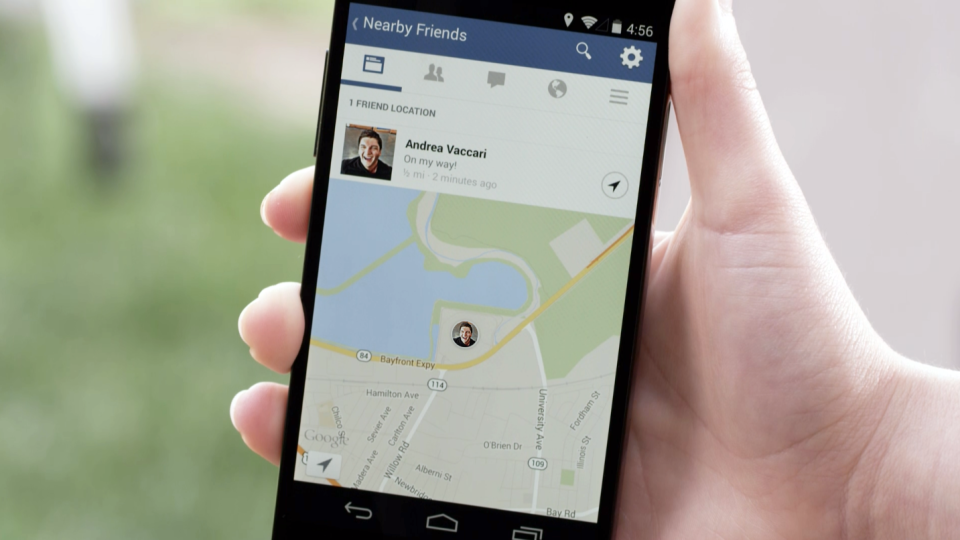
Facebook Nearby Friends feature helps people get together.
While Facebook has made big news buying companies for billions of dollars, it hasn’t been making many location-based services headlines. The recent announcement that it is rolling out a friend finder is interesting news, not only for social applications, but the potential indoor positioning markets. The news is also interesting because as many as half of Facebook users access the social media network through mobile devices.
Signaling that it does have a location strategy, as GPS World reported earlier this week, Facebook announced that it was launching an LBS offering called Nearby Friends. The opt-in service allows users to find out what friends are nearby or mobile.
Nearby Friends will be available on Android and iPhones in the U.S. market this month. In Facebook’s press announcement, apparently privacy is a big issue as the company insists it is an opt-in function.
Once users agree to use the service, they will be notified when friends are in close proximity. Users can select the friends who can see their location — and can turn the service on or off at any time.
At first glance, Nearby Friends could be a valuable tool for users looking to find friends and make plans, but the real potential could be for retailers who wish to drive in-store traffic. Users can not only invite friends to a specific business on a map, but tag other traffic.
The area or business to where the friends are traveling will be displayed on their profile. This allows the friends who opt in to recommend shops, restaurants and other things to do in the specified area.
How retailers get their message out to Nearby Friends users remains to be seen. Research company Berg Insight still says advertising will constitute the main revenues for social networking and local search market segments. However, in several published reports, users have tired of the increased Facebook advertisements.
Berg says that social networking and entertainment has now overtaken mapping and navigation as the largest location market. The company says that those services include general social networking, messaging apps, friend finders such as Nearby Friends, and games.
While Facebook could use the Location History in Nearby Friends to make money selling ads, the company says it isn’t right now. But it has to be the future — and one that, privacy issues aside, could be very lucrative for the company. It could target opt-in users with ads that are only a few feet away or in the area they will meet friends.
The Wall Street Journal reported that Facebook will leverage its user base, estimated at one billion users, to improve ad targeting, expand marketing reach, and to make more money. The company earned $1.24 billion in revenue through mobile ads for the last three months of 2013, according to published reports.
After the announcement that Facebook was launching Nearby Friends, a number of tech business articles sprung up about potential, real and imagined, privacy issues. With the predictable privacy issues comes opportunities for location startups. A new location app is touting itself as the “anti-social networking” tool. Called Cloak, and available in Apple’s App Store, it allows a user to avoid friends they want to avoid by revealing the location of contacts — while keeping the user’s position hidden.
The app, which already has been downloaded more than 100,000 times, uses Instagram and Foursquare data, and published reports say Facebook compatibility is coming soon.
Rumors about Acquisition Prove False?
Earlier this month, several tech business industry publications wrote that Israel-based indoor navigation startup ShopCloud was in talks with Samsung to sell the company for as much as $90 million. Samsung has denied the rumors.
In articles like these, red flags always include terms like “several sources familiar with the details”. The price seemed high for a young company that hasn’t launched a product, though according to published reports, it has an app called Inside.
One analyst says that the Israel tech business media frequently pumps up local companies and even creates buzz for startups — and often these reports are picked up by local journalists.
Autonomous Vehicles Will Happen, but When?
In January’s Transportation Research Board (TRB) meeting in Washington, D.C., attendees agreed that self-driving vehicles are the future. The bottom line is when is the future? “We have seen the business case for autonomous vehicles — it will be a reality. When you look at the number of lives it will save, efficiency of the network, it is very compelling,” said Kevin Link, Verizon senior vice president and general manager, China. “We have to begin a slow migration of educating consumers — one of those ways is through the connected vehicle. I don’t think consumers are there yet.”
Link talked about autonomous vehicles at the Consumer Telematics Conference, also in January, but those at TRB are mainly academics and government officials, not business executives. Most believe it will take decades, Google car aside, to have a fully autonomous vehicle on the road. Others believe that if Detroit does not take notice, they can read about Google dominating this vehicle market, not being a player in it.
In other location news:
Place, the Business of Location conference will be July 22 in New York. Executives from SK Telecom, Thinknear, Sonic Notify, Aisle411, and Factual will join Google, retailer Alex and Ani, and agency MEC North America (WPP), among others. The conference will include case studies and explore how mobile, offline tracking and indoor location will change the future of digital marketing and brand advertising. Many location conferences have died in the last two years, so it is refreshing to see a conference with a strong agenda back on the scene.
Finland-based IndoorAtlas rolled out an indoor mapping application for iOS. While iOS supports Apple’s iBeacon micro-fencing solution for indoor positioning, IndoorAtlas uses the compass chip built into smartphones and does not require external hardware such as Bluetooth beacons or Wi-Fi to determine location, the company said.
The U.S. Patent and Trademark Office awarded Apple a patent that could drive technology on the next generation iPhones. The patent describes a system that combines GPS, Wi-Fi access points, and on-board location databases to provide mobile devices positioning data in all types of environments, particularly indoor location.
Facebook Nearby Friends feature helps people get together.
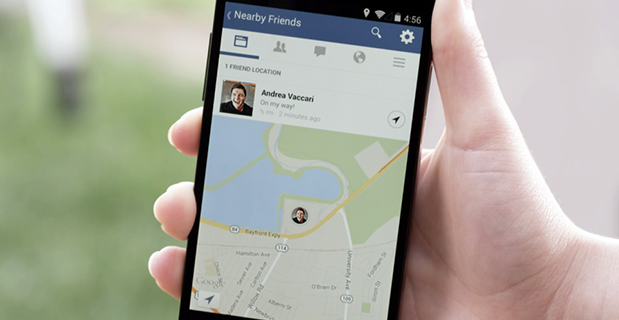
Facebook has started rolling out a feature called Nearby Friends. Users can turn on the feature to help them discover which friends are nearby or on the go. When notified that a friend is nearby, the user can then get in touch or meet up.
“For example, when you’re headed to the movies, Nearby Friends will let you know if friends are nearby so you can see the movie together or meet up afterward,” wrote Andrea Vaccari, Facebook Product Manager, in an article on the website.
Nearby Friends is an optional feature. Users can choose who can see whether they are nearby (such as friends, close friends, or a specific friends list) and it can turned on and off at any time. Both the user and the friend needs to have the feature turned on and choose to share that information before notifications are sent.
Users can also choose to share a precise location with particular friends for a set period of time, such as the next hour. The friend will see exactly the user’s location on a map, to help them meet up.
Nearby Friends will be available on Android and iPhone in the U.S. over the coming weeks.
Facebook has purchased Occulus, a virtual reality gaming startup, for $2 billion. “Today, we’re pleased to announce that we’ve joined forces with Facebook to create the best virtual reality platform in the world,” Occulus announced via a blog post.
“Facebook understands the potential for VR,” the blog said. “Mark [Zuckerberg] and his team share our vision for virtual reality’s potential to transform the way we learn, share, play, and communicate. Facebook is a company that believes that anything is possible with the right group of people, and we couldn’t agree more.”
Occulus demonstrated its most recent version of the Oculus Rift development kit at the Game Developers Conference in San Francisco, March 17-21. Occulus Rift is a virtual reality headset for 3D gaming.
The Oculus Rift DK2 prototype took home the award for Best in Show at January’s Consumer Electronics Show.
Facebook has purchased Occulus, a virtual reality gaming startup, for $2 billion. “Today, we’re pleased to announce that we’ve joined forces with Facebook to create the best virtual reality platform in the world,” Occulus announced via a blog post.
“Facebook understands the potential for VR,” the blog said. “Mark [Zuckerberg] and his team share our vision for virtual reality’s potential to transform the way we learn, share, play, and communicate. Facebook is a company that believes that anything is possible with the right group of people, and we couldn’t agree more.”
Occulus demonstrated its most recent version of the Oculus Rift development kit at the Game Developers Conference in San Francisco, March 17-21. Occulus Rift is a virtual reality headset for 3D gaming.
The Oculus Rift DK2 prototype took home the award for Best in Show at January’s Consumer Electronics Show.
In a year of ho-hum location deals, or the lack of any, the recent Google purchase of Waze for more than $1 billion is a big one. In fact, readers of GPS World magazine’s LBS Insider would have to go back to the summer of 2007, when TomTom purchased Tele Atlas and Nokia bought Navteq, to find an industry acquisition as big as this one.
The Federal Trade Commission is reviewing Google’s $1.1 billion acquisition of Israel-based mapping startup Waze, according to published reports. The big issue is that while Waze’s revenue was too low to trigger automatic review by the FTC, it may have hundreds of millions of users worldwide.
The fact that Google’s acquisition of Waze has caught the FTC’s attention is not unusual, said Mike Dobson, TeleMapics president, who authors a location industry blog at www.telemapics.com. “Google, in an attempt to speed the acquisition, declared that the assets of Waze based in the United States are worth less than the $70.9 million that requires an antitrust review. Google maintains, and I agree, that the majority of the [intellectual property] for which they were willing to pay $1 billion was created in Israel, where it is currently located, and in that location it continues to be revised and enhanced,” he said.
One of the supposed reasons, which were publicized in media reports, is that the deal with Facebook fell through because the social media giant wanted to relocate the Waze development activities to the U.S. and the Israel-based company declined.
Google’s purchase of Waze ends months of rumors and stops other suitors, including Facebook, Apple and Microsoft, from moving in on the mapping startup. Google has said that its mapping technology will be incorporated into Waze.
The Waze deal may strengthen Google, but won’t be the deciding factor on whether it has an unfair advantage in the [location] market, said Marc Prioleau, president of Prioleau Advisors. “They will have that regardless of Waze. I am not sure the criteria for the FTC, but I think Waze is just a spark to trigger a look at Google’s mapping position overall,” he said. “The FTC will have a hard time making the case that Google dominates the industry when Google can point to market share for Apple Maps, Nokia/Here [through its own sites as well as Bing, Amazon, Facebook and others] and even MapQuest, which stubbornly hangs on to a high market share with the over-50 demographic.”
When it comes down to it, it is all about money. “It appears that the FTC’s preliminary interest in the Google acquisition of Waze is in determining if the U.S.-based assets are worth more than $70.9 million, and whether or not Google’s position regarding the Waze IP being located in Israel is justified,” Dobson said. “Many would argue that a considerable portion of the value of the Waze IP affects consumers in the United States, resides on cell phones of users in the United States, and has a functional impact in the United States beyond the $70.9 million that Google is claiming. Functional impact is a difficult issue, but since Waze generates little income, Google is probably in a good position here.”
Dobson said that other pundits are commenting that the problem here is that Noam Bardin, Waze CEO, described Google as its only competition during a recent press conference. “Oh, how unusual, someone selling their company trying to increase the value of the company,” he said. “Has everyone forgotten about Nokia and TomTom? Does anyone really think they are incapable of competing with Google, Waze or the combination of both companies?”
Google Made Strategic Decision Not to Buy Tele Atlas and Navteq
Dobson said that, more troubling for the FTC and other antitrust interests, is this: If Google wanted to monopolize the mapping world, why did it not choose to bid (or counterbid) when Navteq and Tele Atlas were sold in 2007?
“I think the answer to this question is quite plain. Google did not participate in either acquisition because it had tried both companies’ data and found that the content quality and spatial coverage was not quite what Google had set as goals when developing its strategy for mapping. Instead, Google built its own ‘map machine’ and has managed to out-innovate either of these companies over the last several years,” Dobson said. “In addition, both Nokia and TomTom have fallen on hard times, not because of Google’s success, but because both companies overpaid for the assets they acquired, just before a worldwide economic downturn. Reduced budgets (for research and compilation) at TomTom and Nokia have had a lot to do with Google’s success in the mapping world.”
The big deal in Google’s interest in Waze lies in the success that the mapping startup has had in capturing traffic information, as well as how it has attracted a large user community willing to contribute traffic data, Dobson said.
“I doubt that Google will find that the map coverage provided by Waze has data they have not already mapped and mapped more exhaustively than Waze. However, it is somewhat camp to be an ‘anybody but Google’ fan boy and I suspect conspiracy theories about the acquisition will abound,” Dobson said. “I doubt that the FTC will find anything actionable. If Google were to announce next week that it was acquiring Inrix, I suspect that the FTC might have a real case with real antitrust issues.”
While Waze hasn’t generated much revenue, its real-time maps and traffic information are valuable. This value was magnified last year when Apple tried to replace Google Maps on the iPhone with a not-so-good alternative.
Analysts are looking around at what other companies are out there as potential acquisition targets — particularly as the smartphone industry becomes even more competitive. The apps on the smartphones will need to be distinguishable, particularly the mapping systems and capability, say several analysts.
One company that stands out as a potential acquisition target is TomTom, which is the last independent provider of digital maps, now that Navteq was gobbled up by Nokia.
Since the recent CTIA conference wasn’t the buffet of location news, one potential deal could really set the industry on fire going into the summer months. Google and Facebook both are rumored to be in talks to purchase Waze. Some say this would mean Facebook would transform into a mobile advertising company, with local ads, if it were the winning bidder. Google’s rumored interest would block the social media giant’s momentum in that marketplace.
by Kevin Dennehy
In what could be one of biggest deals in the location industry, both Google and Facebook have been rumored to be interested in buying Israel-based mapping and navigation company Waze. Published reports indicate the deal could be worth $1 billion.
Some industry analysts are skeptical that a deal could be valued that high, which would place it in the same realm as Facebook’s $1 billion purchase of photo-sharing service Instagram.
“We really do not know if Facebook is willing to spend a billion dollars on Waze, but if the deal happens, (Facebook) must have considered its options. How could this be? First, I suspect that Facebook is certain it will grow beyond its current boundaries to become the world’s most valuable company,” said Mike Dobson, Telemapics president. “Operating under this mindset, a billion dollars is peanuts, and they will not care if everyone else thinks they overpaid. In other words, Facebook might not be basing its calculation on the same ‘time-value of money’ that the rest of us are using. Second, if the economics do not really matter to Facebook, the more important question is ‘What advantages would Facebook accrue by acquiring Waze?’”
Dobson believes that Waze map databases are not competitive with Google or such commercial providers as Nokia or TomTom. “In essence, Waze does not offer competitive map coverage, competitive data quality, competitive data attributing, or a useful source of POI data. More importantly, I suspect that the Waze database will be a major league headache if Facebook plans to use it as the basis for its mapping activities supporting local search,” he said. “Further, I doubt that Waze understands enough about local advertising to help Facebook realize its most important goal of becoming a powerhouse ad agency capable of creating its own captive local search market, comparable or exceeding that enjoyed by Google.”
Another industry insider, Marc Prioleau of Prioleau Advisors, said that quality and coverage of the maps would make the deal successful — if it really is going to happen. “The rumor mill on Waze seems to be quite active so it is hard to know if there is substance there. Waze has built a very innovative traffic application, and they use the user data to build a digital map data set,” he said. “The value of the company would be tied largely to the quality and coverage of that data set and the perceived ability of a big platform like Facebook to build that out into a truly serviceable worldwide map.”
Waze is a mapping company built through crowdsourcing map and traffic data over mobile phones, which is the “magic” Dobson believes Facebook finds beguiling about the company. While Waze claims 45 million users, its active base is more likely around 10-15 million, Dobson said. “Conversely, if you stop to consider the amount of data you could generate if all of Facebook’s mobile users were gathering mapping data through an app built on Waze, then the company might be willing to gamble on the acquisition,” he said. “Providing analytics on the behavior and location of its mobile users to advertisers and other interested parties could be a huge opportunity. On the other hand, there are numerous paths to this endpoint, not just Waze.”
Dobson said if he were to advise Facebook on the acquisition, a suggested course of action would be that the company write their own crowdsourcing application and build a good quality map database through licensing and direct and indirect map compilation techniques. “My off-the-cuff estimate is that this could be done for less than the cost of the Waze acquisition. Beating Waze into a quality map database is going to be an expensive — well beyond the acquisition cost — and time consuming effort. Perhaps the most glaring lack in the potential Waze acquisition is the absence of a suitable POI database, which, in my opinion, is the most critical need that Facebook will have in local search.”
Dobson said he suspects that Facebook’s competitors are not concerned about the company’s potential acquisition of Waze. “Those who already in the mapping business — Google and Apple — will anticipate that it is likely that Waze could become a significant distraction for Facebook and delay the company effectively competing in the local search market. As far as the competitors are concerned, the longer it takes Facebook to mobilize its efforts in local search, the better,” he said. “In business, as in life, strange choices are made. Perhaps Facebook sees a future in Waze that depends on strategies being implemented by the company that we know nothing about. I hope so, as a good dose of innovation is just what the local search market needs.”
Distinguishing itself is another reason Facebook may be interested in Waze. Providing mapping and traffic capabilities may bring more consumers to its mobile users.
The company is also is redesigning its mobile pages platform to enable local merchant information, according to published reports. These new improvements may even challenge Foursquare and Yelp.
There were questions whether the deal with Facebook will go through as published reports indicated that Waze’s research and development activities would remain in Israel rather than go to California, where Facebook’s headquarters are based.
Google Interested in Waze to Cut off Facebook at the Location Pass?
The rumor mill is heating up as Internet giant Google and Apple are said to also be interested in Waze. “I saw a report indicating that Google was interested. If so, it would seem that this would be a move to deny Facebook access to Waze,” Dobson said. “Google already derives a significant amount of information from passive crowdsourcing — recording the GPS traces of the devices of their users — and I am not sure that the acquisition would provide them any opportunities that they are not already exploiting. Of course, we might remember that Garmin, who had no intention of buying TeleAtlas, made a bid and significantly raised the price that TomTom paid for the mapping company.”
Other analysts say while there have been several news articles on why Google should buy Waze, it all could be poorly informed speculation. Others say that the Israel tech press is quick to spread rumors. One analyst said, “I hear that the talks are legit, but my guess is that the deal in discussion is not $1 billion.”
GreenRoad, a driver performance management company, has announced new features including RFID-based driver identification; real-time email alerts; and an enhanced interface for GreenRoad Smartphone Edition.
GreenRoad’s new RFID feature automates driver association with trips by detecting when a driver boards a vehicle, eliminating the need for drivers to log on with a Dallas key.
One customer, Big Bus Tours, operator of open-top sightseeing tours, has starting using RFID in its fleet of open top tour buses in London, Washington, D.C., and San Francisco, with Dubai and Abu Dhabi soon to follow. Gerry Price, group commercial director, said, “GreenRoad has enhanced driver performance and cut risk in our bus fleet across the world, as well as improving the customer experience for thousands of sightseers. Now with RFID it is even easier for our drivers to use GreenRoad.”
GreenRoad Smartphone Edition has been enhanced with Facebook integration that allows drivers to share their achievements with friends. GreenRoad Smartphone Edition, code named “Asimov,” uses smartphone native functionality, including GPS and built-in accelerometers, to eliminate the need for a professionally installed telematics device in the vehicle.
A new version of GreenRoad Central, the software at the heart of the GreenRoad service, includes real-time alerts for exception events, including high-risk events in all driver behavior categories as well as speed violations. In addition to receiving email alerts in real-time, managers can view their alerts on a To Do list through GreenRoad Central.