Tag: Field Technology Conference

  • Field Technology Conference: The forest and the fish

    PORTLAND, Ore. — Two weeks ago, I attended (and hosted) the Field Technology Conference here in Portland, Oregon. This is the fifth year of the conference. In years past, it’s had a forestry emphasis primary because the Western Forestry and Conservation Association has been a major partner in organizing it.

    This year, the Pacific States Marine Fisheries Commission and Pacific Northwest Aquatic Monitoring Partnership joined the organizing committee. The result was a 50-percent increase in attendance and a more diverse audience.

    Another newcomer to the conference was a Civil GPS Service Interface Committee (CGSIC) U.S. State and Local Government Subcommittee meeting, which was co-located with the Field Technology Conference, offering a direct connection between civil GPS users and U.S. government representatives who are involved in GPS.

    The conference was a two-day event comprised of three technology tracks: a track for general field technology and two tracks for industry-specific (forestry and fisheries) subjects, hands-on technology demonstrations and a field trip. Although forestry and fisheries professionals were the featured user groups, nearly all of the subject matters — GPS, UAVs, smartphones, tablets, laser rangefinders, lidar, photogrammetry, and field data-collection software — is applicable for a wide range of natural resource users involved with GIS (geographic information systems) technology.

    As one of the hosts of the conference, I started out moderating the general session with all of the attendees in one room. This year, my general session topics include geospatial awareness and growth, GPS/GNSS technology, mobile devices (smartphones and tablets) and UAVs.

    Something new I tried this year, which worked out really well, was using audience response “clickers.” These small handheld devices were given to each audience member and allowed them to answer multiple choice questions that I posed in my Powerpoint presentation. I’ve always been a fan of audience input, and started polling the audience during webinars I conducted many years ago. For this conference, I used an audience polling system from Turning Technologies. I’d like to share with you the questions I asked the audience and the responses that I received.

    Question #1: Are you here?


    Comment: This was a test question to see if the audience response system was working properly. I’m still not sure if the audience just had a great sense of humor or a technical problem. I think the former was true. ☺

    Question #2: Have you attended this conference before?


    Comment: This was great news that the conference is attracting new attendees. It’s an annual event held in November, so keep your eyes on it for next year!

    Question #3: After a brief discussion about the availability of higher accuracy geospatial data (eg. GNSS, UAVs, etc.), I was curious about the level of accuracy the audience required in their typical tasks.

    What geospatial data accuracy do your typical tasks require?

    Microsoft PowerPoint - FTCGeneralPlenary2015 [Compatibility Mode

    Comment: I wasn’t sure what to expect with this question, but since I’ve polled a fisheries audience before, I had a feeling accuracy requirements would vary, and they did. Previously, a fisheries audience had told me that they were satisfied with 5-meter accuracy.

    Question #4: The last question leads to this one. I wondered if the audience accuracy requirement was driven by requirement or by availability.

    Are you satisfied with the accuracy of the geospatial data you use?

    Microsoft PowerPoint - FTCGeneralPlenary2015 [Compatibility Mode


    Comment: The answer is clear that, generally speaking, the audience would use higher accuracy geospatial data if it was available.

    Question #5: The next question was a pure technology one. In the day of BYOD (Bring Your Own Device), I’ve been very interested in monitoring the trends in mobile devices. The question about operating systems is relevant because it determines which data collection software you can use. For example, if a specific data-collection software is written only for Windows, it will not run on an Android or Apple (iOS) device.

    Which operating system do you use on your mobile device(s)?

    Microsoft PowerPoint - FTCGeneralPlenary2015 [Compatibility Mode

    Comment: These responses surprised me a bit. They certainly don’t match the global market share figures that I’ve read. Following are the latest mobile device operating system market share numbers reported by IDC and Statista.

    Microsoft PowerPoint - FTCGeneralPlenary2015 [Compatibility Mode


    Microsoft PowerPoint - FTCGeneralPlenary2015 [Compatibility Mode

    Question #6: The next part of my presentation discussed unmanned aerial vehicle (UAV, also known as UAS or drone) technology. UAVs were a significant part of the conference this year. We had many presentations and some static demonstrations on UAV technology. On this subject, I had several questions for the audience.

    Do you currently use a UAS?

    Microsoft PowerPoint - FTCGeneralPlenary2015 [Compatibility Mode

    Comment: These answers were not surprising. Flying UAVs commercially in the U.S. requires a special permission from the Federal Aviation Administration (FAA). To date, the FAA has only issued about 2,000 such exemptions.

    Question #7: Do you anticipate using a UAS?

    Microsoft PowerPoint - FTCGeneralPlenary2015 [Compatibility Mode

    Comment: These answers surprised me a bit. I had no idea the audience would be so interested in personally flying a UAV. This has me thinking about this the same way I think about GPS receivers — just another tool in the toolbox.

    Question #8: How much are you willing to spend on a UAS?

    Microsoft PowerPoint - FTCGeneralPlenary2015 [Compatibility Mode

    Comment: These responses don’t surprise me, although I polled another audience at a different venue that was more engineering-oriented, and the answers were a bit different. The engineering-oriented audience was willing to spend more for a UAV.

    Furthermore, in speaking with various attendees during the conference, there was quite a bit of interest in attaching different sensors to UAVs for various requirements. For example, lidar, multi-spectral and thermal (temperature) sensors were commonly mentioned as payloads they would like to see. The challenge is that the cost of a UAV rises sharply when these types of payloads are accommodated, and conflicts with the audience’s response about how much they are willing to pay for a UAV.

    UAV-tablet-W

    In next month’s column, I’ll post links to the papers presented at the Field Technology Conference as well as videos of papers presented by the CGSIC folks.

    See you next month.

    Follow me on Twitter at https://twitter.com/GPSGIS_Eric

    Source: FTC
  • Kickstarter Comes to GPS; Plus, Jammers and Field Technology Conference

    $2,000 for an RTK base and rover? Yes, it’s real. Well, at least it seems real.

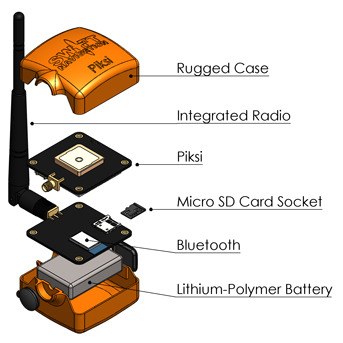
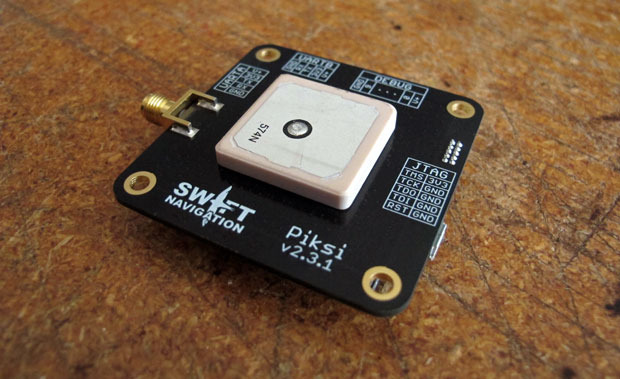
    For $2,000, you can order an RTK base and rover set named Piksi, including radios.

    Photo: Piksi (Swift Navigation)  Piksi_rugged

    It’s an intriguing opportunity, and might be the first brush stroke of the picture I’ve been painting (metaphorically speaking) for the past few years about inexpensive RTK receivers forthcoming. But, before you get really excited, read on.

    Besides the attractive price, something else that makes Piksi interesting is the way the company is financed. The way that a typical company funds new product development is through its own cash flow or financing. The company designs and produces a product, then announces it to potential buyers (you), who then touch, feel and use the product to understand how it performs…all before making the decision to purchase. Piksi (Swift Navigation) doesn’t follow that model.

    Piksi is using a new-age, crowd-sourced funding model called Kickstarter. With Kickstarter, a group of people (creators) offer to design and produce a certain product if they can recruit enough “investors” to fund their endeavor. The “investors” aren’t traditional venture capitalists, nor people who would own stock in said company. The investment is simply a commitment to buy the product based on the specifications provided by the creators, before the product is finished. If the company has enough commitments from “investors,” the creators commit to designing, building and delivering the product.

    Furthermore, there are certain levels of investment available for Piksi, from $7 which will get you a Swift Navigation micro-USB cable, to $2,000, which will get you a ruggedized version of the complete RTK kit, including base, rover, XBee radios, Bluetooth and SD card storage. So far, Swift Navigation has raised $161,369 towards the project with today, September 4, being the last day. That’s far more than the $14,000 goal it set.

    The caveat is that the product is not complete yet, at least the RTK portion. According to Swift Navigation:

    We have already built a small batch of Piksi receivers that are ready to ship and have locked down all part sourcing and manufacturing for further batches, so there are unlikely to be any unanticipated delays in the delivery of Piksi hardware.

    However, it’s difficult to know exactly how long the RTK functionality will take to implement — software development schedules seem to always run over their anticipated delivery dates, even when you take into account Hofstadter’s Law. We feel the goals we’re proposing to accomplish with this campaign are reasonable — adding a new set of software functionality (which we successfully implemented on a previous platform) upon an existing base of stable hardware and software.

    The gamble that the investor takes is that Swift will be able to finish the product, produce it, and meet the performance specifications. However, that’s only part of the battle. I spent better than 10 years of my life managing the design and production (somewhat) of GPS-based hardware and software for mapping and surveying. There are a million details. A major part of developing a hardware/software product like this is making it reliable. What I mean by reliable is that it behaves the same way every time you push the ON button, and works consistently and reliably all day until you press the OFF button. That’s not easy to achieve without a lot of sophisticated testing in different environments, and nothing can fix a poor reliability design (except a redesign).

    The guys behind the Piksi don’t seem to be total GPS-rookies, but do lack substantial real-world experience. Click here and then click on Bios to read about their backgrounds. But who knows? Maybe that’s an advantage, not being conditioned to “follow the rules.”

    One last note, and an important one. It’s only an L1 system, so don’t get too excited. L1 means that you really can’t use an RTK network (practically speaking) and that the baseline distance needs to be pretty short. The RTK initialization and re-initialization times will be measured in minutes, not seconds, and that’s assuming they get the RTK algorithms correct (and reliable).

    Sorry to burst your bubble.

    Actually, the concept of an inexpensive, bootstrapped L1 RTK system is not difficult to envision. The GPS OEM boards are readily available, as well as the GPS antennae, wireless comms and the rest of the components. At the risk of sounding pompous, I could put that kind of project together. The trickiest part of the project would be developing/implementing reliable RTK software.

    No matter what, it will be interesting to hear about what these guys come up with. In the words of the late Steve Jobs, “stay hungry, stay foolish.”

    GPS jammers are cheap, but don’t get caught using one.

    Even though they are illegal to market, sell and operate in the U.S., Americans are buying cheap GPS jammers, via Internet stores, from companies operating outside of the U.S. Operating one of these devices in the U.S. is a risky venture (as you’ll read below).


    Although they don’t seem to be a serious threat yet, they could become a threat as GPS receivers become more ubiquitous and concerns about privacy continue to ramp up.

    The Federal Communications Commission (FCC) is responsible for enforcing the U.S. laws enacted that prohibit the use of GPS jamming devices. If you look at the FCC’s enforcement history here, you’ll see that there isn’t much enforcement activity. However, a recent enforcement action was imposed on a guy in New Jersey who made the mistake of driving by the Newark International airport with his GPS jammer turned on. Uh oh. The FCC tracked down the offender and issued a Notice of Apparent Liability for Forfeiture that included a fine of nearly $32,000. Whoa, that’s a lot of dough. Wonder if he is trying to sue the company he bought it from? Not likely, as they are most certainly outside of the U.S. and out of reach of the U.S. judicial system. Caveat emptor.

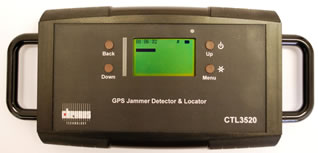
    You can be assured that if jamming reports increase, there will be more jamming detection and location equipment deployed to hold people accountable, like this new, handheld GPS jammer detector and locator from Chronos:

    Chronos_ctl3520

    You might want to visit this GPS.GOV website on GPS jamming. It contains a lot of information about the U.S. regulations surrounding the marketing, sales and use of GPS (and cell phone) jamming devices.

    Third annual Field Technology Conference

    FTC2013_logo

    In 2010, I, along with two colleagues, put together a conference here in Portland, Oregon, and named it the Field Technology Conference. We created the conference to focus on geospatial technology hardware and software used in the field. It’s the essence of what a conference should be, a group of people gathering to share ideas of common interest. It’s mostly devoid of commercial interests, save a few really neat (and valuable) giveaways and a few exhibit booths. You probably haven’t heard about the conference because we have a very small marketing budget, and the organizers (three of us) can only spend a few hours a month brainstorming, finding speakers, and organizing the event.

    This year, our third, will focus on existing and emerging technologies: GPS/GNSS, UAVs, 3D printing, mobile devices, imagery and geospatial software. Our outdoor demonstration area was very popular last year so we’ll offer that again, as well as a UAV demonstration. We’re also planning an on-site demonstration of 3D printing. Can you imagine 3D printing a topographic survey?

    Something new this year is our association with the CGSIC (Civil GPS Service Interface Committee). CGSIC is co-locating a regional event with our conference. What that means is that speakers from the U.S. government (Air Force, State Deptartment, DOT, etc.) will make GPS-centric presentations. CGSIC events are the only live communication channel between the U.S. Air Force GPS operations personnel and civilian GPS users. This is your chance to ask Air Force personnel questions, in person, that you’ve always wanted to know about GPS. If you’re unable to travel to Portland for the conference (October 23-24), GPS World magazine is planning on streaming the CGSIC presentations live over the Internet, as well as posting the recording on its website.

    Although the conference is organized by the Western Forestry and Conservation Association (which organizes a lot of conferences), take a look at the agenda and you’ll see the content will be of interest to anyone involved with geospatial data collection and processing technology, not just foresters and environmental scientists. For conference details, click here.

    Thanks, and see you next month.

    Follow me on Twitter at https://twitter.com/GPSGIS_Eric