DroneShield has begun releasing a software update across its counter-unmanned-aerial-system (C-UAS) devices, including portable, vehicle-based and fixed-site devices. The devices are used by the military, the intelligence community, U.S. Homeland Security, law enforcement, critical infrastructure and others.
The updates will be rolling out across DroneShield devices globally in the coming week, with heightened urgency given the widespread use of drones in Ukrainian and Middle Eastern conflicts. The technology upgrade is validated by deployments with the U.S. Air Force and Australian Army.
Enrolled devices receive quarterly firmware updates of the proprietary DroneShield RFAI artificial intelligence engine. Some of these updates are major enhancements, such as this 2Q22 release.
Major upgrades include:
Site Install Wizard. The new Spectrum Viewer mode, in which C-UAS detection devices scan the deployment area for optimal sensor placement
Machine Learning in the Loop. This option enhances the RFAI engine from the data received by the user.
Both features were added in response to end-user requirements.
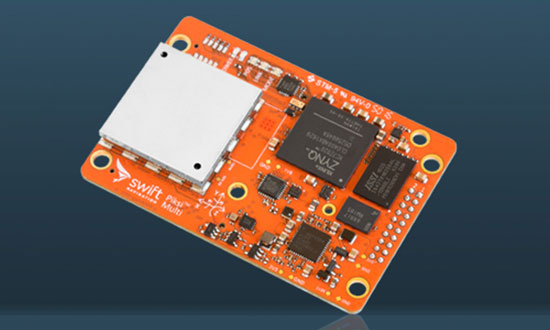
The Piksi Multi GNSS receiver. (Photo: Swift Navigation)
Swift Navigation has upgraded the firmware to its flagship product — the Piksi Multi GNSS receiver. This marks the sixth major release to Piksi Multi since it was launched in February 2017.
The upgrade is available free of charge to Swift customers.
The firmware release also enhances Duro, the ruggedized version of the Piksi Multi receiver housed in a military-grade, weatherproof enclosure for long-term outdoor deployments.
Swift Navigation is a San Francisco-based tech firm building centimeter-accurate GNSS technology and a cloud-based corrections service to power a world of autonomous vehicles, the company said.
The Duro enclosure. (Photo: Swift Navigation)
Firmware Release 2.0 for Piksi Multi and Duro supports two additional major satellite constellations — the Chinese constellation (BeiDou B1/B2) which, once completed, will contain 37 satellites and the European Union-based constellation (Galileo E1/E5b), which will eventually consist of 30 satellites.
Adding to the existing GPS, GLONASS and SBAS constellations already supported by Swift’s GNSS receivers means that users will have more access and visibility from satellite systems across the globe.
Piksi Multi’s performance will further improve over time as the total of 136 satellites planned for these major constellations are fully deployed.
The addition of BeiDou and Galileo constellations creates more robust positioning performance in a variety of challenging skyview environments and puts Piksi Multi on par with leading industry receivers costing up to ten times a much.
With this 2.0 release, Piksi Multi is feature-complete, and Swift’s engineering team has delivered on planned product features on the Piksi Multi Product Summary.
MSM Messages 4-7. The new firmware adds support for RTCM 3.2 Multi Signal Messages (MSM). Though Swift devices already support RTCM 3.1, the addition of MSM allows for another flavor of differential corrections supported by BeiDou and Galileo, while also supporting both GPS and GLONASS with MSM new messages. MSM also allows for interoperability with other existing third-party GNSS receivers for all modern signals and constellations.
Fix Improvements. Firmware 2.0 provides Piksi Multi and Duro improvements on fixing in long base lines in poor atmospheric conditions, making the devices more resilient to Ionospheric effects during periods of high Ionospheric activity.
Higher Baud Rate Support for UART. New baud rates were added including 460800 and 921600.
Acquisition Improvements. Enhancements made allow Piksi Multi and Duro to power on to a usable signal more quickly and acquire satellites in start-up mode faster, by several seconds.
“The growing Swift engineering team has been hard at work developing Piksi Multi to its full potential,” said Samir Kapoor, executive vice president of engineering and product at Swift Navigation. “With support for all modern satellite constellations and multiple performance improvements, Piksi Multi offers unmatched affordability, priced at ten times the savings yet on par with other leading GNSS receivers.”
“Swift’s vision of making GNSS devices that are centimeter-accurate, with fast RTK convergence times and robust positioning performance all at highly-competitive prices has come to fruition,” Kapoor said. “With Piksi Multi feature complete, we look forward to adding to our line of products with additional offerings later this year.”
Swift Navigation has issued a new firmware upgrade to its flagship product Piksi Multi GNSS module.
This marks the fifth major point release to Piksi Multi and is available free of charge to Swift customers. The most recent provided GLONASS support, among other features.
The firmware release also enhances Duro, the ruggedized version of the Piksi Multi receiver housed in a military-grade, weatherproof enclosure designed for long-term outdoor deployments.
Duro – Piksi enclosure.
Firmware Release 1.5 for Piksi Multi and Duro supports four regional Satellite Based Augmentation Systems (SBAS) — the United States-based Wide Area Augmentation Systems (WAAS), the pan-European Union-based European Geostationary Navigation Overlay Navigation System (EGNOS), the Japanese Multifunctional Transport Satellites (MTSAT) Satellite Augmentation System (MSAS) providing coverage for Japan and Australia and the GPS-Aided GEO Augmented Navigation (GAGAN) regional system operated by the Indian government.
These four regional satellite systems are used to improve the overall performance of GNSS such as GPS and GLONASS, both of which are supported by Swift’s receivers.
SBAS support is particularly relevant for Swift customers located in places where cell phone coverage is sparse or is not available, such as rural areas where precision agriculture operations are taking place or alternatively in marine locations, lakes, in-land waterways and up to approximately 100 miles off shore where cellular or internet coverage may not be feasible.
Applications using SBAS do not require a local reference station, allowing rovers such as drones, combines and other agricultural equipment and marine vessels to benefit from satellite corrections accurate to a sub-meter, when centimeter-accuracy is not required and where internet or cell coverage is spotty or absent.
SBAS Support — The new firmware adds support for WAAS + EGNOS + MSAS + GAGAN regional satellite constellations and augments standard positioning performance for GLONASS (G1/G2) + GPS (L1/L2C) for use with Swift Navigation products.
Acquisition Improvements — Firmware 1.5 allows Piksi Multi and Duro a faster time to first fix and once a signal has been acquired, improves accuracy and availability. Time to first RTK fix was improved by 21 seconds.
Standard Positioning Performance (SPP) Enhancements — Time to first SPP improved by 7 seconds.
Increased Satellite Count for RTK — Increased satellite count used in the RTK engine improves RTK performance in all environments, particularly those where skyview is partially obscured and/or rapidly changing.
“The addition of four regional satellite constellations for our devices enhances reliability and improved position accuracy in challenging or remote environments where autonomous vehicles may have limited or no cell coverage. Essentially, SBAS provides a free corrections service, allowing our precision agriculture, marine and other customers to receive satellite corrections without a base station,” said Anthony Cole, Ph.D., director of the measurement and positioning team at Swift Navigation. “Being hardware-ready means that Piksi Multi and Duro users simply download the 1.5 firmware at no additional cost, to get the latest features and performance improvements.”