
Tag: firmware

  • Hexagon | NovAtel updates firmware with advancements in GNSS reliability

    Hexagon | NovAtel updates firmware with advancements in GNSS reliability

    Hexagon | NovAtel has released its latest firmware for the OEM7 family of GNSS receivers, featuring improvements in positioning reliability and accuracy.

    Proven in tough defense markets, and now available for all customers, the firmware release sets new standards for innovation and reliability with the introduction of advanced tracking capabilities that enhance GNSS performance in challenging or obstructed environments, such as under foliage or in mixed urban scenarios.  

    Customers can now benefit from enhanced position accuracy and availability, leveraging NovAtel’s SPAN GNSS+INS technology, precise point positioning (PPP), and real-time kinematic (RTK) capabilities. This ensures greater operational availability and reduced downtime, according to the company.

    Key features

    • Tracking improvement of 5-7 decibels (dB) and acquisition improvement of 4-5 dB for most GNSS signals
    • PPP root mean squared (RMS) error improvement up to 26% under challenging conditions
    • RTK RMS error improvement up to 15% under challenging conditions
    • Up to 48% improvement on the 3D position error when using SPAN in severely GNSS-challenged environments.

    “Our latest firmware release is a testament to our dedication to innovation and customer success,” said Jonathan Auld, president, NovAtel Positioning Division, Hexagon. “By enabling receivers to track weaker signals and maintain positioning in the most challenging environments, we are empowering our customers with the tools they need to overcome obstacles and achieve their goals with confidence.”

    The latest firmware for OEM7 GNSS receivers is now available. Visit NovAtel to download it for your specific platform.
  • NovAtel firmware release delivers enhanced signal acquisition, accuracy

    NovAtel firmware release delivers enhanced signal acquisition, accuracy

    NovAtel, part of Hexagon’s Positioning Intelligence division, now brings users greatly improved processing speed and accuracy as well as significantly reduced signal acquisition time through the latest 7.07.03 firmware release.

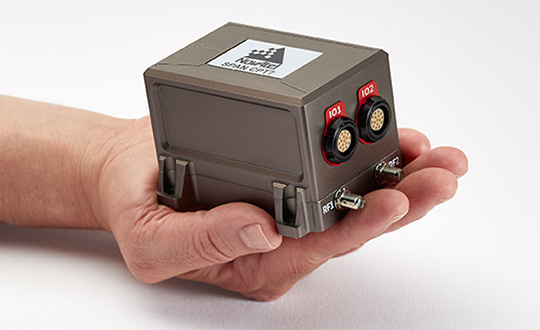
    The SPAN CPT7. (Photo: NovAtel)
    The SPAN CPT7. (Photo: NovAtel)

    The firmware works best with the recently launched TerraStar-X correction service, which delivers accuracy and reliability, as well as the OEM7, SPAN CPT7 and PwrPak7 products, which use signals from all GNSS constellations and frequencies to provide users with reliable autonomy and exceptional positioning availability.

    The 7.07.03 firmware offers a significant improvement to the SPAN GNSS + INS (inertial navigation system) technology. SPAN with 7.07.03 shows improvements of up to 20% in the horizontal position over the entire SPAN IMU catalog and across various industry use cases including agriculture and marine. SPAN with 7.07.03 also provides improved motion detection, resulting in more robust time to convergence.

    “The 7.07.03 firmware features improvements to both our SPAN Marine and SPAN Rail profiles that will greatly impact application performance and consistency,” noted NovAtel Director of Product Management, Neil Gerein, “The SPAN Marine Profile sees improvements to the heave performance and will allow users to start their work significantly faster thanks to a simplified setup for applications in marine dynamics. The SPAN Rail Profile improves position accuracy over long GNSS outages, which is crucial for applications in rail environments that often deal with potential signal obstructions such as trees, tunnels and dense urban areas.”

    To download the 7.07.03 firmware update for your platform, click here.

  • NovAtel’s OEM7 7.03.00 firmware offers new and enhanced features

    NovAtel’s OEM7 7.03.00 firmware offers new and enhanced features

    NovAtel’s OEM7 v7.03.00 firmware is now available on all OEM7 receivers. The OEM7700, OEM719 and OEM729 can be updated to the 7.03.00 firmware, which supports new features like the SPAN Land Vehicle technology, direct inertial measurement unit (IMU) connections and tracking of the NavIC Indian regional satellite system on the L5 frequency.

    The SPAN Land Vehicle feature provides performance benefits specifically for extended loss of GPS signals, robust alignment routines and improved attitude performance for fixed-wheel land vehicle applications. During extended periods of GNSS outage, typically in low-dynamic operating environments or in dense urban canyons, the SPAN Land Vehicle feature optimizes integrated GNSS+INS performance to maintain accurate position, velocity and attitude.

    To achieve this, NovAtel uses intelligent vehicle dynamics modeling and its patented Antenna Phase Windup Technology. Intelligent vehicle modeling identifies IMU errors in the integrated GNSS+INS system that accumulate after extended GNSS outages and reduces the impact of those errors within the SPAN solution.

    NovAtel’s Antenna Phase Windup technology is used to sense changes in direction and, when combined with intelligent vehicle modeling, corrects for IMU errors in attitude (roll, pitch, yaw).
    Users can now connect SPAN enabled OEM7 receivers directly to the ADIS-16488 and Epson G320N IMUs using an SPI interface, and to the STIM300 IMU using RS422, without the need for an interface card.

    OEM7 receivers with NavIC L5 frequency tracking enabled will be able to access the test signals of the Indian Regional Navigation Satellite System (IRNSS) before it becomes operational (targeted for early 2018).

  • Septentrio releases 4.2 firmware for greater performance, security and functionality

    Septentrio releases 4.2 firmware for greater performance, security and functionality

    Septentrio has released version 4.2 firmware for the AsteRx4, AsteRx-U and the newly launched AsteRx-m2. The 4.2 firmware brings higher output rates, low and constant latency, support for TerraStar-C and a built-in NTRIP caster.

    AsteRx-m2 UAS receiver.

    The 4.2 firmware targets machine control applications delivering higher output rates with consistent and low latency. Maximum output rates have increased on all platforms: up to 100 Hz for the AsteRx4 and AsteRx-m2 and 50 Hz for the AsteRx-U, with latencies better than 10 ms and 20 ms respectively.

    TerraStar-C is now supported, bringing precise point positioning (PPP) horizontal position precision to 4 cm. In addition, Septentrio algorithms deliver fast PPP re-convergence making PPP even more attractive for positioning in difficult environments.

    For the AsteRx4 and the AsteRx-U, the 4.2 firmware enhances ease-of-use by including a built-in NTRIP caster. Correction data from the receiver is available for up to 10 NTRIP clients (or rovers) over the internet. The caster supports up to three mount points and can also rebroadcast correction data from a remote NTRIP server.

    “For machine control and automation, Septentrio receivers have unique low-latency behaviour which is constant and independent of the update rate.” stated Francesca Clemente, Product Manager at Septentrio. She continued: “The 4.2 firmware demonstrates Septentrio’s commitment to advancing performance and functionality of its products.”

  • Swift Navigation releases firmware 1.1 upgrade for Piksi Multi

    Swift Navigation releases firmware 1.1 upgrade for Piksi Multi

    The Piksi Multi. Photo: Swift

    Swift Navigation has released its first major firmware upgrade for its flagship product, the Piksi Multi GNSS module.

    The upgrade is available at no cost to Piksi Multi users and expands on dynamic real-time kinematic (RTK) application support, increasing functionality for users, expanding use-case applications and allowing users to better leverage existing infrastructure and facilitate post-processing.

    Firmware version 1.1 updates include:

    • Increased Data Output Rates to Support Dynamic Use Cases
    • GNSS Measurements (Raw Data) – Up to 20 Hz
    • RTK Output Support
    • Low Latency Mode – Up to 20 Hz
    • Time-Matched/Heading Mode – Up to 5 Hz
    • IMU (Raw Data) – Up to 200 Hz

    Moving Baseline RTK Support. The capability to do real-time, precise relative positioning between two receivers where both receivers can now be in motion.

    RTK-Based Heading Support. The capability to do real-time RTK-based heading for direction finding — even when stationary — without the need for expensive navigational equipment such as gyrocompasses.

    Improved 1 PPS Support. The Piksi Multi Pulse Per Second (PPS) feature has been upgraded to support more customization.

    Standalone RINEX Conversion Utility Tool. The tool allows end-users using RTKLIB, such as those with UAV surveying applications, additional tools to support their post-process kinematic needs.

    Improved Compatibility with Existing Infrastructure (RTCM 3.1 Input). This added support enables end-users to better leverage existing base station infrastructure to receive RTK corrections (observations, station coordinates, etc.) from already deployed Continuously Operating Reference Stations (CORS).

    For detailed information about the upgrades, refer to the Piksi Multi Firmware 1.1 Release. For detailed instructions on how to upgrade a Piksi Multi device, refer to Section 7 of the Getting Started Guide, Piksi Multi – Upgrading Firmware. For firmware release binaries and product support documentation, visit support.swiftnav.com.

  • GeoMax updates Zenith35 Pro firmware

    GeoMax updates Zenith35 Pro firmware

    RNAN_6885-zenith-W
    Photo: Geomax

    GeoMax has updated the firmware on its Zenith35 Pro GNSS receiver, which was introduced in November 2016.

    The update is for NovAtel’s OEM7 Measurement Engine built into the receivers. Update OM7MR0102SN0005 addresses a real-time kinematic (RTK)-network connection issue preventing reception of corrections when connecting to selected NTRIP networks in some countries.

    Note that the receiver’s onboard firmware version remains unchanged at 2.01.

    The compact and fully ruggedized Zenith35 Pro has 555 channels. Its multi-constellation and multi-frequency capability supports all satellite systems today and in the future.

    The Zenith35 Pro incorporates “Tilt&Go” functionality that allows users to measure inaccessible points. This significantly increases efficiency in the field, since leveling time is eliminated. Tilt and compass values for each measurement are stored for quality control and documentation purposes.

    The unit is IP68-rated for water and dust, and is shock protected.

    GeoMax, based in Switzerland, is part of Hexagon.

  • Firmware update for u-blox M8 GNSS receiver adds Galileo

    u-blox has released new firmware, FW 3.01, for its u-blox M8 concurrent multi-GNSS platform.

    u-blox M8 FW 3.01 now also supports Galileo, in addition to GPS, GLONASS, BeiDou, QZSS and SBAS. It can track up to three constellations concurrently and makes use of all SBAS and QZSS augmentation systems at the same time.

    With Galileo fully deployed, the European positioning system will provide access to 24 additional satellites, significantly increasing availability of GNSS signals and further improving position accuracy in challenging urban environments. u-blox M8 supports Galileo-based eCall, the European emergency call system, which will be required in new vehicles starting 2018. u-blox M8 is also compliant with ERA-GLONASS, eCall’s Russian equivalent.

    In addition, with FW 3.01, u-blox M8 now boosts the BeiDou acquisition sensitivity and adds support to the Indian GAGAN augmentation system.

    u-blox M8 chips and modules are able to operate reliably in difficult environmental conditions as well as in a security attack scenario. Because a growing number of wireless systems rely on GNSS positioning, the threat of attacks, such as diversion of drones or hijacking of car electronics, has become very real.

    Security mechanisms are now embedded in FW 3.01, the result of years of intense research at u-blox R&D labs. An anti-spoofing feature detects fake GNSS signals, and a message integrity protection system prevents “man-in-the-middle” attacks. Yet another security function detects and suppresses jamming. Since all this functionality is already built into u-blox M8 FW 3.01, these security mechanisms are a lot more effective than an external system implementation.

    Automotive-grade u-blox M8 products benefit from an extended operating temperature of -40 to +105°C and are AEC-Q100 Grade 2 qualified. The extended temperature range allows more flexibility in vehicle integration, such as by integrating a u-blox M8 GNSS receiver into a roof-top antenna where temperatures can reach 105°C.

    Another feature of FW 3.01 is the 10 percent power reduction compared to earlier firmware versions of u-blox M8.

    The u-blox M8 platform supports applications where navigation performance, reliability, and high accuracy are paramount, whereas the recently announced u-blox 8 platform addresses power sensitive applications such as wearables. u-blox M8 and u-blox 8 products are pin- and software compatible.

    Firmware to upgrade existing flash-ROM based u-blox M8 products can be downloaded from the u-blox website. Products with FW 3.01 in ROM will become available in Q2′ 2016.

  • NVS Technologies AG Releases Raw Data Firmware for NV08C Multi-GNSS Receivers

    NVS Technologies AG, GNSS receiver developer, announces today the release of the optimized and raw data output enabled firmware v0204 for its NV08C-CSM and NV08C-MCM GPS/GLONASS receivers.

    Firmware v0204 provides significant performance improvements, as well as a group-delay calibrated raw data (carrier phase, code phase, and Doppler) output function, to the highly integrated NV08C-CSM SMT receiver module and the compact NV08C-MCM BGA SiP receiver. Firmware v0204 enables the NV08C-CSM and NV08C-MCM receivers to be utilized in a wide range high-precision applications, including survey equipment, GIS portable devices, and machine control and precision agriculture systems.

    NVS Technologies’ customers can take full advantage of NVS Technologies’ professional grade NV08C-CSM and NV08C-MCM multi-GNSS receivers’ capabilities. These receivers deliver true simultaneous multi-constellation navigation + up to 10Hz NMEA and raw data outputs, the company said.

    Firmware v0204 is download-able free of charge at www.nvs-gnss.com/support/firmware.