Tag: flooding

  • Drones key to Hurricane Ian response

    Drones key to Hurricane Ian response

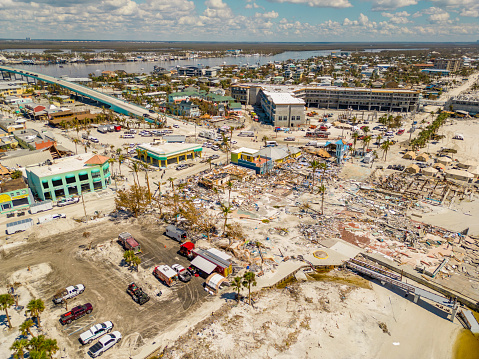
    A photo taken in the aftermath of Hurricane Ian shows the massive destruction on Fort Myers Beach. (Photo: felixmizioznikov/iStock/Getty Images Plus/Getty Images)
    A photo taken in the aftermath of Hurricane Ian shows the massive destruction on Fort Myers beach. (Photo: felixmizioznikov/iStock/Getty Images Plus/Getty Images)

    Not to harp on an event that’s already passed out of the headlines and national coverage, but Hurricane Ian — a Category 4 storm that hit Florida in September — was full of destructive winds and caused major damage that could be with us for years before things get fixed. One source also indicated that so far we have lost 157 people, mostly from drowning — nothing will ever fix those losses.

    So harp on I will, especially about the role drones and drone pilots played in rescuing survivors, and determining and mitigating effects of the storm.

    The place that took the hurricane hardest was Fort Myers on the southwest Florida coast. The following video is from a security camera.

    While Hurricane Ian was making a mess of Cuba and crawling over the Caribbean and into the Gulf of Mexico, drones were already flying over areas where the storm could cross from the Gulf onto land — initially forecast around Tampa. But the forecast landfall continued to drift south, over where I live in Venice and 150 miles south of Tampa to Fort Myers.

    Before landfall, drone operators in Fort Myers were gathering video/geolocation information on buildings and streets in the path that the forecast 14-foot storm surge might take. They identified areas of potential damage and places people might need rescue.
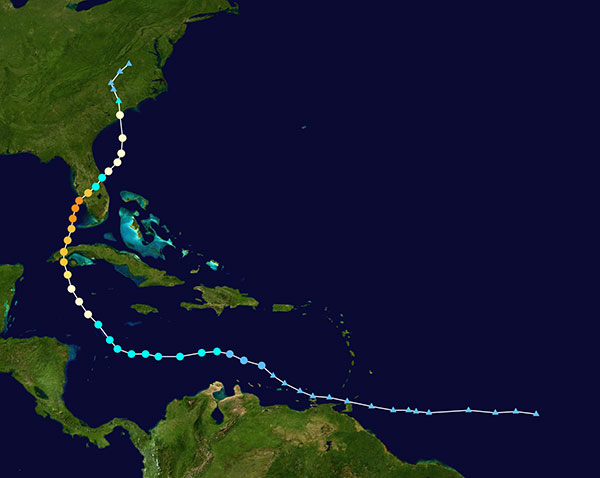
    Map plotting the storm's track and intensity using data from the National Hurricane Center and a NASA image. (Image: public domain/FleurDeOdile/Wikipedia)/
    Map plotting the storm’s track and intensity using data from the National Hurricane Center and a NASA image. (Image: public domain/FleurDeOdile/Wikipedia)/

    After the storm hit, first responders began searching more than 400 destroyed houses in Fort Myers, some using the pre-storm drone video to rescue any trapped survivors.

    The need was not only for access in difficult conditions, but also for communications. AT&T reportedly got cell coverage up quickly in a couple of areas, and Verizon flew tethered drones (capable of flying for up to 1,000 hours) to restore phone coverage over a circular radius area of five to seven miles. Verizon also hooked up generators and engaged satellite internet coverage for local use, and took a portable cell-site on a barge out to Sanabel Island, which had been cut off from the mainland. T-Mobile put generators at cell-sites that lost power and deployed satellite and ground-based portable cell coverage.
    Photo: Verizon
    Verizon tethered drones provided cellular service for first responders. (Photo: Verizon)

    Powerful Drone

    Loss of power was another issue. Florida Power and Light (FPL) flew its recently acquired fixed-wing FPLAir One drone to assess damage to its power distribution infrastructure, which supplies about 12 million people on Florida’s west coast.
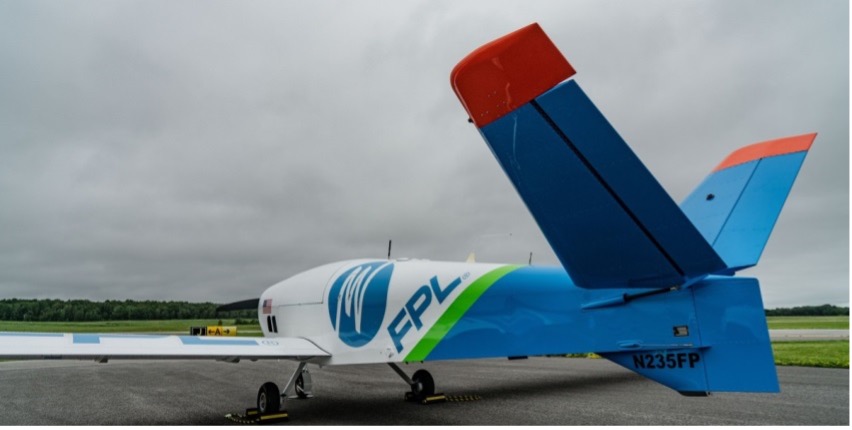
    FPL drone used in power loss assessment (Photo: FPL)
    FPL drone used in power loss assessment. (Photo: FPL)

    Using the drone in damage assessment efforts enabled FPL to get suitable crews to the right places early in the recovery effort.

    FPLAir One is a group 4/5 large UAV. It appears to be a Navmar Applied Sciences Corporation (NASC)/Sonex Aerospace TEROS unmanned aircraft, which is based on an earlier Sonex-powered glider design introduced in 2003. Because of this heritage and its rugged airframe, the TEROS is ideally suited for flights in high wind conditions — great for FPL’s long-range pre- and post-storm assessment application using FLIR and video cameras.

    The drone’s extensive prior airframe proving is assisting NASC/Sonex in its quest for certification of TEROS by the Federal Aviation Administration (FAA). FAA certification will ultimately support its integration into the National Airspace System (NAS) and allow operators to move on from the individual FAA approvals required for each operational drone scenario.

    Drones to the Rescue

    The principal application for hundreds of drone flights by several organizations was search and rescue for missing residents, mostly in the flooded area in and around Fort Myers. Drones also helped rescue people in North Port, where floodwater was as high as four feet, collapsing roofs and trapping people in their homes.

    Skydio provided drones for several search-and-rescue programs by police and other agencies, as well as coaching personnel who might lack experience in flying them. More than 500 drone flights were accomplished in the first days after the storm, a large number using autonomous flight capability, greatly assisting rescue efforts to locate trapped people. First responders were also able to determine whether access was possible, or what steps were initially needed to even enable access.

    Insurance companies are also using drone assessment video, determining the level of damage to homes and vehicles, in an effort to put assistance where it was most needed early on. Using artificial intelligence to align food-stamp users with badly damaged homes identified on satellite images in Lee, Collier and Charlotte counties, GiveDirectly offered immediate $700-assistance to many survivors. If all these offers were accepted, the cost could be as much as $2.4 million in no-strings-attached immediate aid for those worst hit.

    In the aftermath of the largest, most damaging hurricane to hit the United States since 1935, volunteers, first responders, drone pilots, aid agencies, and power, communication and insurance companies all made use of drones. These agencies and companies are still helping many thousands of people to survive and start the long task of picking up the pieces of their lives.
  • Teren kicks off nationwide lidar content library program

    Teren kicks off nationwide lidar content library program

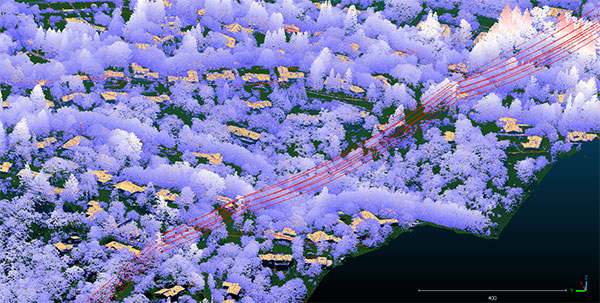
    Image: Teren
    Image: Teren

    Teren, a climate resilience analytics company, has expanded its Premium 4D Content program for regions across the United States, including the Gulf Coast, Midwest, Rocky Mountains and West Coast.

    Teren acquires and quickly processes high-fidelity lidar data, making it available via its content library, and delivers analytics with actionable insights to energy and engineering firms.

    “Climate change is causing drought, flooding, landslides and wildfires across the country – significantly impacting asset owners and project developers. As a result, the market demand for high-fidelity, temporal data to identify, prioritize, and monitor climate-related risk is higher than ever,” said Toby Kraft, Teren CEO.

    Teren is amassing a content library of remotely-sensed 3D (spatial) data across the United States. That data is updated on regular intervals to monitor changes over time providing a unique 4D (temporal) view. This 4D data library feeds analytics that identify risk, inform mitigation, and strengthen asset resilience. While remotely-sensed data has traditionally been sourced on a project-by-project basis, Teren offers its data and analytics as a subscription service. This model drives down the costs for clients and stakeholders, helping to maximize the speed of delivery, return on investment, and data value.

    “In our flagship content region, Appalachia, our customers tap into our 4D content library to identify and monitor the terrain and surface conditions surrounding their assets — primarily aiming to identify and mitigate landslides before they become catastrophic incidents,” Kraft said. “We’re expanding the program nationwide to meet the growing demand for terrain monitoring and climate resilience analytics around events such as erosion, flooding, wildfires and more.”

    Teren’s solution saved clients in Appalachia an estimated $152 million annually, preventing 24 failures per year due to landslides. While landslides are not as pervasive across the United States, companies can apply the data and analytics suite for the following:

    • Gulf Coast: inundation, subsidence, land movement
    • Midwest: erosion, flooding, subsidence
    • Rock Mountains: landslides, flooding, wildfire
    • West Coast: wildfires, land movement, flooding.

    Traditionally used by the energy sector, Teren’s data has also proven to be highly valuable to state and federal agencies, insurers and civil engineers. Teren expects to see increased variability across clients and use cases as the content region expands.

    To learn more about Teren or to request a demo, visit www.teren4d.com.

  • L3Harris explains how ENVI is used for disaster response at Esri UC 2019

    At the Esri 2019 User Conference, L3Harris’ Zachary Norman discusses how the company’s ENVI® (Environment for Visualizing Images) image analysis software, combined with deep learning, help with disaster response. Norman covers two scenarios where the technology can be used: flooding and forest fires, including the California Camp Fire in November 2018.

  • Dewberry provides data analytics for Houston post-flooding

    Dewberry, a privately held professional services firm, has been selected as a consultant to Civis Analytics to perform comprehensive data analytics, including flood hazard and property loss modeling and damage estimation, to support the city of Houston’s post-Hurricane Harvey recovery efforts.

    Hurricane Harvey flooding in Houston. (Photo: FEMA)
    Hurricane Harvey flooding in Houston. (Photo: FEMA)

    The granular, structure-level understanding of this catastrophic flooding event will be critically important to the city’s efforts to catalog impacts and direct resources to the rebuilding and recovery efforts, Dewberry said.

    The resulting data will be made accessible to authenticated city staff and non-profit organizations through the new Houston Estimation and Analysis of Loss (HEAL) platform. A cloud-based system that will be used in disaster mitigation planning, HEAL will aggregate data, analytics, tools and visualizations in a web-based environment available to city, state and federal officials and other stakeholders.

    Hurricane Harvey flooding in Houston. (Photo: FEMA)
    Hurricane Harvey flooding in Houston. (Photo: FEMA)

    The data development effort featured a hindcast model of the historic Hurricane Harvey storm event, which dropped 51 inches of rainfall within the city of Houston and surrounding areas over five days in August.

    The HEAL platform will provide the city with a comprehensive data collection and analytical architecture with the ability to calculate and report unmet needs at various levels, such as structure, parcel and census block.

    The analytics will include extensive modeling to estimate flood depth and extent and the structural and contents losses created by it. Model validation will use a wide set of data from debris removal pickup locations, and community field data collection, to federal assistance information, as well as non-traditional sources such as social media videos.

    Hurricane Harvey flooding in Houston. (Photo: FEMA)
    Hurricane Harvey flooding in Houston. (Photo: FEMA)

    For this complex project, Dewberry’s innovative approach has involved strong applications of science and engineering including meteorological data processing, 2D flood risk modeling, and damage assessment to replicate post-Harvey conditions in Houston.

  • Satellite imagery details historic floods in India

    DigitalGlobe has released pre- and post-event satellite imagery of the areas in India affected by heavy flooding.

    According to the company, massive flooding devastated the Kerala state of India in late May and early August. At least 164 people were killed and more than 223,000 were displayed from their homes and are living in relief camps. In addition, Kerala has seen 40 percent more rainfall than normal since June, which has triggered landscapes in several districts.

    In an effort to support disaster response and as a part of its Open Data Program, DigitalGlobe decided to publicly release the satellite images. According to the company, its Open Data Program supports the humanitarian community by providing critical and actionable information to assist response efforts.

    Check out the before and after images below.

    Satellite image ©2018 DigitalGlobe, a Maxar company.
    An overview of the fields and villages before the flood in the Kerala state of India in March 2018. (Satellite image ©2018 DigitalGlobe, a Maxar company.)
    Satellite image ©2018 DigitalGlobe, a Maxar company.
    An overview of the fields and villages during the flood in the Kerala state of India in August 2018. (Satellite image ©2018 DigitalGlobe, a Maxar company.)
    Satellite image ©2018 DigitalGlobe, a Maxar company.
    Before the flood in Champakulam in March 2018. (Satellite image ©2018 DigitalGlobe, a Maxar company.)
    Satellite image ©2018 DigitalGlobe, a Maxar company.
    A closeup of the flood in Champakulam in August 2018. (Satellite image ©2018 DigitalGlobe, a Maxar company.)
    Satellite image ©2018 DigitalGlobe, a Maxar company.
    Before the flooding in Moncompu, Kerala, in March 2018. (Satellite image ©2018 DigitalGlobe, a Maxar company.)
    Satellite image ©2018 DigitalGlobe, a Maxar company.
    During the flooding in Moncompu, Kerala, in August 2018. (Satellite image ©2018 DigitalGlobe, a Maxar company.)
    Satellite image ©2018 DigitalGlobe, a Maxar company.
    An overview of the roads and villages before the flooding in Kerala in March 2018. (Satellite image ©2018 DigitalGlobe, a Maxar company.)
    Satellite image ©2018 DigitalGlobe, a Maxar company.
    Trapped cars are on the roads in Kerala during the flooding in August 2018. (Satellite image ©2018 DigitalGlobe, a Maxar company.)
    Satellite image ©2018 DigitalGlobe, a Maxar company.
    People are stranded on a road southeast of Champakulam in August 2018. (Satellite image ©2018 DigitalGlobe, a Maxar company.)
    Satellite image ©2018 DigitalGlobe, a Maxar company.
    Vehicles are trapped on a road southeast of Champakulam in August 2018. (Satellite image ©2018 DigitalGlobe, a Maxar company.)