Tag: Flyability

  • Launchpad: New solutions for surveying, OEM, machine control and more

    Launchpad: New solutions for surveying, OEM, machine control and more

    Read a roundup of recent products in the GNSS and inertial positioning industry from the May 2025 issue of GPS World magazine.


    SURVEYING

    Integrated Navigation Solution
    Ideal for inspection and survey applications
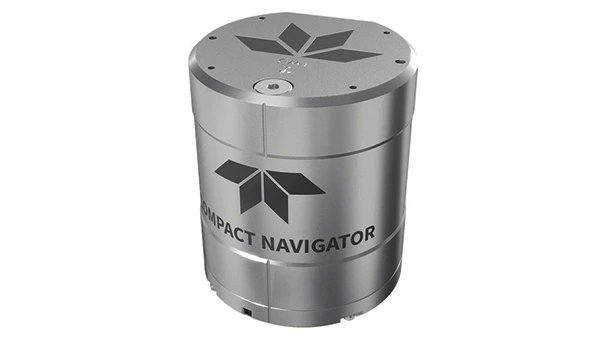
    Teledyne's compact navigator
    Photo: Teledyne

    Teledyne Compact Navigator is an ultra-compact autonomous integrated navigation system engineered for subsea and surface vehicles. It is ideal for small vehicles, enabling inspection and survey operations on compact platforms. The system is offered in two depth-rated models, one capable of operating at 4,000 m and another at 300 m. The Compact Navigator consumes less than 7 watts of power, extending mission duration by conserving energy. The system operates fully autonomously, eliminating the need for external aiding or operator intervention. Advanced phased array Doppler Velocity Log technology enhances performance while allowing the device to be mounted on an autonomous underwater vehicle or ship hull.

    The Compact Navigator supports a broad range of applications, including autonomus underwater vehicles, shallow water surface navigation, operations in GNSS-denied environments and dynamic positioning for surface vehicles. The system provides true North-seeking gyrocompass-grade performance, and its web-based user interface supports integration, operation and troubleshooting. It is factory-calibrated and offers a battery backup option for reliability in demanding conditions. The system operates independently of satellite signals, making it resistant to jamming or signal loss. This capability is significant for shallow water navigation, where GNSS-based systems may be unreliable.

    Teledyne Marine

    3D Reality Capture Solution
    Can be used across various industries
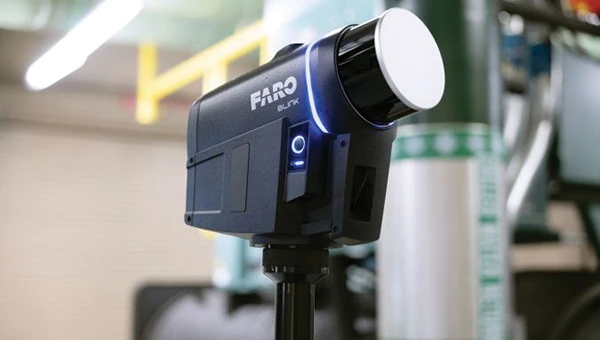
    Faro's 3D Reality Capture Solution.
    Photo: Faro

    FARO Blink, a new 3D reality capture solution, is designed to make collecting and utilizing 3D data more accessible and efficient. It centers on software-driven technology integrating advanced visualization and automated workflows through the FARO Sphere XG Digital Reality Platform. This integration aims to simplify operations and deliver faster, more actionable insights for users across various industries.

    FARO Blink is tailored for professionals in fields such as surveying and construction. It offers high-quality visualization and can streamline workflows, allowing teams to efficiently capture, view and share 3D data, thereby enhancing project progress and collaboration.

    Faro

    Multibeam Echosounder
    For bathymetric surveying
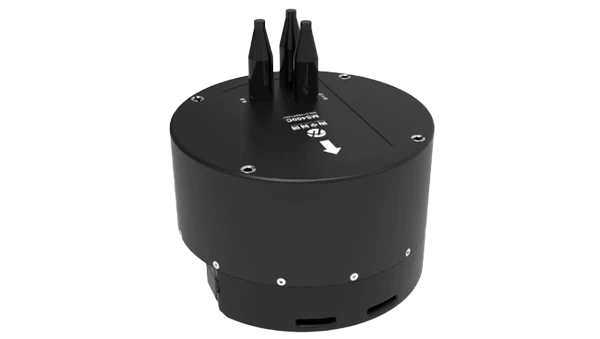
    Hydro-Techmarine's multibeam echosounder
    Photo: Hydro-Techmarine

    The MS400C is a fully integrated multibeam echosounder designed for uncrewed surface vessels. The new system combines sonar processing, inertial navigation, GNSS positioning and sound velocity sensing into a single unit.

    The MS400C seeks to address deployment challenges faced by USV operators during hydrographic surveying. Its compact, lightweight design allows direct mounting on small platforms. Installation involves connecting a few cables to the IPC and power supply and to the primary and secondary GNSS antennas. With preconfigured spatial relationships, operators can deploy and start surveying quickly, reducing configuration errors and ensuring consistent data quality.

    Equipped with Auto Survey functionality, the system calibrates parameters based on water conditions, which streamlines pre-survey procedures. Real-time roll compensation and attitude data from the internal measurement unit, combined with sound velocity profiling, ensure high-fidelity depth measurements, even in dynamic conditions. Designed for autonomous and remotely operated survey platforms, the MS400C supports data collection in confined waterways.

    Hyrdo-Techmarine

    RTK/PPK GNSS System
    With tilt compensation
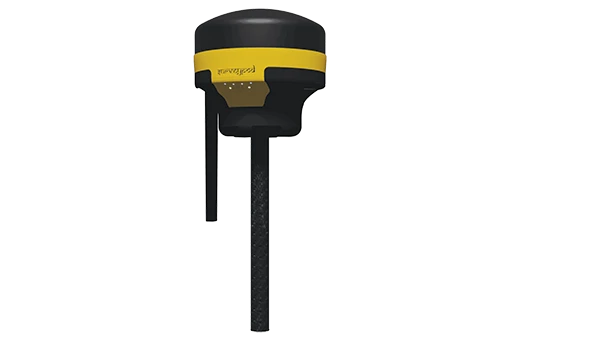
    Surveyann's RTK/PNK GNSS System
    Photo: Surveyann

    The SurveyPod RTK/PPK GNSS system is built for professionals in surveying, agriculture, mining and construction. The system integrates GPS, GLONASS, Galileo and BeiDou signals for improved satellite visibility and accuracy, even in harsh environments.

    Powered by a CORS Network, SurveyPod offers real-time, centimeter-level positioning ideal for high-precision applications. The device supports tilt compensation for reliable data collection at angles and boasts up to 16 hours of battery life, making it ideal for extended field operations. With this launch, Nibrus Technologies is expanding its survey equipment portfolio, offering a Made-in-India GNSS solution to the global market.

    Surveyann

    OEM

    North-Seeking IMU
    Operates independently of GNSS
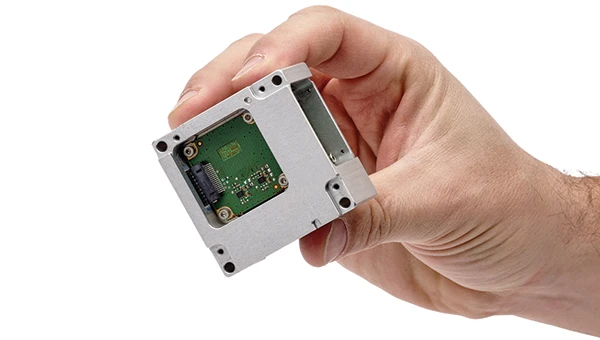
    SBG Systems' North-Seeking IMU
    Photo: SBG Systems

    This MEMS-based north-seeking inertial measurement unit (IMU) operates independently of GNSS. It can achieve a heading accuracy greater than 1° secant latitude without GNSS assistance. When integrated with GNSS and SBG Systems’ navigation algorithms, it can achieve INS heading accuracy greater than 0.01°.

    Measuring 52 x 52 x 36 mm and weighing less than 150 g, it consumes only 2 watts of power. It offers long-term reliability in demanding conditions, and its ITAR-free status allows unrestricted global deployment. SBG Systems also has developed a new pure north-finding algorithm capable of rapid initialization in both static and dynamic conditions within one minute, as well as an advanced GNSS/INS fusion algorithm that delivers exceptional single-antenna heading accuracy even in low-dynamic environments.

    The IMU is particularly suited for subsea applications, including remotely operated vehicles and autonomous underwater vehicles, as well as geospatial and marine surveying tasks requiring precise single antenna heading accuracy.

    The first off-the-shelf solutions are expected to be available by early 2026.
    SBG Systems

    Post-Processing Software
    With upgraded features
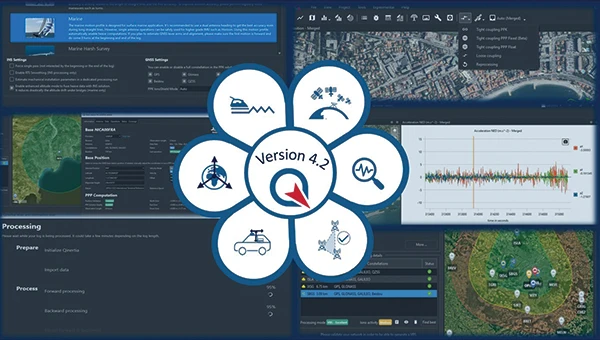
    Post-Processing Software from SBG Systems
    Photo: SBG Systems

    Qinertia 4.2 is an updated version of SBG Systems’ post-processing software for GNSS and INS data. One of the notable additions is the beta version of Precise Point Positioning Fixed Ambiguity, which offers centimeter-level accuracy processing without the need for a base station. The update also includes a new RTS smoothing option, the Trajectory Smoother, which enhances INS processing by removing artifacts while maintaining precision. Another feature is the standalone Lever Arm Estimation Tool, now available as a separate application with a simplified interface. The Advanced Virtual Base Station Network Creation has been enhanced with improved base station quality indicators to increase reliability.

    It is compatible with the New Ellipse series and supports Teledyne Intrepid INS. The software now offers faster processing speeds, enhanced geodesy functionalities such as base station velocity analysis, and updated tools for assessing processing quality through new status plots. It also supports the latest firmware versions of Ekinox, Apogee, Navsight and Quanta systems.
    SBG Systems

    MACHINE CONTROL

    GNSS Receiver and INS System
    For machine guidance
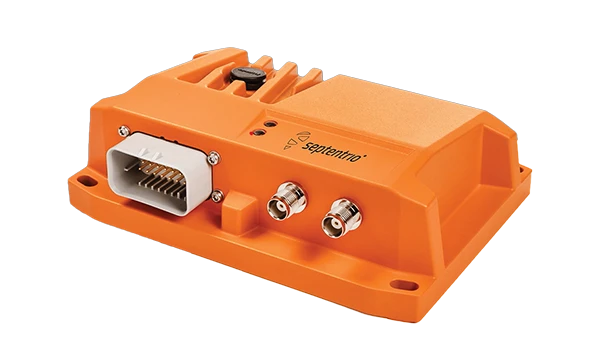
    Septentrio's GNSS Receiver and INS System
    Photo: Septentrio

    The AsteRx RB3 GNSS receiver and the AsteRx RBi3 GNSS/INS system are designed to operate in extreme environments. They feature IP69K-rated housings and components that have undergone ISO-standard testing.

    The technology offers durability under heavy shocks, vibrations and challenging environmental conditions, making it suitable for demanding applications such as construction, mining and port automation.

    The AsteRx RB3 and RBi3 utilize multi-frequency GNSS technology to deliver precise, centimeter-level positioning even in environments where GNSS signals are typically difficult to maintain. The receivers can be mounted externally on heavy machinery or integrated into chassis systems, offering flexibility in placement and simplifying installation.

    The AsteRx RBi3 incorporates FUSE+ technology, which combines a high-performance GNSS engine with an industrial-grade inertial sensor. This integration provides accurate orientation data, such as heading, pitch and roll, alongside reliable positioning. In dual-antenna configurations, the receivers deliver sub-degree GNSS heading accuracy immediately upon initialization. The AsteRx RB3 and RBi3 are ideal for machine guidance in industries requiring rugged equipment to maintain precision under extreme conditions.

    Septentrio

    Handheld Reality Capture Solution
    For maximum mobility 
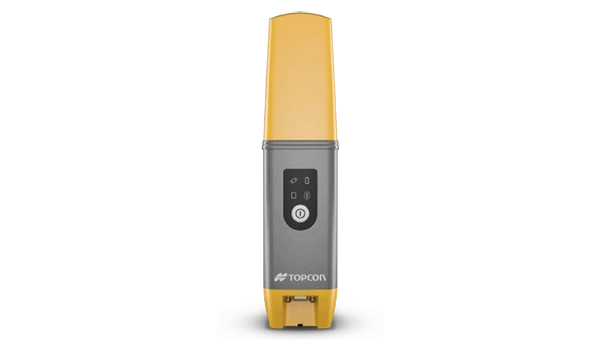
    Topcon Positioning's Handheld Reality Capture Solution
    Photo: Topcon Positioning

    Designed for mass data solutions, the CR-H1 utilizes PIX4Dcatch, a specialized application with integrated lidar that runs on iPhone devices. It collects images and employs photogrammetry to create detailed, full-color 3D point clouds. The iPhone connects to Topcon’s HiPer CR receiver, enabling the application to collect georeferenced images. The receiver and iPhone are mounted on a specialized handle designed and manufactured by Topcon so that users can capture point clouds without a tripod.

    The CR-H1 can be used for utilities and subsurface mapping, construction verification and earthworks, civil engineering and site verification, land surveying and forensics and 3D data capture. Topnet Live subscriptions are available for the CR-H1, providing real-time GNSS corrections that deliver higher-quality point clouds. 

    Topcon Positioning

    MOBILE

    Handheld GPS Device
    Can provide up to 200 hours of GPS navigation on a single charge
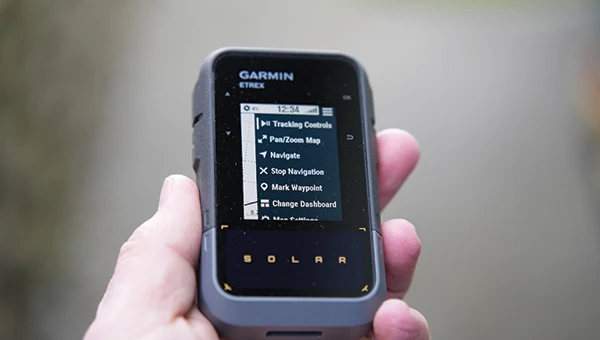
    Garmin's Handheld GPS Device
    Photo: Garmin

    The Garmin eTrex Solar is a handheld GPS device with a built-in solar charging feature. This feature allows for potentially unlimited battery life in optimal sunlight conditions. Even without direct solar input, the device can provide up to 200 hours of GPS navigation on a single charge, making it suitable for extended trips with limited access to power.

    The device supports GPS, GLONASS, Galileo, QZSS, IRNSS and Beidou. It features a rugged design, an IPX7 water resistance rating, and a compact, lightweight body that can be attached to a backpack or worn around the neck. Users can import GPX files and navigate to waypoints, courses and geocaches. It also includes a three-axis compass and can store up to a thousand waypoints, 50 courses and 200 activities.

    Users can connect the eTrex Solar to their smartphones through the Garmin Explore app, which enables additional features such as geocaching details, weather updates, software updates, trip planning, and cloud storage syncing.

    Garmin

    New Product Offerings
    Now featuring marine GNSS antennas
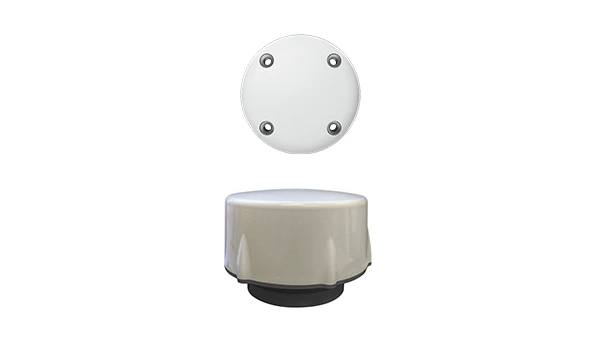
    New product offerings the now feature marine GNSS antennas from Geo-matching.
    Photo: Geo-matching

    Geo-matching has expanded its product database to include GNSS antennas. The initial marine GNSS antennas featured in this new category are the VP6300 from Calian GNSS, formerly Tallysman, and the AV34 from Trimble.

    Geo-matching features detailed information on more than 1,300 products across 63 categories for surveying, navigation and machine guidance. The website is designed to guide users through complex product specifications, offering access to brochures, case studies, product videos and professional reviews. Among the many categories available on Geo-matching.com are hydrographic processing software, GNSS receivers, GIS software, inertial navigation systems, total stations, UAVs, sidescan sonars, imaging sonar and more. The platform encourages users to browse its extensive catalog, upload new products, leave reviews and register their companies to add products to the database.

    Geo-matching

    UAV

    Mapping UAV
    With a new “Smart Return-to-Home” feature
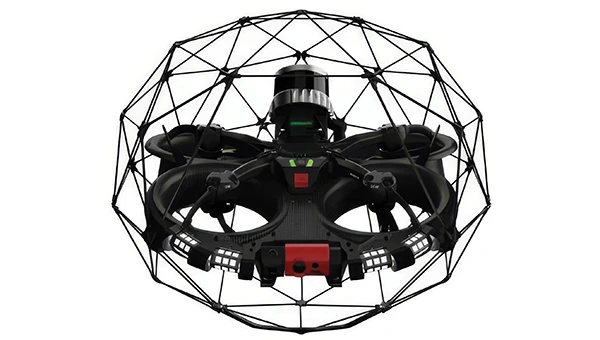
    Mapping UAV with "smart  return to home" feature from Flyability
    Photo: Flyability

    Flyability has introduced a “Smart Return-to-Home” (RTH) feature for its Elios 3 UAV, designed to enhance its autonomous capabilities. This feature allows the UAV to return to its take-off point using the shortest available path while avoiding obstacles in real time.

    During flight, Smart RTH monitors battery levels through a new flight management gauge, notifying the pilot when it is time to return. The feature is activated via Flyability’s Cockpit flight app, and pilots can take manual control at any point. By automating the return process, the system helps pilots focus on inspections without concerns about battery management or navigation in complex environments. Smart RTH uses lidar scans to generate a flight plan that the UAV executes independently.

    Flyability

    Drone Detection Software
    FAA compliant
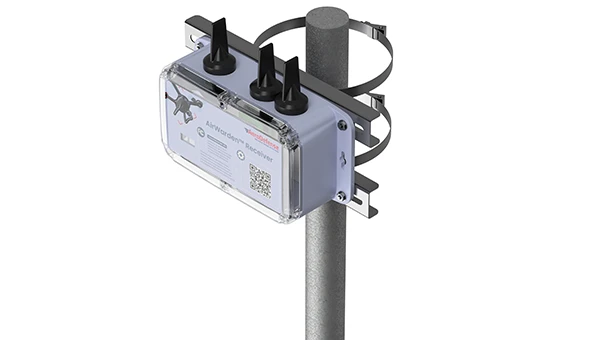
    New drone detection software from Aerodefense
    Photo: Aerodefense

    The AirWarden Remote ID Receiver detects and decodes Remote ID signals broadcast by UAVs. It is designed for organizations and authorities that need to monitor UAV activity for safety, security and compliance with regulations.

    It decodes the information transmitted by UAVs in accordance with FAA and other regulatory standards. The data it captures includes the UAV’s identification number, its precise location (latitude, longitude and altitude), the takeoff location, operator location if available, timestamps, and other relevant metadata.

    The AirWarden can be deployed as a standalone unit or integrated into larger security and monitoring systems. Users interact with the system through a web-based or software interface that facilitates live monitoring, alert management, and data analysis.

    Additionally, the AirWarden can integrate seamlessly with other security infrastructure, such as video surveillance and access control systems. This integration seeks to improve how security teams automate responses and coordinate actions when unauthorized or suspicious drone operations are identified.

    Aerodefense

  • GeoSLAM partners with Flyability on Elios 3 indoor drone

    GeoSLAM partners with Flyability on Elios 3 indoor drone

    Photo: Flyability
    Photo: Flyability

    Flyability has unveiled the Elios 3, a collision-tolerant drone equipped with a lidar sensor for indoor 3D mapping. The drone is powered by a new SLAM engine called FlyAware that lets it create 3D models as it flies.

    It also is accompanied by a new version of Flyability’s software for inspectors, Inspector 4.0.

    The launch of the Elios 3 marks a new partnership with GeoSLAM. The Elios 3 comes with an Ouster OS0-32 lidar sensor, allowing inspectors to collect data for the creation of survey-grade 3D models using software from GeoSLAM.

    The drone gives users real-time digital replicas of previously inaccessible areas with the inclusion of the lidar sensor and GeoSLAM’s Connect software. The drone is protected by a cage and has advanced collision-tolerance features that allow inspectors to fly it inside dangerous confined spaces such as boilers, pressure vessels and mines.

    With its integration with Connect, the Elios 3 creates survey-grade point clouds. Fitted to the back of the drone, the lidar sensor maps the environment in real time using Flyability’s FlyAware SLAM algorithm.

    Survey package option

    Those that need highly accurate data can upgrade to the survey package, provided by GeoSLAM, providing access to the Connect software, as well as specialist Volumes and Draw modules. Powered by GeoSLAM’s established SLAM algorithm, Connect offers a simple and automated way to process point cloud data.

    Using the survey package, data is processed to an accuracy of 8 mm, suitable for mapping hazardous environments such as mines and industrial applications including chimneys, production plants, warehouses, silos and tanks. Processed data can then be viewed in the easy-to-use 3D viewer and exported to industry-standard file types including LAZ, LAS, PLY and TXT for use in third-party software.

  • Xponential: Where UAVs (and companies) go to see and be seen

    Xponential: Where UAVs (and companies) go to see and be seen

    This year’s AUVSI Xponential show continued to demonstrate how large, thriving and visionary the UAV market is proving itself to be. With attendance around 8,000 people, an extensive technical program featuring more than 300 speakers, and a huge show floor displaying a wide range of sizes, configurations and applications, this was truly 2019’s place to be, see and — for the exhibitors — be seen.

    On the large-format side,

    • an expanding test-range facility in North Dakota brings experimental capability to the oversize crowd,
    • Bell and Boeing are going full-tilt with large UAVs, both rotor and fixed-wing, and
    • a higher level market is emerging at 20 kilometers (12 miles, or 65,000 feet) above the Earth.

    In the smaller-sized portion of the market, hydrogen fuel cells are extending operational time, and indoor inspections can be significantly cost- and time-reduced with new task-specific models.

    Hurricane Irma response. Tuesday morning’s opening keynote featured an overview of how Florida Power and Light (FPL) and Precision Hawk undertook recovery inspections following Hurricane Irma in 2018.

    This rang a bell for me, as Irma was the first hurricane I lived through; it passed 30–50 miles to the east of us, up the center of Florida.

    FPL flew 4,000 miles with Precision Hawk drones, looking for downed and damaged transmission lines and blown transformers throughout its massive distribution network.

    UAVs on the Show Floor

    With roughly 800 exhibitors, it’s impossible to see everything, let alone talk with all the companies. So the following is a small subset from the show, with highlights from the large-format UAV sector and a few smaller ones. Further coverage of the show will appear in next month’s newsletter column.

    The Bell Nexus demonstrator drew crowds at AUVSI Xponential 2019. (Photo: Tony Murfin)
    The Bell Nexus demonstrator drew crowds at AUVSI Xponential 2019. (Photo: Tony Murfin)

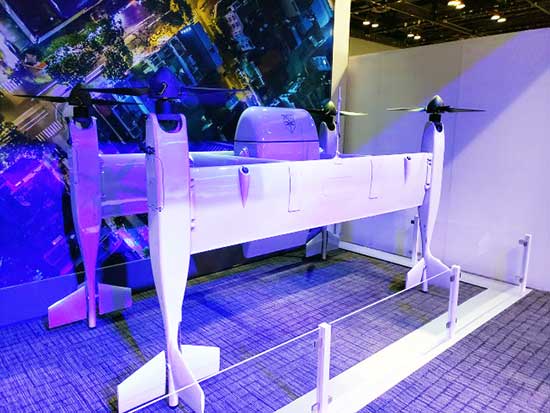
    Bell Helicopter. The Bell Nexus demonstration tilt-rotor – judging solely by the number of smartphone picture takers – was the hit of the show.

    Nexus is gleaming blue, with six 8-foot tilt-rotors. The booth had a massive display screen in the back running a loop of its exploits, along with what seemed to be animations of future adventures — flying people around city-center skyscrapers.

    Tail-sitter package delivery drone. (Photo: Tony Murfin)
    Tail-sitter package delivery drone. (Photo: Tony Murfin)

    This brings up lots of potential failure modes to be mitigated (six rotors rather than one regular helicopter rotor blade and a complex control system, for instance) for the Federal Aviation Administration (FAA) to chew on during the certification process.

    A large four-tail package-carrying sitter drone for larger item deliveries took second place at the Bell booth, even though it is possibly closer to becoming a reality than the gleaming blue star of the show.

    Boeing's tilt-rotor UAV prototype recently flew its first test flight. (Photo: Boeing)
    Boeing’s tilt-rotor UAV prototype recently flew its first test flight. (Photo: Boeing)

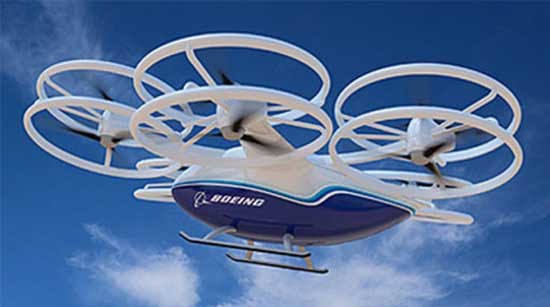
    Boeing. Meanwhile, Boeing was apparently preparing to fly a prototype version of a tilt-rotor UAV, only Boeing’s is designed to be a heavy cargo lifter. The Cargo Air Vehicle prototype vehicle has six tilt-capable dual-rotor systems, weighs 1,100 pounds and is 17.5 x 20 x 5 feet tall. It’s interesting how similar the Bell and Boeing (production concept) configurations seem to be.

    Boeing design concept for the Cargo Air Vehicle. (Image: Boeing)
    Boeing design concept for the Cargo Air Vehicle. (Image: Boeing)

    Ballard. Most multi-rotors on UAVs are driven by electric motors, so battery capacity determines the duration of flying time. Ballard has developed the FCair hydrogen fuel cell, which can extend flight time to up to 90 minutes, almost three times that of lithium-ion battery-powered drones.

    FCair 600w hydrogen fuel cell. (Photo: Ballard)
    FCair 600W hydrogen fuel cell. (Photo: Ballard)

    Insitu, AeroVironment, Lockheed-Martin, and others have flown the Ballard fuel-cell system; apparently this list also includes the U.S. Naval Research Laboratory and the Air Force.

    Grand Sky. The Grand Sky Aviation Park in North Dakota is co-located within the 217 acres Grand Forks Air Force Base (AFB) and has FAA approval as a UAV beyond-visual-line-of-sight (BVLOS) test range.

    North Dakota has invested more than $34 million in UAV efforts within the state, with a good chunk going towards the infrastructure at Grand Sky. Now only UAVs fly out of the facility, with Northrop Grumman and General Atomics making it an operational base for Global Hawk, Reaper and Predator drones.

    One of the principal benefits is the ability to fly BVLOS operations for large drones at Grand Sky. The system uses two long-range primary radars, one at Grand Forks AFB and the other in Hillsboro, that can detect non-cooperative aircraft.

    Harris RangeVue radar and Harris ADS-B sensors coupled with the Air Force’s DASR-11 radar enable BVLOS testing without using a chase plane or staying within line-of-sight. This enables 10–12 hour missions within the 30-mile, 18,000-foot BVLOS range, with continuous electronic monitoring by the ground-based radar system.

    A new operational center is being built to house the integrated system and to provide access for visiting drone operators, and the BVLOS range is expected to be ultimately extended all the way to the Canadian border.

    Flyability. The Elios 2 UAS system has evolved to include a rotatable thermal and high-definition visual camera payload, 10,000-lumen oblique lighting system, and reversible rotors that enable the UAV to back out of tricky situations.

    A geodesic-like cage surrounding the drone makes it collision-tolerant and enables flight in restricted indoor areas such as refinery enclosures, mines, vats, cargo holds and nuclear containment vessels — anywhere, in fact, that inspections today are regularly conducted by people.

    A typical nuclear plant inspection might cost $500,000, while this drone system costs around $35,000, and an inspection might take around 10 minutes. For traditional inspections, plants might have to go offline completely while people crawl around in extremely difficult, often dangerous spaces, and manual reports might take significant time to produce.

    Flyability claims huge savings in inspection time with their system, as well as automated analysis and production of reports.

    AeroVironment. Just before the show, SoftBank, Japan and AeroVironment held a press conference in Japan outlining their HAPSMobile Joint Venture to address the lack of communications access in many parts of the world. Almost 3.7 billion people, or half the world’s population, currently do not have internet access.

    SoftBank wants to provide internet inexpensively, without the need for extensive ground infrastructure, by operating high-altitude pseudo-satellite (HAPS) UAVs. HAPS is expected to fly in the stratosphere at a 20-kilometer height for up to six months, powered by solar cells and equipped with payloads that enable direct connection to the internet for users on the ground.

    Airborne-type certification and spectrum will be required for the uplink/downlink. Both present significant challenges, but HAPS suppliers, including Airbus, Facebook and others are joining the fight for spectrum. AeroVironment has a $65 million contract from HAPSMobile to develop and produce HAPS UAVs, and build of their Hawk 30 HAPS UAV is well underway.

    HAPSMobile has also taken a minority $125 million position with Loon, which has been flying stratospheric balloons for several years, providing wireless coverage in Puerto Rico after Hurricane Irma, and network coverage in South America.

    Other suppliers exploring the HAPS market at the show included Airbus, which displayed its Zephyr UAV and recently announced the opening of the Wyndham HAPS launch site in Western Australia; and UAVOS, which announced a new control system for its HAPS vehicle.

    In addition, Boeing’s unmanned aircraft subsidiary, Aurora Flight Sciences, has already made significant claims about the capabilities of its own Odysseus HAPS UAV program.

    Recapping the Recap. With many more exhibitors and limited time, the rest of the story from Chicago’s 2019 Xponential exhibition will have to wait till next month, to include show news from Sagetech, uAvionics, Sensefly, Fortem, Septentrio, NovAtel and others.

    In sum, we see a wide range of different applications all benefiting from unmanned air vehicles of different types and configurations. A number of outfits are working the HAPS gamble, North Dakota’s BVLOS test-range expansion brings experimental capability to the oversize crowd, and Bell and Boeing are going full-tilt with large UAVs, both rotor and fixed-wing.

    These developments clearly indicate that the UAS business continues to grow into a huge number of applications and to look very healthy.

  • Launchpad: Automated modules, drones, lasers

    Launchpad: Automated modules, drones, lasers

    OEM

    Automobile module

    Supports integration of telematics, managed services

    The LE940A9 automotive-grade smart module supports LTE Advanced Category 9 (Cat 9) networks. It comes in three multi-band, multi-mode variants, including Voice-over-LTE (VoLTE), and is optimized for automobile manufacturers to deploy next-generation connected car technology in world markets. It features worldwide GNSS support including GPS, GLONASS, Galileo, Beidou and QZSS. The LE940A9 delivers 450-Mbps download and 50-Mbps upload speeds with extremely low latency and advanced security, enabling the next wave of automobile industry’s applications and services that also serve as a springboard for autonomous driving.

    Telit, www.telit.com

    Refreshed board

    Low-power, high-precision, positioning and heading

    The refreshed Vector Eclipse H328 is designed for robotics, autonomous vehicles, antenna pointing, marine survey, machine control and any application where high-accuracy positioning and heading is required. The multi-frequency, multi-GNSS H328 is an all-signals receiver board that includes Hemisphere’s new and innovative hardware platform, reducing its overall cost, size, weight and power consumption. It also integrates the Atlas GNSS Global Correction Service. The H328 offers fast accuracy heading of better than 0.17 degrees at 0.5-meter antenna separation and aiding gyroscope and tilt sensors for temporary GNSS outages. The 60 x 100 millimeter module with 24-pin and 16-pin headers is a drop-in upgrade for existing designs using this industry standard form factor.

    Hemisphere GNSS, www.hemispheregnss.com

    Personal mobility

    Wheelchair with embedded 3G module can be upgraded with GNSS

    A cellular module is embedded in a personal mobility wheelchair built by WHILL, a Japanese company specializing in innovative products for the mobility industry. The WHILL Model C features cloud connectivity based on a 3G cellular module from u‑blox. The embedded module features worldwide UMTS/HSPA and GPRS/EDGE coverage with a small footprint, also enabling easy and cost‑effective bolting on of a u‑blox GNSS receiver such as the MAX‑7C. The personal electric vehicle combines a sleek design with the latest innovative functionalities, enabling users to live an active lifestyle. As WHILL is looking into autonomous driving for people with disabilities, u‑blox plans to contribute with wireless positioning and connectivity technology.

    WHILL KK, www.whill.jp; u-blox, www.u-blox.com

    GNSS for small cells

    Technology for 5G networks, IoT

    The OSA 5405 SyncReach is an integrated Precision Time Protocol (PTP) grandmaster and GNSS receiver with a patent-pending dual antenna and receiver to enable the mass roll out of small cells. The new technology has been engineered to provide accurate and affordable phase synchronization for the rapidly growing small-cell market and meet the stringent timing requirements of 4.5G and 5G connectivity. With the OSA 5405, operators can migrate from legacy GNSS RF antennas and cables to standard, cost-effective copper and fiber Ethernet cabling, reducing capital expenditure and operating expenses. Available in both indoor and outdoor variants, the OSA 5405 can be deployed in challenging environments, including urban canyons where GPS signals fail or positioned on indoor windows to avoid multipath signal interference from objects in the building.

    Oscilloquartz, www.oscilloquartz.com

    LPWA with GNSS

    Global, dual-mode low-power wide-area (LPWA) cellular module

    The AirPrime WP77 smart wireless modules simplify LPWA deployments for customers developing products that need to connect to multiple networks where different LPWA technologies are supported.

    With integrated GNSS for tracking and location-based services, low-power modes and a comprehensive set of interfaces for connecting sensors and companion chips (including Wi-Fi and Bluetooth), customers can develop multi-service platforms for the transportation market, and use the WP77 for applications requiring low throughput and optimized power performance. The WP77 supports both LTE-M (Cat-M1) and NB-IoT (Cat-NB1) with optional 2G fallback, allowing customers to deploy the same device with multiple network operators worldwide. For those deploying in regions where 4G LTE coverage is not as widely available, 2G fallback ensures their devices stay connected to the network.

    Sierra Wireless, www.sierrawireless.com

    GNSS-aided ins

    Absolute orientation for devices

    The INS-T-306 module is a GNSS-aided inertial navigation system that combines GPS L1/L2, GLONASS, BeiDou and a high-performance strap-down system. It is capable of determining position, velocity and absolute orientation (heading, pitch and roll) for any device on which it is mounted. The INS-T-306 aims at facilitating motionless and dynamic applications that need high accuracy, such as vessels, ships, helicopters, unmanned aerial vehicles (UAVs) and unmanned ground vehicles (UGVs). The INS-T-306 uses an advanced GNSS receiver, barometer, magnetometers, micro-electro-mechanical (MEMS) accelerometers and gyroscopes to provide accurate position, velocity, heading, pitch and roll of the device under measure. The unit supports differential GPS (DGPS) and real-time kinematic (RTK). It is able to integrate into the lidar brands Velodyne, Riegl and Faro.

    Tersus GNSS, www.tersus-gnss.com

    UAV

    UAV detection

    Effective detection and neutralization of drones

    The SafeSky multi-sensor UAV detection and tracking system detects and neutralizes drones in any weather, providing true dome-like protection. A combination of proprietary radar, acoustic, vision and RF sensors enables minimized alarm-rates detection of small drones at a distance of at least 1,000 meters. Its miniaturized, low-power radars are based on proprietary space technology developed with the European Space Agency. All sensors data is fused and the result presented in an integrated software environment. No-drone zones are easily defined. Alarms are issued via SMS, email and in graphical and sound form. The SafeSky application is web-based and can be run on desktop computers and tablets for untethered operation. To neutralize drones, the system uses directive jammers or drone hacking (depending on regulations), forcing the drone to return to its operator or land safely in a controlled manner.

    Advanced Protection Systems, www.detectdrones.com

    Fixed-wing drone

    Large area survey tool

    The DATAhawk PPK is an ultra-high accuracy fixed-wing drone package designed for professional surveyors that need maximum geospatial precision. It provides absolute (not relative) survey-grade results within minutes. The drone produces repeatable results. It is equipped with a dual-frequency L1/L2 receiver tracking GPS and GLONASS; 132 hardware channels allow simultaneous tracking of all visible GPS/GLONASS satellites. This system allows the aircraft to fly much further than with an RTK system, once flight camera positions are corrected by combining GNSS recordings of the aircraft with the corresponding information of the reference base station on the ground. The UAV is free of the requirement of a separate, high bandwidth, GPS link to a base station.

    Quest UAV, www.questuav.com

    Light imager

    Dual thermal and visible sensor drone camera

    The FLIR Duo is the same size and shape as popular action cameras, but features advanced capabilities. Equipped with FLIR’s smallest and lightest Lepton thermal camera core, operators are no longer constrained by daylight. The Duo provides the power to see objects over 100 yards away in complete darkness, smoke and light fog. Equipped with a 160 x 120 thermal camera and High-Definition (HD) 1080 color camera, FLIR Duo allows operators to swap between the two cameras mid-flight or view both in a picture-in-picture mode via the FLIR UAS app. FLIR’s proprietary multi-spectral dynamic (MSX) image processing algorithm embosses the thermal image with key details from the visible camera, resulting in a sharp dual-spectrum image. A fully radiometric variant called Duo R delivers accurate, calibrated temperature measurements in every pixel.

    FLIR, www.flir.com

    Drone deterrence

    Technology without electronic jamming is safe for urban areas

    ApolloShield is a radio system that detects and drives unauthorized drones away at the push of a button. Its RF jammers are field-proven, immediately deployable devices that emit strong signals that break the communications of unwanted drones, driving them away from secure sites. Drone identities are extracted from the radio signal and can be used as a lead to catch the operator. ApolloShield is customizable so that every site will have optimal protection, yet is plug-and-play and can be deployed in a few hours at any location and operated without any special training. The system consists of several elements, including an omni-directional antenna, a signal processing unit (pictured), and the Cloud Control Center that can be accessed from any cloud-connected device (pictured). ApolloShield is designed for various threat scenarios, including surveillance, accident response, terrorism, and incarceration violations using drones.

    ApolloShield, www.apolloshield.com

    Collision-tolerant UAV

    Reduces accidents and injuries

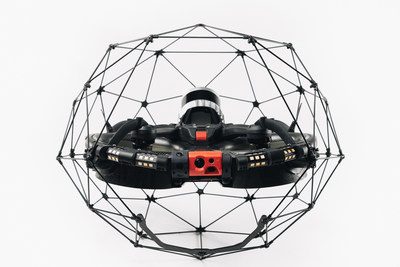
    The Elios drone solves the challenge of flying drones indoors in complex and confined spaces or in contact with humans, reducing the risk of collisions and injuries. By enabling remote visual inspection in any indoor environments, Elios eliminates the need for workers to enter hazardous places or face dangerous situations. The protective carbon-fiber frame is collision-tolerant up to 15 km/h. Elios reduces downtime and performs an entire inspection in hours, eliminating the need for scaffolding, rope access, or cranes for visual inspections of difficult-to-reach areas. Its integrated payload includes simultaneous full HD and thermal imagery recording, and adjustable tilt angle.

    Flyability, www.flyability.com

    Navigation kit

    RTK GNSS for pixhawk drones

    The Here+ RTK GNSS kit is an open source drone navigation kit. It is built around u‑blox’ NEO‑M8P high-precision real-time kinematic (RTK) GNSS module. Supported by Ardupilot out of the box, the kit consists of a round rover designed to be mounted on the drone and is connected to the flight controller using a supplied 8‑pin CLIK-mate connector (for the autopilot Pixhawk2) or an optional 4 pin + 6 pin DF13 connector (for the Pixhawk1). The base station with its smaller GNSS receiver and an external antenna complete the equipment. The open-source drone technology is intended to reach a larger community and assist drone companies with affordable accessories for applications such as agriculture, powerline inspection, precision farming, logistics and 3D mapping.

    HEX, www.hex.aero

    Agriculture sensor

    Customizable filters allow for unique crop health detection

    The Quad Sensor features four fully customizable imagers for collecting precision agriculture data. In its standard configuration, the sensors offer standard normalized difference vegetation index (NDVI), green NDVI, normalized difference red edge (NDRE) and high-resolution color data capture in a single flight. Simultaneous collection of NDVI and NDRE data provides users with informative, accurate insights about crop health while streamlining operations. Custom filtering options provide virtually limitless configuration options. Because the Quad Sensor allows targeting of specific vegetative indices, it is being used by universities, researchers, large growers and agriculture advisors.

    Sentera, www.sentera.com

    Auto-follow camera drone

    Autonomous drone takes flight

    The Airdog ADII builds on the high-performance elements of the original Airdog drone. It combines advanced intelligent tracking technology with a durable design and autonomous, all-terrain flight performance. Built for hands-free operation, the ADII eliminates the need for manned operation, giving the user complete active freedom with perfect content capture. Customizable flight trajectories allow for more dynamic angles and obstacle avoidance, and scenic-capture modes provide unique filming perspectives. Its pro-grade camera stabilization and auto-record system guarantee smooth, framed, professional-grade footage even in challenging environments, such as high speeds, wind, water and abrupt elevation and terrain changes. The durable, lightweight, waterproof AirLeash tracking device allows for hands-free action with simple controls. The backlit LCD interface is loaded with easy flight, start-up tutorials and preset, sport and customizable modes plus a series of automated creative modes for capturing scenery.

    Airdog, www.airdog.com

    Onboard Defense

    Micro Electronic Defense System (OMEDS) for drones, robots

    The Pyramid installs easily to fully secure a drone or robot, add system robustness, and provide data for better planning and execution of missions. The Pyramid provides three layers of functionality: advanced security for the system and data with real-time full system encryption and GPS spoofing protection; operational reliability and robustness with RF link redundancy; and mission-enhancing benefits of RF mapping provided by collection and analysis of big data. RF mapping visually maps the datalink’s RSSI and GPS reception for better mission planning and execution. This enables better, safer, continuous autonomous operation in all environments. It includes virus and malware protection, and full system encryption for remote-control, telemetry and video links. Pyramid weighs about 1 ounce (30 grams), measures 2 inches (5 cm) and has no effect on a system’s performance. Regulus is offering a test and evaluation program to customers.

    ​​Regulus Cyber, www.regulusx.com

    UAS mapping software

    Cloud support added

    Version 17.1 of the UAS Mapping desktop product now includes an upload-to-the-cloud feature. The upgrade includes the capability to upload any UAS Mapping content to a SaaS-based sharing and collaboration platform. Users can instantly bring their drone/UAS/UAV data online. The upload process is fluently integrated in the workflows of the product, with the required checks and validations. Upload time depends on the internet connection. Once uploaded, the data is immediately available for sharing on 3dmapping.cloud. The new Catalog tool adds insight and overview of all data-collection jobs.

    Orbit GT, www.orbitgt.com

    Survey & Mapping

    Survey-grade laser

    For field data collection and mapping

    The TruPoint 300 is a fully integrated laser with vertical and horizontal angle encoders capable of producing 3-D, survey-grade measurements. It produces +/–1 millimeter range accuracy. The phase-technology product has a laser diode that emits light pulses with a distinct wavelength and pulse repetition frequency that obtains millimeter accuracy. The fully integrated MapStar Angle Technology makes the Trupoint 300 suitable for GIS, incident mapping, crush analysis, surveying, electric utilities, architecture and construction. It will measure the distance between two remote points and has onboard solutions for volume, height, 2D and 3D area. Professionals can navigate through measured data, routines and menus with a full-color touchscreen.

    Laser Technology Inc., www.lasertech.com

    Surveying application

    Enables custom app design for Android and iOS

    TerraGo Magic is a custom app designed for both iOS and Android platforms that simplifies the process of designing a custom application for specific clients and needs.Surveying firms can install this tool in their mobile device to enable the specific collection and sharing of important data that can vary as needed. The data can overlay Google and Apple Maps and allow attachments of images and video. The app avoids the time-consuming coding process, and can significantly improve workflow for many firms.

    TerraGo, www.terragotech.com

    Rugged receiver

    For harsh construction environments

    The Vector VR1000 GNSS receiver enables better positioning for machine control applications. Designed specifically for harsh construction environments, the Vector VR1000 — when combined with SiteMatrix software — can empower heavy equipment manufacturers to provide their own machine control and guidance solutions to their customers. It also has a new web user interface. The multi-frequency, multi-GNSS receiver offers real-time kinematic (RTK) positioning and high-precision heading. It has an Athena RTK engine, Atlas L-band corrections and excellent connectivity. With a baseline separation up to 10 meters, users can achieve heading accuracies of up to 0.01 degrees. The 744-channel VR1000 tracks GPS, GLONASS, BeiDou, Galileo, QZSS and IRNSS. Its connectivity features support Ethernet, CAN, internal 400-MHz/900-MHz radio, serial, Bluetooth and Wi-Fi. Integrated L-band adds support for Atlas GNSS global corrections for meter- to sub-decimeter-level accuracy.

    Hemisphere GNSS, www.hemispheregnss.com

    Imaging scanner

    Miniaturized for quick collection of as-built reality-capture data

    The BLK360 miniaturized 3D imaging laser scanner simplifies collection of as-built reality-capture data for work in architecture, design, construction and engineering, among other vertical markets. It is an easy-to-use and powerful device that enables professionals to capture 360-degree high-dynamic range (HDR) spherical imagery within minutes. Users place the lightweight BLK360 on a level surface or tripod and, with the push of a button, it captures 360-degree HDR spherical imagery and takes a 360,000 points per second laser scan. The BLK360 features +/–4 mm accuracy at 10 meters and an overall 0.6–60-meter range. Within three minutes, the spherical image and laser scan is completed and ready to view in the Autodesk ReCap Pro for mobile app, which runs on an iPad Pro. From there, users can take measurements, add markup and annotations or share onsite data with their colleagues back in the office.

    Leica Geosystems, lasers.leica-geosystems.com

  • Indoor drone inspections made safer and faster

    A manufacturer of refinery infrastructure was about to finish the assembly of a radiant box when a thumbnail-size notch was noticed in one of the pipes just before it was to be installed. The radiant box facility is used in the process of refining hydrogen under very high temperature (1,300 to 2,000°F) and pressure (45 to 360 psi).

    The Elios by Flyability is a collision tolerant drone.

    The notch was noticed near the end of the assembly process of the 144 40-foot-high vertical pipes composing the radiant box. The refinery owner insisted that each of the installed pipes be inspected thoroughly before moving to the final stages of testing and firing up the radiant box.

    The refinery manufacturer faced a difficult problem. Made of a particular heat-resistant alloy containing 30 percent chrome, the pipes need careful treatment — contact with another alloy could damage them, which made use of scaffolding impractical. Instead, the customer turned to Industrial SkyWorks and its indoor inspection drone, Elios by Flyability.

    The complexity of the location, the large number of pipes, and the fact that they could easily be mixed up required a meticulous work approach by Industrial SkyWorks. The two-man UAV crew set up a charging station just outside the building. Four flights were needed per pipe to ensure complete coverage. Using the onboard lights of the Elios, the UAV flew to the top of each pipe and descended slowly, recording video.

    The Elios drone flew continuously for nearly five days in a dry and dusty environment, imaging both sides of each pipe. Once finished, the crew presented high-resolution video of each pipe to the satisfied client.
    Resulting savings are estimated at 75 percent for cost and 85 percent for time, the company said. For instance, using a UAV avoided the need for workers to work at height with the associated safety procedures.

    Photo courtesy of Flyability.