Fraunhofer IIS has opened paper submissions for The International Conference on Indoor Positioning and Indoor Navigation (IPIN) 2023, which takes place Sept. 25 -28 at the Nordostpark in Nuremberg, Germany.
The event is dedicated to indoor positioning, its applications and recent developments. The last decade has seen tremendous technical advances in indoor positioning. However, unlike the GNSS solutions established in the outdoor environment, there is not yet a technology that is affordable and accurate enough for the general market.
The potential applications of indoor localization are all-encompassing, from the home to vast public areas, from internet of things and personal devices, to monitoring applications.
The conference expects to attract up to 300 industrial and academic experts from the fields of computer science, electronics and surveying to address these challenges and the future of the industry.
To learn more about the conference and paper submissions, visit INIP-Confrence.org.
On Nov. 15, the European Union Agency for the Space Programme (EUSPA) opened the Galileo Open Service Navigation Message Authentication (OSNMA) Public Observation test phase for the secured signal.
The OSNMA is a freely accessible data-authentication function for the Galileo Open Service worldwide. OSNMA provides receivers a first-level of protection against spoofing the Galileo Open Service, assuming that the receiver meets requirements. This is realized by transmitting authentication-specific data in previously reserved fields of the E1 I/NAV message.
Galileo OSNMA improves confidence on the user side by enabling the user to verify the authenticity of the Galileo navigation parameters required for positioning, navigation and timing. In particular, it will allow the user to authenticate geolocation information of the Open Service:
the ephemerides and clock corrections
the ionospheric corrections
the status flags
the Broadcast Group Delay
the GST to UTC parameters
TeleOrbit quickly authenticates with Goose
In late 2020 and the first half of 2021, TeleOrbit GmbH and Fraunhofer IIS worked on a project to implement the Galileo OSNMA capabilities onto its powerful and compact GNSS receiver lab “Goose”. This project, completed in May, successfully authenticated simulated OSNMA signals.
For the new phase, the team at Fraunhofer IIS adapted the setup to the newly published Interface Control Documents (ICDs) and receiver guidelines, and was able to authenticate the live signal on Nov. 16.
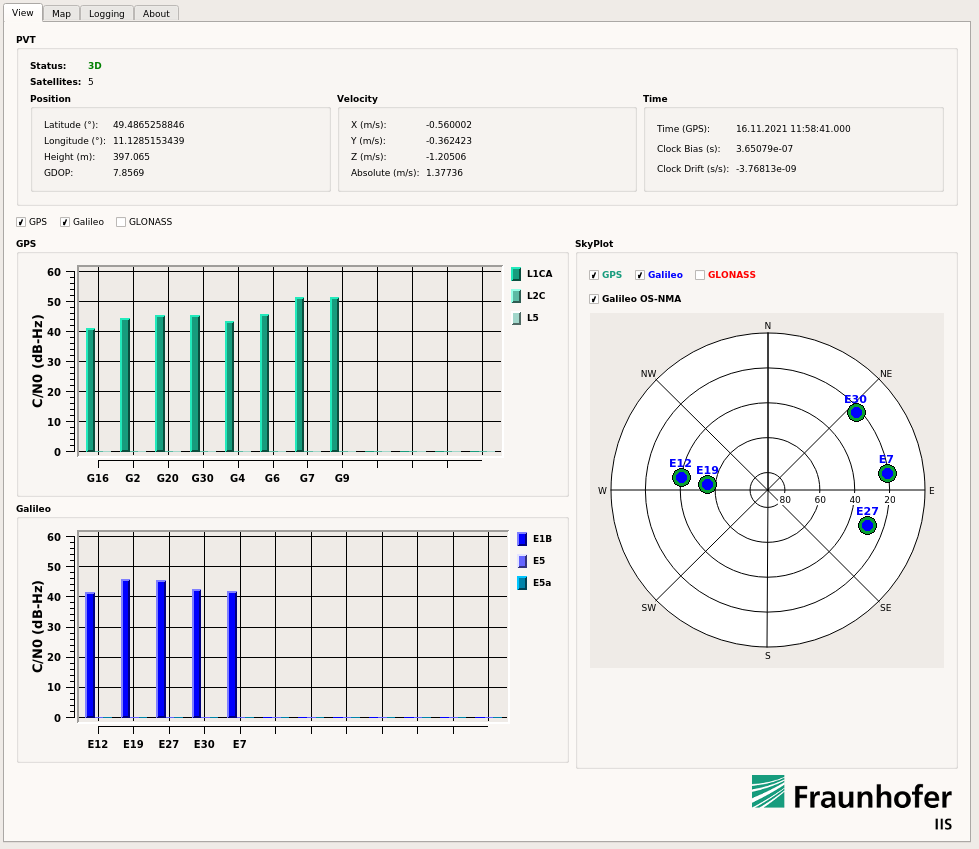
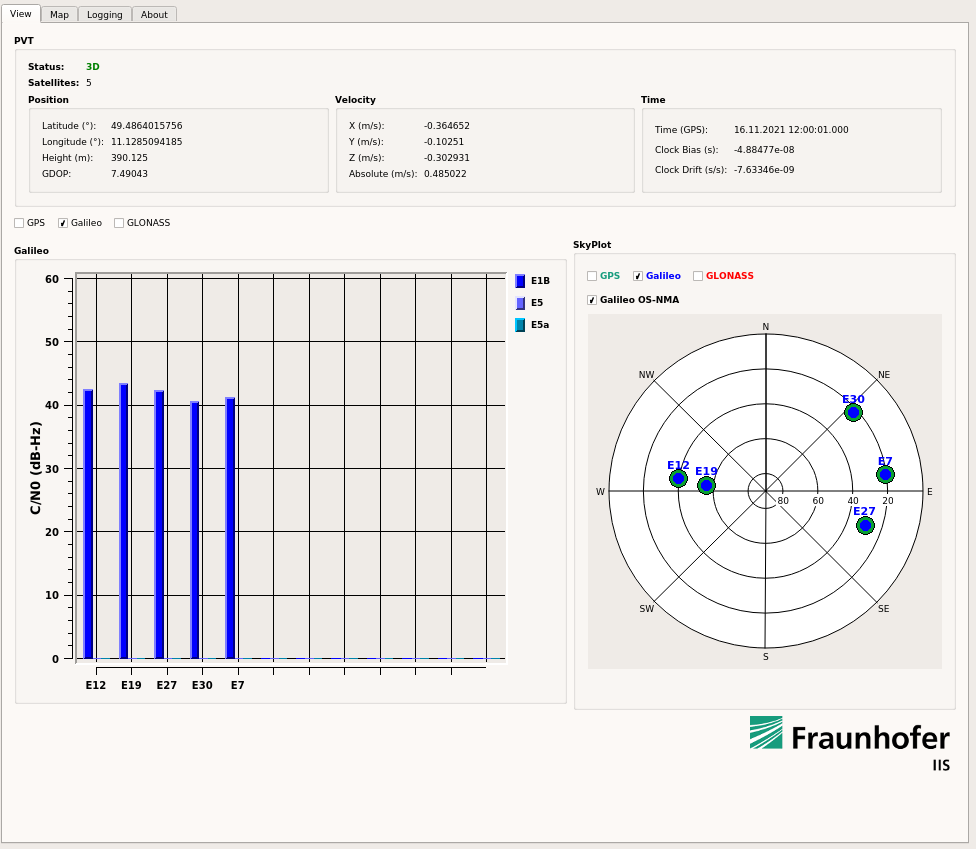
The screenshots below show snapshots of the Goose user interface with enabled OSNMA and successfully authenticated satellites, indicated by the green circle surrounding the blue Galileo satellites in the skyplot.
Interested users can sign up for this OSNMA test phase on GSC website. The site provides access to all corresponding documents and information, including the current ICD, receiver guidelines, OSNMA public key and Merkle Tree Root — both needed for the authentication process.
To learn about using GOOSE for your own tests and projects, contact [email protected].
On a test track in Sweden, a truck successfully merged between two cars driving alongside it in a fully automated maneuver. The live demonstration took place at the AstaZero test site near Borås, Sweden, on Nov. 21, 2019, showing automotive industry experts how well the automated merging solution performed.
The Fraunhofer Institute for Integrated Circuits IIS and project partners RISE, Scania, Waysure, Ceit-IK4, Baselabs and Commsignia are taking part in an EU-funded project PRoPART, which stands for Precise and Robust Positioning for Automated Road Transports.
Vehicles on the road already perform certain steps on behalf of the driver, such as parking. Together with its project partners, the Fraunhofer IIS has developed a precise and robust position determination system for use in autonomous trucks as part of PRoPART.
Autonomous driving is about interactions among vehicle systems, connecting vehicles and equipping them with precise and robust navigation solutions. The challenge is to ensure that different automated driving systems deliver precise and reliable positioning information.
Using GOOSE technology
With its GOOSE GNSS receivers, Fraunhofer IIS provides highly accurate and reliable positioning to the PRoPART project. The GOOSE can bridge signal interruptions for short periods of time, potentially obviating the need for the driver to intervene at all.
In conjunction with GNSS, developers are using a combination of sensors such as radar and cameras in the vehicle. Supplemented by reference stations along the route, the combination of GNSS and sensor data enables highly available position solutions up to the decimeter range.
“This is a key step on the road to autonomous driving,” explained group manager for precise GNSS receivers Matthias Overbeck, Fraunhofer IIS. “It’s about ensuring the merging maneuver is precise and avoiding accidents — something we can achieve only with highly accurate and reliable positioning technology.”
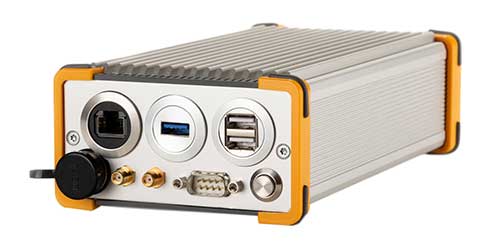
GOOSE platform. (Photo: Fraunhofer IIS)
Spoofing protection
These days, a variety of electronic systems for providing satellite navigation signals are available and are often used to generate fake positions for gaming apps on smartphones. Such systems could disrupt satellite receivers while remaining undetected.
GOOSE makes use of the Galileo Open Service Navigation Message Authentication (OS-NMA), which is not officially available until 2020. OS-NMA transmits encrypted keys on the Galileo satellite signals that make it extremely difficult to fake a position, thus ensuring that reliable positioning information can be provided to vehicles in the future.
By Alexander Rügamer, Daniel Rubino, Xabier Zubizarreta, Wolfgang Felber, Fraunhofer IIS, and Jan Wendel and Daniel Pfaffelhuber, Airbus Defense and Space GmbH
This work presents a new secure localization method that can be used for UAVs to obtain a new level of protection against hostile and unauthorized UAVs. While non-spreading code-encrypted (SCE) GNSS devices can be blocked, authorized UAVs using this method have unrestricted access to the non-spoofable and trusted SCE GNSS. The proposed method is to store short sequences of SCE PRN code chips on the user receiver before the mission.
The Precalculate & Process architecture. (Images: Fraunhofer IIS)
These SCE PRN code chips allow the user receiver to calculate at pre-defined points in time a secure and trustable SCE PVT position. Since no communication channel is required, this method mitigates the risk that hostile forces may try to jam the UAV’s radio control. Moreover, radio silence can be realized, which is beneficial or even required for some missions.
No dedicated security module required on the user terminal, no SWaP problems, no keying issues, no handling of controlled items on user side, no need for a communication link giving rise to the availability and radio silence issues, and no security issues due to the short SCE PRN code chip sequences valid only for the limited mission duration and inside a limited area.
Potential target markets for this method are police and special forces and other authorized users which are allowed to use certain SCE GNSS and would like to equip their UAVs with a secure, unspoofable positioning solution. Check out more information here.
Spirent Communications plc has partnered with Fraunhofer IIS and LZE GmbH to ensure continuity of supply of Spirent’s Galileo Public Regulated Service (PRS) Radio Frequency Constellation Simulator (RFCS) product extension after the United Kingdom leaves the European Union (EU).
The new partnership will see sales and order processing hosted by LZE GmbH of Erlangen, Germany, with Munich-based Fraunhofer lIS taking on responsibility for the future development, fulfillment and support of Galileo PRS in the Spirent GSS9000 GNSS test solution.
Fraunhofer will become the sole owner of the SimPRS software/firmware, which will no longer be accessible to Spirent after the U.K. leaves the EU.
Spirent is exhibiting this week at ION GNSS+ 2018 in Miami.
This partnership and strategy is technically made possible through Spirent’s RFCS system architecture providing a clearly defined interface, with strict need-to-know separation between the core RFCS and PRS hardware and software components. This well-defined delineation ensures that both the RFCS and PRS simulation tools can be developed independently, the companies said.
“We are delighted with this new partnership with Fraunhofer and LZE,” said Martin Foulger, general manager of Spirent’s global positioning business. “We have been actively exploring contingency strategies to address the possibility that our UK-based Positioning Technology Division would be disallowed from engaging with Galileo PRS-related activities following Brexit. With this partnership in place, LZE, Fraunhofer IIS and Spirent are confident that this new approach will successfully deliver continuity of supply for Galileo PRS on the GSS9000 RFCS.”
Spirent and Fraunhofer IIS, together with key Spirent Galileo RFCS customers, can confirm that authorization was given by the relevant authorities to proceed with the partnership and that a legal framework was agreed between the two organizations.
That framework is allowing both parties to execute on a focussed technology transfer, training and quality assurance plan that will result in Fraunhofer IIS taking qualified technical ownership of the SimPRS product by the end of 2018.
The technical challenge and programmatic risks associated with this migration exercise are significantly mitigated by Spirent’s similar experience in working with a third-party U.S. entity to add GPS Modernized Navstar Security Algorithm (MNSA) support to the GSS9000.