Tag: GAJT-410ML

  • Anti-Jamming Antennas for the U.S. Military

    Anti-Jamming Antennas for the U.S. Military

    Q & A with Peter Soar, Business Development Manager, Military and Defense, Hexagon | NovAtel. Read more from this cover story here


    U.S. Army m2A3 Bradley Fighting Vehicle prepares for a platoon live-fire exercise at Pabradė Training Area, Lithuania, Oct. 13, 2022. It has a GAJT anti-jamming antenna. (Image: U.S. Army National Guard photo by Sgt. Lianne M. Hirano)
    U.S. Army m2A3 Bradley Fighting Vehicle prepares for a platoon live-fire exercise at Pabradė Training Area, Lithuania, Oct. 13, 2022. It has a GAJT anti-jamming antenna. (Image: U.S. Army National Guard photo by Sgt. Lianne M. Hirano)

    What have been the advances since you began deliveries of the GAJT-710ML?

    The original signal plan for GAJT-710ML was GPS L1 and GPS L2 only, with specific capability to use civil, P(Y) and M-Codes. GAJT-710ML as delivered in 2019 addressed GPS L1, Galileo E1, QZSS L1, GPS L2, QZSS L2. The version delivered provides situational awareness by jammer power level – by automatic gain control (AGC), as well as jammer direction-finding to the most powerful jamming signal. We are in the process of improving GAJT-710ML to be able to give simultaneous directions to multiple jammers.

    Meanwhile, deployment of GAJT-410ML has started. This is a 4-element version of the same technology as GAJT-710ML but for smaller platforms. By using an internal junction box, the user can install this GAJT with just one small RF cable penetrating the vehicle armor. The latest GAJT version is GAJT-AE2. This UK-built board-level product is also able to use the strong L5 signals.
    We have also launched the Robust Dual Antenna Receiver (RoDAR). Our engineers put an anti-jam algorithm directly on our OEM7 dual-antenna receivers (OEM718D and OEM7720).This is for the very small platforms that cannot carry a full GAJT. It only provides one null (as it has two antennas) although it does so simultaneously on L1 and L5 and related GNSS signals.

    NovAtel’s GAJT are commercial off-the-shelf (COTS) products. How does that help you with exports?

    GAJT products are built in Canada (mainly) and the UK and are subject from source to the Controlled Goods Program of Canada and UK Export controls respectively, but are not subject to U.S. International Traffic in Arms Regulations (ITAR) until shipped to the United States. RoDAR is based on OEM7 receivers which are free from export controls and because only one null is created per frequency, the RoDAR configuration is also free from export controls.

    Once goods controlled by Canada or the UK land in the United States, or are incorporated into an already ITAR controlled system, then they become subject to the ITAR. Being COTS helps with export classifications because GAJT is dual-use. For example, it is used in oil and gas exploration. One of the ways that we work with the U.S. Department of Defense and other departments is via Hexagon U.S. Federal, which is a U.S.-proxied organization that can operate at classification levels beyond what other Hexagon units can.

    Has the form factor remained essentially the same, and will it remain the same, while you upgrade the electronics?

    The GAJT-710ML form-factor remains unchanged. This is important because the installation schemes take time to design and the customer likes continuity in the area. We intend for follow-on products —which will naturally be better performing, lower volume and lower power — to have an optional interface that will allow mounting on existing installation schemes. GAJT-410ML and the other products are smaller.

    Hexagon says that its anti-jam technology increasingly emphasizes protecting GPS signals against Cyber Electromagnetic Activities (CEMA) from the advanced armed forces of nations. What are some examples and in what direction is anti-jam technology evolving?

    Most conflicts of the previous generation were “asymmetric” in terms of the military technology deployed by each side. Now we see more conflicts between advanced armed forces which are more symmetric and expect that to continue. Anti-Jam technology is evolving to encompass all the GNSS signals and other PNT sensors that are being used by allied defense forces. This includes added GPS signals (beyond L1 and L2) as well as GNSS, L-Band corrections, SBAS and other emerging PNT signals. One task for us is to discern users’ requirements. Even within NATO there are different national policies as to which signals and sensors are essential/desirable/not to be used.

  • Anti-jam technology gets smaller with NovAtel system

    Anti-jam technology gets smaller with NovAtel system

    Photo: NovAtel
    Photo: NovAtel

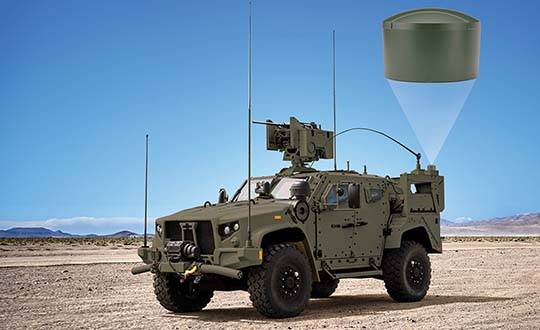
    Hexagon | NovAtel launched the GAJT-410ML GPS anti-jam system in 2019. The compact design of the new, smaller version of NovAtel’s GPS Anti-Jam Technology (GAJT) can be rapidly integrated into space-constrained military vehicles (see photo). The system is easy to use while protecting GPS-based navigation and precise timing receivers (including M-code) from intentional jamming and accidental interference, according to NovAtel.

    Spoofing, or the ability to give false data to a receiver, is a different challenge from jamming, with potentially even graver consequences. The GAJT portfolio provides protection from both jamming and spoofing to best defend military systems.

    Spoofing Detection. As a trusted partner for guidance, navigation and control, NovAtel is developing robust spoofing detection technology that will be available in the company’s product portfolio soon. The additional spoofing information empowers users to make informed decisions about the radio frequency environment they are operating in, alerting them if malicious actors are present. This provides actionable intelligence as part of a layered approach to defend against jamming and spoofing.

    NAVWAR Support. NovAtel OEM components and military off-the-shelf items are engineered to deliver precise, assured positioning and timing. Deep GNSS expertise and lean manufacturing capabilities enable the effective delivery of high-performance products in large volumes with minimal production and delivery times. This approach is combined with a high level of support to achieve low product return rates.

  • NovAtel reduces size of anti-jam GAJT

    NovAtel reduces size of anti-jam GAJT

    NovAtel has added the GAJT-410ML to its GPS Anti-Jam Technology (GAJT) portfolio. Designed specifically for rapid integration into space-constrained military land applications, the easy-to-use system protects GPS-based navigation and precise timing receivers, including M-code, from both intentional and accidental interference, the company said.

    The GAJT-410ML is the next evolution of NovAtel’s battle-proven anti-jam technology. It maintains the high levels of interference rejection performance as in the larger GAJT-710ML system, but in a lower size, weight and power (SWaP) design.

    Photo: NovAtel
    Photo: NovAtel

    Working alongside the GAJT-410ML, the Power Injector Data Converter (PIDCTM) provides access to the jammer status and direction-finding (DF) information. It also provides clean power and data over the same cable that delivers the protected GPS signal back to the receiver, which reduces the need for costly platform modifications. The PIDC can be supplied in either an enclosure or board and is available to license for installation into third-party equipment.

    NovAtel Defence Segment Manager Dean Kemp noted, “Building on the success of our existing anti-jam portfolio, the GAJT-410ML is the first system to address the needs of smaller land-based platforms and add situational awareness capability to already high levels of mitigation performance.”

    “This product offers more choices for system integrators and end users to protect against GPS denied or constrained situations and delivers on our commitment to provide assured positioning anywhere,” Kemp added.

    Learn more about the GAJT-410ML anti-jam antenna or talk with NovAtel’s team of specialists at these upcoming trade shows:

    • The Special Operations Forces Industry Conference (SOFIC) – May 20 – 23, 2019, Tampa, FL USA
    • CANSEC – May 29 – 30, 2019, Ottawa, ON Canada
    • Joint Navigation Conference (JNC) – July 8 – 11, 2019, Long Beach, CA USA
    • International Defence Industry Exhibition MSPO (Canadian Pavilion) – September 3 – 6, 2019, Kielce, Poland
    • Defence & Security Equipment International (DSEI) – September 10 – 13, 2019, London, UK