Tag: Galileo 6

  • System of Systems: Galileo birds active, faulty launch victims still viable

    System of Systems: Galileo birds active, faulty launch victims still viable

    Galileo birds active

    Faulty launch victims still viable
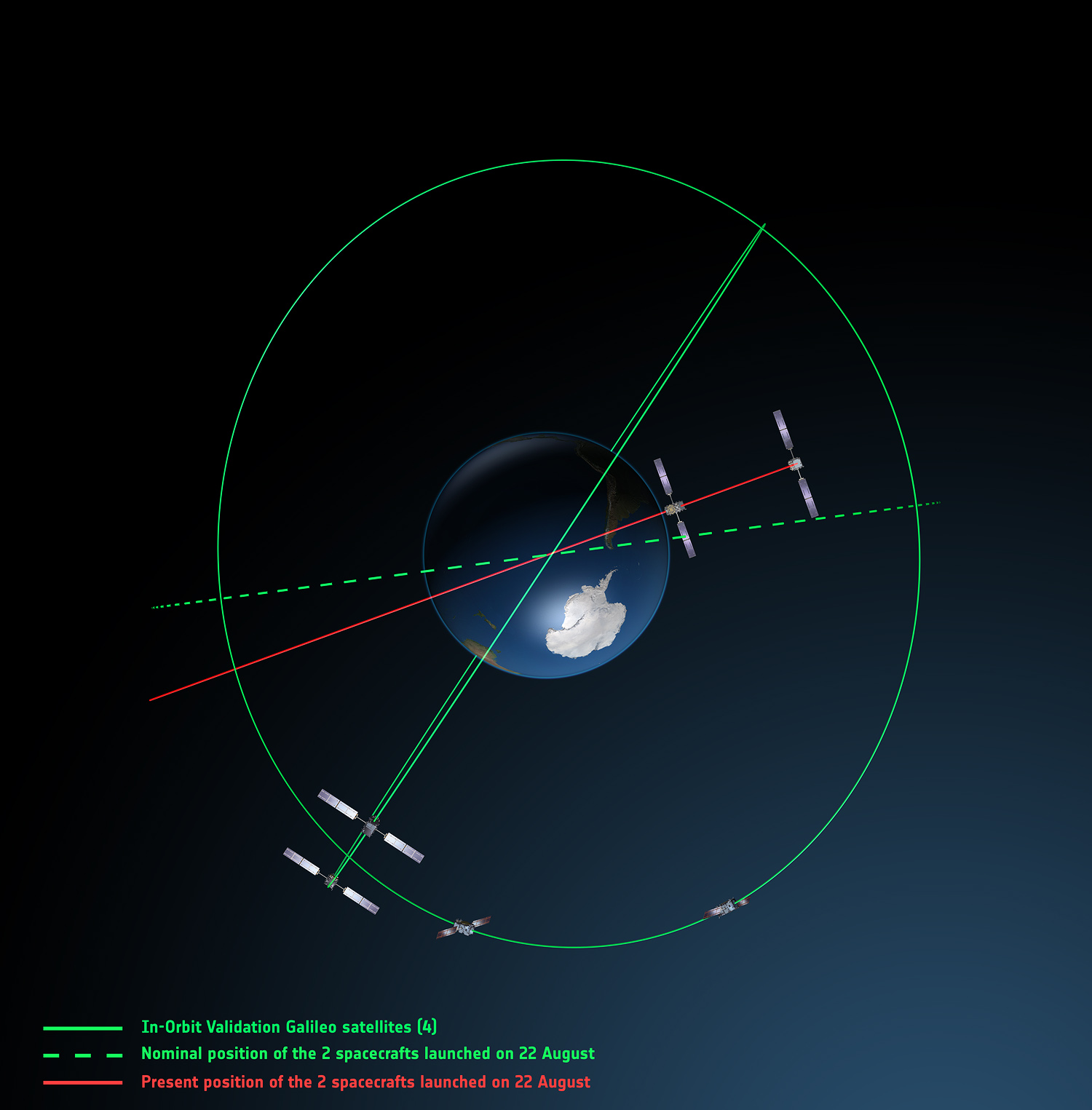
    Galileo orbits viewed from above.
    Galileo orbits viewed from above.

    Europe’s fifth and sixth Galileo satellites, salvaged from their faulty 2014 Soyuz launch, will begin broadcasting working navigation signals for test purposes, for the benefit of receiver manufacturers, service providers and scientific researchers. The European Commission will decide later whether the two satellites will become part of the operational Galileo constellation.

    The European Space Agency performed a complex series of in-orbit maneuvers to raise and circularize the two after they arrived in space too low and too elliptical for full Galileo use. Their initial orbits dipped the satellites too close to Earth to keep their antennas properly locked on the planet.

    “Once their orbits were modified, their navigation payloads could be turned on and in-orbit testing could take place,” explained Marco Falcone, head of the Galileo System Office. “The good news was their performance was excellent.

    “The navigation signals will include a signal health status reading that ‘signal component currently in test’ and its navigation data validity status will be ‘working without guarantee.’ In this way, these signals will not disturb the performance of any receivers using the Galileo signals coming from the other satellites. On the user community side, some application providers are interested in harnessing as many available satellites as possible for precision applications.”

    Testing will take place in two phases: initially their navigation signal will be updated via the Galileo ground segment every 14 hours or so. Later this year, the ground segment will be reconfigured to send updates more often, enhancing navigation precision, although they will remain outside the official constellation until decided otherwise.

    The two satellites are also midway through an ambitious space experiment to test Einstein’s General Theory of Relativity more precisely than ever before, by measuring how their onboard time varies in accordance with their altitude and therefore gravity, known as their gravitational redshift.

    New Activation. Galileo GSAT-0210 (PRN E01), one of two launched May 24, began dual-frequency broadcast on Aug. 17, transmitting E1 and E5a signals.


    GPS III launch RFP

    Competitive bids invited

    The U.S. Air Force released a Request for Proposal (RFP) in August for GPS III-3 launch services, scheduled to begin in 2019. The contract will be a standalone for a single GPS III launch.The United Launch Alliance (ULA) and Space Exploration Technologies (SpaceX) are expected to compete for the contract. In April, SpaceX was chosen to launch the GPS III-2 satellite in May 2018. ULA chose not to compete.

    The RFP seeks an Evolved Expendable Launch Vehicle (EELV) Launch Service. The Air Force’s acquisition strategy seeks a balance between mission success/operational needs and lowering launch costs, reintroducing competition for national security space missions.

    This is the second competitive launch service solicitation under the current procurement strategy. Previously, ULA was the only certified launch provider. In 2013, ULA was awarded a sole-source contract for launch services as part of an Air Force Block Buy of 36 rocket cores. In May 2015, SpaceX was certified for EELV launches, yielding two qualified launch service providers.


    M-code, OCX updates

    The Air Force awarded a $52.6 million contract to Raytheon for modernization of the Miniature Airborne GPS receiver 2000 (MAGR-2K): test and delivery of an M-code automatic dependent surveillance and broadcast-capable system. Congress has mandated the military buy only M-code GPS equipment by 2018. Last year, Rockwell Collins received a $36.6 million contract for such equipment.

    OCX.
    Raytheon is implementing changes to its GPS Next-Generation Operational Control System (OCX). “Momentum is very good” towards a December 2020 deadline for software delivery, said the program manager. A Pentagon review in July followed breach of a critical cost-growth cap. The complexity of cyber security requirements contributed to delays to date. The company expects to deliver Block 0 software in 2017, in conjunction with plans to launch GPS III satellites. However, the capability will not be turned on until 2018, when an OCX Block 0 launch-and-checkout capability for GPS III launches is to begin.
  • Galileo satellites set for year-long Einstein experiment

    News from the European Space Agency

    Europe’s fifth and sixth Galileo satellites — subject to complex salvage maneuvers following their launch in 2014 into incorrect orbits — will help to perform an ambitious year-long test of Einstein’s most famous theory.

    Galileos 5 and 6 were launched together by a Soyuz rocket on August 22, 2014. But the faulty upper stage stranded them in elongated orbits that blocked their use for navigation.

    ESA’s specialists moved into action and oversaw a demanding set of maneuvers to raise the low points of their orbits and make them more circular. “The satellites can now reliably operate their navigation payloads continuously, and the European Commission, with the support of ESA, is assessing their eventual operational use,” explained ESA’s senior satnav advisor Javier Ventura-Traveset. “In the meantime, the satellites have accidentally become extremely useful scientifically, as tools to test Einstein’s General Theory of Relativity by measuring more accurately than ever before the way that gravity affects the passing of time.”

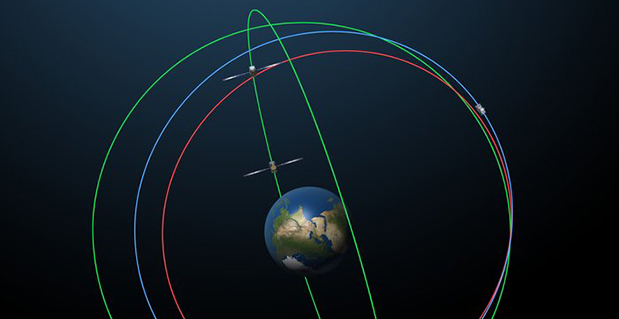
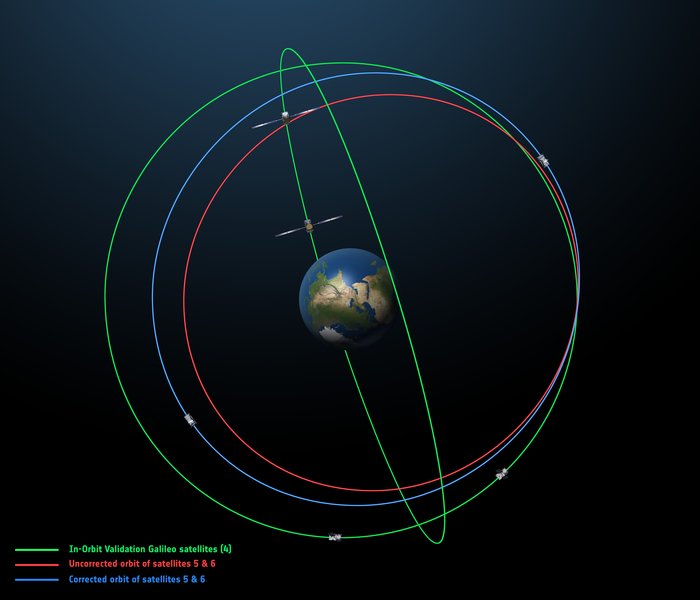
    The original (in red) and corrected (in blue) orbits of the fifth and sixth Galileo satellites, along with that of the first four satellites (green).
    The original (in red) and corrected (in blue) orbits of the fifth and sixth Galileo satellites, along with that of the first four satellites (green).

    Although the satellites’ orbits have been adjusted, they remain elliptical, with each satellite climbing and falling some 8500 km twice per day. It is those regular shifts in height, and therefore gravity levels, that are valuable to researchers.

    Albert Einstein predicted a century ago that time would pass more slowly close to a massive object. It has been verified experimentally, most significantly in 1976 when a hydrogen maser atomic clock on Gravity Probe A was launched 10,000 km into space, confirming the prediction to within 140 parts in a million.

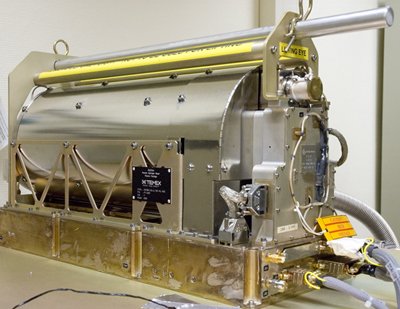
    Passive hydrogen maser atomic clock of the type flown on Galileo, accurate to one second in three million years. (Photo: ESA)
    Passive hydrogen maser atomic clock of the type flown on Galileo, accurate to one second in three million years. (Photo: ESA)

    Atomic clocks on navigation satellites have to take into account they run faster in orbit than on the ground — a few tenths of a microsecond per day, which would give us navigation errors of around 10 km per day.

    “Now, for the first time since Gravity Probe A, we have the opportunity to improve the precision and confirm Einstein’s theory to a higher degree,” comments Javier.

    This new effort takes advantage of the passive hydrogen maser atomic clock aboard each Galileo, the elongated orbits creating varying time dilation, and the continuous monitoring thanks to the global network of ground stations.

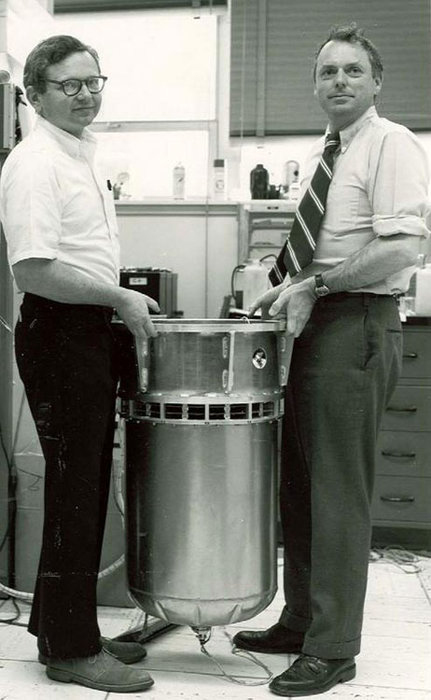
    he Gravity Probe A payload of 1976, flown in a highly elliptic single orbit to measure the ‘gravitational redshift’ of Einstein’s Theory of General Relativity more accurately than ever before, seen with its designers Robert Vessot and Martin Levine of the Smithsonian Astrophysical Observatory. The experiment compared a hydrogen maser clock on Earth with its replica in space as it ascended to about 10 000 km, and confirmed theoretical expectations to an accuracy of 0.02%.
    The Gravity Probe A payload of 1976, flown in a highly elliptic single orbit to measure the “gravitational redshift” of Einstein’s Theory of General Relativity more accurately than ever before, seen with its designers Robert Vessot and Martin Levine of the Smithsonian Astrophysical Observatory. The experiment compared a hydrogen maser clock on Earth with its replica in space as it ascended to about 10,000 km, and confirmed theoretical expectations to an accuracy of 0.02%. (ESA file photo)

    “Moreover, while the Gravity Probe A experiment involved a single orbit of Earth, we will be able to monitor hundreds of orbits over the course of a year,” explained Javier. “This opens up the prospect of gradually refining our measurements by identifying and removing systematic errors. Eliminating those errors is actually one of the big challenges. For that we count on the support of Europe’s best experts plus precise tracking from the International Global Navigation Satellite System Service, along with tracking to centimeter accuracy by laser.”

    The results are expected in about one year, projected to quadruple the accuracy on the Gravity Probe A results.

    The two teams devising the experiments are Germany’s ZARM Center of Applied Space Technology and Microgravity, and France’s SYRTE Systèmes de Référence Temps-Espace, both specialists in fundamental physics research.

    ESA’s forthcoming Atomic Clock Ensemble in Space experiment, planned to fly on the International Space Station in 2017, will go on to test Einstein’s theory down to 2–3 parts per million.

  • Latest Galileo Satellites Will Head to Plane A

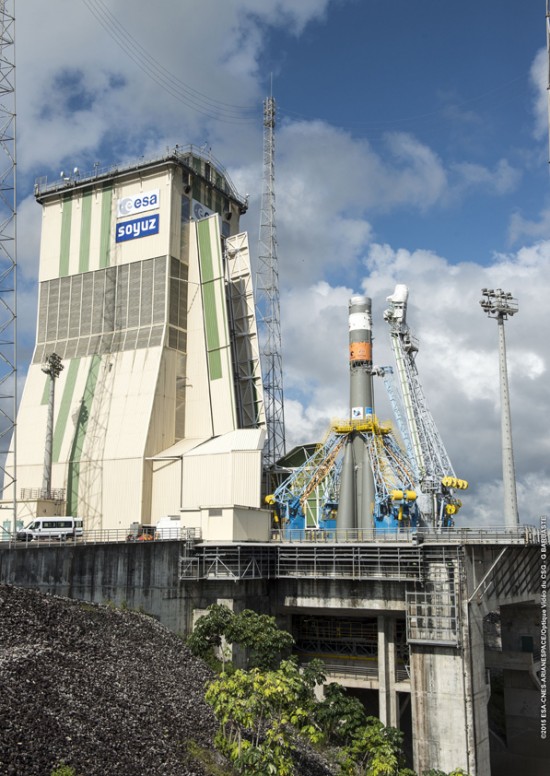
    The Soyuz launcher is transferred to the launch pad. (Credit: Arianespace)
    The Soyuz launcher is transferred to the launch pad. (Credit: Arianespace)

    I had the honour of the first question at today’s Galileo press conference hosted by the European Space Agency (ESA), and it was about the status of the satellites launched last March. The answer to that question and others are below.

    The satellites being launched this evening are destined for Plane A and will be its first occupants. They will occupy slots 5 and 8 in the plane. They will undergo a 76-day-long in-orbit test procedure before being made available to users.

    The satellites launched in March, Galileo satellites 7 and 8 (a.k.a. FOC-FM3 or GSAT0203 and FOC-FM4 or GSAT0204 using PRNs 26 and 22, respectively), have essentially completed in-orbit testing and should be available to users sometime this month.

    The ground segment is to be modified to enable the production of navigation messages for satellites 5 and 6 (a.k.a. FOC-FM1 or GSAT0201 and FOC-FM2 or GSAT0202 using PRNs 18 and 14, respectively) launched in August 2014 into wrong orbits (a “kind of Plane D” according to one of the ESA officials at the press conference). This will occur by the beginning of 2016 when these satellites will then be available for testing in navigation and positioning applications. They will not be included in the broadcast almanac as the orbits are too far from nominal to be represented by the standard almanac format. But the signals should be fully usable by those receivers and chipsets that can acquire and track Galileo satellites without an almanac. Testing will be carried out to see if the satellites can become part of the operational constellation.

    IOV-4 (a.k.a. FM4 or GSAT0104 using PRN 20), the in-orbit validation satellite that suffered a power failure in May 2014 and is only broadcasting on the E1 frequency, may become operational for single-frequency use if suitable ground segment modifications can be made.

    The next Galileo launch after this evening’s will be in December on a Soyuz launcher when another two satellites will be placed into orbit.

    In 2016, there will be one launch but using, for the first time, the Ariane 5 launcher, to place four satellites into orbit.

    In 2017, there will be two launches: a Soyuz launch orbiting two satellites, and an Ariane 5 launch, orbiting four satellites.

    A 30-satellite constellation will be in place by 2020, following ESA’s slogan “30 satellites by 2020,” with 10 satellites per plane with each plane having two spare satellites. This should be feasible as two satellites are now being manufactured every three months. Twenty-four satellites is the minimum for Galileo operational capability.

  • ESA Releases Guide on Galileo 5 and 6 Recovery

    The European Space Agency has published a short guide on the recovery of Galileo satellites 5 and 6. The PDF of “Salvage in Space: Recovering Galileo 5 and 6” can be downloaded.

    The four-page guide, written for a non-technical audience, describes the root cause of the anomaly that placed the two satellites into the wrong orbit, and the solution used to correct the orbits.

  • Galileo 6 Signals Acquired

    News courtesy of CANSPACE Listserv.

    On March 17, some stations participating in the International GNSS Service Multi-GNSS Experiment acquired E1 and E5a signals from Galileo 6 (FOC-FM2, GSAT0202). The satellite is using pseudorandom noise code E14.

    The orbit of Galileo 6 was recently adjusted to make it more circular with a higher perigee after it was launched into an incorrect orbit last August.

  • Sixth Galileo Satellite Reaches Corrected Orbit

    Sixth Galileo Satellite Reaches Corrected Orbit

    The original (in red) and corrected (in blue) orbits of the fifth and sixth Galileo satellites, along with that of the first four satellites (green). Photo: European Space Agency
    The original (in red) and corrected (in blue) orbits of the fifth and sixth Galileo satellites, along with that of the first four satellites (green). Photo: European Space Agency

    By the European Space Agency

    The sixth Galileo satellite of Europe’s navigation system has entered its corrected target orbit, which will allow detailed testing to assess the performance of its navigation payload.

    Launched with the fifth Galileo last August, its initial elongated orbit saw it traveling as high as 25,900 km above Earth and down to a low point of 13,713 km — confusing the Earth sensor used to point its navigation antennas at the ground.

    A recovery plan was devised between ESA’s Galileo team, flight dynamics specialists at ESA’s ESOC operations centre and France’s CNES space agency, as well as satellite operator SpaceOpal and manufacturer OHB. This involved gradually raising the lowest point of the satellites’ orbits more than 3500 km while also making them more circular.

    The fifth Galileo entered its corrected orbit at the end of November 2014. Both its navigation and search and rescue payloads were switched on the following month to begin testing. Now the sixth satellite has reached the same orbit, too.

    This latest salvage operation began in mid-January and concluded six weeks later, with 14 maneuvers performed in total. Its corrected position is effectively a mirror image of the fifth satellite’s, placing the pair on opposite sides of the planet. The exposure of the two to the harmful Van Allen Belt radiation has been greatly reduced, helping to ensure future reliability.

    Significantly, the corrected orbit means they will overfly the same location on the ground every 20 days. This compares with a standard Galileo repeat pattern of every 10 days, helping to synchronize their ground tracks with the rest of the constellation.

    The test results from Galileo 5 proved positive, with the same test campaign for the sixth satellite due to begin shortly, overseen by ESA’s Redu centre in Belgium. A 20 m-diameter antenna will study the strength and shape of the navigation signals at high resolution.

    “I am very proud of what our teams at ESA and industry have achieved,” says Marco Falcone, head of Galileo system office. “Our intention was to recover this mission from the very early days after the wrong orbit injection. This is what we are made for at ESA.”

    The decision whether to use the two satellites for navigation and search-and-rescue purposes will be ultimately taken by the European Commission, as the system owner, based on the in-orbit test results and the system’s ability to provide navigation data from the improved orbits.

    The next pair of satellites is due for launch on March 27.

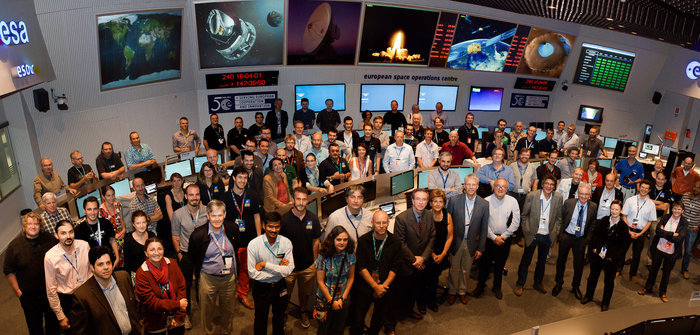
    The Galileo operations team, joined by Director General Jean-Jacques Dordain, Director of Human Spaceflight and Operations Thomas Reiter and experts from European industry, in the Main Control Room at ESA’s Space Operations Centre, ESOC, in Darmstadt, Germany, August 28, 2014. (Photo courtesy of ESA)
    The Galileo operations team, joined by Director General Jean-Jacques Dordain, Director of Human Spaceflight and Operations Thomas Reiter and experts from European industry, in the Main Control Room at ESA’s Space Operations Centre, ESOC, in Darmstadt, Germany, August 28, 2014. (Photo courtesy of ESA)
  • Orbit of Second Wayward Galileo Satellite Adjusted

    Editor’s Note: See the report from the European Space Agency here.


    An official with the European Space Agency has confirmed that the sequence of maneuvers to adjust the orbit of the second of two Galileo satellites launched into a wrong orbit in August 2014  has been completed.

    The orbit of the first satellite, known variously as GSAT0201, Galileo FOC-FM1 or Galileo 5 (with COSPAR ID 2014-050A and NORAD ID 40128) was raised during operations carried out in November, and the satellite began transmitting L-band signals on Nov. 29.

    Maneuvering of the second satellite (GSAT0202, Galileo FOC-FM2 or Galileo 6, with COSPAR ID 2014-050B and NORAD ID 40129) began around Jan. 15. The procedure took somewhat longer than that for the first satellite as it also involved changing the mean anomaly of the satellite to be about 180° away from that of the first satellite.

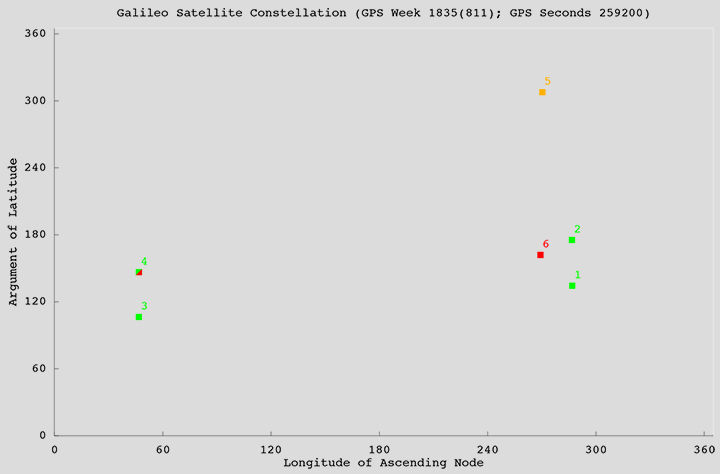
    The locations of the satellites in the Galileo constellation are shown in the accompanying figure. Satellites in green are transmitting a full complement of L-band signals. Galileo 4 (GSAT0104), one of the in-orbit validation satellites, suffered a power anomaly and only transmits on the E1 frequency. Galileo 5 is transmitting L-band signals but its orbit cannot be properly represented in the Galileo broadcast almanac. Galileo 6 has not started transmitting valid L-band signals yet.

    Officially, all Galileo signals are currently declared unavailable during an extended period of testing following ground segment upgrades. However, signals continue to be monitored by stations participating in the International GNSS Service Multi-GNSS Experiment.

    galileo_constellation-rev