Tag: Galileo 8

  • ESA declares Galileo 7 and 8 fully operational

    ESA declares Galileo 7 and 8 fully operational

    News from the European Space Agency

    Having completed their rigorous checks in space, two more of Europe’s Galileo satellites are now fully operational, broadcasting navigation signals and relaying search and rescue messages from across the globe.

    Galileo 7 and 8 were launched on March 27 from Europe’s Spaceport in French Guiana. Once the satellites were nursed to life in orbit, their navigation payloads underwent a lengthy test campaign.

    This involved assessing that the satellites themselves were performing as planned and meshing with the worldwide Galileo ground network.
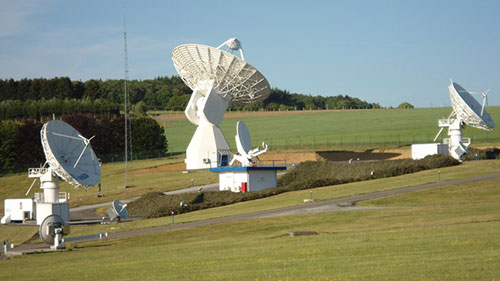
    Galileo's 20-m IOT L-band antenna is the largest dish at ESA's Redu ground station.
    Galileo’s 20-m IOT L-band antenna is the largest dish at ESA’s Redu ground station.

    The satellites’ secondary search and rescue payloads were also put to the test, picking up and relaying UHF signals from distress beacons as part of the international Cospas–Sarsat system.

    Radio-frequency measurements were made from ESA’s Redu centre in Belgium. The site boasts a 20 m-diameter dish to analyse Galileo signals in great detail. Last but not least, security testing has ensured that Galileo’s Public Regulated Service – a maximum precision service restricted to authorised users – is as secure as required.

    “These latest two operational Galileos are the third and the fourth Full Operational Capability satellites,” said David Sanchez-Cabezudo, ESA’s Galileo In-Orbit Test Manager.

    “These are the versions that will make up the bulk of the Galileo constellation in space, with 16 satellites still to be launched.

    “The checks carried out from the Galileo Control Centres in Oberpfaffenhofen in Germany and Fucino in Italy, as well as from Redu, prove the performance of these two satellites is excellent for navigation purposes.

    “New onboard features such as seamlessly swapping between the different atomic clocks – a unique feature in global satnav systems – has been verified, which translates into more robust navigation services.”
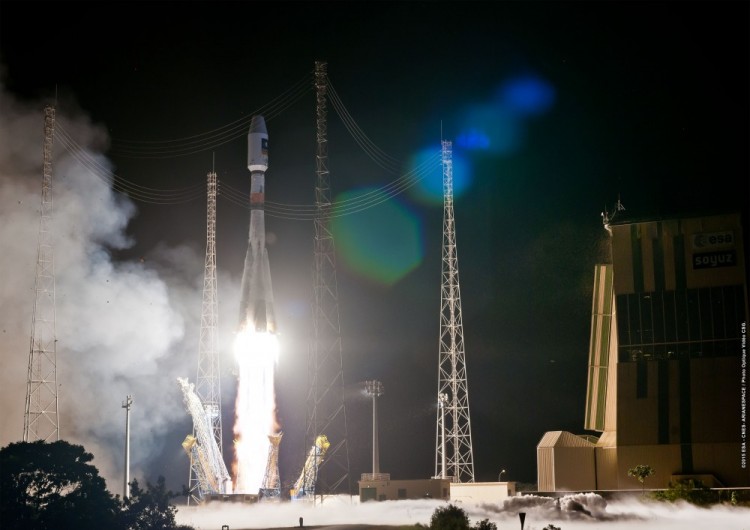
    Soyuz launches Galileo 9 and 10 into orbit on Sept.10. (Credit: Arianespace)
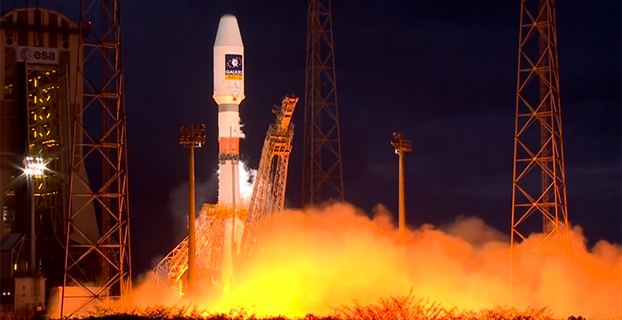
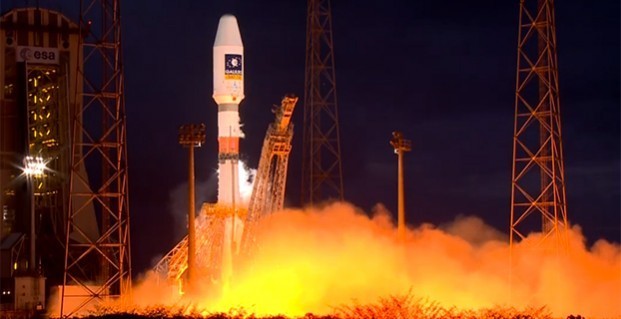
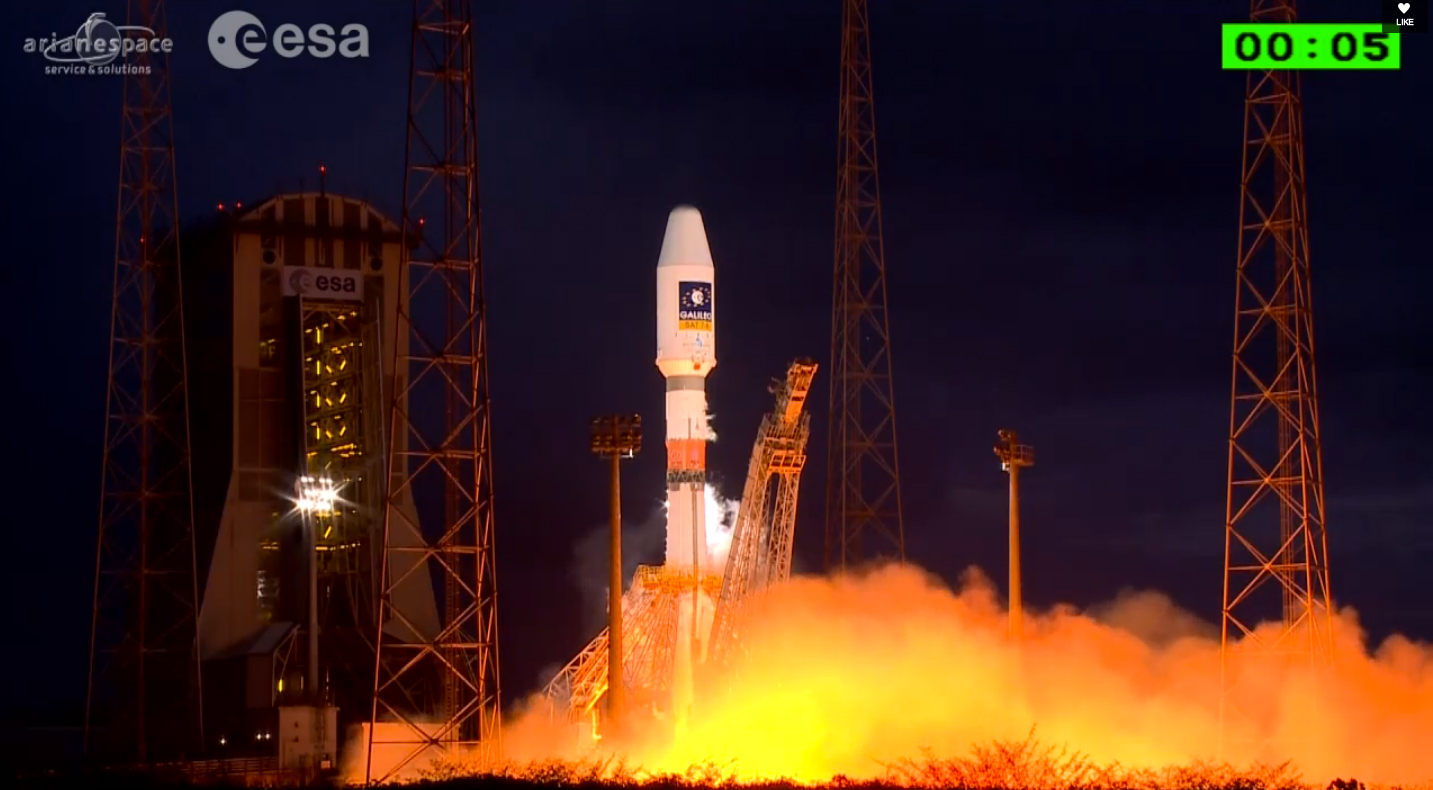
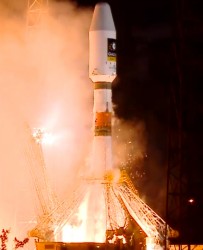
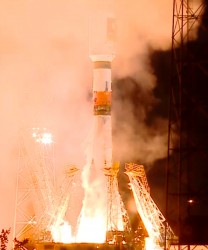
    Liftoff of Soyuz ST-B flight VS11 carrying Galileo satellites 7 and 8, March 27 at 22:46 GMT, from Europe’s Spaceport in French Guiana.

    The first pair of full satellites was placed in incorrect orbits in 2014 by a malfunction of their Soyuz launcher’s upper stage, but the elongated orbits have since been modified so that the navigation payloads can perform as planned. The European Commission is set to make a decision on whether they will be employed as part of the Galileo constellation.

    The second pair, launched in March, was inserted into the correct orbits. September’s third pair, also in the correct orbits and undergoing payload testing, should enter service early next year.

    The latest twins have arrived in French Guiana, aiming for a Soyuz launch on Dec. 17. The intention is to have those satellites ready to enter the operational constellation by next spring.
  • Latest Galileo Satellites Will Head to Plane A

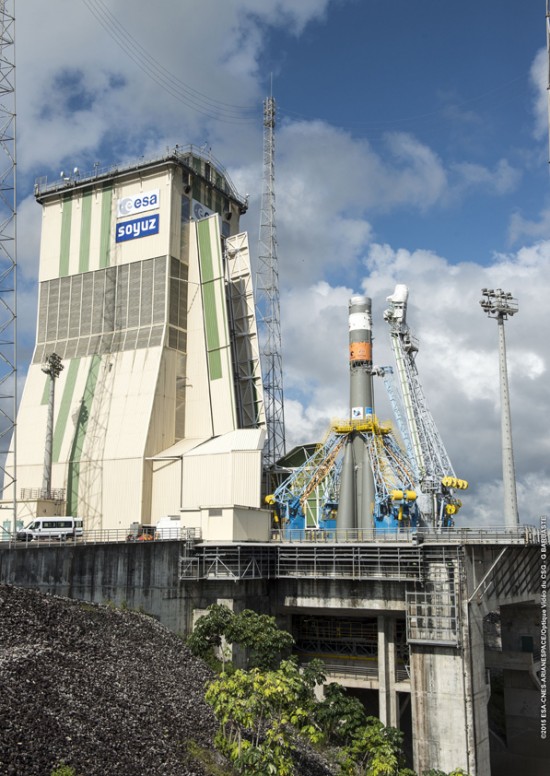
    The Soyuz launcher is transferred to the launch pad. (Credit: Arianespace)
    The Soyuz launcher is transferred to the launch pad. (Credit: Arianespace)

    I had the honour of the first question at today’s Galileo press conference hosted by the European Space Agency (ESA), and it was about the status of the satellites launched last March. The answer to that question and others are below.

    The satellites being launched this evening are destined for Plane A and will be its first occupants. They will occupy slots 5 and 8 in the plane. They will undergo a 76-day-long in-orbit test procedure before being made available to users.

    The satellites launched in March, Galileo satellites 7 and 8 (a.k.a. FOC-FM3 or GSAT0203 and FOC-FM4 or GSAT0204 using PRNs 26 and 22, respectively), have essentially completed in-orbit testing and should be available to users sometime this month.

    The ground segment is to be modified to enable the production of navigation messages for satellites 5 and 6 (a.k.a. FOC-FM1 or GSAT0201 and FOC-FM2 or GSAT0202 using PRNs 18 and 14, respectively) launched in August 2014 into wrong orbits (a “kind of Plane D” according to one of the ESA officials at the press conference). This will occur by the beginning of 2016 when these satellites will then be available for testing in navigation and positioning applications. They will not be included in the broadcast almanac as the orbits are too far from nominal to be represented by the standard almanac format. But the signals should be fully usable by those receivers and chipsets that can acquire and track Galileo satellites without an almanac. Testing will be carried out to see if the satellites can become part of the operational constellation.

    IOV-4 (a.k.a. FM4 or GSAT0104 using PRN 20), the in-orbit validation satellite that suffered a power failure in May 2014 and is only broadcasting on the E1 frequency, may become operational for single-frequency use if suitable ground segment modifications can be made.

    The next Galileo launch after this evening’s will be in December on a Soyuz launcher when another two satellites will be placed into orbit.

    In 2016, there will be one launch but using, for the first time, the Ariane 5 launcher, to place four satellites into orbit.

    In 2017, there will be two launches: a Soyuz launch orbiting two satellites, and an Ariane 5 launch, orbiting four satellites.

    A 30-satellite constellation will be in place by 2020, following ESA’s slogan “30 satellites by 2020,” with 10 satellites per plane with each plane having two spare satellites. This should be feasible as two satellites are now being manufactured every three months. Twenty-four satellites is the minimum for Galileo operational capability.

  • Both New Galileo Satellites Now Transmitting

    News courtesy of CANSPACE Listserv


    Signals from both Galileo satellites launched March 27 are now transmitting signals.

    Researchers at Université de Liège and at the German Aerospace Center (Deutsches Zentrum für Luft- und Raumfahrt, or DLR) reported on May 21 that the first of the full-operational-capability (FOC) satellites had begun transmitting standard L-band signals. The satellite, designated Galileo 8, is using pseudorandom-noise-code identifier 22.

    The first E1 and E5 signals from Galileo 8 were received at an International GNSS Service Multi-GNSS Experiment tracking station in Windhoek, Namibia, at about 11:32 UTC on May 21. The satellite’s signals were subsequently tracked by a station in Wettzell, Germany, and then by others.

    The other satellite, Galileo 7, began transmitting standard L-band signals on May 25. The first E1 and E5 signals from Galileo 7 were received around 17:00 UTC. The satellite is using PRN code 26.

    The signals will be set unhealthy for use until satellite commissioning is completed.

    Galileo 7 is also known as GSAT0203, FOC-FM3 and as NORAD object 40544. Galileo 8 is also designated GSAT0204, FOC-FM4 and NORAD object 40545.

  • New Galileo Pair Head to Working Orbit

    New Galileo Pair Head to Working Orbit

    Galileo 7 and 8 were launched into orbit on time today. (Screenshot of  ESA/Arianespace livestream feed.)
    Galileo 7 and 8 were launched into orbit March 27. (Screenshot of ESA/Arianespace livestream feed.)

    Europe’s two newest Galileo satellites — launched March 27 — have carried out maneuvers to take them down to their working positions in orbit. Both satellites are performing well. Galileo 7 and 8 were launched into a circular 23,522 km altitude orbit about 300 km above their final orbit.

    Using their onboard thrusters, the two Galileo satellites have performed all their Launch and Early Operations Phase (LEOP) maneuvers, reports the European Space Agency (ESA). The maneuvers began as soon as the automatic initialization sequence was completed.

    A joint team of ESA and CNES personnel oversaw the LEOP process from the French space agency CNES in Toulouse. On March 28, the team ensured that the two satellites’ solar arrays deployed correctly and oversaw the gradual switch-on of the satellites systems.

    Once the two satellites passed inspection, control was passed to Galileo’s Oberpfaffenhofen-based Control Centre (run by SpaceOpal, a joint venture by DLR Gesellschaft für Raumfahrtanwendungen and Telespazio) to prepare for their final In-Orbit Testing (IOT) in two phases: commissioning for the host satellite platforms, and then their navigation and search and rescue payloads. Platform commissioning is now taking place.

    The Galileo satellites’ navigation and the search and rescue payloads will be switched on in few weeks and will begin detailed in-orbit testing, overseen from ESA’s Redu centre in Belgium, which is equipped with a 20-meter antenna for high-resolution acquisition of the navigation signals.

    The hosting of Galileo’s LEOP team alternates between CNES in Toulouse and ESA’s ESOC control centre in Darmstadt, Germany. Early operation of the next pair of Galileo satellites will be masterminded from ESOC — launch is scheduled for September.

  • Galileo’s Two Newest Birds Undergoing Initial Checks

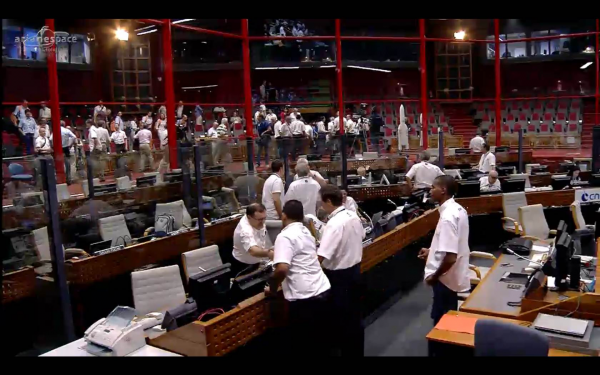
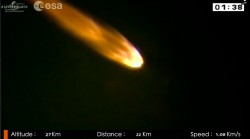
    The Galileo launch team celebrates after a successful launch. (Screenshot of ESA/Arianespace live stream of lift-off.)
    The Galileo launch team celebrates after a successful launch. (Screenshot of ESA/Arianespace live stream of lift-off.)

    The two newest Galileo satellites — dubbed Adam and Anastasia — launched Friday are now being checked out by the European Space Agency (ESA) and France’s CNES space agency from the CNES Toulouse centre.

    Following these initial checks, the two satellites will be handed over to the Galileo Control Centre in Oberpfaffenhofen, Germany, and the Galileo in-orbit testing facility in Redu, Belgium, for testing before they are commissioned for operational service. This is expected by mid-year.

    Screenshot of ESA/Arianespace live stream following lift-off.
    Screenshot of ESA/Arianespace live stream following lift-off.

    Adam and Anastasia are the third and fourth Full Operational Capability (FOC) spacecraft for Europe’s Galileo global navigation satellite system.

    After an initial powered phase of Soyuz’ three lower stages, the launch included two burns of the Fregat upper stage — separated by a three-hour-plus ballistic phase — to place the two 700-kg.-class satellites at their targeted deployment point, according to launch contractor Arianespace. Total payload lift performance for the flight was estimated at 1,597 kg. on a mission to a circular medium-Earth orbit.

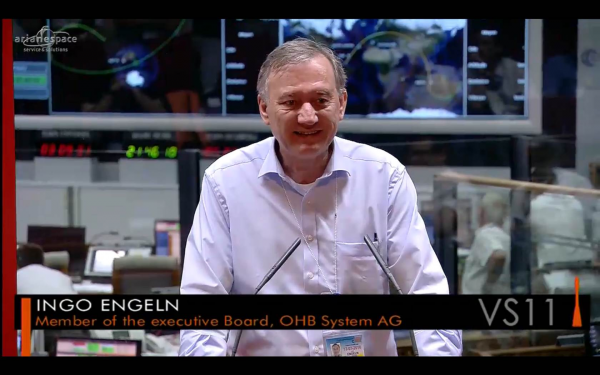
    During post-launch comments from the Spaceport, Arianespace Chairman and CEO Stéphane Israël thanked and congratulated everyone involved with the Soyuz mission — designated VS11 in the company’s numbering system — but added that there is still much work to be done for the Galileo program moving forward.

    He said there are six more Galileo launches to come following tonight’s success: three missions on Soyuz with six additional FOC satellites, and three launches on Ariane 5, with 12 more units.

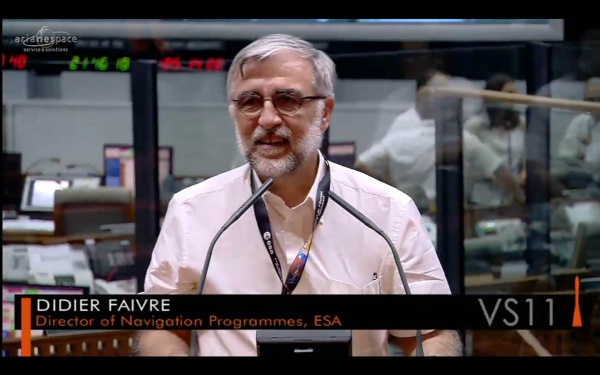
    Didier Faivre-ESA
    Screenshot of ESA/Arianespace live stream following lift-off.

    “The satellites are doing fine and are in good hands, managed by the Toulouse CNES [French space agency] operational center,” added Didier Faivre, director of Navigation Programs for ESA. “Let’s rejoice with this very good news. We will be back as soon as possible to continue deploying our satellites.”

    The on-target Soyuz launch of Adam and Anastasia followed by one day the 35th anniversary of Arianespace’s creation in 1980. Adam and Anastasia were built by OHB System, with Surrey Satellite Technology Ltd. supplying their navigation payloads.

    Galileo’s FOC phase — during which the network’s complete operational and ground infrastructure will be deployed — is being managed and funded by the European Commission, with ESA delegated as the design and procurement agent on the commission’s behalf.


  • Two Galileo Satellites Launched for Europe’s Navigation Constellation

    Two Galileo Satellites Launched for Europe’s Navigation Constellation

    Galileo 7 and 8 were launched into orbit on time today. (Screenshot of ESA/Arianespace livestream feed.)
    Galileo 7 and 8 were launched into orbit on time today. (Screenshot of ESA/Arianespace livestream feed.)

    UPDATE: The two Galileo satellites are confirmed separated from their Soyuz Fregat upper stage into 22,522 altitude orbit right on schedule, according to ESA. Both are in their planned orbits.


    Two more Galileo satellites were successfully launched today from Europe’s Spaceport in French Guiana. The seventh and eighth Galileo satellites were lifted aloft on time at 21:46:18 GMT (22:46:18 CET) atop a Soyuz ST-B rocket.

    The first three stages of the Soyuz rocket are delivering the Galileo satellites and their Fregat upper stage into low orbit. Then the reignitable Fregat, as much a spacecraft as a rocket stage, will take over the task of hauling the satellites higher through a pair of burns. The satellites will be released in opposite directions by their dispenser once they reach their set 22,522 kilometer-altitude orbit 3 hours, 47 minutes, 57 seconds after launch.

    The launch is designated VS11 in Arianespace’s numbering system. Flight VS11’s passengers — built by OHB System, with Surrey Satellite Technology Ltd. supplying the navigation payloads — are the third and fourth Full Operational Capability (FOC) satellites in the Galileo program, which is creating a European-operated space-based navigation system.

    The European Commission is managing and funding Galileo’s FOC phase, during which the network’s complete operational and ground infrastructure will be deployed. The European Space Agency has been delegated as the design and procurement agent on the commission’s behalf.

    Watch a replay of the launch here:

  • Watch Friday’s Launch of Galileo 7 and 8

    Watch Friday’s Launch of Galileo 7 and 8

    The upper composite containing the seventh and eighth Galileo satellites attached to their dispenser atop the Fregat upper stage inside the launcher fairing was hauled up the mobile launch tower then attached to the first three stages of its Soyuz ST-B launcher on March 24. (Photo courtesy of ESA)
    The upper composite containing the seventh and eighth Galileo satellites attached to their dispenser atop the Fregat upper stage inside the launcher fairing was hauled up the mobile launch tower then attached to the first three stages of its Soyuz ST-B launcher on March 24. (Photo courtesy of ESA)

    The seventh and eighth Galileo satellites are scheduled for launch Friday, March 27, at 21:46:18 GMT (22:46:18 CET) atop a Soyuz ST-B rocket from Europe’s Spaceport in French Guiana. Streaming starts at 21:24 GMT (22:24 CET) at the European Space Agency website.

    The first three stages of the Soyuz rocket will take the Galileo satellites and their Fregat upper stage into low orbit. Then the reignitable Fregat, as much a spacecraft as a rocket stage, will take over the task of hauling the satellites higher through a pair of burns. The satellites will be released in opposite directions by their dispenser once they reach their set 22,522 kilometer-altitude orbit 3 hours, 47 minutes, 57 seconds after launch.

    The webstream will cover the launch and orbital insertion in two parts. The first part begins at 21:24 GMT (22:24 CET) and ends at 22:19 GMT (23:24 CET). The second part begins at 01:22 GMT (02:22 CET) and ends at 02:17 GMT (03:17 CET).

  • Galileo Satellites Enclosed for Friday’s Launch

    Galileo Satellites Enclosed for Friday’s Launch

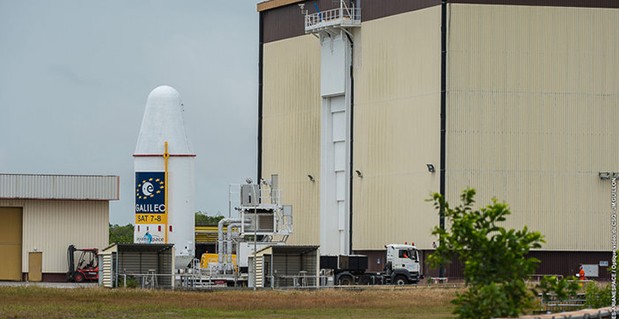
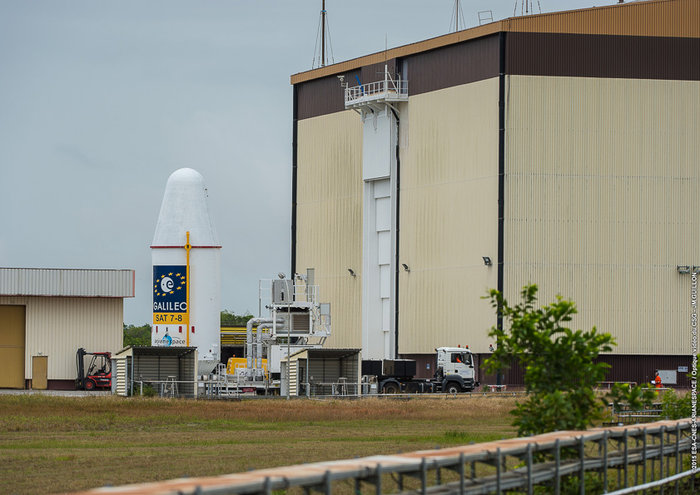
    The upper composite, containing the seventh and eighth Galileo satellites attached to their dispenser atop the Fregat upper stage inside the launcher fairing, being moved from the S3B building to the Soyuz launch site of Europe’s Spaceport on March 24. Photo: European Space Agency
    The upper composite, containing the seventh and eighth Galileo satellites attached to their dispenser atop the Fregat upper stage inside the launcher fairing, being moved from the S3B building to the Soyuz launch site of Europe’s Spaceport on March 24. Photo: European Space Agency

    By the European Space Agency

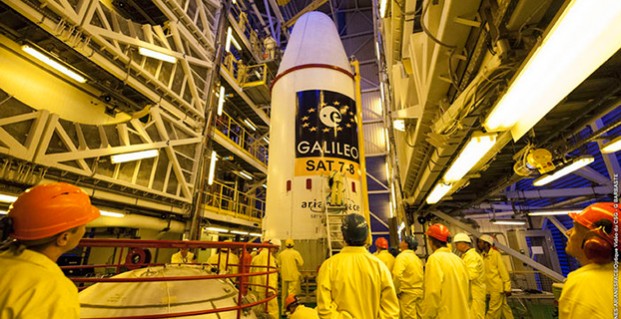
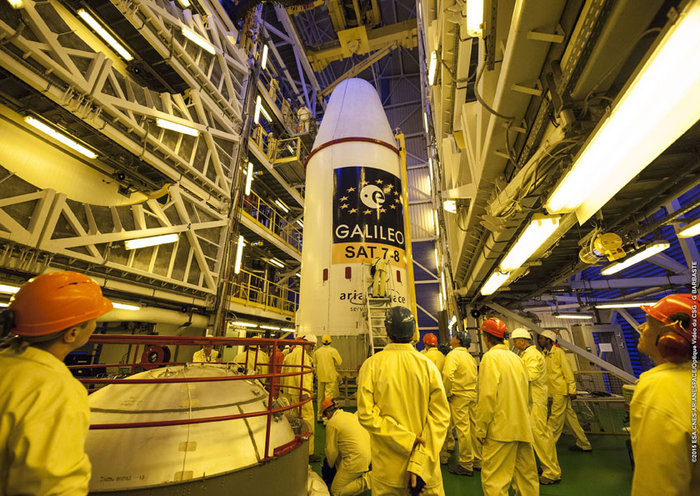
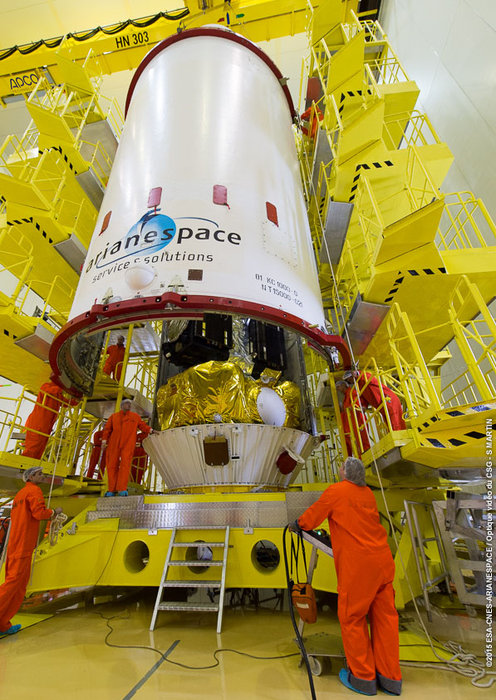
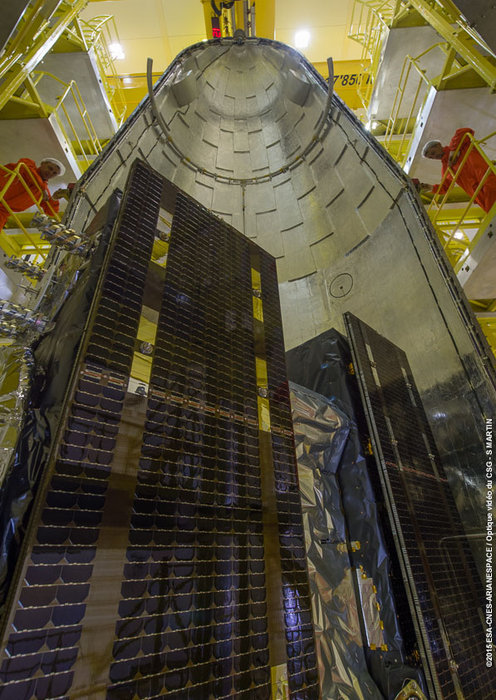
    The seventh and eighth Galileo satellites attached to their dispenser atop the Fregat upper stage being enclosed within their Soyuz launcher fairing on March 20. Photo: European Space Agency
    The seventh and eighth Galileo satellites attached to their dispenser atop the Fregat upper stage being enclosed within their Soyuz launcher fairing on March 20. Photo: European Space Agency

    Thousands of engineers have worked on the seventh and eighth navigation satellites of Europe’s Galileo constellation in recent years, but last Friday marked the very last time the spacecraft were glimpsed by human eyes.

    The team from ESA and builders OHB in the S3B building of Europe’s Spaceport in French Guiana looked on as the focus of their work disappeared from view.

    The pair of satellites — already resting atop their Fregat upper stage and attached to their dispenser — was enclosed within the halves of the Soyuz rocket’s protective fairing.

    This unit was moved yesterday to the launch site, where it will be lifted atop the first three stages of the Soyuz ST-B to complete the vehicle for Friday’s launch.

    Last week saw the two satellites being fuelled in the Spaceport’s S5A preparation hall and then brought together atop the dispenser that will support them during the rigours of ascent.

    The dispenser’s final task is to release them in opposite directions once their 22 522 km-altitude orbit is reached. The satellites themselves will then gradually lower themselves to their working 22 322 km orbit.

    After fueling, the satellites plus dispenser were moved to the S3B processing building, where their Fregat was already fueled and waiting.

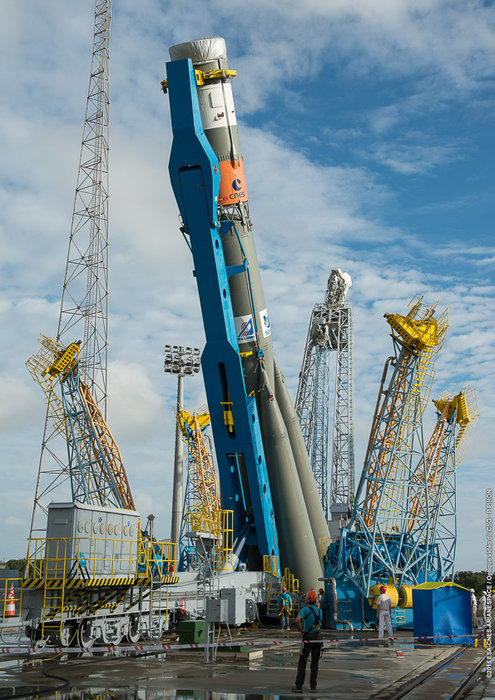
    The first three stages of the seventh and eighth Galileo satellites’ Soyuz ST-B rocket being raised to the vertical on the launch pad at Europe’s Spaceport in French Guiana, awaiting the addition of the ‘upper composite’ containing the Galileo satellites plus the Fregat upper stage enclosed within the Soyuz fairing. Photo: European Space Agency
    The first three stages of the seventh and eighth Galileo satellites’ Soyuz ST-B rocket being raised to the vertical on the launch pad at Europe’s Spaceport in French Guiana, awaiting the addition of the ‘upper composite’ containing the Galileo satellites plus the Fregat upper stage enclosed within the Soyuz fairing. Photo: European Space Agency

    The reignitable Fregat is as much a spacecraft as a rocket stage. Once the Soyuz reaches low orbit, Fregat will take over the task of hauling the satellites higher through a pair of burns.

    The two Galileos and their dispenser altogether weigh more than one and a half tonnes, so the attachment operation took place with great care and precision.

    Then the fairing halves were slowly slid into place around them and closed. Enclosed in this way, the satellites will be protected from the harsh slipstream and vibration of the first few moments of launch, when the Soyuz is still travelling through the thickest layers of atmosphere.

    The fairing is due to be ejected 3 min 29 sec after liftoff. Until liftoff, the satellites remain connected to the outside world via power and data links, allowing ESA’s Galileo team keep a check on their battery charging and the health of their atomic clocks.

    The satellites stay switched off during launch, and will be activated automatically on separation from the dispenser.

    Launch is due at 21:46:18 GMT (22:46:18 CET, 18:46:18 local time) on 27 March. The satellites are scheduled for release upon reaching their set orbit 3 h 47 min 57 sec after launch.

    The seventh and eighth Galileo satellites were enclosed within their protective Soyuz fairing on Friday, 20 March 2015, ahead of their launch a week later. Photo: European Space Agency
    The seventh and eighth Galileo satellites were enclosed within their protective Soyuz fairing on Friday, 20 March 2015, ahead of their launch a week later. Photo: European Space Agency
  • Soyuz in the Launch Zone for March 27 Galileo Launch

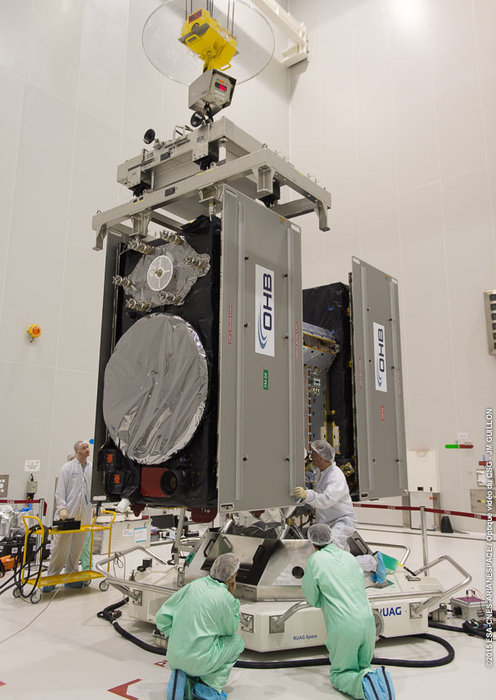
    The seventh and eighth Galileo satellites being fitted together onto the dispenser, March 16-17. (Photo courtesy of ESA)
    The seventh and eighth Galileo satellites being fitted together onto the dispenser, March 16-17. (Photo courtesy of ESA)

    The Soyuz for Arianespace’s next medium-lift mission is in the launch zone at French Guiana, where it stands ready to receive the two spacecraft passengers that will join Europe’s Galileo global navigation satellite system.

    Applying procedures that have been followed since the workhorse Soyuz launcher inaugurated the Space Age, the basic three-stage vehicle for Arianespace’s March 27 flight emerged today from its MIK integration building in the Spaceport’s northwestern sector.

    Riding horizontally on a transporter/erector rail car, Soyuz was transferred to the ELS launch zone — which was followed by its erection to the vertical orientation and positioning over the launch pad, suspended in place by four large support arms.

    With this step completed, all was ready for the purpose-built 53-meter-tall mobile gantry to be moved into position around the launcher — a phase of the processing in French Guiana that differs from Soyuz operations at Baikonur Cosmodrome in Kazakhstan and Plesetsk Cosmodrome in Russia.  The gantry provides a protected environment for installation of the “upper composite,” which consists of the two Galileo spacecraft, the Soyuz’ Fregat upper stage and a two-piece protective payload fairing.

    The March 27 launch — designed VS11 in Arianespace’s numbering system — is scheduled to lift off at precisely 6:46:18 p.m. local time in French Guiana, with its Galileo satellite passengers to be deployed during a flight lasting approximately 3 hrs., 47 min. Total payload lift performance is estimated at 1,597 kg., which includes a combined mass of some 1,428 kg. for the two spacecraft.

    Flight VS11’s passengers — built by OHB System, with Surrey Satellite Technology Ltd. supplying their navigation payloads — are the third and fourth Full Operational Capability (FOC) satellites in the Galileo program, which is creating a European-operated space-based navigation system.

    The European Commission is managing and funding Galileo’s FOC phase, during which the network’s complete operational and ground infrastructure will be deployed. The European Space Agency has been delegated as the design and procurement agent on the Commission’s behalf.

    Follow Arianespace’s launch activity at: www.arianespace.com.

  • Galileo at Your Service


    On the eve of the Galileo 7 and 8 launch, the European Space Agency has created a short video to explain the value of the satellite constellation to its citizens. With the Galileo System, Europe will provide a full range of services and applications across many different areas for Europe and beyond.

  • Galileo 7 and 8 Fitted to Dispenser in Preparation for Launch

    Galileo 7 and 8 Fitted to Dispenser in Preparation for Launch

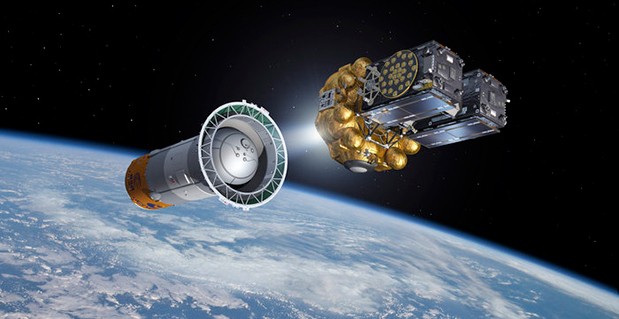
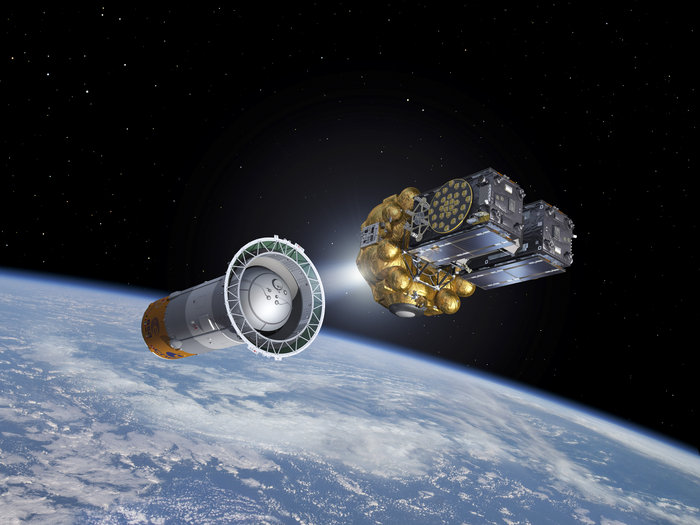
    Artist's view of Galileo satellites attached to their dispenser atop their Fregat upper stage separating from the Soyuz upper stage. The Fregat then flies them the rest of the way up to medium-Earth orbit.  (courtesy of ESA)
    Artist’s view of Galileo satellites attached to their dispenser atop their Fregat upper stage separating from the Soyuz upper stage. The Fregat then flies them the rest of the way up to medium-Earth orbit. (courtesy of ESA)

    News courtesy of the European Space Agency

    The seventh and eighth Galileo satellites being fitted together onto the dispenser, March 16-17. (Photo courtesy of ESA)
    The seventh and eighth Galileo satellites being fitted together onto the dispenser, March 16-17. (Photo courtesy of ESA)

    The seventh and eighth Galileo satellites, set for launch together in nine days’ time, have been fitted together onto the dispenser that will carry them during their flight to orbit.

    The fueling of the two satellites was completed last week, leaving them ready to be placed into launch configuration. They were carefully lowered into place then attached to the dispenser. The operation went smoothly, the two satellites having previously gone through separate “fit checks” with the dispenser in advance of fueling.

    The specially designed carrier will hold the satellites in place during their four-hour flight into orbit some 22,300 km above our planet. Then, at the correct altitude, the two satellites are sprung away in opposing directions. Next, the dispenser plus satellites will be placed onto the Fregat upper stage of their Soyuz ST-B launcher.

    As much a spacecraft as a launch stage, the reignitable Fregat will haul the Galileo satellites most of the way up to their final orbital altitude, once the first three stages of the Soyuz have taken them up to their initial orbit.

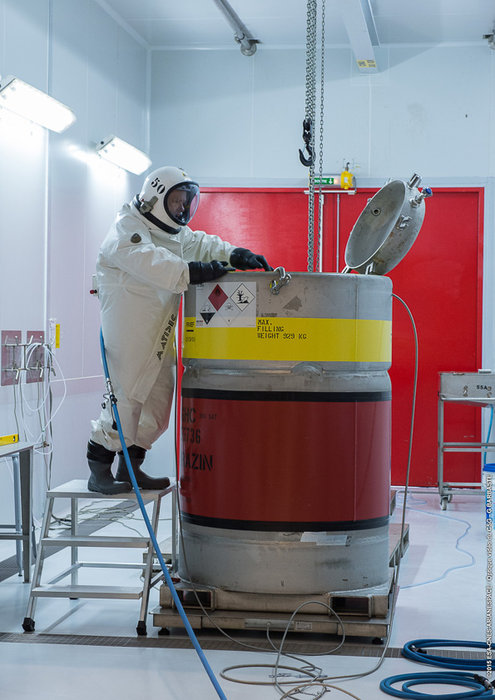
    Fuel for the seventh and eighth Galileo satellites, checked by an engineer in a protective SCAPE (Self Contained Atmospheric Protective Ensemble). Fuelling of the two satellites took place at the end of the second week of March 2015, allowing the satellites to be fitted to their launch dispenser ahead of the March 27 launch. (Photo courtesy of ESA)
    Fuel for the satellites is checked by an engineer in a protective SCAPE (Self Contained Atmospheric Protective Ensemble). (Photo courtesy of ESA)

    Note the protective metal panels covering the solar wings folded against the sides of the Galileo satellites. Protecting these delicate solar arrays during handling on the ground, these panels will be removed ahead of launch.

    The launch of the seventh and eighth Galileo satellites is scheduled for March 27.

  • Counting Down to Galileo

    Galileo 7 and 8 launch on March 27. The Galileo satellite navigation system remains on track after successful in-orbit validation and the salvage for navigational testing of two satellites launched into an incorrect orbit. The mini-constellation of satellites in orbit plus their associated ground segment has allowed in-depth testing of the overall Galileo system, and the performance was good. Now with the launch of the latest pair of satellites, ESA and the European Commission are progressing with the deployment phase of the program.