Tag: Galileo Control Centre

  • ESA completes end-to-end test of enhanced, secure Galileo service

    ESA completes end-to-end test of enhanced, secure Galileo service

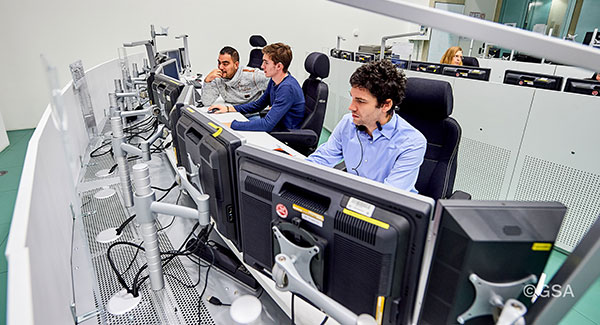
    Galileo Control Centre in Oberpfaffenhofen, Germany. (Photo: ESA)
    Galileo Control Centre in Oberpfaffenhofen, Germany. (Photo: ESA)

    News from the European Space Agency (ESA)

    Europe’s Galileo satellite navigation system continues to evolve. For the first time, end-to-end testing of the Galileo system demonstrated signal acquisition of an improved version of the Public Regulated Service (PRS), the most secure and robust class of Galileo services.

    The system test extended from the Galileo Security Monitoring Centre in Spain and the Galileo Control Centre in Germany to a Galileo satellite at ESA’s ESTEC technical heart in the Netherlands, which then broadcast in turn to a user receiver.

    Galileo’s PRS is an encrypted navigation and timing service for governmental authorized users and sensitive applications intended to remain available even in scenarios where other Galileo services might be degraded or jammed.

    An initial version of the PRS signal has been broadcast by the satellites up to now, but as of next year the signals will evolve into an enhanced version known as Full Operational Capability Public Regulated Service (FOC PRS), which has been defined in close collaboration with the European Commission, the European Union Agency for the Space Programme (EUSPA) and the EU Member States.

    The system’s FOC PRS capability is being enabled by an expansion of the Galileo ground mission segment — important upgrades of the Galileo Security Monitoring Centres (GSMCs) in St. Germain-en-Laye, France, and Madrid, Spain. These two sites oversee PRS provision and monitor its performance.

    This coming version of the security monitoring centers, set for the following year, is being developed by an industrial consortium led by Thales Alenia Space in France.

    Meanwhile the progressive deployment of remote system infrastructure is taking place over the course of this year, readying Galileo sensor stations to receive the upgraded PRS signals.
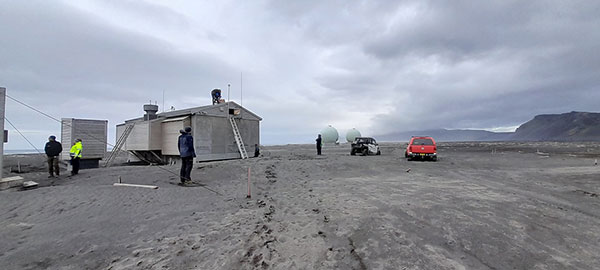
    Upgrade of Galileo Sensor Station on Norway's remote Jan Mayen Island in the Arctic Ocean. (Photo: ESA)
    Upgrade of Galileo Sensor Station on Norway’s remote Jan Mayen Island in the Arctic Ocean. (Photo: ESA)

    “To qualify, the FOC PRS Signal in Space required a major Galileo end-to-end test, demonstrating the compatibility of the space segment with the ground and user segments, called the System Compatibility Test Campaign (SCTC),” explained Federico Di Marco, ESA SCTC test director. “This test involved all Galileo key players spread across Europe, requiring close cooperation between the teams and months of preparation.”

    The SCTC was led by an ESA engineering team from the agency’s ESTEC technical center in Noordwijk, the Netherlands supported by the System Engineering Technical Assistance industrial team led by Thales Alenia Space in Italy and in close collaboration with the operations team supervised by EUSPA.

    “The testing involved three centers across Europe: the GSMC in Madrid, the Galileo Control Centre in Oberpfaffenhofen, and ESTEC hosting an actual Galileo satellite plus FOC PRS user receivers,” added Edward Breeuwer, who is in charge of Galileo system qualification at ESA.
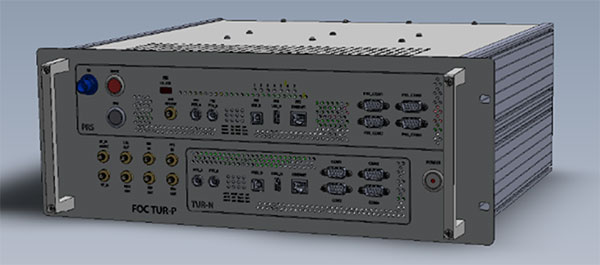
    FOC PRS test receiver developed by Antwerp Space under ESA contract. (Photo: ESA)
    FOC PRS test receiver developed by Antwerp Space under ESA contract. (Photo: ESA)

    The FOC PRS signal was generated at the GSMC, sent to the German control center, then uplinked to the Galileo satellite at ESTEC, where the satellites are tested for space in advance of launch. The Galileo satellite then broadcast the FOC PRS signal in turn, to be picked up by a pair of receivers also on site: one developed by Antwerp Space under ESA contract and the other developed by Leonardo as part of a national development undertaken by Italy’s Competent PRS Authority, charged with overseeing the country’s PRS use.

    “This marks the first time we have integrated such a nationally developed receiver within a system test activity,” said Fabio Covello, who oversees system security for ESA. “Having achieved this for PRS makes us very proud. We are confident that this experience can pave the way for future fruitful collaborations between the Galileo Programme and EU Member States, in the frame of specific tests to guarantee compatibility between the ESA-developed system and nationally developed PRS receivers.”

    This successful outcome sets the scene for the PRS qualification at ground segment and system level, followed by operational validation planned in coming months, culminating in the first FOC PRS Signal In Space operational broadcast, in the course of next year.
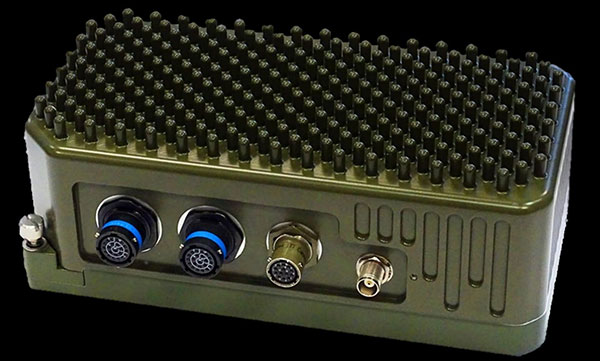
    FOC PRS test receiver developed by Leonardo as part of a national development undertaken by Italy’s Competent PRS Authority, charged with overseeing the country’s PRS use. (Photo: ESA)
    FOC PRS test receiver developed by Leonardo as part of a national development undertaken by Italy’s Competent PRS Authority, charged with overseeing the country’s PRS use. (Photo: ESA)
  • How Galileo performed its authenticated positioning fix

    How Galileo performed its authenticated positioning fix

    News from the European Space Agency (ESA)

    In a first for any satellite navigation system, Galileo has achieved a positioning fix based on open-service navigation signals carrying authenticated data. Intended as a way to combat malicious spoofing of satnav signals, this authentication testing began at ESA’s Navigation Laboratory — the same site where the very first Galileo positioning fix took place back in 2013.

    These historic first authenticated signal position, velocity and timing fixes were made using a total of eight Galileo satellites for around two hours on Nov. 18. The tests represent a first proof of concept for an eventual operational service offering positioning with authenticated data to users.

    Spoofing has, for instance, been demonstrated as a means of forcing down drones or redirecting ships, while some high security locations — as well as disrupted international borders — have become notorious for spoofing signals that prevent the reliable use of satnav in their vicinity.


    The Galileo Control Centres send the navigation signal to the GSC for the addition of the authentication code, which is then returned for uplink to the satellites.


    “When a receiver picks up a navigation signal from a satellite, up until now it has no way of confirming that was indeed its source,” said navigation engineer Stefano Binda, overseeing the project for ESA. “This can result in spoofing — malicious people and organisations using false signals to mislead users about their actual position. This authentication service offers a way to prevent such deception.”

    “In recent years, this problem has become sufficiently pronounced as a weak point that the European Commission, ESA and European GNSS Agency (GSA) decided to develop signal authentication as a differentiator for Galileo,” Binda said.

    An ESA Navigation Directorate team at the Agency’s ESTEC technical centre in the Netherlands worked with its GSA counterparts at the twin Galileo Control Centres (GCCs) in Italy and Germany and the Galileo Service Centre (GSC) in Spain. “In everyday authentication you might send a document that has been digitally signed, where both sender and recipient use compatible cryptographic keys to validate the document’s source of origin,” Binda said.

    “In this case we were working with a constrained amount of bandwidth within the navigation signal, so instead opted for a ‘delayed key’ approach. This means the initial data come along together a short tag which, within a short stretch of time usually not exceeding 30 seconds, is followed by a key, which is able to validate the tag and authenticate the data associated with it.”

    During the test campaign, the Galileo Control Centres send the navigation signal to the GSC for the addition of the authentication code, which is then returned for uplink to the satellites, to be received and authenticated by the test receivers at ESTEC’s Navigation Lab and elsewhere in Europe, in participating laboratories.

    To enabled the authentication test campaign, Thales Alenia Space in France served as prime contractor to upgrade of the Galileo Mission Segment — the world-spanning system that determines and create the navigation messages broadcast by Galileo satellites. Thales Alenia Space in Italy was responsible for the system level integration.

    No modification of onboard satellite systems has been required to support Open Service Navigation Message Authentication (OSNMA), as spare bandwidth was made use of.

    “We used our standard laboratory Septentrio test user receivers with a software add-on,” Binda said. “The beauty of this approach is that receivers will be able to make use of the future authenticated service without needing any new hardware, only software updates — apart from additional measures that might be mandated for operation in practice.”

    ESA and GSA are continuing their authentication testing, with a view to introducing an operational Open Service Navigation Message Authentication service for users in the near future.

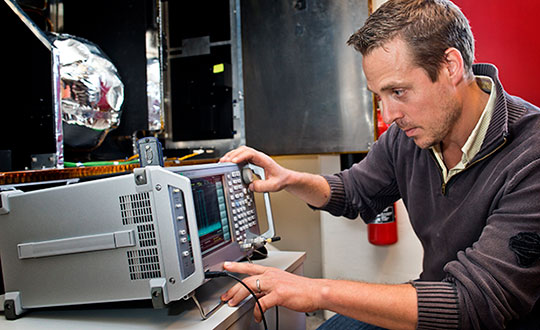
    ESA’s Radio Frequency Systems, Payload and Technology Laboratories perform RF research for both the space and ground segments. (Photo: ESA)
    ESA’s Radio Frequency Systems, Payload and Technology Laboratories perform RF research for both the space and ground segments. (Photo: ESA)
  • Galileo Team Raced to Respond Following FOC Launch

    Galileo Team Raced to Respond Following FOC Launch

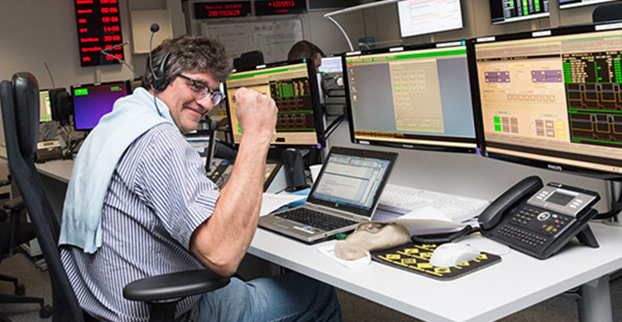
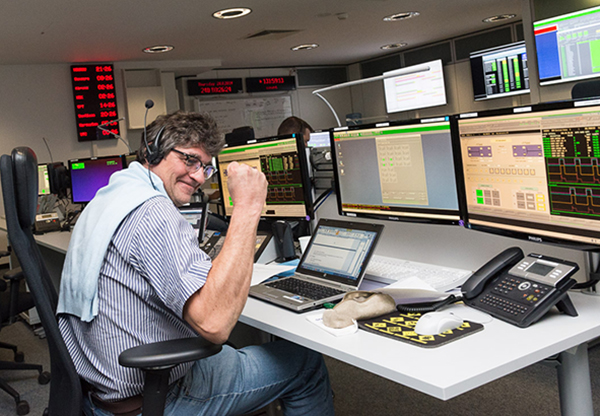
    Flight Operations Director Hervé Côme celebrating success finding the satellites. Photo: Galileo Control Centre
    Flight Operations Director Hervé Côme celebrating success finding the satellites. Photo: Galileo Control Centre

    On September 27, the first two Galileo Full Operational Capability (FOC) satellites were handed over from the European Space Agency’s Space Operations Centre (ESOC) in Darmstadt, Germany, to the Galileo Control Centre, Oberpfaffenhofen, which will care for them pending a final decision on their use.

    The satellites, launched on August 22, are in excellent health and working normally. However, a launcher problem left the pair in the wrong orbit, with higher apogee, lower perigee and an incorrect inclination compared to the planned circular orbit.

    According to a release by the European Space Agency, the orbit presented a sudden and unexpected — though not untrained for — challenge to the team at ESOC responsible for the launch and early orbit phase. For months before each Galileo launch, a joint team of mission operations experts from ESA and France’s CNES space agency train intensively for this critical period, which typically lasts about eight days, from separation until handover to Oberpfaffenhofen.

    “After launch, we quickly discovered that one of each satellite’s pair of solar wings had not deployed correctly,” said Liviu Stefanov, Spacecraft Operations manager. “At the same time, difficulties in receiving radio signals — indicated by unusually low power and instability — alerted us to the fact that the orbits could be incorrect. Basically, the ground stations were pointing to where we expected the satellites to be, and they weren’t there, so we weren’t getting good signals.”

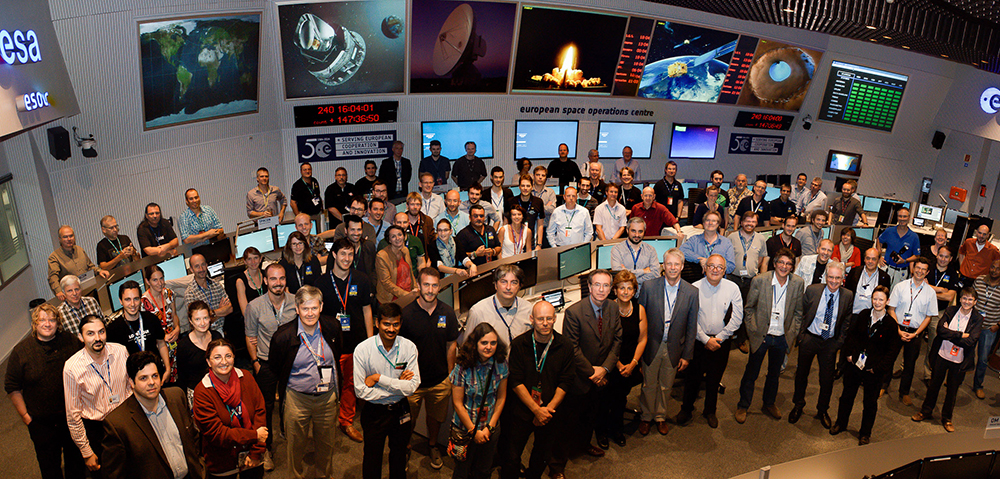
    The joint ESA–CNES Galileo operations team in the Main Control Room at ESA’s Space Operations Center, August 28. (Photo credit: R. Solaz).
    The joint ESA–CNES Galileo operations team in the Main Control Room at ESA’s Space Operations Center, August 28. (Photo credit: R. Solaz).

    Engineers determined within four hours the approximate actual orbit and then generated new commands to point the ground antennas to establish robust radio links. Working around the clock, and with assistance from the Galileo project engineers and the satellite builder, the teams then started to look at how to free the solar arrays. “Each undeployed wing had to be treated as a separate problem,” said Flight Operations Director Hervé Côme.

    “Each satellite had to be maneuvered separately into an orientation where the undeployed panel was facing the Sun because we realized that one cause was linked to the low temperature of the release mechanism. It all required developing, validating and rehearsing new flight operation procedures on the fly.”

    It took three days to release the trapped solar wing of the first satellite, and then two days later the second Galileo’s stuck array was also freed. The satellites have since been brought into full operation, as the teams in Darmstadt were tasked to retain control for five weeks — four weeks longer than planned.

    “This was very demanding on the ESA and CNES personnel, and on the ESOC operations team in particular, but the strong bonds developed through months of joint training enabled them to perform very well,” Liviu said.

    Possible uses of the two satellites are now being studied, and a future mission scenario will be decided at a later date.

    While the process of handing over the satellites to the Galileo Control Centre (where they are operated by teams from a private company, spaceopal GmbH), had been practiced in the past, this was the first time it was done with FOC satellites in orbit. The delicate process involves transferring responsibility for commands and telemetry, and beginning the satellites’ secure mode of operation by the teams at Oberpfaffenhofen. The handover ran very smoothly over the last weekend in September.

    “By the end of the Saturday, the first satellite was fully handed over, while the second handover took place on Sunday,” said Richard Lumb, ESA’s Galileo Mission director.

    “I am extremely proud of the entire Mission Control Team and the way they handled a dramatic and very critical situation resulting from multiple, independent anomalies,” said Paolo Ferri, ESA’s head of Mission Operations. “After launch, the joint team managed to maintain control of the satellites under extremely difficult conditions, rapidly stabilized them, and determined the actual orbit. The accuracy and professionalism of the subsequent handover activities also showed that the joint team at ESOC and the spaceopal team at the Galileo Control Centre are very well tuned for this procedure, which will become increasingly frequent with future launches.”

  • Galileo Satellites Handed over to Control Center in Germany

    Europe’s first two Galileo satellites have reached their final operating orbits, opening the way for activating and testing their navigation payloads, reports the European Space Agency (ESA).
     
    Marking the formal end of their LEOP Launch and Early Operations Phase, control of the satellites was passed on November 3 from the CNES French space agency center in Toulouse to the Galileo Control Centre in Oberpfaffenhofen in Germany.

    Oberfaffenhofen, operated by the German Aerospace Center DLR, will be in charge of the satellites' command and control for the whole of their 12-year operating lives, ESA said.

    The two Galileo satellites were launched by Soyuz from French Guiana on 21 October. Three hours and 49 minutes after launch, their Fregat-MT upper stage carried them into their planned 23 222 km orbit, where they were released simultaneously.