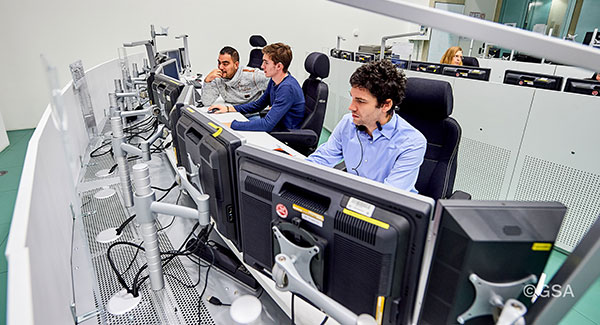
Galileo Control Centre in Oberpfaffenhofen, Germany. (Photo: ESA)
News from the European Space Agency (ESA)
The 11th launch of Galileo satellites, planned for Dec. 1, marks an important program milestone. With an upgrade of the Galileo Control Segment (GCS), this will be the first launch where the satellites’ first steps into space will be overseen from the Galileo Control Centre in Oberpfaffenhofen, Germany.
Up until now, the Launch and Early Operations Phase (LEOP) of Galileo satellites has been overseen from an external mission control site — either ESA’s ESOC control centre in Darmstadt, Germany, or French space agency CNES’s site in Toulouse, France.
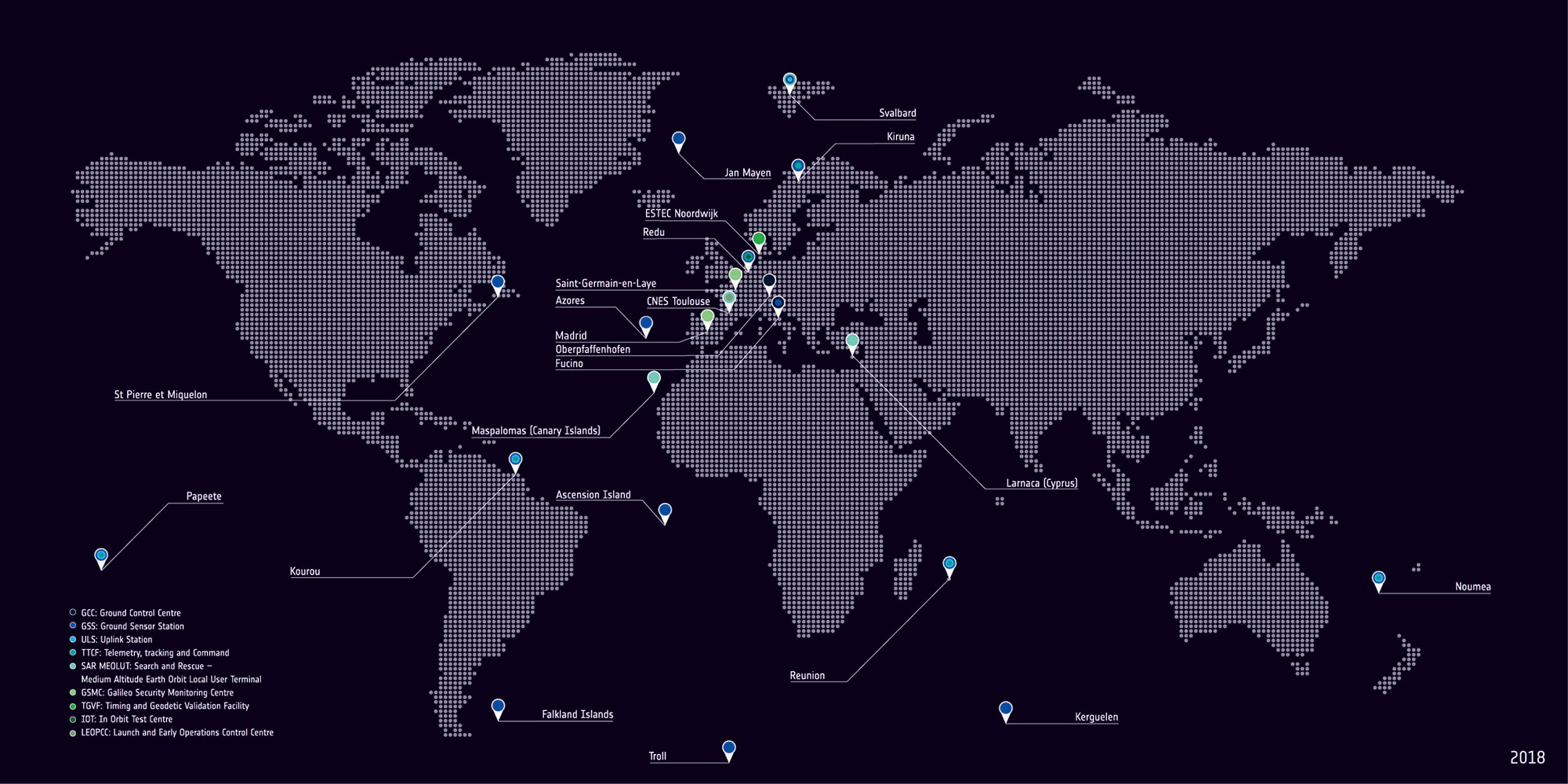
The demanding upgrade of the GCS to Version 3.0 was performed by an industrial consortium led by GMV in Spain. The control segment encompasses the two Galileo Control Centres in Oberpfaffenhofen in Germany and Fucino in Italy, as well as six Telemetry, Tracking and Control (TT&C) ground stations used to monitor and command the 26 Galileo satellites in orbit.
As well as increasing overall reliability and cybersecurity, the new upgrade opens the way to significant expansion of the Galileo constellation, enabling oversight of up to 38 satellites.
Over the last three years, a complete technological refresh of the GCS software and hardware was done, including porting of software modules corresponding to several million lines of code, the deployment of equipment at many Galileo sites, and the execution of a rigorous level of testing throughout all elements comprising the system.
Commencing in mid-2018, the upgrade had to contend with the worldwide COVID-19 pandemic midway through its lifetime, but the team pushed on to conclude at the end of July. Since Aug. 4, it has been used to nominally operate all the satellites in the constellation.
The project was overseen by ESA in its System Prime role managing Galileo’s design, development, qualification and deployment of future upgrades on behalf of the European Commission, Galileo’s owner.
With Europe’s Galileo constellation in space now expanded to 26 navigation satellites — and Galileo Initial Services available to users worldwide — the infrastructure on the ground that controls them is undergoing a corresponding expansion.
ESA has awarded a new work order for the Galileo Control Segment — that part of the Galileo system responsible for the monitoring and control of all the satellites in orbit — to GMV Aerospace and Defence, Spain.
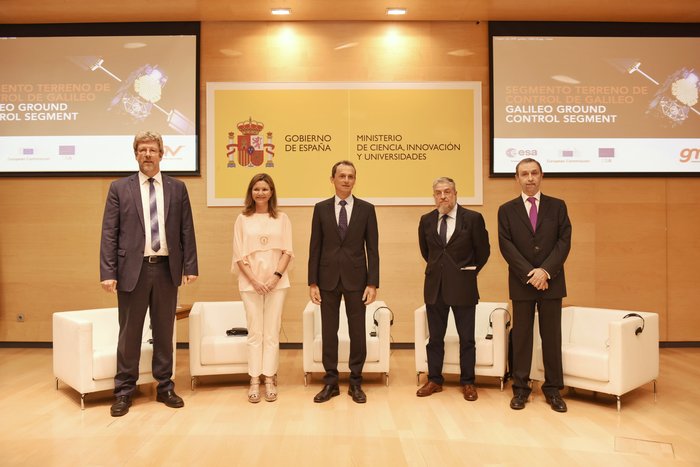
The contract was signed by ESA Director of Navigation Paul Verhoef and Jesús B. Serrano Martínez, CEO of GMV, in a ceremony hosted at Spain’s Ministry of Science, Innovation and Universities in Madrid, in the presence of Spanish Science Minister and former ESA astronaut Pedro Duque.
The ground control contract was signed Sept. 6 at at Spain’s Ministry of Science, Innovation and Universities in Madrid. From left: Verhoef; Secretary General of Transport of Spain’s Ministry of Public Works, María José Rallo, representing Spain in the EU Committee on Satellite Navigation Programmes; Spanish Science Minister and former ESA astronaut Pedro Duque; European Commission adviser on navigation activities Augusto González; and Martínez. (Photo: ESA)
Galileo’s Control Segment is hosted at the Oberpfaffenhofen Control Centre in Germany, with a “hot backup” in place at Galileo’s second Control Centre, at Fucino in Italy. It also extends to a network of Telemetry, Tracking and Control (TT&C) ground stations placed around the globe to stay linked with all satellites in the constellation.
The combination of these Control Centres plus TT&C stations are vital to keep Galileo running at its highest possible performance level. They monitor the overall status of the constellation, gather telemetry and uplink telecommands to each satellite, while also performing two-way radio and Doppler ranging to keep precise track of their position in space, identifying any orbital drift that might degrade the system’s accuracy.
The Galileo Control Segment has been designed to allow the automatic execution of routine operations. It also includes elements supporting flight dynamics analyses, constellation operations short-term planning as well as operations preparation.
Galileo’s global ground segment. (Map: ESA)
This first work order for the “Galileo Control Segment Exploitation Phase” contracts GMV Aerospace and Defence as prime contractor to undertake all necessary activities to upgrade the Galileo Control Segment as part of Galileo’s Exploitation phase.
This work includes upgrading the system architecture to manage a constellation of up to 41 Galileo satellites, updating obsolescent elements in the current system, improving operability linked to the provision of services and the addition of a new, second TT&C station to be based in Kourou, French Guiana.
The integration, qualification, deployment and migration into operational service of the various segments of the upgraded Galileo Control Segment will be undertaken over the next three years.
The Galileo ground station near New Caledonia capital Nouméa incorporates a Galileo Sensor Station (foreground) that monitors the quality of navigation signals and an uplink station (background) to relay navigation corrections to the satellites for rebroadcast to users. An antenna 13 meters in diameter for controlling the satellites has also been built, ready to come online later this year. (Photo: ESA)
This process is to undertaken while maintaining coherence with the other segments of the overall Galileo system – such as the Galileo Mission Segment which oversees Galileo services, the external control centres that carry out initial satellite switch-ons and in-orbit testing and the satellite platform and payload manufacturers, OHB System AG in Germany and Surrey Satellite Technology Ltd in the UK.
ESA has issued this work order in its role overseeing Galileo’s deployment, the design and development of future upgrades and the technical development of infrastructure on behalf of the European Commission, Galileo’s owner.