
Tag: Galileo PRS signal

  • Directions 2016: Galileo — strategic tool for European autonomy

    Directions 2016: Galileo — strategic tool for European autonomy

    Jeremie Godet, Galileo Implementation Head of Sector, European Commission (left); Fiammetta Diani, deputy head of Market Development, European GNSS Agency.
    Jeremie Godet, Galileo Implementation Head of Sector, European Commission (left); Fiammetta Diani, deputy head of Market Development, European GNSS Agency.

    By Jérémie Godet and Fiammetta Diani

    The Galileo programme is currently in its deployment phase, which is due for completion in 2020. Following declaration of initial services in 2016, an exploitation phase will start and aim at delivering a fully operational system by the end of 2020. The deployment and the exploitation are entirely financed through the budget of the European Union, while two non-EU members, Norway and Switzerland, contribute through international agreements.

    The aim of the Galileo programme is to establish and operate the first global satellite navigation system under the control of the European Union, thus contributing, amongst other things, to the strategic autonomy of the Union. This is the first time that the EU has developed, owned and been responsible for such a large-scale infrastructure.

    While independence is the main political objective, ensuring compatibility and interoperability with other existing and future systems is also critical. Indeed, frequency compatibility has been achieved with GPS, IRNSS, QZSS and COMPASS with a range of coordinations achieved in the last two years under the framework of the International Telecommunication Union (ITU). A wider international agreement was previously reached in 2004 between the U.S and the EU, achieving the compatibility and interoperability of their respective systems and resulting in a common modulation for both systems’ state-of-the-art open signals. A positive outcome of this for all GNSS users is that similar signals have been adopted by other global or regional systems, in particular the MBOC modulation jointly defined by the U.S. and the EU (Galileo, GPS, COMPASS, QZSS), the ALTBOC modulation adopted by COMPASS and a common signal in E6 adopted by QZSS.

    The Galileo programme will provide unique services, functionalities and performance levels that have never, or not yet, been provided by other satellites navigation providers.

    What Will Users Get, and When?

    These services, defined in consultation with user communities and EU Member States, will be offered by the system:

    • An Open Service (OS): With positioning accurate to around 1 meter using up to three different frequencies (E5a, E5b and L1), free of charge to the user and providing positioning and synchronization information intended mainly for high-volume satellite navigation applications;
    • A Public Regulated Service (PRS): Restricted to government-authorized users, for sensitive applications which require a high level of service continuity. It will use strong encrypted signals. This service is intended for security-related use for the EU Member States, the European Council, the European Commission, the European External Action Service and duly authorized Union agencies. It may be accessed by non-EU states and international organizations subject to bilateral agreements.
    • A contribution to the Search and Rescue Service (SAR) of the COSPAS-SARSAT system: Galileo’s worldwide search-and-rescue service will help to forward distress signals to a rescue coordination center by detecting emergency signals from beacons and relaying messages to them in near real time.
    • A contribution to integrity monitoring services by means of Galileo OS signals, in cooperation with other satellite navigation systems, aimed at users of safety-of-life applications in compliance with international standards;
    • A Commercial Service (CS): Encrypted for authentication purposes and offering very high accuracy to the sub-decimeter level, it will target applications for professional or commercial use owing to improved performance and data with greater added value than that obtained through the open service.

    As of 2016, Galileo will progressively offer initial services for the open service, search-and-rescue service and the public regulated service. Those initial services will be gradually improved, and the other two services will be gradually implemented, with the aim of reaching full operational capability by end 2020.

    The performance improvements of the services expected between 2016 and 2020 are linked to completion of the constellation deployment. In 2018, this will reach 24 satellites, the number required to achieve Galileo’s positioning performance targets, and the completed constellation with up to 30 satellites will be in place by the end of 2020 to provide the necessary spares to ensure performance commitments.

    On top of this, a number of additional capabilities are planned to be added to the core services, including:

    • An improvement of the OS nav message with full backward compatibility to enhance both the time-to-first-fix and the ability to perform signal acquisition and tracking for users in lower visibility conditions (INAV improvement);
    • An authentication of the OS navigation message allowing users to verify that a certain number of broadcast parameters are the actual Galileo data — aimed at applications requiring trusted position and timing information for commercial purposes;
    • An improvement of the PRS;
    • A new functionality within SAR that provides, via the navigation message, a Return Link Message to distress beacons acknowledging that a rescue center has received their distress signal.
    • Constellation Status

    The current Galileo constellation is composed of two different families of satellites: the In-Orbit-Validation (IOV) satellites procured before 2010 and the Full-Operational-Capability (FOC) satellites procured after 2010. Since the last Galileo launch on Sept. 10, there are four IOV satellites and six FOC satellites in orbit. The FOC satellites have improved capabilities regarding signal transmission compared to the IOV satellites, despite a similar mass and size. The FOC satellites carry a SAR payload; two IOV satellites have this capability. While this initial deployment faced a number of difficulties, these are now well behind us.
    Sixteen more FOC satellites are being built. The next launch of two FOC satellites is scheduled for Dec. 17, and four more launches (three Ariane 5 and one Soyuz) are foreseen from 2016 to mid-2018. This implies four to six satellites launched per year, and this is judged perfectly realistic as demonstrated already in 2015.

    An additional series of satellites will be procured in 2016 for deployment starting in late 2019/early 2020.

    Preparing to Use and Benefit

    The ultimate objective of the Galileo program is for its signals to be translated into valuable and reliable services for users across the globe. Europe aims to generate the return on investments in terms of public benefits for citizens and businesses, and for this reason the users are at center of the program.

    This is the focus of the European GNSS Agency (GSA), which is in constant dialog with user communities via a wide range of activities.

    For example, cooperation with chipset and receiver manufacturers aims to ensure that all products are Galileo-ready. This process involved a successful testing campaign done in cooperation with ESA and the EC’s Joint Research Centre (JRC). Equally important is to work closely with large user communities, such as road, maritime and rail, to support them in updating their systems so that they are ready to use Galileo. This is accomplished by dedicated market and technical support, via cost-benefit analyses, testing campaigns, initiation of standards and certification processes, user satisfaction surveys and more. These actions are part of tailored adoption roadmaps built with each user community. Periodic user fora are also organised to get feedback on current services and collect ideas for the evolution of the European GNSS systems.

    EU R&D programmes, such as Horizon 2020 for the development of Galileo applications as well as the recently launched Fundamental Elements program that focuses on funding European GNSS chipset and receiver technologies, are essential tools for preparing users and supporting EU competitiveness in the downstream sector.

    The GSA leverages these EU R&D programmes as a tool for adoption with large user communities and receiver manufacturers fully involved. The projects are managed by experienced staff specialised in different markets and application areas. In the case of PRS, the core user equipment technology is being designed and tested. This work is already paying off; today, a growing number of receivers available on the global market are Galileo-enabled, while almost 70 percent of the models have EGNOS.

    Among others, Europe’s ST Microelectronics in the automotive sector, and the U.S.’s Broadcom and the Taiwanese Mediatek in smartphones, have already announced their Galileo-ready chipsets. Many other chipset manufacturers are ready and tested for Galileo. It is expected that, with recent successful launches and the deployment schedule, most of them will bring their Galileo products to market in 2016.

    Galileo on the Horizon

    Despite its particularly challenging complexity, involving extensive technical and security requirements, Galileo deployment is now progressing well and services will be provided starting in 2016, to reach their full operational capability in 2020. One early benefit of interoperability with GPS is that even before the Galileo constellation is completed, the number of L5/E5a signals in space will allow meaningful use of that frequency for the first time. Galileo will deliver real advances in precision, availability, coverage and additional features unprecedented in any other satellite navigation systems to date: while GPS is today’s de facto standard, Galileo is aiming to be the world’s second GNSS reference system by 2020.


    Governance Set-up

    The European Commission (EC) has overall programme supervision and budget responsibilities. The EC delegates system design and infrastructure procurement to the European Space Agency (ESA) and service preparation, delivery and operations to the European GNSS Agency (GSA). ESA is one of founders of the Galileo system and has been responsible for the development phase, co-financed by the Member States of ESA and the EU. ESA is the procurement agent of core infrastructure and in charge of the overall system integration since 2007.

    The GSA’s role will grow considerably in the exploitation phase as it becomes the day-to-day interface with ESA in several areas, including infrastructure roll-out and maintenance. The GSA will procure main operations of the system from 2017 and will operate key services facilities such as the Galileo Security Monitoring Centre in France and the UK, the European GNSS Service Centre in Spain, and the Galileo Reference Centre in the Netherlands. The GSA also supports the enabling of receivers and chipsets for Galileo use and the development of applications in downstream segments, in close cooperation with the major user communities.
     

  • QinetiQ Announces Robust GNSS Receiver for Galileo PRS

    QinetiQ Announces Robust GNSS Receiver for Galileo PRS

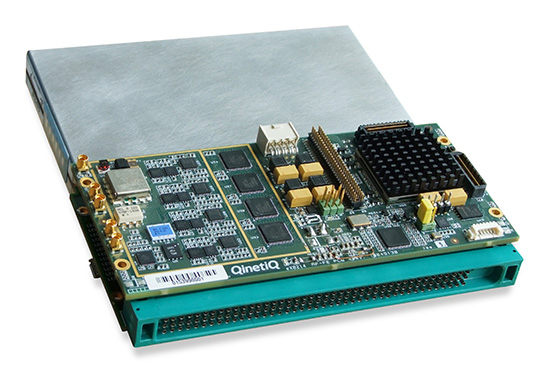
    The QinetiQ PRS receiver.
    The QinetiQ PRS receiver.

    QinetiQ today announced a major breakthrough in developing a robust navigation receiver that will use the Galileo, Europe’s satellite navigation system — in particular, the secured Public Regulated Service (PRS).

    QinetiQ’s new high-performance, next-generation GNSS receiver is multi‑constellation and multi‑frequency, and is designed to process encrypted signals from the Galileo PRS service as well as open services such as GPS. Qinetiq introduced the receiver today at the UK Space Conference, being held July 13-15 in Liverpool.

    The receiver — now a in prototype form — is a significant step towards developing an end-user product for navigation, tracking and timing, QinetiQ said. It will offer highly secure, accurate and reliable position, velocity and timing intended for users with a mission-critical need such as governments, the military and emergency services across Europe. 

    “We are delighted that, after years of QinetiQ R&D and collaboration with the EU, European Space Agency (ESA) and UK government, we have achieved this major step towards our goal of offering robust navigation products using Galileo,” said Nigel Davies, head of QinetiQ’s Secured Navigation Group. “It is a significant breakthrough for us to have built a fully operational receiver on a platform, which proves our product architecture, functionality and algorithms.”

    “Our next step will be working to refine the product family and preparing it to be brought to market, which includes developing additional features and reducing its size to that of a postage stamp, in a form factor similar to our existing, highly successful Q20 receiver,” Davies said. “We have full confidence in this product and are proud to be at the forefront of this exciting new phase in European navigation.”

    The prototype receiver is a multi-constellation, multi-frequency, all‑in‑view receiver that can receive and process the Galileo PRS as well as Galileo Open Service and GPS Standard Positioning Service. It is also designed to utilize other GNSS signals including the Russian GLONASS and Chinese Beidou systems as well as space-based augmentation services (SBAS) such as WAAS and EGNOS.  

    The receiver, which is based on the military standard SEM-E form factor, is also designed for integration into multi-sensor navigation systems and is designed to provide high levels of protection against jamming and spoofing.  It has a fast acquisition capability and is designed for government security accreditation.

    It is expected that a suite of robust products will be ready by 2020 to coincide with the completion of the Galileo project, which will be the world’s third GNSS to be completed after the United States and Russian systems.

    The new receiver is part of a long pedigree in robust GNSS receivers. Q20 was QinetiQ’s first GPS receiver, designed for specific challenging applications: high dynamics, or high sensitivity like tracking from inside a shipping container. QinetiQ’s family of receivers will include two new products based on the new receiver. Q40 will be QinetiQ’s next-generation robust open service receiver, which will be a multi‑constellation, multi‑frequency open-service receiver which can use signals from all of the GNSS open services. Q50 will incorporate all of the functionality of the Q40 receiver, but also offer Galileo PRS for authorized users who need the additional capabilities and robustness.

    “The device we have built is a major stepping stone to Q40 and Q50 as the technology has all been built for the receiver products and is designed to be shrunk on to a single ASIC microchip,” Davies said. “Our focus of attention will now be to turn what we have built into an ASIC product which is ready for market.”

  • New Expectations Accompany Galileo Viability

    New Expectations Accompany Galileo Viability

    Alan Cameron
    Alan Cameron

    It is heartening to see a burgeoning constellation and its operators move on from doubt to certainty, as Galileo prepares for fuller operational capability and the expectations that scope elicits.

    To pick up the thread from last month’s column covering keynote speeches at the European Navigation Conference: plenaries subsequent to the opening session focused respectively on “GNSS for Aeronautical Applications: from GPS to Multi-Constellation with Galileo,” and “GNSS Resilience for Terrestrial & Naval Applications.”

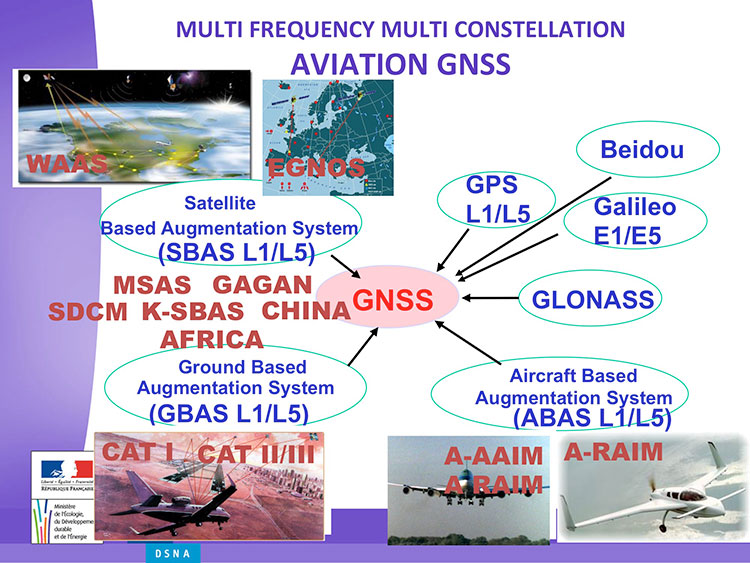
    Avionics. Benoit Roturier, GNSS and Performance-Based Navigation program head for the French air traffic control agency, Direction des Services de la Navigation Aérienne (DSNA), reviewed the rather complex assembly of air navigation systems gradually coming together. Not quite — or not nearly — a system of systems, as I understand it, more a conglomeration of systems.

    Slide from Benoit Roturier's presentation on behalf of the French air traffic control agency. (Courtesy of Benoit Roturier)
    Slide from Benoit Roturier’s presentation on behalf of the French air traffic control agency. (Courtesy of Benoit Roturier)

    Multi-constellation GNSS combos, with added context from satellite-based augmentation systems (SBAS), target provision of performance-based navigation (PBN) in all phases of flight, with increased robustness and availability, as well as escalating categories of precision approach and landing. Roturier presaged the SBAS message agreement that also took place in April with his observation that “[The] most benefits are achieved with two constellations — but which ones?” As four constellations and two frequencies deliver “many, many potential navigation modes,” how can air traffic controllers limit complexity while achieving maximum benefits? At the very least, there is a need to agree on main mode and reversion modes.

    He gave an overview of upgrades planned, in progress, and completed at airports around France. 141 runways are as of January 2015 equipped with PBN, with GNSS and often EGNOS approaches, compared with 260 still relying on older systems. He concluded with a summary of DSNA views, including “SBAS/EGNOS is seen as a free of charge, performing, mature and here to stay technology, supporting navigation and surveillance (ADS-B) performance requirements.”

    By the way, June’s EAGER enewsletter column will cover a recent EGNOS demonstration flight and the current state of runway approaches in Europe. Subscribe here for free.

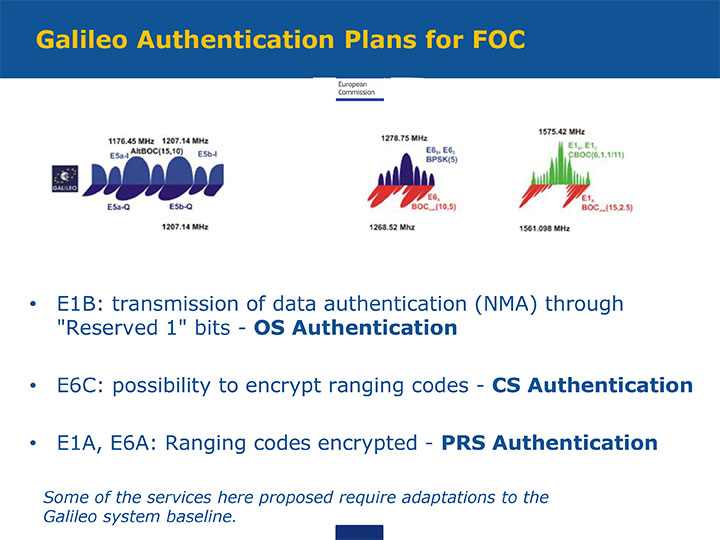
    GNSS Resilience. The second plenary, on resilience, brought forth some of the most pointed commentary of the conference. Ignacio Fernández Hernández of the European Commission spoke on Galileo differentiators for resilience: its authentication plans for the Open Service, Commercial Service, and Public Regulated Service, respectively. “The proposed GNSS authentication services are 100 percent backward compatible and interoperable with other receiver-based technologies.”

    Slide from presentation by Ignacio Fernández Hernández of the European Commission on Galileo differentiators for resilience. (Courtesy of the EC)
    Slide from presentation by Ignacio Fernández Hernández of the European Commission on Galileo differentiators for resilience. (Courtesy of the EC)

    Hernandez proferred the caveat that “some of the required changes to deliver these services (particularly OS authentication) are pending on an impact analysis by industry/ESA and are not yet in the baseline. We hope however to have them in the baseline soon and we’re working hard for it.”

    Matteo Paonni of the EC’s Joint Research Centre addressed spectrum management and regulatory issues, specifically the hot-button topic pseudolites. The EC is working closely with the United States and others to limit potential in-band interference risks. Outdoors, pseudolites are clearly undesirable; indoors, they offer some potential, but must be controlled.

    Paonni stressed that there is a clear need to protect GNSS spectrum, and that the EC and its member states are doing their utmost to install such protections, and are also promoting GNSS radio-frequency interference detection and mitigation initiatives. Galileo’s PRS is more robust and resilient, but it is not invulnerable.  GNSS vulnerabilities should be appreciated and backups put in place for critical systems; backups such as eLORAN, mini atomic clocks, GSM network, and so on.

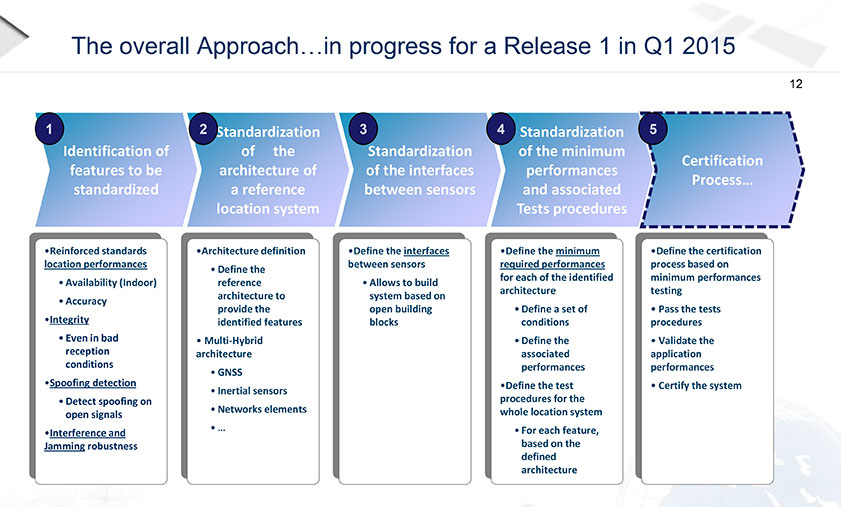
    Michel Monnerat of Thales Alenia Space focused on resilience in the road and LBS sectors. With a wide range of environments, devices and applications coming into play, “we need standardization” to specify levels of integrity and levels of performance for each different set of parameters. Thales Alenia is developing just such a set of performance requirements and references, with a first version set for release and discussion soon.

    Slide presented by Michel Monnerat of Thales Alenia Space, which is working on a standardization protocol proposal, to be released soon. (Courtesy of Thales Alenia Space)
    Slide presented by Michel Monnerat of Thales Alenia Space, which is working on a standardization protocol proposal, to be released soon. (Courtesy of Thales Alenia Space)

  • European GNSS Agency Seeks Ideas to Support Adoption of Galileo Public Regulated Service

    European GNSS Agency Seeks Ideas to Support Adoption of Galileo Public Regulated Service

    LOGO_GSAThe European GNSS Agency (GSA) is inviting European industries and Member State Competent Public Regulated Service (PRS) Authorities to share their views and ideas on which technologies at user segment level are important to support the adoption of the PRS. In particular, industries with potential interests and capabilities to support the development of Galileo PRS user segment technologies such as receivers, security modules, and dedicated infrastructure are encouraged to join the discussion.

    PRS signals will be restricted to authorized users by governments for sensitive applications that require a high level of continuity. The PRS uses robust signals that are encrypted and resistant to jamming.

    The GSA’s objective is to ensure that PRS service is affordable and secure for all interested users while also ensuring that European industry maintains its competitive edge in the global satellite navigation marketplace.

    The GSA has already conducted several studies and projects aimed at identifying, developing and sustaining the necessary technology to support PRS market uptake. Additional initiatives are expected to be launched within the Horizon 2020 Framework Programme and in other programme initiatives in late 2014 and 2015.

    Based on openly available information, the GSA has drafted a roadmap for developing and identifying the necessary secure technologies. This roadmap will be augmented by information gathered during the current consultations. It is expected that industry will provide additional inputs and ideas that may be
    explored in the frame of Horizon 2020 and other initiatives. The GSA will use this information in planning long-term activities in support of PRS adoption, with a focus on technology preparation for a more effective market uptake.

    Consultations will focus on the following topics:

    • Necessary steps for transforming the identified technologies into products competitive enough in terms of cost, power, dimension etc. to support the market uptake of PRS within the 2018-2020 timeframe.
    • Collection of information on the current European capability and capacity with the manufacturing sectors, with particular attention to nanotechnology manufacturing capabilities, and ideas of how to better use it for PRS market uptake.
    • Ideas of how to build, starting from the most promising technologies, the manufacturing lines capable of serving the PRS user segment need.
    • Main domains, elements and interfaces that will benefit from standardization, allowing for a stronger market adoption of PRS.
    The deadline to receive requests is February 28. All consultations will be organized between February and April 2014. For more information and to arrange a one-on-one meeting, send an email to: [email protected].

    Galileo PRS is restricted to governmental authorized users. It is intended for use with sensitive applications that require a high-level of service continuity. Authorized users include Member States, European Council, European Commission, EEAS, EU agencies and, subject to security agreements with the EU, third countries and international organizations.


  • Europe Tests Galileo Public Regulated Service

    European Union member states began their independent testing of the Public Regulated Service (PRS) broadcast by the four Galileo navigation satellites in orbit. Transmitted on two frequency bands with enhanced protection, PRS offers a highly accurate positioning and timing service, with access strictly restricted to authorized users, such as government defense, security, and emergency services.

    PRS access was initially considered for Galileo’s Full Operational Capability phase, but it has been enabled in 2013 in response to the strong interest of member states in this service. To allow early access to PRS during the current phase, the European Commission and ESA began the joint project PRS Participants To IOV (PPTI) in July 2012.

    ESA ensured the availability of several tools developed under ESA contracts, including test receivers and other qualification equipment. ESA’s PRS Laboratory, based at the Agency’s ESTEC technical centre in Noordwijk, the Netherlands, provided training, demonstrations and sample data.

    “Belgium, France, Italy, and the UK have now performed independent PRS acquisition and positioning tests. In parallel, ESA, through collaboration with Dutch and Italian authorities, is conducting PRS fixed and mobile validation in several locations in the Netherlands and Italy,” said Miguel Manteiga Bautista, head of ESA’s Galileo Security Office.

    The PRS tests have demonstrated a current autonomous positioning accuracy of less than 10 meters when in the correct geometrical configuration. This is an impressive result considering the small number of Galileo satellites in orbit and the limited ground infrastructure so far deployed.

    Italy has developed its own PRS receiver, and tests have confirmed the feasibility of independent PRS receiver development and verification based on specifications provided by ESA.

    “The PPTI project is still ongoing to test more advanced functionalities this coming autumn and to run the first aeronautical PRS tests in collaboration with the Dutch authorities. Other member states have also expressed their willingness to join the IOV PRS experimentation campaigns soon,“ concluded Miguel Manteiga.

    The project is a first step to ensure use of the PRS as soon as it becomes operational. It will be complemented by PRS pilot projects, focused on PRS applications, which are currently under definition in a common effort between European agencies.

    The United States has submitted a request to be able to use Galileo’s PRS. Other non-EU countries have also expressed a desire to be associated with the program.

  • Galileo’s Secure Service Tested by Member States

    EU Member States have begun their independent testing of the most accurate and secure signal broadcast by the four Galileo navigation satellites in orbit.

    Transmitted on two frequency bands with enhanced protection, the Public Regulated Service (PRS) offers a highly accurate positioning and timing service, with access strictly restricted to authorized users.

    “Galileo is in its In-Orbit Validation phase, planned to include experimental demonstrations of PRS capabilities in terms of positioning and access control,” explained Miguel Manteiga Bautista, heading ESA’s Galileo Security Office.

    PRS access was initially considered for Galileo’s Full Operational Capability phase, but it has been enabled in 2013 in response to the strong interest of Member States in this service. To allow early access to PRS during the current phase, the European Commission and ESA began the joint project ‘PRS Participants To IOV’ (PPTI) in July 2012.

    ESA ensured the availability of several tools developed under ESA contracts, including test receivers and other qualification equipment. ESA also provided the critical knowhow and expertise required to conduct these experimental campaigns.

    ESA’s PRS Laboratory, based at the Agency’s ESTEC technical centre in Noordwijk, the Netherlands, was used to provide training, demonstrations and sample data.

    “As a result, Belgium, France, Italy and the UK have now performed independent PRS acquisition and positioning tests. In parallel, ESA, through collaboration with Dutch and Italian authorities, is also conducting PRS fixed and mobile validation in several locations in the Netherlands and Italy,” added Miguel Manteiga.

    The PRS tests have demonstrated a current autonomous positioning accuracy below 10 m when in the correct geometrical configuration. This is an impressive result considering the small number of Galileo satellites in orbit and the limited ground infrastructure so far deployed.

    In the case of Italy, which has developed its own PRS receiver, the tests have already confirmed the feasibility of independent PRS receiver development and verification based on specifications provided by the Eurpoean Space Agency (ESA).

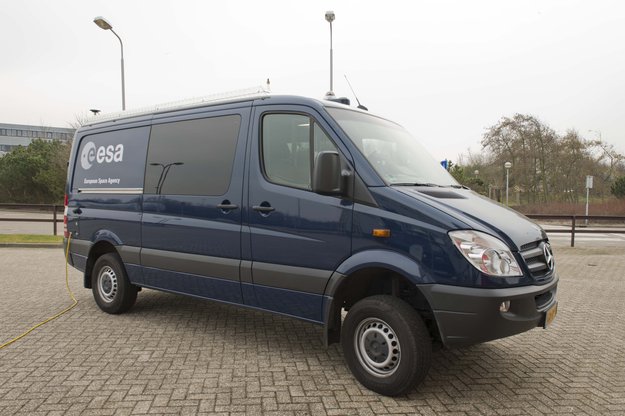
    ESA's new Telecommunications and Navigation Testbed Vehicle, a mobile test platform to support test campaigns for navigation and telecommunications services, most notably Europe's Galileo constellation.
    ESA’s new Telecommunications and Navigation Testbed Vehicle, a mobile test platform to support test campaigns for navigation and telecommunications services, most notably Europe’s Galileo constellation.

    “But the PPTI project is still ongoing in order to test more advanced functionalities this coming autumn and to run the first aeronautical PRS tests in collaboration with the Dutch authorities. Other Member States have also expressed their willingness to join the IOV PRS experimentation campaigns soon,“ concluded Miguel Manteiga.

    The project is the first step to ensure the use of the PRS service as soon as it is operational. It will be complemented by the PRS Pilot Projects, focused on PRS applications, which are currently under definition in a common effort between the EU Member States, the European Commission, ESA and the European Global Navigation Satellite System Agency.

    In addition to the qualification of the PRS service, these initiatives will allow the timely availability of competitive PRS receivers in Europe and the setting up of organizations in the Member States required to handle PRS, ESA said.

  • European Secured Navigation Arrives with Galileo PRS-only Positioning

    image001QinetiQ and Septentrio jointly announced today that a milestone in the Galileo European Navigation Satellite System’s development and deployment program has been achieved. On March 12, staff at the European Space Agency at ESTEC, Noordwijk, The Netherlands, achieved the first navigation solution using only the encrypted Galileo Public Regulated Service (PRS) signals broadcast by the four Galileo In-Orbit Validation (IOV) satellites launched in 2011 and 2012. Septentrio and QinetiQ, working in close partnership, developed one of the two PRS test user receivers used in this historic first test.

    PRS positioning was achieved using the Galileo PRS Test User Receiver (TUR-P) jointly developed by Septentrio and QinetiQ under an ESA contract. For the reception test, the receiver was installed in the PRS test facility in ESTEC and operated by technical experts from ESA. Positioning accuracy of ~10 meters was achieved, excellent for a first test so early in the system’s deployment. The TUR-P now continues to be used as part of the campaigns running during the Galileo In Orbit Validation Phase.

    This milestone builds on a number of previous major Septentrio/QinetiQ achievements including:

    • First laboratory demonstration of the PRS signal acquisition and tracking in QinetiQ (Malvern, UK, 2006).
    • Successful RF compatibility test between a Galileo payload and the TUR-P (Portsmouth, UK, 2010).
    • Successful Galileo end-to-end system test including the Galileo Ground Mission Segment (GMS) and its key management facilities, satellite and TUR- P (Rome, Italy, 2011).
    • First successful reception and processing of the PRS signal from space (Fucino, Italy, 2012).

    As key, long-term contributors to the Galileo program, Septentrio and QinetiQ have worked closely with ESA, the European GNSS Agency (GSA) and European industrial partners since 2003.

    “Following last year’s first successful reception and processing of PRS signals from Galileo satellites, I am very pleased to see the program moving forward successfully,” said Leo Quinn, CEO of QinetiQ. “Achieving a first PRS-only Galileo navigation solution is a major achievement. With positioning, navigation and timing services increasingly critical to the safety, security and economic activity of UK and our European neighbours QinetiQ are very proud to be contributing to the development of Europe’s first secured satellite navigation services.

    “This milestone is another important step towards the launch of operational Galileo services and will continue to build confidence in both prospective users and the industrial supply base. It showcases QinetiQ’s capabilities in this field and signals the way towards the production of exciting new solutions for critical navigation and timing applications.”

    “Today, together with our partners, we take another decisive step in the early availability of commercial PRS receivers and Septentrio is extremely proud of this historic milestone for the Galileo program,” commented Peter Grognard, Septentrio’s founder and CEO. “This builds on a list of major achievements for Septentrio since the reception of the first Galileo signal from space in 2006. We are delighted to continue the excellent collaboration with ESA and to contribute to this ambitious European project.”

  • Septentrio, QinetiQ Partnership Delivers Galileo PRS Signal Reception

    Another major milestone in the Galileo system’s development and deployment program has been achieved. Septentrio and QinetiQ, working in close partnership with the European Space Agency (ESA) and their industrial partners, achieved the world’s first successful reception of the encrypted Galileo Public Regulated Service (PRS) signal from the first Galileo satellites, launched in November 2011.

    The signal was received on the Galileo PRS Test User Receiver (PRS-TUR) jointly developed by Septentrio and QinetiQ under an ESA contract. For the reception test, the receiver was installed in the Galileo Control Centre in Fucino, Italy and operated by technical experts from ESA. This milestone builds on a number of previous major Septentrio/QinetiQ achievements including:

    • First ever laboratory demonstration of the PRS signal acquisition and tracking in QinetiQ (Malvern, UK, 2006).
    • Successful RF compatibility test between a Galileo payload and the PRS-TUR (Portsmouth, UK, 2010).
    • Successful Galileo end-to-end system test including the Galileo Ground Mission Segment (GMS) and its key management facilities, satellite and PRS-TUR (Rome, Italy, 2011).

    Septentrio and QinetiQ are long-term contributors to the Galileo Programme, working closely with ESA, the European GNSS Agency (GSA), and European industrial partners since 2003.

    “Septentrio is extremely proud of this historic milestone for the Galileo programme," said Peter Grognard, founder and CEO of Septentrio Satellite Navigation. "This is the most important milestone for Septentrio since the reception of the world’s first Galileo signal from space on January 12, 2006, with a Septentrio receiver. We are honoured and grateful for the excellent collaboration with ESA. Septentrio is marking another industry-first on the Galileo programme, and will continue playing a key role in this exciting and ambitious European project. Today, together with our partners, we take a decisive step in the early availability of commercial PRS receivers to foster user acceptance and market success of this Galileo service.”

    "This achievement, together with Europe’s recent commitment to a full Galileo constellation, has been a necessary step in giving European industry confidence to start investing in developing commercial PRS receiver products ready for the launch of Galileo navigation services in a few years time,” Leo Quinn, CEO of QinetiQ, said.

  • Septentrio, QinetiQ Partnership Delivers Galileo PRS Signal Reception

    Another major milestone in the Galileo system’s development and deployment program has been achieved. Septentrio and QinetiQ, working in close partnership with the European Space Agency (ESA) and their industrial partners, achieved the world’s first successful reception of the encrypted Galileo Public Regulated Service (PRS) signal from the first Galileo satellites, launched in November 2011.

    The signal was received on the Galileo PRS Test User Receiver (PRS-TUR) jointly developed by Septentrio and QinetiQ under an ESA contract. For the reception test, the receiver was installed in the Galileo Control Centre in Fucino, Italy and operated by technical experts from ESA. This milestone builds on a number of previous major Septentrio/QinetiQ achievements including:

    • First ever laboratory demonstration of the PRS signal acquisition and tracking in QinetiQ (Malvern, UK, 2006).
    • Successful RF compatibility test between a Galileo payload and the PRS-TUR (Portsmouth, UK, 2010).
    • Successful Galileo end-to-end system test including the Galileo Ground Mission Segment (GMS) and its key management facilities, satellite and PRS-TUR (Rome, Italy, 2011).

    Septentrio and QinetiQ are long-term contributors to the Galileo Programme, working closely with ESA, the European GNSS Agency (GSA), and European industrial partners since 2003.

    “Septentrio is extremely proud of this historic milestone for the Galileo programme,” said Peter Grognard, founder and CEO of Septentrio Satellite Navigation. “This is the most important milestone for Septentrio since the reception of the world’s first Galileo signal from space on January 12, 2006, with a Septentrio receiver. We are honoured and grateful for the excellent collaboration with ESA. Septentrio is marking another industry-first on the Galileo programme, and will continue playing a key role in this exciting and ambitious European project. Today, together with our partners, we take a decisive step in the early availability of commercial PRS receivers to foster user acceptance and market success of this Galileo service.”

    “This achievement, together with Europe’s recent commitment to a full Galileo constellation, has been a necessary step in giving European industry confidence to start investing in developing commercial PRS receiver products ready for the launch of Galileo navigation services in a few years time,” Leo Quinn, CEO of QinetiQ, said.