Tag: GEDI

  • ESA and NASA launch open-source biomass platform

    ESA and NASA launch open-source biomass platform

    The European Space Agency (ESA) and National Aeronautics and Space Administration (NASA) have publicly released a globally harmonized assessment of aboveground biomass — information vital for managing global climate change.

    The Multi-mission Algorithm and Analysis Platform (MAAP) provides seamless access to aboveground biomass information from both NASA and ESA Earth observation data. The open-science tool is now fully operational and accessible online.

    The beta of the dashboard is now available.
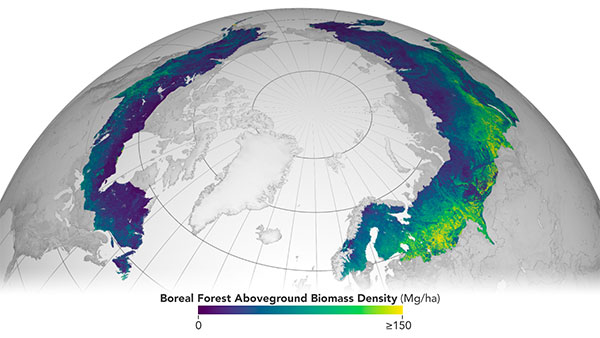
    Circumboreal forest biomass density mapped at high spatial resolution (30 m) with NASA’s ICESat-2, the joint NASA/USGS Landsat-8, and ESA Copernicus Digital Elevation Model (DEM) data. This provisional product is representative of 2020 conditions and is an open-source science product created on the NASA-ESA MAAP platform that will be validated in the coming months. (Image: NASA/ESA)
    Circumboreal forest biomass density mapped at high spatial resolution (30 m) with NASA’s ICESat-2, the joint NASA/USGS Landsat-8 and ESA Copernicus Digital Elevation Model (DEM) data. This provisional product is representative of 2020 conditions and is an open-source science product created on the NASA-ESA MAAP platform that will be validated in the coming months. (Image: NASA/ESA)

    MAAP is the culmination of a two-year NASA and ESA effort and reflects the cooperation between the two agencies under the NASA and ESA Joint Program and Planning Group (JPPG) Joint Working Group (WG) on Ground Segment and Operations.

    The MAAP platform enables international scientists and researchers to collaboratively develop algorithms and code as well as analyze and visualize large datasets acquired from sources including satellite instruments, the International Space Station, and airborne and ground campaigns. The large data and high-performance computing required for MAAP, along with a shared code repository and catalog, are stored and managed in the cloud. MAAP capabilities are supported and shared between NASA and ESA.

    “Biomass is the first ESA mission with open-source algorithms,” said Clement Albinet, ESA’s Biomass data quality manager. “Thanks to that, the community will be able to access all the source code, the test data and all the documentation, and will be able to contribute in a collaborative way to the improvement of the biomass products. MAAP will allow scientists to easily work with large datasets at a global scale and to finally focus on science.”

    The initial application of MAAP focuses on aboveground biomass to help determine the size and carbon content of Earth’s forests. These data are vital for informing our understanding and forecasting of climate change, including regular updates to the Intergovernmental Panel on Climate Change (IPCC).

    While biomass is the first application of MAAP, it can be adapted for collaborative exploration across the breadth of science data and scientific disciplines available through NASA, ESA and similar research agencies.

    MAAP includes data from missions such as NASA’s Global Ecosystem Dynamics Investigation (GEDI) and the joint NASA/ESA AfriSAR campaign, and will eventually support data from upcoming NASA and ESA missions such as the joint NASA/Indian Space Research Organization SAR (NISAR) and ESA’s Biomass mission.

    Several projects are producing continental to global biomass maps for 2020, including ESA’s Climate Change Initiative Biomass and JPSs global map, both at 100 m, as well as NASA’s GEDI 1-km map. GEDI, the Global Ecosystem Dynamics Investigation, is a spaceborne laser instrument that measures the structure of Earth’s forests in high resolution and three dimensions.

    The world’s Earth observation biomass community is undertaking an exercise on MAAP aimed at resolving discrepancies between those products and producing harmonized estimates of biomass and uncertainty at a policy-relevant, jurisdictional-level scale.

  • Ecometrica Platform to help share NASA Earth data

    This image shows the Global Ecosystem Dynamics Investigation Lidar (GEDI) being assembled NASA’s Goddard Space Flight Center. (Photo: NASA)
    This image shows the Global Ecosystem Dynamics Investigation Lidar (GEDI) being assembled NASA’s Goddard Space Flight Center. (Photo: NASA)

    Under a contract with the University of Maryland, Ecometrica, a sustainability and space data company, will be helping disseminate data from NASA’s latest “Global Ecosystem Dynamics Investigation” (GEDI) lidar instrument.

    According to Ecometrica, the Ecometrica Platform will make processed maps more widely available to end users and reduce the need for additional processing of highly technical remote sensing lidar data.

    GEDI is led by the University of Maryland, in collaboration with NASA Goddard Spaceflight Center, and deploys a multibeam lidar instrument onboard the International Space Station to measure the forest vertical structure and biomass. Carried from Earth to the International Space Station atop a reusable SpaceX Falcon 9 rocket, it is already providing valuable raw data, which will be crucial in better understanding climate change and the Earth’s ecosystems, Ecometrica said.

    “The value of downstream satellite data in managing climate and environmental risks is significant and it is important that this is available and easily accessible to users all over the world,” said Richard Tipper, executive chairman at Ecometrica. “Projects such as Forests 2020, the global forest monitoring initiative that is part of the U.K. Space Agency’s international program, and managed by Ecometrica, are already proving very successful in using data from space to protect ecosystems on Earth. Importantly, this has also helped create an international skills-base and infrastructure across tropical forest countries, which can now benefit from the results of the very latest Earth observation instruments from NASA.”

    The lidar instrument is operated by the university, which is working with Ecometrica to make data available globally in a format that is easy to use for environmental monitoring and protection purposes. According to Ecometrica, its platform will display key findings on rapidly updating maps, allowing conservation organizations and government agencies around the world to tap into the findings and use the real-time data to monitor forest canopies and cover.

    The partnership is set to continue as part of the latest three-year contract.