
It happened over 20 years ago and I remember it like it was yesterday.
Three young U.S. Air Force officers stood respectfully in the office of Lt Gen Thomas Moorman, then Vice Commander of Air Force Space Command. All three were summoned to the same meeting, but I expect none of us knew exactly why. It would soon become apparent that we were there for “The Talk.”
For those of you unfamiliar with “The Talk,” it is not unlike the awkward conversation most young men have with their fathers around the age of puberty. However, this talk would determine if the powers that be thought we had a future in the USAF.
I naively assumed that all military officers at some point experience “The Talk” with their superiors, but I have discovered this is not the case. For many, “The Talk” launches them confidently into the latter part of their service careers, and for others it is the dreaded signal that immediately pursuing other endeavors is in order, i.e., look for a new day job.
The three of us that day actually had little to fear. We all served, or in my case were serving, as Executive Officer for General Thomas Moorman. Serving as an Executive Officer for a senior General Officer can be daunting, but for each of us it was also a rewarding experience; indeed, none of us could have asked for a more perfect mentor and role model. Plus, we knew that General Tom Moorman cared about each one of us. He did not choose his Executive Officers lightly…many volunteered, few were chosen. Plus, I will give you a hint: long though the hours may be, it is easy to work for a man that you admire, and to this day we all admire General Tom Moorman.
The meeting that day was short and to the point. We were all cheerfully informed that we had a future in the USAF and from that simple statement we also knew that assignments would be forthcoming. I say cheerfully because, when all is said and done, General Tom Moorman is a very cheerful man. He always has a ready smile, is kindhearted and loves a good joke. He also has a prodigious memory and is a workaholic, but that often comes with the territory. He is tough when he needs to be, but his countenance inspires confidence. So we all felt honored, fortunate and even blessed to be mentored, counseled and led by this wonderful man. I know we all left his office that day with a smile on our face, although my trip was only about five feet outside his front door. We all briefly discussed what our future assignments might hold and then went our separate ways, little aware of what the future would actually hold.
Of the four officers in the AFSPC Vice Commander’s office that day, all experienced or are experiencing successful military careers: two eventually pinned on four stars, one found himself literally and successfully fighting for his life in intensive care at the United States Air Force Academy hospital only a year later, and yours truly proudly served his country for 30 years and now finds himself writing about “The Talk” and having a conversation with General William “Willie” Shelton, who now sits in that same office where “The Talk” occurred 20 years ago.
Indeed, General Willie Shelton and I have been good friends for almost 25 years, and so it feels natural for us to sit down and have a brief conversation about the past and what the future holds for him and his family, for Air Force Space Command and, of course, the Global Positioning System.
WS = General (USAF) – William Shelton, Commander, Air Force Space Command
DJ = Don Jewell (USAF, Ret) Defense Editor, GPS World magazine
DJ: First of all, General Shelton, thank you for your time today. To say that you are a busy man is a gross understatement and we do sincerely appreciate you taking the time to have this conversation.
First of all, on a personal note as an Air Force Academy graduate, with numerous assignments in the Colorado Springs area, do you find this to be a nostalgic time in your life?
WS: Don, it is great to be back in Colorado Springs. You know Linda and I really love it here. If any place is home anymore then this is it, and when retirement comes around, this is the place where we will retire. So we are delighted to be back in town and delighted to be back at Air Force Space Command.
DJ: You and I have spoken many times about how much we, and our families, love this area. However, I’m not sure that back when we were carpooling together to Falcon, now Schriever Air Force Base, either one of us would have predicted we would be having this conversation 20 years later and you would be presiding over the 30th anniversary of Air Force Space Command. Can you tell us about some of the 30th anniversary plans?
WS: Don, there are numerous activities planned around our 30th anniversary. We have new Space Pioneers that we will induct. We’ve planned a big Commanders Conference, of course. We are bringing in our Commanders Group, which is a group of civilians from across the Command that provides advice to our Commanders. We are also having a 30th Anniversary Gala sponsored by the Space Foundation at the Broadmoor. And while we are looking forward to all these activities, there is another major event that is special to me and I know will be to you and many of us in this community, and that is the naming of our new education building after General Thomas Moorman.
DJ: I know General Moorman must be pleased about that. He always pushed education as a way to get ahead in the USAF and in life. I’ve heard he’s been a bit under the weather; will he and Barbara be able to attend the dedication ceremony?
WS: Absolutely, he and Barbara and several family members will attend, along with several of his old cronies. It will hopefully be a nice celebration.
DJ: Indeed, it will probably be old home week for many of them — many of whom you and I met when we worked for General Moorman back in the day. There will be a lot of people looking forward to that dedication ceremony.
And speaking of General Moorman helps me segue into our next topic, which is stewardship. General Moorman has always been a big proponent of the importance of the stewardship of space. In this case I would like to bring us around to the stewardship of one system in particular, and that of course is the Global Positioning System or GPS.
Recently a retired General officer, who you know well and has served as a mentor and still serves as an advisor, made a telling comment concerning the stewardship of GPS, “Thank God GPS is run by the United States Air Force and not the French Air Controllers, who go on strike every August.”
WS: I had not heard that one but it does make a point. I guess what I want to say about stewardship is that for 20+ of the 30 years that AFSPC has been in existence, the USAF has been the proud steward of GPS. We built and sustained the constellation, we have operated the constellation, we have been the engine driving many of the innovations in receiver technology — indeed there have been a whole variety of technologies and innovations concerning GPS that the USAF has been behind.
Now this takes nothing away from a critical industry that continues to develop applications that I personally never dreamed of. But in terms of the basic provisioning of the GPS capability and all that GPS enables today, we — the United States Air Force and Air Force Space Command — are very proud of our accomplishments and our stewardship
DJ: Certainly no one can deny the Air Force has been an excellent steward of GPS, but what can you tell us about the future of GPS? What do you personally see as the way ahead? You have commissioned several studies to look into what the future holds. What can you share with us?
WS: First of all, Don, we want to stay the course with GPS III and then maybe look at some different constructs for future satellites…adding some capabilities and looking at a whole mix of future opportunities. But as you said, those are all studies that are under way. In this budget environment we definitely don’t have a course set in concrete, but for GPS III we are definitely on a good path for now. I think we want to stay on that path. It is really a very good and well-run program. It is on schedule and pretty much on cost. We have a little bit of cost growth in the program but it is not anything outside the management reserve fenced for the program. So we are in very good shape on GPS III. Lockheed Martin is doing a very good job putting the factory together, in Denver, to crank out those satellites. All signs are good.
DJ: That’s great to hear. Coincidentally, I have a column coming out shortly on the status of the GPS III program. Now, what can you share with us about OCX, the ground control segment?
WS: Don, the ground segment is coming along. OCX has had some issues but we really believe we have turned the corner on OCX.
Indeed, my hat’s off to Raytheon for really taking this on. The management within Raytheon has taken this program very seriously. They’ve brought in the right people and basically turned the OCX program around, and we are confident that we are going to be in a good place once we get OCX delivered. It is not going to be as soon as we had hoped. It is not going to be coincident with the arrival of GPS III, but it will be ready shortly thereafter, and we will have some capability of controlling the GPS III satellites until we can get them OCX support.
DJ: That, of course, brings us to the inevitable “gap” question, which I know you have been asked a hundred times; it sounds like you now have a plan for that eventuality.
WS: We do. We have some special software that we are going to have to work to get that accomplished, but we have a good plan to make that happen. We will be in good shape on GPS III. We will not have all the capabilities that OCX will bring us, of course, but we will at least be able to make use of the satellites while we are waiting on OCX to deliver.
DJ: There are those who openly speculated about whether OCX even had a future, so it is certainly good to hear that there is a plan, you have confidence in that plan, and in the future of OCX.
You and I had a conversation recently where you stated emphatically that you were not interested in placing GPS III satellites on orbit just as a means of storage, but that they had to be operational.
WS: That’s exactly right. We certainly need to get the first GPS III satellite up as soon as possible to make sure that we don’t have any design issues. And you’re right, I am not in favor of storing on orbit, because of life-limiting components.
DJ: Then you must be comfortable with the fact that in the future we will most assuredly be launching GPS-IIFs and GPS-IIIs simultaneously?
WS: Yes, we know how to handle that.
DJ: OK, then as long as we are discussing GPS III, why don’t we move into the arena of trying to pin down a vehicle or set of vehicles for dual launch? You and I once discussed GPS III vehicles 7-8 for that honor, and you mentioned at the time that it was a moving target. Where do we stand today?
WS: Don, I think we are now probably talking about GPS III vehicles 9-10. We are still in the study phase on this issue with Lockheed Martin and United Launch Alliance. We are still trying to figure out how we would do dual launch and what kind of capabilities we need to develop. I think this is really the wave of the future…being able to put two up simultaneously will save us a lot in launch costs.
Plus, we will look at new launch entrants. If a new entrant can come in and provide a cost-effective launch capability for several launches, then we will look seriously at them as well.
DJ: I can barely remember the last GPS launch failure — it was more than 15 years ago — but that is the last thing any space program needs, a launch failure. In that regard are you comfortable with the, as you say, new entrants into the launch market?
WS: Not yet. We will go through a very rigorous certification process to get new entrants certified, but once they are certified we will look to contract with them just like we do with ULA today. New entrants will certainly introduce new options for us.
DJ: Some would argue that the USAF really has very little choice but to look at alternative launch systems. I was briefed recently that the projected on orbit costs of an initial GPS III satellite, with NRE (non-recurring expenses) but without added launch costs, is in the neighborhood of $265M. When you add the launch costs of approximately $220M, you get to $480M or just shy of half a billion dollars in a hurry. Is this sustainable?
WS: That is exactly why we are looking at alternatives to include dual launch. We know we need to bring the launch costs down as much as we can. We are doing that in a variety of ways, both in terms of how we are acquiring boosters, and what we are paying ULA for — just an overall launch capability from an infrastructure point of view. We are, as I said, considering new entrants. So there are a variety of things we are doing, trying to get a handle on launch costs.
DJ: So, what I take away from that is that studies are under way both for dual launch and launch acquisition and stay tuned for more. But in the area of affordability in this budget environment, surely there is more to consider than just launch costs?
WS: Of course, we are looking at GPS III for example — when I first arrived here the plan called for GPS III A, B and C variants. I thought that was probably not going to be affordable in the future. So we scrapped the A, B and C mentality and went with a basic GPS III. Now as we can afford it, we will roll in additional capabilities that we might want or need for the future. I think that helps control the costs. We are also looking at what we can do in the manufacturing area to help control costs. So we are going at this from a variety of ways. We are leaving no stone left unturned in terms of trying to drive out costs.
DJ: Controlling costs is certainly admirable, but you and I have been in the space business for a long time and I cannot ever remember launch costs going down, can you? Do you really think you can make that happen?
WS: I suppose it depends on what you mean by going down. I don’t know that we will ever get cheaper than we are right now, but the cost projections left unchecked were a 40% increase in costs. So we are really talking about controlling the growth as much as we are about reducing costs.
Now, if you can introduce some of these new entrants and they deliver on their promise — for example let’s say you can do a medium class EELV [Ed. Evolved Expendable Launch Vehicle] for $90M, which has been suggested by one particular company…what a bargain. Now we will see if that price really holds when we put in our mission assurance requirements and as we look at those rocket companies when they actually go into production as opposed to a one-off type of rocket.
DJ: When you talk to Dr. Bradford Parkinson about launch and the history of GPS, he will quickly remind you that back in the day, GPS could not stand on its own as a space requirement. Back in 1978, GPS had to have additional payloads to justify the mission just to get the GPS satellites into orbit. That is certainly not the case today, so are you seriously looking at a GPS-only configuration?
WS: God bless Brad Parkinson. He certainly fought through a very different environment than we have today. And yes, we are certainly looking at a very de-scoped capability for NDS [Ed. Nuclear Detection System], and we are considering some options that might have some GPS platforms being a navigation payload only. So, we will see what comes out of the studies. We are concerned about the size, weight and power of the NDS payload, and we think we have a handle on that for GPS III number 9 and out. But the first eight GPS III satellites will still have a fairly heavy NDS payload.
DJ: Well, these things do take time to fix. And speaking of the number of satellites, things have changed quite a bit from when you were the 2SOPS Commander (2nd Space Operations Squadron) back in 1990. GPS had only been FOC (Full Operation Capability) for about five years and you were struggling just to keep 24 active payloads on orbit. Today there are 32 active payloads and three residuals. Do you think we are going to be able to maintain those numbers?
WS: This is actually more of a debate about actual coverage of the GPS constellation. I don’t think it is going to be as much about numbers as it will be about coverage and dealing with things like terrain, terrain masking, and urban canyons. How much coverage do we in the United States want to provide? Do we want to instead count on other satellite systems to fill in gaps that we might have — such as systems like Galileo? So it is going to be an interesting future. We really have some serious debates on what kind of coverage we want to provide from GPS and what kind of coverage we might count on from others. We also have to consider how we might alter our architecture designs based on the need for coverage.
DJ: Now it sounds like we are getting close to discussing the mastodon that has been unsuccessfully trying to hide in the corner, and that is budget issues. Cost savings and cost reductions are terms thrown around by your budgeters today. I assume you are looking at all these issues to include the dreaded sequestration costs.
WS: It is all the same to me; whether it is cost avoidance or cost savings, it is all part of the space budget. But as to sequestration, that’s another matter.
Space and cyber are foundational capabilities for this nation. That said, we’ll take our reductions, and certainly we’re proactively looking for places we can reduce, but we believe foundational space and cyber capabilities will have to remain to support every other military operation.
I challenge audiences to find a military operation that doesn’t in some way depend on space and cyber. That foundational capability must be protected, despite what might happen with sequestration or any other budget reduction.
DJ: In a couple of weeks you will be attending the annual AFA (Air Force Association) national meeting in the D.C. area. Is there a space message, such as you just mentioned… all military operations depend on space and cyber in some way, that you will be trying to get across this year?
WS: Don, the message I am trying to develop is the need for a partnership across the community. From Capitol Hill to OSD [Ed. Office of the Secretary of Defense] to the operational commands, to Air Force Space Command including SMC [Ed. Space and Missile Systems Center] — we all need to have a very strong partnership and pull on the rope in the same direction so that we are not at cross purposes. As we look at some of the acquisition challenges and as we look at some of the congressional marks, it is not always apparent that we are all singing from the same hymnal. That is one thing I would like to see us work very hard — getting everybody on the same sheet of music.
DJ: While that is certainly a laudable goal, with all the budget issues and everybody wanting to have a hand in the space AOR (area of responsibility), do you really think it is realistic or even doable?
WS: I am not so naïve as to believe that there will ever be a time when there will not be challenges to our plans. We would like to get to the place where the long experience we have with GPS — along with the architectural designs we have developed that have helped give us that experience — that all this carries some weight.
DJ: I agree, but a great deal of that weight and responsibility winds up on your shoulders. I don’t think that you or I ever thought there would be three billion plus GPS users in the world. Isn’t this global utility we call GPS an incredible burden on the USAF and yourself? No other service in the world today has the responsibilities that are attendant on the USAF as stewards of the Global Positioning System.
WS: Don, I think we happily bear that burden. To tell you the truth, our job is to provide the best signal that we can provide from space. That is what we do every day, and we are happy to do that. We know it supports billions of users, and we know that we are underpinning economic institutions around the world. We know we have fundamentally changed war fighting as a result of that signal. So it is a source of pride for us – it is not a burden.
DJ: Well said! Any final thoughts? There are so many issues we haven’t had time to discuss.
WS: The one point I want to be sure and make is one of credibility. There are certainly some naysayers out there, but I firmly believe that we have proven our credibility over the past 20-plus years that we have been flying the GPS constellation. I think we have done a good job… I am talking about the U.S. Air Force writ large now… a good job of funding the GPS constellation and being responsible stewards of the capability and insuring that that the world has this capability where it is needed. GPS has enabled applications that are simply mindboggling, and the credibility piece doesn’t get stated as often as it could.
The other issue is that there are certainly threats to GPS that we need to pay attention to. The jamming threats are obvious. Not so obvious are the spectrum threats such as we have been through in the last year. We need to continue to be vigilant and protect that part of the spectrum that is essential for GPS to work as well as it does.
It is truly a physics problem. It is not just GPS encroachment on somebody else’s spectrum. The way receivers are designed to work, they have to be able to acquire the GPS signal and the harmonics of that signal in an adjacent spectrum. If you bring in rather noisy signals or you allow noisy signals to operate in the GPS neighborhood, you are going to kill the accuracy of GPS. So, I think as we continue to provide good stewardship for GPS, we need to be good stewards of the spectrum as well.
DJ: Actually, I was hoping this would come up. I want to publicly thank you for being one of the few general officers, from any service, who stood up and were counted when it came to this huge threat to billions of GPS users worldwide.
But, in the end, were you surprised that it took over a year to fight the spectrum battle?
WS: Not necessarily. I knew we were into a very structured process with the FCC [Ed. Federal Communications Commission] and they have their way of doing business. I was confident that once we could get the facts on the table, the right decisions would be made. It was just a problem of making sure that the facts were heard. In the end it came out like it should have come out, it just took longer than I think most people were comfortable with.
DJ: Without a doubt the world and GPS users everywhere owe you a great debt of gratitude for your fearless leadership during a very trying time. Thank you for your leadership, and thank you for taking the time to speak with us today.
WS: It was my pleasure, Don.
Until next time, happy navigating. All of us at GPS World hope to see you at the ION Technical Meeting in Nashville, Tennessee, September 17-21 , 2012. Drop by the booth and get acquainted.

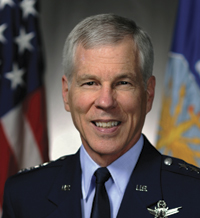 Shelton Space Commander
 Des Dorides for European GNSS Supervisory Agency