Tag: GeoDecisions

  • GeoDecisions expands geospatial data services with acquisition of WorldView Solutions

    GeoDecisions, Gannett Fleming’s geospatial technology division, has acquired WorldView Solutions, a geographic information systems (GIS) consulting firm based in Richmond, Virginia.

    The acquisition, which became effective Oct. 26, expands the geospatial data services that GeoDecisions provides to commercial clients as well as federal, state and local governments.

    “Consolidation of the geospatial marketplace is necessary for firms to remain competitive and provide the most robust and seamless solutions to clients,” said Brendan Wesdock, MCP, GISP, president of GeoDecisions. “We’ve collaborated with WorldView on many projects, and our corporate cultures, client-centered approach, and long-term business goals are in lockstep. The acquisition makes great sense because, by combining forces, we are better equipped to invest in creating products that push the boundaries of geospatial technology and bring greater value to our clients while advancing an aggressive growth plan to expand our geographic footprint.”

    WorldView has offered geospatial technology solutions for nearly 20 years, providing resource and asset management, machine learning, artificial intelligence and consulting capabilities to the private and public sectors and nongovernmental organizations. The firm’s 45 employees have been retained and there are not any immediate changes in project management or technical staff for existing WorldView projects.

    “Through this acquisition, WorldView’s employees have access to the enhanced capabilities and expanded resources that GeoDecisions and its parent company, Gannett Fleming, bring to the table as a 2,300-person company,” said Jamie Christensen, former president and CEO of WorldView. “Together, we are strengthened in our ability to work with our clients to define their needs and identify the most effective geospatial solutions to solve their complex challenges.”

    GeoDecisions will continue to offer ready-to-install products created by WorldView, including PracticeKeeper, a comprehensive web-based solution that enables soil and water conservation districts, departments of environmental protection, and private entities to track all data related to conservation planning, nutrient management, watershed management, erosion and sediment control, and compliance and complaint management.

    OrbWeaver, a cloud-based geospatial data-mining tool that provides location-based insights to clients across industries, will also remain available. The software uses specified geospatial parameters and datasets along with machine learning algorithms to discover, integrate, and map other relevant target data sources such as environmental conditions, demographic characteristics, transportation infrastructure, and existing businesses.

    For instance, a real estate agent may use the tool to discover, mine, and rank relevant data sets for a full-scope analysis of properties they are considering for purchase.

    According to the companies, WorldView has successfully undertaken many assignments for municipalities, districts and counties, as well as state and federal projects. Recent projects in their portfolio include: the development of the Virginia Department of Environmental Quality’s Land Application Tracking Module to better track the permits and biosolids land application activity throughout the Commonwealth; the implementation of Spotsylvania Utilities Department’s new asset management system, Cityworks; the implementation and maintenance of the Virginia Department of Transportation’s SMART Portal, a web-based solution that collects funding applications and supports statewide prioritization for transportation project selection; the implementation of PracticeKeeper to help Durham County Soil & Water Conservation District develop and manage conservation plans, document best management practices and improve reporting; and processing more than 20 terabytes of raster data for the University of Vermont to categorize the Chesapeake Bay watershed into 12 land-cover types to support the Chesapeake Conservancy’s watershed and storm water management and conservation efforts.

  • U.S. Army recognizes GeoDecisions for modernizing convoy mapping module

    Automated Movement and Identification Solutions (AMIS), a division of the U.S. Department of the Army, has bestowed a Certificate of Appreciation to GeoDecisions, Gannett Fleming’s geospatial technology division.

    The certificate recognizes GeoDecisions for its outstanding technical expertise and dedication in the modernization of the Transportation Coordinators’ – Automated Information for Movements System II (TC-AIMS II) Convoy Planning Highway Regulation (CPHR-M) module.

    TC-AIMS II CPHR-M is an advanced software solution used to plan the Army’s convoy movement around the globe. GeoDecisions integrated the Transportation Geospatial Information System (TGIS) map and routing tool through the TGIS application programming interface to embed the map within the TC-AIMS system.

    The TGIS integration with TC-AIMS provides enhanced, real-time mapping functions, faster processing speeds, and a more user-friendly experience.

    The recognition also honors the GeoDecisions team for its technical knowledge, attention to detail, and ability to recognize, understand and address issues quickly to allow CPHR-M to stay on schedule.

    The team’s efforts resulted in more than a dozen changes to the baseline to provide better performance and additional capabilities that were not identified at the start of the project.

    “It’s almost unheard of to receive an award like this from a government program, so we feel especially humbled by this honor,” said Brendan Wesdock, MCP, GISP, president of GeoDecisions. “We’ve built an exceptional team of geospatial professionals who continuously push the boundaries of geospatial technology to deliver the most effective and valuable solutions to our clients.”

    AMIS is the primary source of providing automated movement and identification solutions across the DOD and around the globe. AMIS is the essential supplier for Transportation Coordinators’ – Automated Information for Movements System II (TC-AIMS II) with approximately 5,000 active users.

    The GeoDecisions team (from left): Jay Ross, senior software test specialist; Jeff Carter, TGIS lead system administrator with sub-consultant Aegis Strategies, LLC; Steve Kraabel, senior client manager; Debra Houser, director of Application Development; Bret Huber, lead and software developer; (not pictured) Andrew Miller, developer. (Photo: GeoDecisions)
    The GeoDecisions team (from left): Jay Ross, senior software test specialist; Jeff Carter, TGIS lead system administrator with sub-consultant Aegis Strategies, LLC; Steve Kraabel, senior client manager; Debra Houser, director of Application Development; Bret Huber, lead and software developer; (not pictured) Andrew Miller, developer. (Photo: GeoDecisions)


  • GeoDecisions Helps PennDOT Handle Millions of Traffic Records

    GeoDecisions-TMS
    The PennDOT TDS developed by GeoDecisions enables collection and processing of millions of data points.

    GeoDecisions, an information technology company specializing in geospatial solutions, has developed a new traffic data system (TDS) that processes more than 20 million new records per month for the Pennsylvania Department of Transportation (PennDOT).

    Built on the Esri platform, the TDS helps PennDOT’s Bureau of Planning and Research better manage the download of traffic data from collection sites throughout the commonwealth of Pennsylvania.

    “Built to Federal Highway Administration standards, GeoDecisions’ redesign of our TDS provides us a method to seamlessly introduce new counting devices, more efficiently verify our raw traffic data, and speed up our process for creating yearly traffic volume maps,” said Andrea Bahoric, planning division manager with PennDOT.

    The new TDS improves PennDOT supervision of 45,000 short-term or portable counters that classify vehicles, record traffic volume and weight, and determine driving speed. The system’s mobile Field Operations Module (FOM) also streamlines in-pavement counter inventory and maintenance activities.

    “FOM enables PennDOT field technicians to use smartphones or tablets to perform site reviews and document issues,” said Greg Ulp, senior project manager with GeoDecisions. “Convenience and efficiency are critical factors when enhancing technology and managing assets.”

    PennDOT’s predecessor traffic data management system contained nine applications with dated technology requiring manual intervention to collect and verify information. GeoDecisions’ TDS redesign features five modules streamlined for better performance and usability. The new automated system includes remote user access and cutting-edge GIS mapping, web service, database and coding technologies.

    “Our transportation system solutions provide a proven business model for analytics, reporting, reliability, and technology workflow management,” said Tom Saltzer, vice president of government delivery with GeoDecisions. “PennDOT’s redesigned TDS is a long-term collection, verification, and geospatial solution that reflects their ongoing enterprise GIS investment strategy.”

  • Cold Assets: GeoDecisions Platform Used to Track Icebergs

    Cold Assets: GeoDecisions Platform Used to Track Icebergs

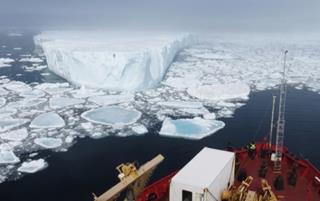
    This photo shows drifting icebergs from the Amundsen during research expedition. (Photo: courtesy of Greg McCullough, University of Manitoba)
    This photo shows drifting icebergs from the Amundsen during research expedition. (Photo: courtesy of Greg McCullough, University of Manitoba)

    A Canadian expedition team used GeoDecisionsGeoILS platform to help track icebergs during a voyage to better understand how icebergs drift. An intelligent location server using the Esri ArcGIS platform, GeoILS enables users to monitor and locate assets and facilitate quick and coordinated responses.

    GeoDecisions, an information technology company specializing in geospatial solutions, partnered with Solara Remote Data Delivery Incorporated, Canada’s Carleton University and Esri during the project.

    Led by University of Manitoba Scientist David Barber, the crew of Canadian Coast Guard Icebreaker Amundsen sailed off the coast of Newfoundland and Labrador to research ice hazard mitigation, the effects of climate change, and polar region technology requirements. GeoILS location intelligence helped crew members visualize, analyze, and leverage project-pertinent data.

    “During the expedition, researchers and scientists used GeoILS to assess drifting through sensor monitors attached to the icebergs,” said Brian Smith, vice president of commercial solutions with GeoDecisions. “In addition to reporting and notifications, GeoILS provided the project team with maps that were tailored by selecting desired iceberg information and the geographic area of interest based on user-defined criteria.”

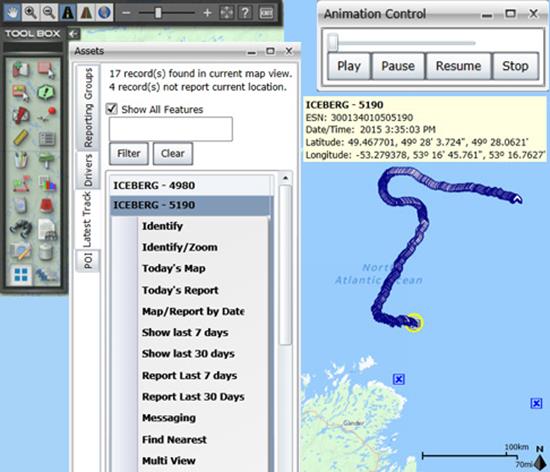
    Above is a representative snapshot of GeoILS’ features and range of functionality used during the Canadian iceberg expedition.
    Above is a representative snapshot of GeoILS’ features
    and range of functionality used during the
    Canadian iceberg expedition.

    GeoDecisions’ data portal was used with Iridium Solara tracking devices during the iceberg research project. “We are excited to provide tools to scientists who are gaining critical insights into the behavior of icebergs and global climate change,” said Tom Tessier, president of Solara Remote Data Delivery Incorporated.

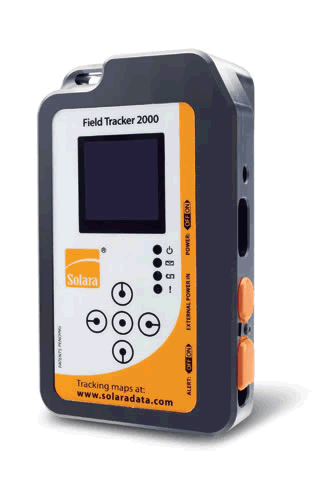
    Solara Field Tracker 2000.
    Solara Field Tracker 2000.

    “GeoILS and the satellite tracking beacons worked very well during this project,” added Derek Mueller, assistant professor and physical geography program supervisor with Carleton University. “Thanks to our partners’ efforts, we now have a great new suite of tools for examining our data.”