Tag: Goose

  • Galileo OSNMA position opens, TeleOrbit authenticates with Goose

    Galileo OSNMA position opens, TeleOrbit authenticates with Goose

    On Nov. 15,  the European Union Agency for the Space Programme (EUSPA) opened the Galileo Open Service Navigation Message Authentication (OSNMA) Public Observation test phase for the secured signal.

    The OSNMA is a freely accessible data-authentication function for the Galileo Open Service worldwide. OSNMA provides receivers a first-level of protection against spoofing the Galileo Open Service, assuming that the receiver meets requirements. This is realized by transmitting authentication-specific data in previously reserved fields of the E1 I/NAV message.

    Galileo OSNMA improves confidence on the user side by enabling the user to verify the authenticity of the Galileo navigation parameters required for positioning, navigation and timing. In particular, it will allow the user to authenticate geolocation information of the Open Service:

    • the ephemerides and clock corrections
    • the ionospheric corrections
    • the status flags
    • the Broadcast Group Delay
    • the GST to UTC parameters

    TeleOrbit quickly authenticates with Goose

    In late 2020 and the first half of 2021, TeleOrbit GmbH and Fraunhofer IIS worked on a project to implement the Galileo OSNMA capabilities onto its powerful and compact GNSS receiver lab “Goose”. This project, completed in May, successfully authenticated simulated OSNMA signals.

    For the new phase, the team at Fraunhofer IIS adapted the setup to the newly published Interface Control Documents (ICDs) and receiver guidelines, and was able to authenticate the live signal on Nov. 16.

    The screenshots below show snapshots of the Goose user interface with enabled OSNMA and successfully authenticated satellites, indicated by the green circle surrounding the blue Galileo satellites in the skyplot.
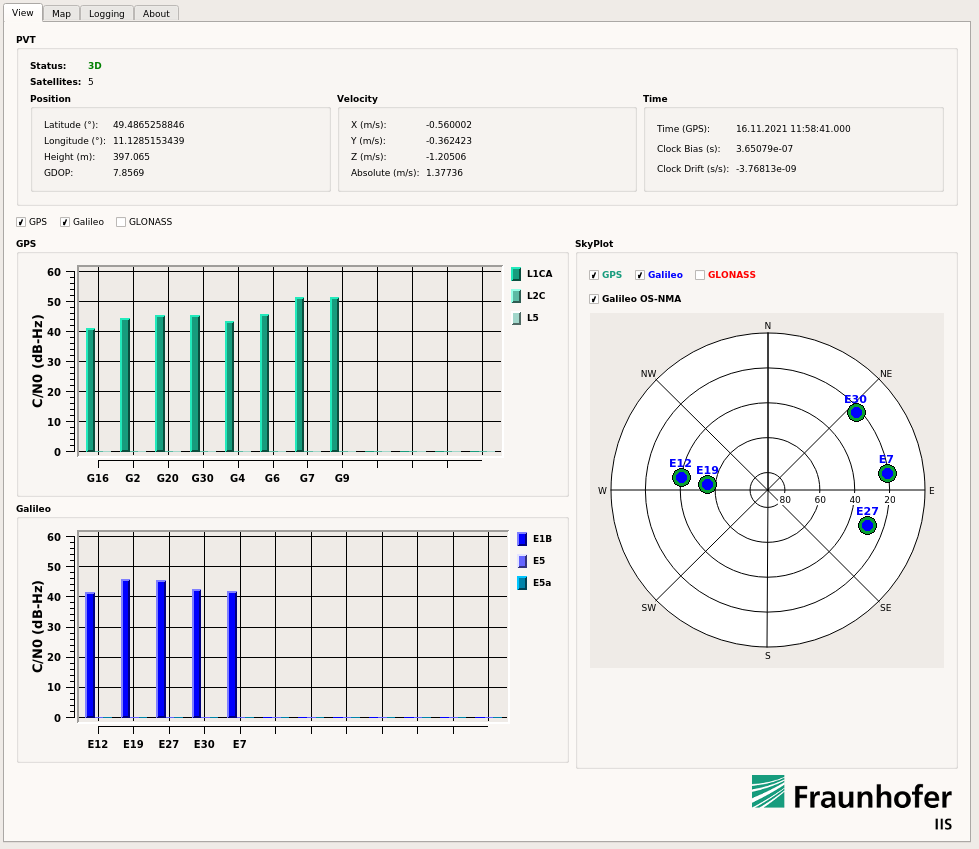
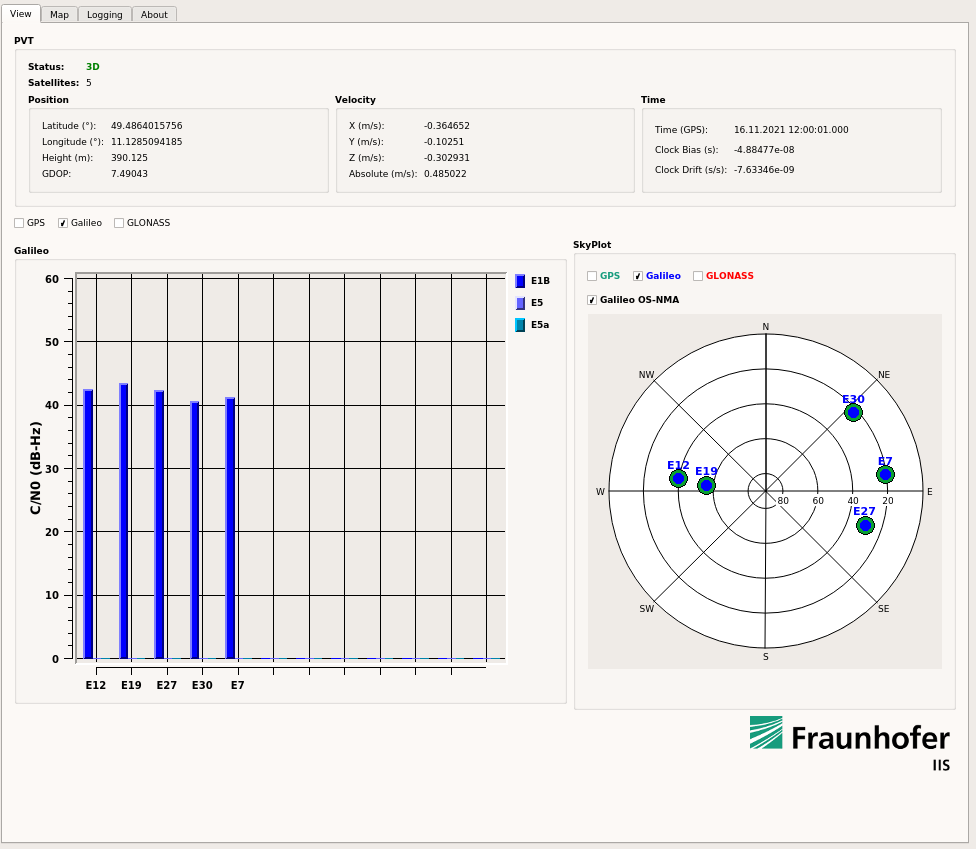
    GPS + Galileo authenticated Galileo PVT. (Image: Fraunhofer IIS)
    GPS + Galileo authenticated Galileo PVT. (Image: Fraunhofer IIS)


    Galileo-only authenticated PVT. (Image: Fraunhofer IIS)
    Galileo-only authenticated PVT. (Image: Fraunhofer IIS)

    Access Now Available

    Interested users can sign up for this OSNMA test phase on GSC website. The site provides access to all corresponding documents and information, including the current ICD, receiver guidelines, OSNMA public key and Merkle Tree Root — both needed for the authentication process.

    To learn about using GOOSE for your own tests and projects, contact [email protected].
  • Fraunhofer and PRoPART successfully test autonomous merging

    Fraunhofer and PRoPART successfully test autonomous merging

    On a test track in Sweden, a truck successfully merged between two cars driving alongside it in a fully automated maneuver. The live demonstration took place at the AstaZero test site near Borås, Sweden, on Nov. 21, 2019, showing automotive industry experts how well the automated merging solution performed.

    The Fraunhofer Institute for Integrated Circuits IIS and project partners RISE, Scania, Waysure, Ceit-IK4, Baselabs and Commsignia are taking part in an EU-funded project PRoPART, which stands for Precise and Robust Positioning for Automated Road Transports.

    Vehicles on the road already perform certain steps on behalf of the driver, such as parking. Together with its project partners, the Fraunhofer IIS has developed a precise and robust position determination system for use in autonomous trucks as part of PRoPART.

    Autonomous driving is about interactions among vehicle systems, connecting vehicles and equipping them with precise and robust navigation solutions. The challenge is to ensure that different automated driving systems deliver precise and reliable positioning information.

    Using GOOSE technology

    With its GOOSE GNSS receivers, Fraunhofer IIS provides highly accurate and reliable positioning to the PRoPART project. The GOOSE can bridge signal interruptions for short periods of time, potentially obviating the need for the driver to intervene at all.

    In conjunction with GNSS, developers are using a combination of sensors such as radar and cameras in the vehicle. Supplemented by reference stations along the route, the combination of GNSS and sensor data enables highly available position solutions up to the decimeter range.

    “This is a key step on the road to autonomous driving,” explained group manager for precise GNSS receivers Matthias Overbeck, Fraunhofer IIS. “It’s about ensuring the merging maneuver is precise and avoiding accidents — something we can achieve only with highly accurate and reliable positioning technology.”

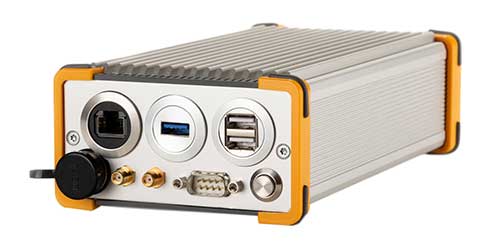
    GOOSE platform. (Photo: Fraunhofer IIS)
    GOOSE platform. (Photo: Fraunhofer IIS)

    Spoofing protection

    These days, a variety of electronic systems for providing satellite navigation signals are available and are often used to generate fake positions for gaming apps on smartphones. Such systems could disrupt satellite receivers while remaining undetected.

    GOOSE makes use of the Galileo Open Service Navigation Message Authentication (OS-NMA), which is not officially available until 2020. OS-NMA transmits encrypted keys on the Galileo satellite signals that make it extremely difficult to fake a position, thus ensuring that reliable positioning information can be provided to vehicles in the future.

  • Research Online: Receiver with open software interface

    For research purposes, the GNSS Receivers with Open Software Interface (GOOSE) hardware platform provides a development chain from experimental PCIe slot card to a professional embedded GNSS receiver.

    The platform can be seen as a hardware-assisted software receiver where computational complex methods are implemented on digital FPGA hardware whereas algorithms can be developed and implemented on receiver side on a user-friendly GNU/Linux system. A transparent access to the hardware is made available via the Open GNSS Receiver Protocol that gives deep access to the hardware control and enables deepcoupling of inertial sensors and optimized precise positioning solutions.

    It is therefore targeted at researchers, software developers and algorithm experts to build up new methods and applications. At the end of the project, 20 GOOSE platforms will be available for selected researchers for free.

    The main benefits for potential product developers are an improved development process for GNSS receiver firmware, the possibility to embed application-specific software on the receiver, an access to all potentially relevant data for an improved position solution based on open white-box approach and the enabling of deeply coupling inertial sensors.

    By Matthias Overbeck, Fabio Garzia, Alexander Popugaev, Oliver Kurz, Frank Forster, and Wolfgang Felber, Fraunhofer Institute for Integrated Circuits, and Ayse Sicramaz Ayaz, Sunjun Ko, and Bernd Eissfeller, Universitat der Bundeswehr, Germany. Presented at ION GNSS+ 2015.

  • FieldLogix releases ‘Goose’ fleet management app

    News ImageFieldLogix, a fleet management service company, has released its newest mobile application for iPhones, Goose.

    Goose allows dispatchers to optimize drivers’ routes and remain in direct communication. “It ensures that drivers have optimized routes, job details and navigation all on their iPhone,” the company said in a news release. “Goose simultaneously notifies the company’s clients of the driver’s ETA to ensure they are ready for the driver’s impending arrival via text messaging. Goose even accounts for Google’s real-time traffic speeds in its ETA calculations.”

    “Goose provides an Uber-like experience for the clients of delivery and service companies.” said Yukon Palmer, FieldLogix’s founder and CEO. “Rather than waiting around for a four-hour time window, a company’s clients now have more accurate ETA’s for driver arrival times. Plus, drivers will be much more efficient with their time on the road, allowing them to get home to their families in a timely manner. Dispatchers also benefit by properly planning their drivers’ workdays and staying on top of their statuses. Goose is a significant step into the future of GPS fleet management.”

    Goose provides ETA notifications via text message.