Tag: GPS accuracy

  • Our insatiable appetite for GPS

    Our insatiable appetite for GPS

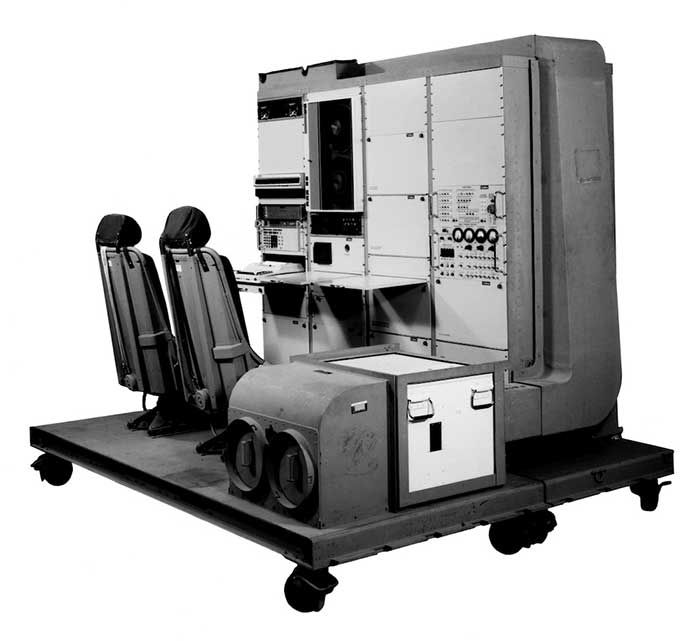
    1976: The first military GPS five-channel receiver built in one of several programs that studied the feasibility of GPS. The receiver weighed more than 270 pounds and had seats for two operators. (Photo: Rockwell Collins/Smithsonian)
    1976: The first military GPS five-channel receiver built in one of several programs that studied the feasibility of GPS. The receiver weighed more than 270 pounds and had seats for two operators. (Photo: Rockwell Collins/Smithsonian)

    Like the internet before it, GPS started as a niche technology and became a universally recognized one, though much misunderstood and often taken for granted. Both systems originated in the U.S. Department of Defense (DOD) to support military missions, and then exploded into mass-market civilian technologies. While the internet passed from military to civilian hands very early in its history, GPS is still operated by the U.S. Air Force, making it a unique experience for the DOD: a system for which it is responsible that has orders of magnitude more civilian applications and users than military ones.

    GPS has transformed entire professions — most notably, surveying; created new industries — such as ride sharing; boosted innumerable fields of scientific research — from archaeology to zoology; facilitated many aspects of everyday life — such as finding retail outlets and getting there; and given an advantage to U.S. military forces. One application discussed 30 years ago that has not yet lived up to its promised return on investment is precision agriculture.

    Challenges and debates that loomed large in the early days turned out to be growing pains —most notably, Selective Availability (SA). In 1990, Javad Ashjaee reflected the attitude of much of the GPS industry and user community when he said, “I can’t think of a word to say how bad it is.” Other debates have proven more persistent — such as the interference threat posed by LightSquared, reborn after bankruptcy as Ligado Networks.

    GPS first drew considerable publicity in the wake of Desert Storm, when it became the subject of television features, newspaper reports, and special sections in the pages of recreational catalogs. “Ironically,” Brad Parkinson pointed out in September 1994 in GPS World, “civil companies [such as Garmin] developed most receivers used in Desert Storm, with no help from military sponsorship.” Later that decade, while most people were finally aware of GPS technology, it began disappearing deep into its applications and the systems that use it.

    In September 1991 — three and a half years before U.S. Air Force Space Command declared the system’s full operational capability (FOC) on April 27, 1995 — in a speech to the International Civil Aviation Organization in Montreal former FAA Administrator James B. Busey said: “I want to emphasize that we fully support the eventual replacement of [GPS] by other systems — and we are certain that will happen.” That may still happen, in the distant future. However, what Busey did not foresee is that GPS became but an element, though a key one, in a much larger positioning, navigation and timing (PNT) system. This worldwide system includes three other GNSS and two regional ones, several publicly and privately operated augmentation services, and a wide range of complementary and alternative technologies. These include inertial navigation (which has advanced much in the past three decades) and RF signals of opportunity. It may soon include navigation signals from non-GNSS satellites, eLoran, enhanced distance measuring equipment, and Earth-fixed navigation using very low frequency.

    I began my current career in geospatial technologies exactly 20 years ago, as this magazine’s managing editor, just a few months after the end of SA increased GPS’ accuracy by an order of magnitude, and equally expanded the number of its potential applications. Yet today, I still marvel at how pervasive this technology has become and how much further it will transform our lives.

    I will end with a quote from an early GPS World columnist, Hale Montgomery, who wrote in October 1991, “GPS users show an insatiable appetite for ever more precise data. Give them a mile and they want an inch.”


    Seeking back issues: I have the entire collection of GPS World’s print edition, except for the first issue, the 10 issues in the second year (1991), and the September through December 1993 issues. I would be thrilled to receive those missing issues, or facsimiles, from anybody who has them. Email [email protected].

  • Raytheon launches WAAS payload to improve GPS accuracy for air travel

    Raytheon launches WAAS payload to improve GPS accuracy for air travel

    Raytheon Company has launched its GEO 6 satellite payload into orbit for its 12-year mission. It is the latest payload to support the Federal Aviation Administration’s (FAA) Wide Area Augmentation System (WAAS), which enhances the reliability and accuracy of GPS signals for directing air travel.

    The Raytheon-developed payload is a key element of WAAS, which offers commercial, business and general aviation pilots more direct flight paths, greater runway capability and precision approaches to airports and remote landing sites without dependence on local ground-based landing systems.

    “This latest payload launch is the next step in our journey with the FAA to bolster navigation safety and efficiency for commercial and general aviation,” said Bob Delorge, vice president of transportation and support services for Raytheon Intelligence, Information and Services.

    In June 2016, Raytheon launched WAAS GEO 5, which was recently accepted by the FAA for integration into the operational WAAS system. Both WAAS GEO 5 and GEO 6 were launched to replace aging satellites and enhance GPS precision for the FAA. WAAS increases GPS accuracy from 10 meters to approximately two meters and supports nearly all of the national airspace.

    The WAAS GEO 6 payload is hosted on a geostationary satellite, SES-15, owned and operated by SES. The satellite was successfully launched May 17 from Arianespace’s Guiana Space Center in French Guiana aboard a Soyuz launch vehicle.

  • Follow up: What’s Going to Happen When GPS Accuracy is Cheap?

    I received some interesting e-mails and saw some web comments regarding my newsletter column a couple of weeks ago titled “What’s Going to Happen When High-Accuracy GPS is Cheap?” The comments ranged from “I don’t believe it’s going to happen” to “We’d better adapt to the changes in technology.”

    One comment in particular had me thinking about the title of the original article. Looking back, perhaps I should have used the word “precision” instead of “accuracy” in the title of the article. Accuracy is a tricky subject and a subjective term. What’s accurate to one person may not be to another. Also, you may be precisely correct, but not very accurate at all.

    The point of the commentor was that high-precision GPS equipment in the hands of the general public will create many problems. There’s no doubt that will happen. Is there going to be a new type of service that surveyors can market to in order to clean up the problems that are created? Probably, and quite possibly only a small percentage of today’s surveyors will be qualified to do this type of work. One’s ability to understand and work with spatial data will be critical in helping organizations solve geospatial data problems. Thus, the importance of data management knowledge and skills I’ve mentioned before.

    Geodesy is going to play a big role in the future, regardless if you don’t believe in GPS precision becoming as cheap as I believe. One can’t argue that precision and accuracy are improving, and with that will come geodetic problems with legacy data that need to be solved. Just imagine an electric utility company with its entire distribution system in a GIS (or CAD) that’s been ammended many times over a 30-year period. Imagine the disparate data sources and wildly varying data accuracy in such a system.

    Let’s look at two of the other comments I received. Please note I’ve paraphrased, and sometimes combined, comments for the sake of brevity:


    “They thought EDMs, total stations and online GIS were going to change surveying too, but they really didn’t.”

    EDM’s and total stations are complicated and complex instruments (not to say that GPS receivers aren’t). About 10 years ago when my eldest son was nine, I taught him how to map using RTK. Granted, he was a classic “button-pusher,” having no idea what the technology was doing, but he knew which buttons to push to map a soccer field. I taught him to do this in less than 15 minutes. There’s no way I could have taught him to map a soccer field using an EDM or a total station in that amount of time, even if I had a full day. The first difference between GPS and other mapping instruments: it’s very easy to learn and use.

    This subject reminds me of a photo sent to me from Indonesia many years ago. A guy I knew was training a massive number of Indonesian (200+) foresters on how to use handheld GPS/GIS data collectors. They had little or no previous experience with GPS. He had an auditorium set up with a large projection screen. In one of his Powerpoint slides, he had a photo of a chimpanzee sitting next to a GPS receiver. His point was, of course, that anyone can be taught to map using a GPS receiver. At that time, equipment and software wasn’t as easy to use as it is today. For starters, one had to post-process GPS data to improve accuracy, but even then the point he was making was clear. The ending exercise for the class was to locate three $100 bills stashed separately somewhere in Jakarta using only GPS coordinates provided. I thought that was an ingenius way of keeping the class attentive.

    Anyway, back to the topic.

    There are several reasons one can’t view future high-precision GPS L1/L5 receivers the same as EDMs, total stations, or any other automated measurement tool. GPS is simply different and will have a much greater impact on the way surveyors and their clients work.

    1. GPS receivers are orders of magnitude easier to use and more productive than any other surveying measurement tool in history.
    2. GPS is a mainstream consumer electronic technology that is spurring a lot of innovation.
    3. With L5, GPS technology will be very precise (horizontal and vertical) and very inexpensive.

    For these reasons, I think you can view GPS L1/L5 receivers as game-changing and industry-altering technology. The combination of ease-of-use and low-cost will put high-precision GPS in the hands of everyone from the garbage collector to the policeman mapping accident scenes. That wasn’t the case with EDMs, total stations, or any other measurement technology.


    “Consumer-grade GPS receivers and survey-grade GPS receivers are not the same quality and never will be.”

    This isn’t the case according to several GNSS receiver designers I’ve spoken to. There’s no reason a “consumer-grade” L1/L5 GPS receiver can’t achieve cm-level precision (horizontally and vertically) with a good quality antenna. Of course, it will need a source of correction, but in the 5-10 year window, RTK corrections will be more available and less expensive than they are today. The RTK corrections will likely be free so the only expense will be the wireless data plan.

    There will be dozens, maybe hundreds of GPS chipsets designed for L1/L5. Many will be open systems where companies will be able to load their own firmware into the receiver to add specific features (e.g., more robust ambiguity resolution for surveying). The baseline L1/L5 GPS receiver may be only a few hundred dollars, but a customized version for specific applications will have a premium of a few hundred, or maybe $1,000+. For example, a GPS L1/L5 receiver that also includes Galileo signal and is customized for machine control with specific features might be $1,500. Commercial users will pay that premium. They already justify paying tens of thousands of dollars for the same performance today. The difference is that a low price point will attract a much larger audience.

    There’s no doubt that there will be boutique, niche GPS L1/L5 receivers that will be able to garner a premium price, but surely the days of many thousands of dollars for high-precision GPS receiver are heading to an end.


    This is not the end of land surveying. I didn’t claim it before and I don’t claim it now. That idea is ludicrous. But, you have to ask yourself how much time you spend on projects that will be affected by this technology.

    If 75% of your work is boundary surveys, perhaps you won’t be concerned as much as the company that generates 75% of its revenue from construction work or topographic surveys.

    If 75% of your work is mortgage surveys, you’ve got more to worry about than high-precision GPS.  :-)

    My point is that change is inevitable and that people who have the attitude that this is just another Chicken Little call (the sky is falling!) will be in for a rude awakening when the rubber hits the road. We can have a friendly debate about when this will happen, but there’s absolutely no doubt that it will.


    Free Webinar on June 24

    On June 24, Geospatial Solutions will be conducting a free 60-minute webinar, moderated by me, on “GIS Mapping for Forestry, Agriculture, and Other Natural Resource Professionals.” I will discuss GIS mapping software tools/concepts/techniques as well as GIS mapping hardware such as GPS receivers, digital cameras, and laser rangefinders. Although focused on natural resources, it will be relevant for all pe
    ople interested in GIS mapping, which could be utility companies, municipalities, transportation organizations, etc. Sign up now by clicking here and submit questions in advance.


    Thanks, and see you next week.

    Follow me on Twitter at https://twitter.com/GPSGIS_Eric