Tag: GPS budget

  • Galileo declares: Open for business!

    Galileo declares: Open for business!

    At a Dec. 15 ceremony in Brussels titled “Galileo Goes Live,” two high officials of the European Commission issued the Galileo Initial Services Declaration.

    The declaration means that the Galileo satellites and ground infrastructure are now operationally ready. These signals will be highly accurate but not available all the time, since the constellation is not yet complete and users cannot always count on four satellites being visible at one time at all points on the Earth.

    Galileo Goes Live! ceremony in Brussels: European Commission Vice-President Maroš Šefčovič, responsible for the Energy Union, and Commissioner Elżbieta Bieńkowska, responsible for Internal Market, Industry, Entrepreneurship and SMEs, count down to hit the “Go” button.
    Galileo Goes Live! ceremony in Brussels: European Commission Vice-President Maroš Šefčovič, responsible for the Energy Union, and Commissioner Elżbieta Bieńkowska, responsible for Internal Market, Industry, Entrepreneurship and SMEs, count down to hit the “Go” button. Photo: Galileo

    Simultaneously, the European GNSS Agency (GSA) awarded the Galileo Service Operator (GSOp) contract, with a value of up to 1.5 billion euros, to Spaceopal, a joint venture between Telespazio and the German Space Agency (DLR).

    The Galileo constellation currently consists of 18 satellites in orbit. However, two of these are in an orbit not totally useful for positioning and navigation. Four more, launched in November, may or may not have completed their on-orbit testing (a series of notice advisory to Galileo users or NAGUs has appeared relating to the flag status of each satellite; see details at the end of this story) but have not yet been integrated to the operational constellation. This is expected to take place in spring 2017.

    During the initial phase, the first Galileo signals will be used in combination with other satellite navigation systems, like GPS. In coming years, new satellites will be launched to enlarge the constellation, gradually improving Galileo availability worldwide. The constellation is expected to be complete by 2020 when Galileo will reach full operational capacity (FOC) of 30 satellites: 24 satellites plus six orbital spares, intended to prevent any interruption in service.

    Paul Verhoef, the European Space Agency’s (ESA’s) director of the Galileo Programme and Navigation-related Activities, stated, “Today’s announcement marks the transition from a test system to one that is operational. Still, much work remains to be done. The entire constellation needs to be deployed, the ground infrastructure needs to be completed, and the overall system needs to be tested and verified.

    “In addition, together with the commission we have started work on the second generation, and this is likely to be a long but rewarding adventure.”

    Galileo Initial Services are managed by the GSA. The overall Galileo programme is run by the European Commission, which has handed over responsibility for the deployment of the system and technical support to operational tasks to the ESA.

    Operator Contract. The GSOp contract runs for 10 years and covers operation and maintenance of the Galileo satellite system and its committed performance level: in particular, the operations and control of the system, the logistics and maintenance of the systems, and infrastructure as well as the user support services.

    “With its emphasis on service performance, this contract will shape the future of Galileo. We look forward to building a strong partnership with Spaceopal as Galileo moves towards full operational capability under the responsibility of the GSA from January 2017,” said GSA Executive Director Carlo des Dorides.

    Under GSA management, the contract awarded to Spaceopal specifically includes:

    • Secure operations of Galileo from two mission control centres (GCC), located in Germany and Italy, and the European GNSS Service Centre (GSC) for user support services in Spain;
    • Management of the Galileo Data Distribution Network (GDDN);
    • Integrated logistics support and maintenance for the entire space and ground infrastructure;
    • Monitoring of the system performance;
    • Support for the completion of the Galileo infrastructure and associated launches.

    Spaceopal has served as the contractor for Galileo operations since 2010 under the Galileo Full Operational Capability (FOC) Operations Framework Contract.

    Products and Services. The first Galileo smartphone by Spanish company BQ is now available on the market, and other manufacturers are expected to follow suit. Application developers can now test their ideas on the basis of a real signal.

    With the declaration, Galileo will start to deliver, in conjunction with GPS, the following three types of services free of charge. Their availability will improve as more satellites are launched.

    The Open Service is a free mass-market service for users with enabled chipsets in, for instance, smartphones and car navigation systems. Fully interoperable with GPS, combined coverage will deliver more accurate and reliable positioning for users.

    Public Regulated Service is an encrypted, robust service for government-authorized users such as civil protection, fire brigades and the police.

    Search and Rescue Service is Europe’s contribution to the long-running Cospas–Sarsat international emergency beacon location. The time between someone locating a distress beacon when lost at sea or in the wilderness will be reduced from up to three hours to just 10 minutes, with its location determined to within 5 kilometers, rather than the previous 10 kilometers.

    Advisory Updates. USABINIT NAGUs were issued for 11 satellites: 0101, 0102, 0103, 0203, 0204, 0205, 0206, 0208, 0209, 0210 and 0211.

    USABINIT, or Initially Usable, notifies users that a satellite is set healthy for the first time. 0104 had a power problem and is operating on E1 only. 0201 and 0202 were launched into lower orbits.

    0207 and 0212–0214 are still undergoing commissioning and drifting to their designated orbital slots.


    Ground control upgrade for GPS III approved

    The U.S. Air Force approved Lockheed Martin’s design to upgrade the current GPS satellite ground control system with new capabilities that will enable it to operate more powerful and accurate GPS III satellites.

    The successful Critical Design Review (CDR) for the Contingency Operations (COps) contract, completed on Nov. 17, gives Lockheed Martin a green light to proceed with software development and systems engineering to modify the existing GPS ground control system, called the Architecture Evolution Plan (AEP) Operational Control Segment.

    The AEP is currently maintained by Lockheed Martin and controls the 31 GPS IIR, IIR-M and IIF satellites in orbit today.

    The COps modifications will allow the AEP to support the more powerful, next-generation GPS Block III satellites, enabling them to perform their positioning, navigation and timing mission, once they are launched. COps is envisioned as a temporary gap filler prior to the entire GPS constellation’s transition to operations onto the next generation Operational Control System (OCX) Block 1, currently in development.

    On Oct. 15, under a separate contract, Lockheed Martin completed the Commercial Off-the-Shelf (COTS) Upgrade #2 (CUP2) project — part of a multi-year plan to refresh the AEP’s technology and enhance the system’s ability to protect data and infrastructure from internal and external cyber threats, as well as improve its overall sustainability and operability. CUP2 is now fully operational and managing the current GPS constellation.

    Lockheed Martin also is under contract to develop and build the Air Force’s first 10 GPS III satellites, which will deliver three times better accuracy, provide up to eight times improved anti-jamming capabilities, and extend spacecraft life to 15 years, 25 percent longer than the newest GPS satellites on-orbit today.

    GPS III’s new L1C civil signal will make it the first GPS satellite to be interoperable with other international global navigation satellite systems.


    GPS funded at $847 million for FY 2017

    On Dec. 23, 2016, President Obama signed the National Defense Authorization Act (NDAA) for Fiscal Year 2017. The act includes policy and funding guidance for the GPS program of $847.362 million. This total excludes $13.171 million requested for the GPS IIF program, which requires FY 2017 funding for on-orbit support and contract closeout.

    Procurement of GPS III satellites is budgeted at $34 million, development of GPS III satellites is at almost $142 million and the next-generation ground control system (OCX) is budgeted at $393 million, which comes with certification and congressional briefing requirements. The amount includes funding for the GPS Enterprise Integrator.

    The GPS Enterprise Integrator project includes efforts necessary to accomplish the critical integrating function with the entire GPS user community. The Enterprise Integrator maintains the GPS architecture and system definition, controls and validates interfaces, ensures compatibility of Generation II and III systems, and develops and manages plans for execution and fielding of the GPS enterprise.

    The final defense budget item is $278 million for development of new military GPS user equipment.

    Besides the NDAA, other areas that include funding for GPS and related programs are Transportation (including WAAS), to support designated civil elements of the Air Force GPS program, along with civil GPS augmentations and related activities.

    The Department of Transportation this year requested civil funding for GPS through the Office of the Secretary instead of through the FAA. Also, the request does not include funds for the Nationwide Differential GPS (NDGPS) program in FY 2017.
  • FY 2017 budget request includes $857 million for GPS

    The President’s Budget for Fiscal Year 2017 includes $847.362 million in Department of Defense funds and $10 million in Department of Transportation funds to sustain and modernize the Global Positioning System (GPS).

    Funds will go toward the GPS III program, including the new ground system (OCX), military user equipment, and wide-area augmentation through the Federal Aviation Administration (FAA).

    FY 2017 Program Element
    FY 2016
    Enacted
    FY 2017
    Request
    Space Procurement, Air Force: GPS III Satellites $199.218M $34.059M
    RDT&E, Air Force: GPS III Satellites $180.902M $141.888M
    RDT&E, Air Force: Next Generation Operational Control System (OCX) $350.232M $393.268M
    RDT&E, Air Force: Military GPS User Equipment $142.288M $278.147M
    DOT Research & Technology: Civil Signal Monitoring – Air Force – GPS $15M $10M

    By national policy, DOT provides resources to DOD for assessment, development, acquisition, implementation, operation, and sustainment of additional designated GPS civil capabilities beyond the second and third civil signals. In addition, the DOT budget includes the following GPS augmentations and activities.

    FY 2017 Program
    FY 2016
    Enacted
    FY 2017
    Request
    FAA Facilities & Equipment: Wide Area Augmentation System (WAAS) and GPS Civil Requirements Oversight $80.6M $85M
    FAA Facilities & Equipment: Wide Area Augmentation System (WAAS) GEO Satellite Leases $26.6M $26.6M
    DOT Research & Technology: Positioning, Navigation, and Timing (PNT) $1.61M $1.61M

    More details on the budget are available at GPS.gov.

  • System of Systems: Galileo turns 12 — or 9

    System of Systems: Galileo turns 12 — or 9

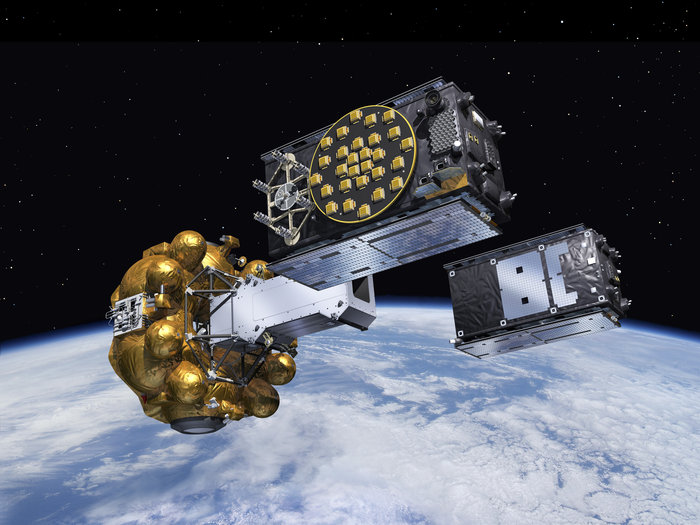
    Galileo Twins Alba and Oriana separate in mid-Earth orbit from the Fregat mother ship (artist’s concept, courtesy of ESA).
    Galileo Fregat upper stage flew the latest two Galileo satellites most of the way up to medium-Earth orbit before they finally separated. (Artist’s concept, courtesy of ESA).

    Galileo satellites 11 and 12 lifted off together on Dec. 17 atop a Soyuz rocket, and successfully deployed in space four hours later. The pair effectively doubles the number of Galileo satellites in space over the last nine months.

    Five satellites are now set operational to the user. Once 9 and 10 (launched in September 2015) as well as 11 and 12 are set operational, a total of nine usable satellites will be in orbit. Satellites 5 and 6 may be partially usable at some point.

    “Along with the ground stations put in place around the globe, this brings Galileo’s completion within reach,” said Jan Woerner, director general of the European Space Agency.

    “Production, testing and launch of the remaining satellites are now proceeding on a steady basis according to plan,” added Didier Faivre, ESA’s director of Galileo and navigation-related activities.

    Starting with launches in the third quarter of 2016, four rather than two satellites at a time will rise into orbit. This accelerated deployment should bring 30 satellites on line — 24 operational and six orbit spares — by 2020 for full operational capability of the European GNSS. Initial operating capability is foreseen by the end of 2016.

    “The target is initial service next year, with a reduced constellation, for the Open Service, Public Regulated Service and Search-and-Rescue,” said Carlo des Dorides, executive director of the European GNSS Agency (GSA). “We will also start proof-of-concept testing for the Commercial Service. The performance will be reduced in terms of availability and continuity because of the reduced number of satellites — but not in terms of accuracy.”

    Fundamental Elements. For the benefit of users and industry on the ground, the GSA announced in September the provision of 100 million euros ($110 million) to promote development of chipsets and receivers. Slated for distribution between 2015 and 2020, the funds are to stimulate market reception for Galileo. The announcement followed a paper published by the Galileo Services industry consortium urged accelerated investment by European governments to safeguard competitiveness of European manufacturers with U.S. and Chinese industry in the satnav user equipment market.

    Sensitivity on PRS. Sorting out access to the encrypted Public Regulated Service (PRS), even among the 28 EU member nations, involves some thorny issues. EU officials have grappled with so-called Common Minimum Standards that set rules on PRS access for national government agencies and PRS hardware manufacturers, with the goal of ensuring that the encrypted signal is not compromised. The diversity of EU nations’ security precautions is wide enough that the European Commission (EC) has reserved the right to conduct inspections of agencies and companies working with PRS to verify compliance. Each nation using PRS will create a specialized agency responsible for its use.

    Due to the sensitive subject matter, the EU will not publish supporting documents for the Common Minimum Standards in the EU’s Official Journal. The standards were nonetheless approved in November.

    Nations outside the EU face a more difficult path to PRS. Norway and the United States have applied. Both are members of the North Atlantic Treat Organization (NATO), and military use by all agreeing parties is a tacit aspect of the PRS. The next step to granting U.S. and Norwegian access is for the EU’s highest decision-making body, the European Council, to give the European Commission authority to open negotiations with U.S. and Norwegian authorities.

    New ICD. In late November, the European Commission published a new release 1.2 of the Galileo Open Service Signal In Space Interface Control Document (OS SIS ICD v1.2).


    GPS Fully Funded, Minus $2 Million

    In late November, President Obama signed the National Defense Authorization Act (NDAA) for Fiscal Year 2016, after vetoing a previous version. The enacted NDAA complies with the two-year budget agreement, which called for a reduction in defense spending.

    The act reduces the GPS IIF line item by $2 million, citing “unjustified support growth” from the U.S. House of Representatives Committee on Appropriations, but otherwise recommends full funding for the Air Force GPS program ($936.775 million).

    Privacy Uptaken. In other Capitol developments, Sen. Al Franken (D-MN) reintroduced the Location Privacy Protection Act. According to the senator’s office, “The Location Privacy Protection Act of 2015 closes legal loopholes that allow stalking applications to exist on smartphones.

    “Sen. Franken’s bill fixes this problem by requiring companies to get customers’ permission before collecting their location data or sharing it with third parties.”

  • Signed budget includes full GPS funding, except for $2M IIF reduction

    On Nov. 25, 2015, President Obama signed the National Defense Authorization Act (NDAA) for Fiscal Year 2016, after vetoing a previous version. The enacted NDAA complies with the two-year budget agreement, which called for a reduction in defense spending.

    The act reduces the GPS IIF line item by $2 million, citing “unjustified support growth” from the U.S. House of Representatives Committee on Appropriations, but otherwise recommends full funding for the Air Force GPS program ($936.775 million).

    The NDAA also includes three GPS-related policy provisions: Reporting Requirement (Section 1621), Oversight Council (Section 1603), and M-Code Equipage (Section 1605).

    New Space Law Mentions PNT Coordination Office

    On Nov. 25, the president also signed the U.S. Commercial Space Launch Competitiveness Act. Title III of the act codifies the support that the Department of Commerce (DOC) provides to the National Coordination Office for Space-Based PNT.

    Specifically, it tasks DOC’s Office of Space Commerce “to provide support to federal government organizations working on Space-Based Positioning, Navigation, and Timing policy, including the National Coordination Office for Space-Based Position, Navigation, and Timing.”

    Senator Franken Reintroduces GPS Data Privacy Bill

    On Nov. 10, Sen. Al Franken (D-MN) reintroduced the Location Privacy Protection Act, which he also introduced during the 112th and 113th Congresses. According to the Senator, “The Location Privacy Protection Act of 2015 closes legal loopholes that allow stalking applications to exist on smartphones.

    Sen. Franken’s bill fixes this problem by requiring companies to get customers’ permission before collecting their location data or sharing it with third parties.” The bill joins several others in the 114th Congress that address geolocation privacy issues, including the Geolocation Privacy and Surveillance Act (“GPS Act”) and the Online Communications and Geolocation Protection Act.

    The summaries here are from the GPS Bulletin, which is available through the gps.gov website.