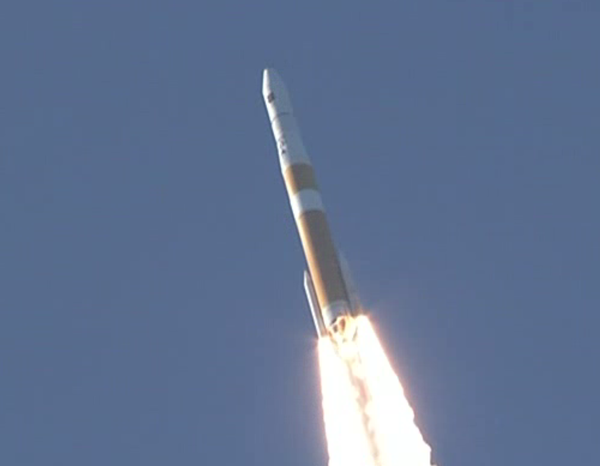
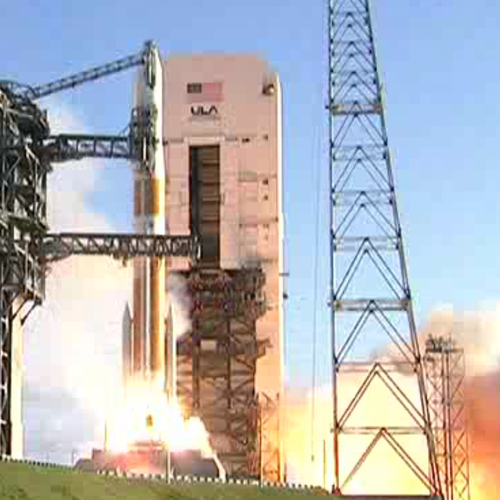
The Delta 4 rocket’s cryogenic upper stage engine experienced a fuel leak that caused a low-thrust condition. Four-and-a-half minutes into the launch, after the first stage had shut down and separated, the trouble began as the RL10B-2 engine on the upper stage extended its nozzle and fired to life.
When the powerplant was igniting and reached its peak chamber pressure, a leak started above the narrow throat portion of the thrust chamber, setting off a chain of nail-biting events over the next three hours as the vehicle made its climb to the GPS constellation. The Delta 4 made autonomous adjustments, however. The onboard inertial guidance and flight control systems compensated for the lower thrust conditions. Its closed loop guidance system measured the decreased thrust in real time and revised the trajectory and burn durations to ensure the mission succeeded. The GPS IIF-3 satellite was delivered to the correct orbit as planned.
It had to happen sometime. I just thought or hoped it might take a few more years.
But I guess I should not be surprised since I experienced a wonderful 30-year U.S. Air Force (USAF) career and that has been over for more than a decade. I have been working GPS issues since 1978. So I guess it should not have come as a surprise when just a couple of weeks ago a wet-behind-the-ears USAF 2nd Lieutenant actually inquired of me, in a public GPS-related forum no less, “So, what did you do in the war, granddad?”
Several irreverent and potentially satisfying responses immediately came to mind:
I am not your granddad.
Where do you get off asking me a question in that tone of voice?
Frankly, it is none of your business.
Instead, I simply inquired, “Which one?” This obviously unexpected response necessitated a long pause while the offender, a now obviously-easily-confused 2nd Lieutenant, ruminated about which war(s) to inquire. For my part I was ready to hit him over the head with my cane if he responded with WWII. Of course I would probably have been accused of child abuse, so he saved the day and a possible court date when he replied in a questioning falsetto, “Vietnam?”
I won’t bore you with my response. However, since that unfortunate “age discrimination” incident (from both parties), it has occurred to me that many of us who were privileged to experience GPS in its infancy are certainly not spring chickens. Indeed, many (Dr. Ivan Getting for one) have passed on to their great reward. Remember, Professor (Colonel) USAF Ret. Bradford Parkinson, who created and ran the NAVSTAR GPS Joint Program Office from 1972 to 1978, was a full colonel in 1972. However, that says nothing about commitment or expertise. Most of us, Brad included, are still as engaged and passionate about the future of GPS as we ever were. Consider that the first satellite in the system, Navstar 1, was launched February 22, 1978. In just a few months the GPS operational constellation will be 35 years old, and Air Force Space Command is celebrating its 30th anniversary this year. My point being that few operational space systems, if any, engender this type of lifelong loyalty, passion and dedication. Plus, those of us who count ourselves among the original sojourners on this amazing journey, especially those who are graying and threatening to beat impertinent whippersnappers with canes, are actually very proud of the fact that we are still engaged, and even more amazed and heartened that there’s a generation of young USAF and other military personnel, engineers, scientists, inventors, and everyday believers to follow in our footsteps. I highlight the USAF personnel because they are the official stewards of GPS.
Indeed, at the recent ION GNSS Conference held it Nashville, Tennessee, it was apparent that many of the youngsters (many of whom are Ph.D.s) are just as engaged as we are. They see a future for GPS and PNT (position, navigation and timing) systems that we may never have imagined. As prescient as many of us “seniors” claim to be, I have no doubt, indeed I fervently hope, that the young men and women following in our footsteps will achieve feats with GPS and PNT systems of which we never dared dream.
ION GNSS 2012 – Nashville
I state here without equivocation or worry of being challenged that the plenary at this year’s event, which was titled “GNSS Revolution, the Catalyst of the New Information Age,” was the best I have ever encountered at any ION event in the past twenty years. Dr. Jade Morton from Miami University was an excellent moderator and kept the program moving along, but it was the presenters, their evident, extensible passion for their subjects and their excellent presentations (see list below) that made the night unforgettable:
1.
High Precision Agriculture: Tony Thelen, Director of Intelligent Solutions Group, John Deere
2.
Crime, Punishment, and the Global Positioning System: Professor David Last, Crime Consultant Engineer and Professor Emeritus, University of Bangor, UK
3.
Precision Navigation Sensors Based on Atom Interferometry: Professor Mark Kasevich, Applied Physics, Stanford Universit
GPS and Agriculture
Tony Thelen, the first presenter from John Deere — yes, the people who make green farm and lawn tractors among other things — actually made GPS and agriculture sound interesting. His presentation was top notch. It certainly kept my interest, and he left me wanting to know more about GPS and agriculture! Of course, I am being a bit disingenuous, since one of my most requested columns, titled “The Farmer in Finland,” concerns the unparalleled John Deere StarFire system, which probably deserves another column soon. Conversations with plenary attendees after his excellent presentation indicate that Tony managed to ignite that spark and interest again for many in the audience. The effect that GPS and companies like John Deere have had on agriculture is simply amazing, and the quantifiable benefits almost beyond belief. Plus, according to Tony Thelen, there is good reason to believe we will continue to be astounded at what the future holds for GPS and agriculture. I encourage you to visit the ION website and review not only Tony’s excellent presentation, but all the ION GNSS 2012 Plenary presentations.
GPS Forensics
When you have three excellent and inspiring speakers lined up for an evening of edification, you always face the conundrum of order. Should the featured or most entertaining speaker be in the middle, or should you risk losing some of your audience early and build toward a climax? With this audience Dr. Jade Morton made the wise decision, and put the most anticipated speaker in the middle of the lineup. There is always great expectation on my part, and I expect from most of the audience, when Professor David Last is scheduled to speak. At Nashville, he certainly did not disappoint. Only the infamous tonal chimes from “Law and Order” could have made his presentation any more dramatic.
For my part, I kept expecting to hear those infamous tones whenever David transitioned to a new slide. David’s presentation was a perfect combination of “Law and Order” combined with “The World of Stupid Criminals.” With material like that, how could it have not been a roaring success? Add the dulcet British Public School accent and perfect comic timing and delivery and you can’t fail. Indeed, anyone listening outside the auditorium that night would have thought they had stumbled upon a standup comic convention instead of a bunch of staid scientists and engineers listening to a presentation on GPS forensics.
David is always interesting, but that night he was competing for and in my book won the ION GNSS Emmy. If you ever have the chance to hear Professor David Last speak publicly, don’t miss it. And criminals in the UK should just surrender — they don’t stand a chance in court against a consulting engineer and expert witness like Professor Last. I dare say even Sherlock Holmes, the famous consulting detective, would be proud of Professor Last.
Cold Atom Interferometry
None of this lessens the impact or obvious passion for his subject displayed by Professor Mark Kasevich from Stanford University. It is not that I don’t have a passion for cold atom interferometry, it’s just that two weeks later I am still trying to figure out what he said and how it applies. I have no doubt that you can, excuse me, that Professor Mark Kasevich can, construct a cold atom interferometer that can be used to determine a position or a fix; I am just trying to figure out how that 10-cubic-foot rack is going to fit into anything remotely mobile. But, of course, even the optimistic Professor Kasevich admitted that mobile or handheld atom interferometers of this caliber are probably 10 years in the future.
So, at this years’ ION GNSS Plenary event, the audience was treated to a down-to-earth and yet exciting look at the future of GPS and agriculture: the comedic and yet brilliant GPS forensic expertise of a passionate John Cleese wannabee, a caped crusader who is feared by criminals everywhere, and the futuristic “Star Trek” look at cold atoms and interferometry. What more could you ask for? This was an evening that for me elucidates the best ION GNSS Plenary ever. My hat is off to ION Executive Director Lisa Beaty and Plenary Program Director Dr. Jade Morton for an excellent program, but mostly I applaud all three speakers for a wonderfully educational and entertaining evening. How often do you get to combine those adjectives?
GPS World Leadership Dinner and Annual Awards Ceremony
However, for myself and many others the highlight of the ION GNSS event for the past several years has been the annual GPS World Gala and Dinner, now known as the annual GPS World Leadership Dinner and Awards Ceremony. This wonderful and prestigious event is the brainchild of Alan Cameron, our beloved editor-in-chief and now publisher of GPS World. Every year the event just gets better and better. The venues are always palatial, and this year was no exception as we held the event at the beautiful Nashville Hermitage Hotel. The stained-glass ceiling in the lobby was astounding.
I won’t say much more since Alan wrote a complete review of the evenings events, except to caution you that invitations to this wonderful event are extremely hard to come by, and if you are nice to me, who knows? You might receive an invitation next year. It reminds me of the admonition from my daughter, a PsyD in Psychology and a practicing clinical psychologist, when she says: “You should always be nice to me Dad. Remember, I get to pick your nursing home!”
Kudos and Final Thoughts on ION GNSS 2012
I can’t complete my comments on ION GNSS this year without pointing out that the venue, Nashville or Music City, and the Renaissance Hotel by Marriott were both outstanding. The ambience of the entire event was professional yet also warm and friendly, and the ION staff as well as the staff at the Renaissance could not do enough to make my stay more memorable. The Renaissance staff was extremely professional and attentive, working hard to make the event a success. I am already looking forward to next year’s conference, which will be held at the same location September 16-20, 2013. Book early and arrive early for reasons I elucidate next.
Lest we forget, while the ION GNSS is the main performance, the center ring if you will, it is historically preceded by the Civil GPS Service Interface Committee (CGSIC) meeting, which is co-chaired by the United States Coast Guard (USCG) NAVCEN/CC. The CGSIC has been around for 52 years, and was outstanding this year. Yes, the title sounds incredibly dry and boring, but CGSIC meetings are actually very informative, down to earth, informal and even occasionally entertaining. The new USCG NAVCEN commander, Captain William Burns, and his NAVCEN team did an excellent job putting the event together. So, again, I highly recommend arriving a couple of days early for next year’s ION GNSS in Nashville, so you too can attend the CGSIC. You will find it worthwhile.
LightSquared
As much as I hate to close my column on a downer I must unfortunately inform you that the amnesiacs at LightSquared (LSQ) are at it again. Not exactly the same amnesiacs, of course, as their CEO resigned in February, and Philip Falcone from Harbinger, whose solipsistic behavior resulted in a federal security SEC indictment for fraud, joined the LightSquared board recently. The U.S. Securities and Exchange Commission recently filed securities fraud charges against Falcone and Harbinger Capital Partners. However, this has not slowed LSQ as it subsequently on Septembert 28 submitted two proposed spectrum sharing filings with the FCC, proposing to utilize the lower 5 MHz of LSQ’s non-existent broadband network in a form that was not initially sanctioned or envisioned and, according to the filings, will not interfere with GPS signals. LSQ did not submit any evidence or test data to prove the lack of interference, just conjecture. These filings, of course, are in addition to LSQ’s recent filing for Chapter 11, better known as a bankruptcy filing. Plus, Philip Falcone has publicly alerted the FCC that LightSquared will not go away!
Where have you heard this song and dance before? I have read both filings very carefully, and they are filled with the same flawed technology and total refusal to adhere to the laws of physics as their previous filings. LSQ fails to understand that you cannot abrogate the laws of physics merely because they are inconvenient and interfere with your grand scheme. Previous test results have determined that transmitters as powerful as the ones proposed by LSQ will interfere with GPS signals no matter what portion of the immediately adjacent spectrum bands are proposed.
The latest filings clearly seem to be a last-gasp effort of a dying company that is attempting to snatch victory from the jaws of defeat. LSQ must think the U.S. government has an incredibly short attention span. In my humble opinion, if the FCC were to approve either of the proposed filings, pilots, airlines and passengers at Ronald Reagan National Airport and other major airports on the East Coast would be unable to use GPS to fly out of or navigate to the airports. LSQ continues to think it is more important to be able to tweet, “I just saw Elvis” than it is to navigate safely to your destination. However, as improbable as the acceptance of these LSQ filings may be, in a recent memo I warned my GPS/PNT colleagues, via notable quotes you may recognize, “…unfortunately this is not over, ‘prepare for boarders’ and remember ‘we have not yet begun to fight’.”
GPS II-F 3
Fortunately, I won’t end on a down note after all. As I write this, the third GPS IIF satellite, designated SVN-65, is on orbit being checked out by the 19th SOPS (Space Operations Squadron) with LADO (Launch, Anomaly, and Disposal Operations) software developed by Braxton Technologies. My hat is off to AFSPC (Air Force Space Command), SMC (Space & Missile Systems Center), Boeing, ULA (United Launch Alliance), the 50th Space Wing, and Braxton Technologies for a successful launch and hopefully a quick and flawless checkout. It has been a long 15 months since the last IIF launch, and this is the only launch in calendar and FY12. Plus, technically the satellite on orbit is actually satellite vehicle (SV) four, as SV three is undergoing some necessary changes. Most experts expect a minimum 30-day checkout. However, my sources tell me it could be as long as 90 days. Wouldn’t it be great if it were sooner? We will just have to wait and see. Stay tuned to GPS World for the latest news on GPS IIF-3. The good news is we have another GPS IIF on orbit.
Until next time, happy navigating, and remember all of us at GPS World now have new email addresses in the following format. If you wish to email me please do so at [email protected]. I look forward to your comments.
UPDATE: The SVN65/PRN24 L5 transmitter has now been switched on. L5 is the civilian safety-of-life GPS signal, designed to meet demanding requirements for safety-of-life transportation and other high-performance applications.
UPDATE: The GPS Block IIF-3 satellite, SVN65, began transmitting L1 and L2 signals as PRN24 on October 8. A number of stations of the International GNSS Service are now tracking the satellite. The satellite is included in broadcast almanacs although it is set unhealthy and will continue to be so until satellite commissioning is completed. The satellite is still drifting towards its designated orbital position of Slot 1 in Plane A.
Meanwhile, SVN27/PRN27 was decommissioned from active service on October 6 and removed from the broadcast almanacs. However, the L-band
transmitters of SVN27 remain active, presumably for end-of-life testing.
UPDATE: According to Boeing, the satellite manufacturer, SVN65 is on orbit and performing as expected. A Boeing press release stated that “Controllers confirmed initial contact with the spacecraft at 11:43 a.m. Eastern time. The satellite’s GPS signals will be turned on and tested within a few days.”
Incidentally, the launch occurred exactly 55 years to the day after the launch of the world’s first satellite, Sputnik I, on October 4, 1957. It was Doppler tracking of that satellite that gave rise to the Transit navigation system and subsequently, its successor, GPS.
The launch of the GPS Block IIF-3 satellite took place as scheduled October 4 at 12:10 UTC (8:10 a.m. EDT), aboard a United Launch Alliance Delta IV rocket from Cape Canaveral, Florida. Spacecraft separation was reported at 16:27 UTC.
The Boeing-built spacecraft is designed to improve network coverage for both civilian and military networks, including a new L5 signal for improved commercial and civil aviation users.
The satellite, also known as SVN65, will be positioned in orbital slot 1, which is in plane A and will use the PRN24 ranging codes. Slot 1 was recently occupied by a Block IIA satellite, SVN39, operating as PRN09. SVN39 is one of the oldest operating satellites in the GPS fleet, having been launched on 26 June 1993. SVN39 underwent an initital Delta-V on September 27 to move it close to SVN38/PRN08 in slot 3 in plane A, making room for the new Block IIF satellite.
“Congratulations to the entire team on today’s successful launch of the GPS 2F-3 satellite,” Jim Sponnick, ULA vice president, Mission Operations, said in a post-launch press release.
“ULA and our mission partners have a rich heritage with the GPS program and we are proud to have served alongside the government and contractor teams over the last two decades to provide important Global Positioning System capabilities for our national defense and for millions of civilian and commercial users around the world.”
A Delta IV rocket lifts-off with an advanced GPS satellite from Cape Canaveral on Thursday. (Credit: ULA/Atkeison).
2. GPS SATELLITE SVN65 (PRN24) WAS LAUNCHED ON JDAY 278.
A USABINIT NANU WILL BE SENT WHEN THE SATELLITE IS SET ACTIVE TO
SERVICE.
3. POC: CIVILIAN – NAVCEN AT 703-313-5900, HTTP://WWW.NAVCEN.USCG.GOV
MILITARY – GPS OPERATIONS CENTER AT HTTPS://gps.afspc.af.mil/
GPSOC , DSN 560-2541,
COMM 719-567-2541, [email protected] , HTTP://gps.afspc.af.mil/GPSOC/GPS
MILITARY ALTERNATE – JOINT SPACE OPERATIONS CENTER, DSN 276-3514.
COMM 805-606-3514. [email protected]