Tag: GPSPatron

  • New GNSS interference report released

    New GNSS interference report released

    Shipborne Measurements Near the Kaliningrad Border

    A major new report by GPSPATRON gathered data between June 23 and Oct. 14, aboard a vessel routinely leaving the Port of Gdańsk and performing extended maneuvers in open water.

    The vessel conducted multiple offshore measurement campaigns, resulting in a shipborne dataset that provides a far more accurate representation of the true GNSS environment experienced by maritime operators in the Gulf of Gdańsk. It also reveals a level of interference complexity and intensity not visible in a previous coastal study.

    In that previous six-month investigation, conducted from a fixed sensor installed at the Gdynia Maritime University campus, the authors documented persistent multi-constellation jamming, as well as indications of mobile maritime interference sources operating in the region. Read the earlier report here: Report on GNSS Interference in the Baltic Sea: Analysis Using a Terrestrial Monitoring System and Comparison with ADS-B Data

    In the present phase of research, the GPSPatron team moved beyond land-based monitoring and installed itsGP-Probe TGE2 interference sensor directly on board a research vessel. The ship operated throughout the southern Baltic Sea, including regular approaches toward the maritime boundary of the Kaliningrad region.

    By placing the sensor on a moving platform rather than a coastal location, they were able to record GNSS interference exactly as it affects real vessels — capturing signal conditions that cannot be observed from shore due to differences in radio horizon, antenna orientation, multipath environment, and proximity to potential interference sources.
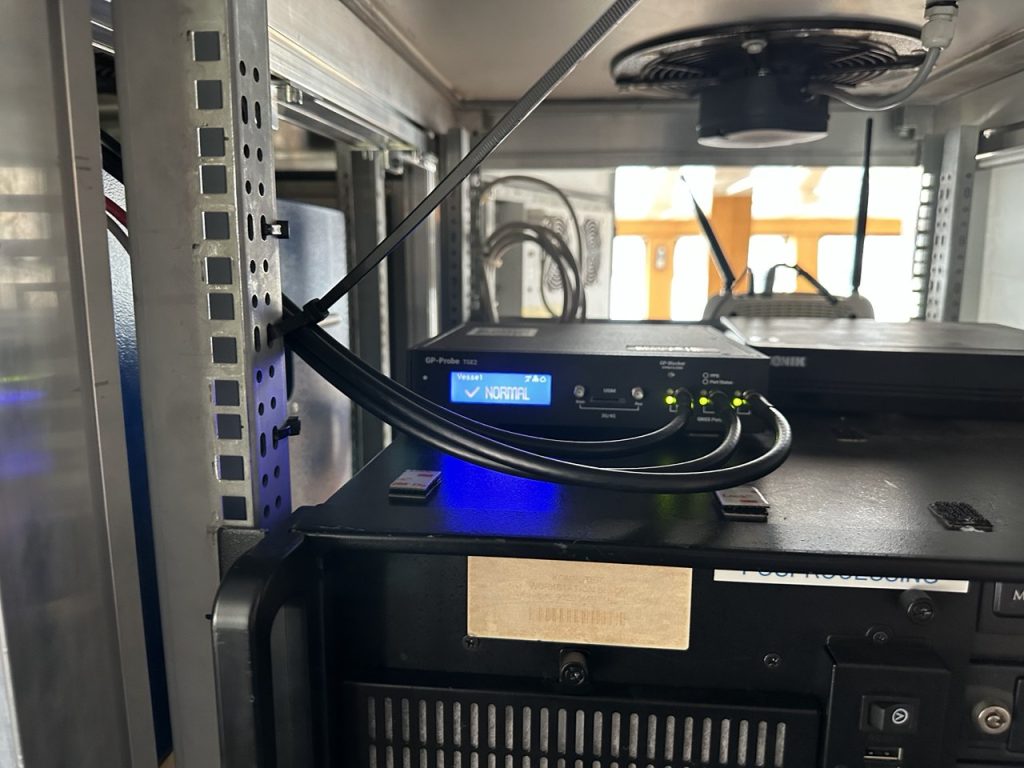
    The GPSPATRON probe TGE2 instaslled within the vessel's equipment. (Photo: GPSPATRON)
    The GPSPATRON probe TGE2 instaslled within the vessel’s equipment. (Photo: GPSPATRON)

    Transition from classical jamming to combined spoofing-jamming interference

    In contrast to the previous six-month coastal study, where all recorded GNSS interference consisted exclusively of multi-constellation jamming, the current shipborne campaign reveals a fundamentally different interference landscape.

    All major events now present a dual-layer structure composed of:

    • GPS L1 spoofing, generating forged satellite-like signals, and
    • Simultaneous jamming of GLONASS, Galileo, and BeiDou.

    This combined architecture forces GNSS receivers to rely solely on spoofed GPS signals while denying access to independent ranging sources. The practice is consistent with commonly used operational strategies: spoofing only one constellation (GPS) drastically reduces system complexity and cost, whereas spoofing all GNSS systems would require multiple parallel RF chains, SDR-based generators, algorithms for signal simulations and amplifiers.

    Highest recorded levels of GNSS disruption

    The most severe interference period occurred from late June through July, during which:

    • GNSS availability dropped to 83.5%,
    • 4 days, 5 hours and 24 minutes of spoofing were recorded — by far the highest cumulative spoofing activity of the entire campaign.

    The single most extreme incident took place between 1 and 3 July, with nearly 30 consecutive hours of spoofing within a 48-hour interval, posing a severe risk for maritime navigation.

    In subsequent months the interference intensity gradually decreased, yet low-power and short-duration events continued to be observed.
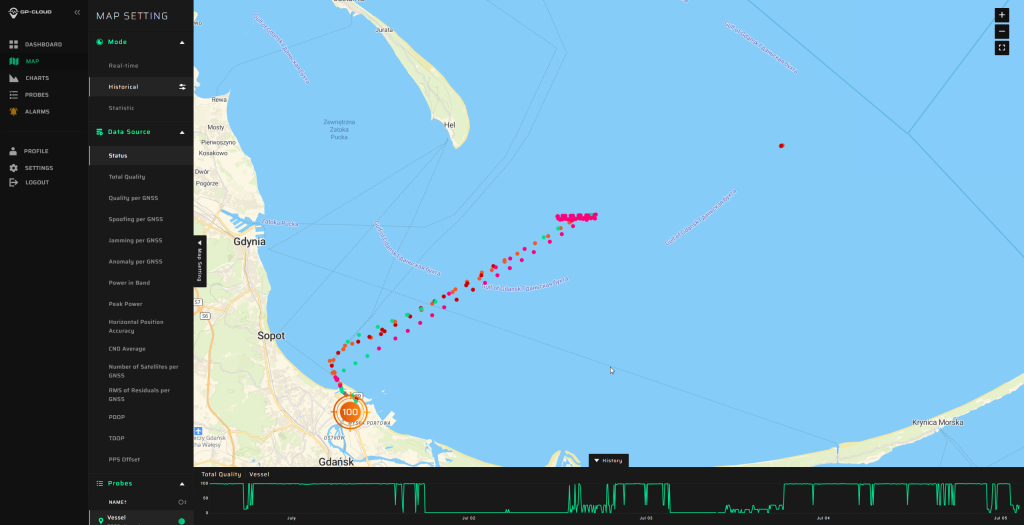
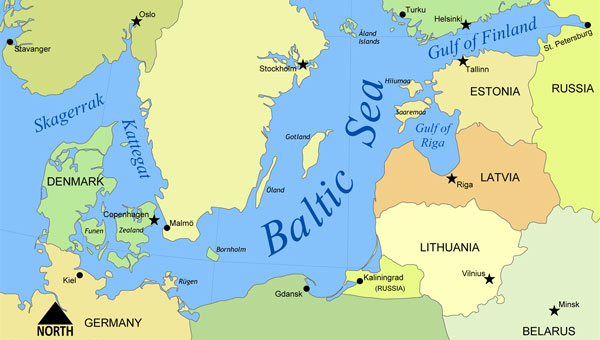
    The area of the Baltic Sea the vessel patroled for GNSS interference. (Image: GPSPATRON)
    The area of the Baltic Sea the vessel patroled for GNSS interference. (Image: GPSPATRON)

    A multi-emitter, synchronously operating interference network

    Spectrogram analysis reveals that the interference does not originate from a single source but from four distinct, technologically different emitters operating in coordination:

    • GPS spoofing transmitter generating forged L1 signals.
    • Lower-band chirp jammer suppressing GPS, Galileo, and BeiDou.
    • Upper-band chirp jammer suppressing GLONASS G1 only.
    • Full-band analog-like broadband jammer covering the entire 60 MHz GNSS L1 band.

    The synchronous activation and termination of all four components indicate a centrally coordinated system, yet their differing spectral signatures, bandwidths, and stability levels confirm multiple spatially separated stations rather than a single unified installation.
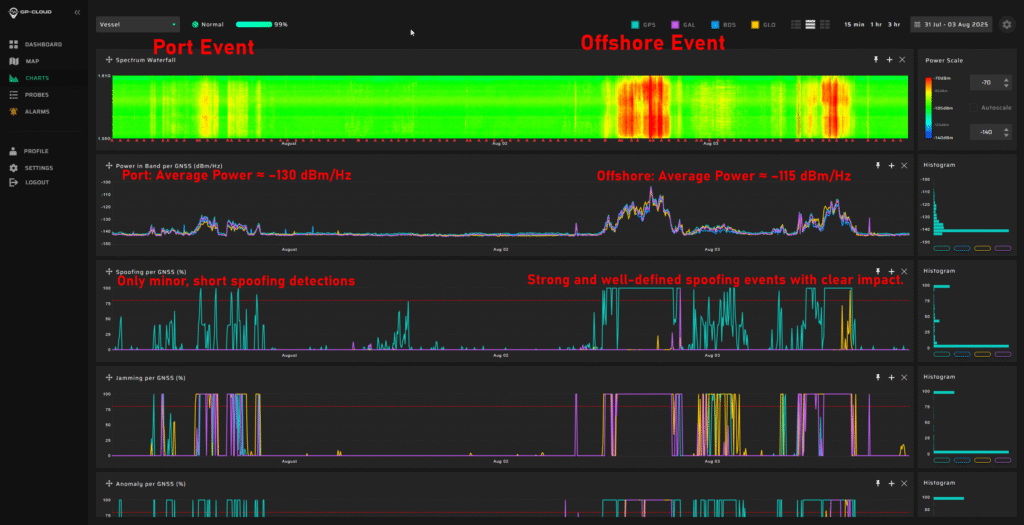
    This GNSS interference analysis shows interference intensity increases away from port. (Image: GPSPATRON)
    This GNSS interference analysis shows interference intensity increases away from port. (Image: GPSPATRON)

    Evolution of interference modulation techniques

    A clear shift is observed compared to the previous study :

    • Previously, the dominant interference source consisted of a high-quality, purpose-engineered wideband signal with three clean constellation-matched components — an indication of modern, precisely designed jamming equipment.
    • In the current campaign, the prevailing interference is simpler wideband chirp jamming, a less advanced technique but deployed at significantly higher power levels.
    • The wideband analog-like component further shows pronounced parasitic frequency fluctuations, characteristic of older low-stability RF hardware.

    This indicates a shift from high-precision jamming to a mixed environment of legacy high-power systems combined with newer spoofing capabilities.

    Interference strongly intensifies offshore

    A distinct spatial gradient was recorded:

    • In the Port of Gdańsk, interference appears weak or barely detectable.
    • As the vessel moves into open water, the same signals become up to 15 dB stronger.
    • The interference power consistently increases when approaching the waters facing Kaliningrad.

    This pattern shows that — intentionally or not — the interference system affects maritime traffic far more than coastal infrastructure, with the operational impact being greatest in offshore navigational zones.

    Download the full report using the form on this page.
  • GNSS disruption at sea level: An interference study in the Baltic Sea

    GNSS disruption at sea level: An interference study in the Baltic Sea

    For years, aviation safety organizations and maritime authorities have relied on ADS-B-based reports to assess GNSS interference. Services such as gpsjam.org, spoofing.skai-data-services.com and flightradar24 have provided valuable insights into interference patterns at high altitudes. However, this data tells only part of the story. Ground-based infrastructure — ports, telecommunications networks, and precision navigation systems — operate in a vastly different signal environment. High-altitude detections cannot reliably indicate the presence or impact of interference at sea level.

    To address this critical knowledge gap, GPSPATRON and Gdynia Maritime University have conducted a six-month study on GNSS interference in the Baltic Sea. Using terrestrial GNSS monitoring technology, the project examined the frequency, duration and characteristics of interference events affecting maritime navigation and other critical applications.

    Data collection and analysis

    At the core of this study is a terrestrial GNSS monitoring system developed by GPSPATRON, designed to capture and analyze signal disruptions in real-time. Installed at the Faculty of Navigation at Gdynia Maritime University, this system continuously recorded GNSS signal integrity and transmitted the collected data to a cloud-based analytics platform. This platform facilitated the automated detection, classification and visualization of GNSS interference events, providing a comprehensive understanding of interference patterns and their potential impact on maritime navigation. The results paint a stark picture of persistent and evolving interference patterns in the Baltic region. More than 84 hours of GNSS interference were recorded, with October exhibiting the highest activity. Two primary interference types were identified: multi-constellation jamming, prevalent in the summer months, and multi-tone interference, which emerged in October.

    Key findings

    • Persistent GNSS Interference: A total of 84 hours of GNSS interference was detected, indicating continuous disruptions in the region. Most incidents were caused by jamming rather than spoofing.
    • October saw peak interference levels: The month recorded six major jamming events totaling 29 hours, showing an escalation in disruption frequency and severity.
    • Maritime sources of interference suspected: Signal pattern analysis confirms that the source was mobile, reinforcing the likelihood of a single ship or multiple vessels operating the same advanced jamming technology.
    • High-Precision Jamming Signatures: The interference signals detected exhibit structured modulation patterns and frequency agility, suggesting the use of highly sophisticated jamming techniques. These characteristics indicate high-grade equipment, potentially of military origin, with capabilities far exceeding those of common commercial jammers. The consistency and precision of these disruptions highlight the need for further investigation into the source and intent behind these operations.
    • No link to ADS-B reports: Despite extensive ground-level interference, ADS-B-based monitoring systems failed to register corresponding events, highlighting their limitations in assessing terrestrial threats.
    • Long-duration disruptions: Some interference events lasted more than seven hours, significantly affecting GNSS-dependent operations in maritime navigation and port activities.

    Implications for maritime and critical infrastructure

    The findings of this study expose a critical gap in current GNSS monitoring methods. High-altitude interference reports, primarily based on ADS-B data, fail to capture the real impact of jamming and spoofing at ground level. Maritime operations, port logistics, and other critical infrastructure remain vulnerable due to this oversight.

    Ports, telecommunications providers, and emergency services rely heavily on GNSS for navigation, timing synchronization, and security. Without precise ground-level monitoring, disruptions can go unnoticed, leading to cascading failures across multiple sectors.

    A major concern is the false sense of security created by ADS-B-based detection systems. While these services report daily interference incidents, they do not reflect the full extent of ground-based GNSS disruptions. As a result, infrastructure operators may underestimate the risk, assuming that existing monitoring solutions provide adequate coverage. This misconception is dangerous, as it masks the severity of interference threats that remain undetected in high-altitude datasets.

    To mitigate these risks, there is an urgent need for a dedicated GNSS interference monitoring network along the Baltic Sea coast. Such a network would provide real-time, localized data to accurately assess threats, detect interference sources, and enhance infrastructure resilience against GNSS disruptions.

    Conclusion

    This study confirms that GNSS interference is a persistent issue at sea level, posing a serious threat to critical infrastructure, which predominantly operates at ground level. Prolonged interference events were recorded, some lasting several hours, leading to significant degradation in positioning and timing accuracy. This disruption directly impacts maritime operations, telecommunications, emergency response, and other sectors reliant on GNSS services.

    High-altitude interference detection alone is insufficient, as it fails to capture threats affecting ground-level operations. Relying solely on ADS-B-based reports creates a false sense of security, leaving critical systems vulnerable to undetected risks.

    To mitigate these risks, there is a clear need for a dedicated ground-based GNSS interference monitoring network. Such a system would provide real-time detection, precise geolocation of interference sources, and timely countermeasures to protect infrastructure.

    GPSPATRON and Gdynia Maritime University urge regulatory bodies to take proactive steps toward enhancing GNSS interference detection and mitigation. Without coordinated action, vulnerabilities in national infrastructure will continue to escalate, leading to potentially severe operational and security consequences.

    The full report can be downloaded from the GPSPATRON website.

  • GPSPatron seeks to protect critical infrastructure

    GPSPatron seeks to protect critical infrastructure

    Screenshot: GPSPatron
    Screenshot: GPSPatron

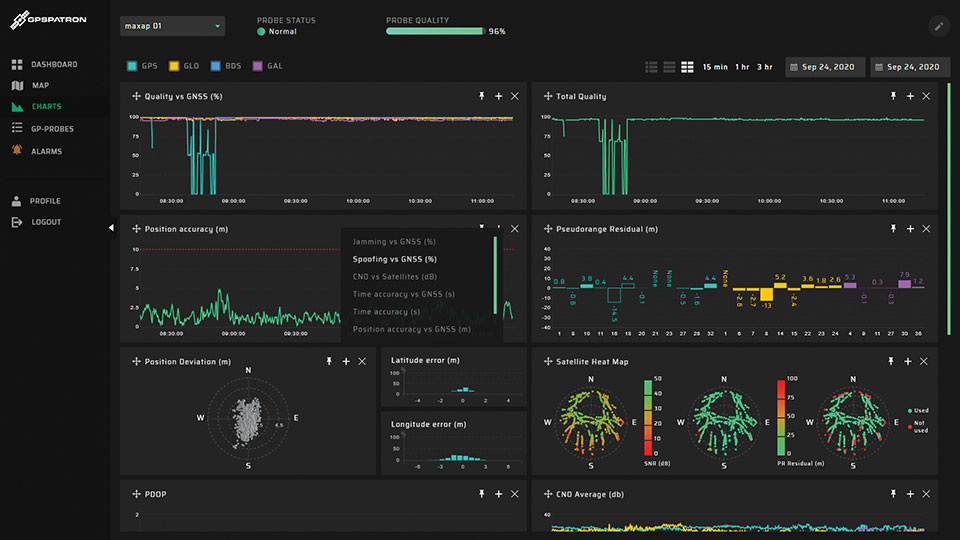
    GPSPatron is offering products and services to protect equipment, particularly GNSS-dependent critical infrastructure. Its GP-Probe TGE2 is designed to protect time servers against threats including spoofing, jamming, ionospheric scintillation and system errors. An embedded PPS phase-error measurement function enables reliable monitoring of the time server’s health by measuring the time offset between internal and external PPS.

    The GP-Probe, in conjunction with GP-Cloud, allows development of robust, resilient clock-synchronization systems. GP-Cloud is a web application for monitoring the quality of the GNSS signal and detecting anomalies in RAW GNSS data.

    Every second, the three-channel GP-Probe measures several signal parameters of all perceptible GPS, GLONASS, BeiDou and Galileo satellites and sends them to GP-Cloud for real-time processing. GP-Cloud allows users to investigate GNSS signal parameters, recognize attack scenarios, and improve resiliency to current and future GNSS threats.

    GPSPatron also provides laboratory testing services of GNSS equipment to identify vulnerabilities. It uses its own GP-Simulator to simulate spoofing attacks. Typical test objects are RTK base stations and time servers. Testing can help uncover possible attack scenarios.

    GPSPatron offers its solutions as a service, providing monitoring without investments in new hardware and software, as well as leasing of equipment.

    GP-PROBE TGE2 FEATURES

    • Three RF channels enable spatial signal analysis to detect coherent spoofing
    • 60 MHz RF signal analyzer for spectrum monitoring with FPGA-powered correlative peak analysis for non-coherent spoofing detection and interference classification
    • Optional GP-Blocker with an embedded noise generator suppresses the most powerful counterfeit RF signals
    • Authenticated PPS output for synchronization of external equipment
    • PPS input for checking time server health and monitoring the entire synchronization system
    • Optional GP-divider enables use of one GNSS antenna for two receivers
    • Form factor of 19-inch rack, half-size
    • Double power module: 110 – 220 AC, 18 – 75 DC
    • Active/passive GNSS antenna support
    • 4G modem and 100BASE-TX Ethernet for data transferring to GP-Cloud
    • Web interface for configuration (HTTP or HTTPS)