The European Union Agency for the Space Programme (EUSPA) has awarded GMV a framework contract to advance the Galileo Reference Centre (GRC), a key facility for monitoring and evaluating the performance of the Galileo satellite navigation system. Located in Noordwijk, the Netherlands, the GRC independently assesses Galileo’s operations, signal quality, and user-level service performance and compares its performance with that of other GNSS.
The upcoming GRC V2 version will introduce real-time monitoring capabilities, enhancing EUSPA’s ability to oversee GNSS services. This evolution will support additional Galileo services, including:
Signal Authentication Service (SAS): Strengthening trust in Galileo signals.
Time Dissemination Service: Enabling precise synchronization for critical infrastructure.
Search and Rescue (SAR): Improving emergency response operations.
Emergency Warning Satellite Service (EWSS): Facilitating public alerts for natural disasters and emergencies.
Key operational improvements in GRC V2 include:
Enhanced monitoring using data from multiple institutions.
Real-time processing for faster user notifications.
Seamless system upgrades without disrupting operations.
Advanced cybersecurity measures integrated into a platform-as-a-service model.
The upgraded GRC is expected to be operational by 2026 without impacting ongoing functions.
The Galileo Reference Centre (GRC), the new state-of-the-art performance monitoring hub for the European Union’s global satellite navigation system, was officially inaugurated May 16 in Noordwijk, the Netherlands.
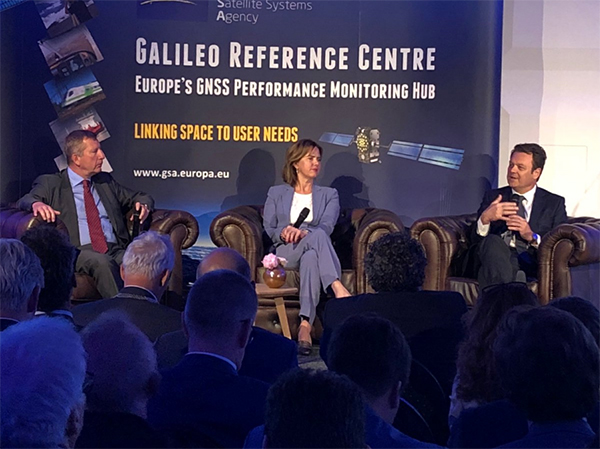
The ceremony was presided by Dutch Minister of Infrastructure and Water Management Cora van Nieuwenhuizen and European GNSS Agency (GSA) Executive Director Carlo des Dorides, among others.
GSA Executive Director Carlo des Dorides (right), Dutch Minister for Infrastructure and Water Management Cora van Nieuwenhuizen, and DG GROW Deputy Director-General Pierre Delsaux at GRC inauguration. (Photo: GSA)
“The Galileo Reference Centre is a state of the art facility that underpins Galileo service provision,” des Dorides said. “The GRC will be instrumental in monitoring the performance of the system and of the service operator, ensuring that users benefit from the most reliable satellite data and, at the same time, disclosing new service potential.”
“I am proud of the fact that the Galileo Reference Centre is located in the Netherlands,” van Nieuwenhuizen said. “The data provided by Galileo will enable us to navigate with an accuracy to within 20 centimeters. In rescue operations, this sharp reduction in response time is going to save human lives.”
Independent monitoring ensures quality for users
The GRC is a cornerstone of service provision for Europe’s Galileo satellite constellation and plays an important role in Galileo’s operations, providing the GSA with an independent means of evaluating the quality of the signals in space and the performance of the Galileo Service Operator (GSOp). In so doing, it helps ensure the provision of high-quality satellite data so users can better rely on and benefit from Galileo.
Managed by the GSA, the GRC is comprised of a core facility in Noordwijk and contributions from EU Member States, Norway and Switzerland. From the core facility, the GRC generates performance evaluation products and reports using data collected in-house and through cooperation with Member States. The Centre also performs dedicated campaign-based analyses to support investigation of any service performance issues and reports on its findings.
In this two-pillar approach, the GRC benefits from and contributes to maintaining long-term competence and expertise at the Member State level, and actively integrates contributions from the EU Member States, Norway and Switzerland to support daily operations and specific campaigns.
The GSA has established agreements with two beneficiaries, one led by the French Space Agency (CNES) and the other by the Netherlands Aerospace Centre (NLR), and 23 organizations from 14 different countries. Member State contributions include data from networks of reference stations and campaigns using vehicles, vessels and airplanes, and reference products.
The GRC is fully independent of the system and the Galileo Service Operator with respect to its operations.
Since June 2017, GRC operations were hosted and operated from a temporary facility at ESTEC, the neighbouring ESA technical centre, which was instrumental in the swift ramp-up of competences. In April the GRC moved to its new home.
Earlier in May, the GRC hosted representatives from US GPS, Russian Glonass, Chinese BeiDou, Japanese QIS and Galileo to discuss the creation of an authoritative international GNSS monitoring and assessment system to benchmark the performance of available GNSS. The meeting was organised through the International GNSS Monitoring and Assessment Task Force of the United Nations Office of Outer Space Affairs (UNOOSA), International Committee on GNSS (ICG).
The Galileo Reference Centre (GRC), which will be established in the Netherlands, will play a crucial role in monitoring Galileo’s performance. The European GNSS Agency (GSA) made the announcement during this week’s European Space Solutions conference in The Hague.
With Galileo Initial Services set to be declared this year, the GRC will play a pivotal role in the programme’s operations, the GSA announced during the 4th European Space Solutions conference in The Hague.
The Galileo Reference Centre (GRC) will be established in Noordwijk, the Netherlands. The GRC’s core mission is to perform independent monitoring of Galileo’s performance and report on its findings.
GRC’s core facility in Noordwijk will also actively integrate contributions from the EU Member States Norway and Switzerland. The core facility is charged with generating performance evaluation products, reporting and performing dedicated campaign-based analyses. It will also rely on a range of facilities and expertise available in the Member States.
The GRC will be implemented using a versioning approach. The first step is expected to be in place at the time of declaration of Galileo Initial Services. The core facility is set to become operational in 2017.
“The use of space data is becoming more urgent and relevant in many areas, for example in maritime safety and smart mobility,” said Melanie Schultz van Haegen, Dutch Minister of Infrastructure and the Environment. “The Galileo Reference Centre will help ensure the provision of high quality satellite data so users can better rely on and benefit from Galileo.”
“When operational, the GRC will provide the GSA with an independent system to evaluate the performance of the Galileo Service Operator and the quality of the signals in space,” said GSA Executive Director Carlo des Dorides. Dorides and van Haegen were joined by Elżbieta Bieńkowska, European Commissioner for Internal Market, Industry, Entrepreneurship and SMEs, to officially sign the GRC hosting agreement during the conference’s opening session.
The GRC in Brief
Galileo is Europe’s global navigation satellite system (GNSS), operated and maintained by the Galileo Service Operator, under contract with the European GNSS Agency (GSA).
The Galileo Service Operator is responsible for ensuring that the programme complies with the Galileo Services performance requirements.
The Galileo Reference Centre (GRC) is one of the Galileo Service Facilities: a facility to support the provision of services to the Galileo Core System and the Galileo users.
The GRC is operated by the GSA: it provides the GSA with an independent means of evaluating the performance of the Galileo Service Operator and the quality of the signals in space.
The GRC is fully independent of the system and the Galileo Service Operator with respect to both the technical solution and operations
The GRC is comprised of both a core facility and contributions available at EU Member States, Norway and Switzerland.
The core facility, located in Noordwijk (The Netherlands), is charged with:
generating performance evaluation products and reports using data collected by itself and through cooperation with Member States;
performing dedicated campaign-based analyses to support investigations of service performance and service degradations;
making use of the GRC’s own data, products and expertise.
Data and products from cooperating entities from the Member States support both daily operations and specific campaigns.
The GRC should benefit from but also contribute to maintaining the long term competences and expertise at the level of Member States.
All of the components of the GRC will be implemented using a versioning approach. The first performance monitoring solution, which primarily relies on contributions from Member States, is expected to be in place at the time of declaration of Initial Services. The core facility is expected to become operational in 2017.