Tag: GSAT-10

  • GSAT-10 Satellite Placed in Geosynchronous Orbit

    The Indian Space Research Organization has announced that the orbit-raising maneuvers of GSAT-10 satellite have been successfully completed from ISRO’s Master Control Facility, Hassan. GSAT-10 was launched September 30. The third and final orbit-raising maneuvers was performed October 3 to place the GSAT-10 in an orbit with 35,734 km apogee (farthest point to earth), 35,585 km perigee (nearest point to earth), and an inclination of 0.172 degree with respect to the equator. Currently, the orbital period of GSAT-10 is 23 hours 50 minutes.

    According to the announcement from the Indian Space Research Organization, the two solar panels and the two dual gridded reflector antennas were also deployed later in the day. Currently, the satellite is in final orbital configuration at 70.18 degree East longitude. In the coming days, the satellite will be moved towards its designated location of 83 degree East and in-orbit testing of its communication and navigations payloads will be performed.

    As is often the case, NORAD/JSpOC has temporarily “lost” the satellite following one of its orbital maneuvers. The last published two-line orbital element set for the satellite is dated September 30.

  • GSAT-10 GAGAN Satellite Launched

    News courtesy of CANSPACE Listserv.


    The Indian Space Research Organisation’s GSAT-10 geostationary communications satellite was launched from the European spaceport in Kourou, French Guiana, on 28 September at 21:18 UTC. The dual-satellite launch also carried the Astra 2F direct-to-home broadcast satellite into orbit for Luxembourg-based operator SES.

    GSAT-10 contains a payload to support the Indian GPS and GEO Augmented Navigation (GAGAN) satellite-based augmentation system. The satellite will likely use PRN code 128 from its orbital slot at 83 degrees east longitude.

    NORAD/JSpOC is tracking four objects from the launch, all in geostationary transfer orbits:

    OBJECT A
    1 38778U 12051A   12274.70409814  .00000012  00000-0  00000+0 0   107
    2 38778 003.6775 154.7710 5937516 178.5931 014.2031 02.01889852    46

    OBJECT B
    1 38779U 12051B   12274.00388870 -.00000099  00000-0  00000+0 0    93
    2 38779 005.9367 154.4296 7276764 178.6603 185.9046 02.28251452    34

    OBJECT C
    1 38780U 12051C   12273.56648427 -.00000125  00000-0  00000+0 0    70
    2 38780 005.9425 154.5770 7276251 178.3304 186.5889 02.28343008    14

    OBJECT D
    1 38781U 12051D   12273.55880826 -.00000125 +00000-0 +00000-0 0 00072
    2 38781 005.9710 153.0905 7273242 179.7915 181.3163 02.28773171000012

    The two satellites are accompanied by the Sylda 5 dual-payload adapter and the ESC-A upper stage of the Ariane 5 launch vehicle. It’s not yet known which objects are which.

    Once GSAT-10’s GAGAN L-band payload is activated, the satellite will be tracked by stations of the International GNSS Service’s Multi-GNSS Experiment in addition to those of the official GAGAN monitoring and control network.

    The following is from a press release issued by ISRO:

    “ISRO’s Master Control Facility (MCF) took over the command and control of the GSAT-10 immediately after the injection. Preliminary health checks on the various subsystems of the satellite, namely, Power, Thermal, Command, Sensors, Controls, etc., were performed and all the parameters were found satisfactory. Following this, the satellite was oriented towards the Earth and the Sun using the onboard propulsion system. The satellite is in good health.

    “In the coming five days, orbit raising maneuvers will be performed to place the satellite in the Geostationary Orbit with required inclination with reference to the equator. The satellite will be moved to the Geostationary Orbit (36,000 km above the equator) by using the satellite propulsion system in a three step approach.

    “After the completion of orbit raising operations, the two solar panels and both the dual gridded antenna reflectors of GSAT-10 will be deployed for further tests and operations. It is planned to experimentally turn on the communication payloads in the second week of October 2012.

    “After the successful completion of all in-orbit tests, GSAT-10 will be ready for operational use by November 2012. GSAT-10 will be positioned at 83deg East orbital location along with INSAT-4A and GSAT-12. The operational life of GSAT-10 is expected to be 15 years nominal.

    “GSAT-10 Satellite has 30 Communication Transponders [12 in Ku-band, 12 in C-band and 6 in Extended C-Band]. Besides, it has a Navigation payload “GAGAN” that would provide GPS signals of improved accuracy (of better than 7 meters) to be used by the Airports Authority of India for Civil Aviation requirements. GSAT-10 is the second satellite in INSAT/GSAT constellation with GAGAN payload after GSAT-8, launched in May 2011.”

  • GSAT-10 with GAGAN Spreads Its Wings in Test Before Ariane 5 Launch

    India’s GSAT-10 telecommunications satellite — one of two passengers for Arianespace’s upcoming Ariane 5 mission in September — has been put through its paces during pre-flight preparations at the Spaceport in French Guiana, including a solar panel deployment test, according to Arianespace.

    Also aboard GSAT-10 is the GAGAN (GPS and GEO augmented navigation) payload, which will support the Indian government’s implementation of a satellite-based regional capability to assist aircraft navigation over Indian airspace and in adjoining areas. The initial GAGAN payload was carried aboard the GSAT-8 spacecraft, orbited by Arianespace on an Ariane 5 mission in May 2011.

    The solar panel checkout involved the extension of its multi-segment solar panels, validating the proper operation before they are definitively stowed against the satellite in the final lift-off configuration. The test uses an overhead latticework that helps support the solar panel’s weight — simulating zero gravity conditions of space as the panel opens to its full length.

    Performed under the control of GSAT-10 satellite team members, the extension validation was conducted in the S5C high bay area of the Spaceport’s S5 payload preparation center — the largest individual hall in this facility.

    GSAT-10 was developed by the Indian Space Research Organisation (ISRO), and will meet the growing need for Ku- and C-band transponder capacity.  It is to become part of the Indian National Satellite (INSAT) system of geostationary spacecraft — representing one of the largest domestic communications satellite networks in the Asia-Pacific region.

    Configured with 12 Ku-band, 12 C-band and 12 extended C-band transponders, GSAT-10 utilizes the I-3K satellite bus developed by ISRO, with a power capability of some six kilowatts and a liftoff mass estimated at 3,400 kg.

    The upcoming Ariane 5 flight with GSAT-10 and the Astra 2F satellite as its co-passenger is set for September 21 from the Spaceport’s ELA-3 launch
    complex. This will be Arianespace’s fifth mission from French Guiana in 2012 with the heavy-lift workhorse.

    Below, one of GSAT-10’s two solar panels is extended during deployment verifications performed in the Spaceport’s S5 payload preparation center.

    940-1

    940-2

    940-3


  • Update on EGNOS and GAGAN SBAS Satellites

    Source: GPS
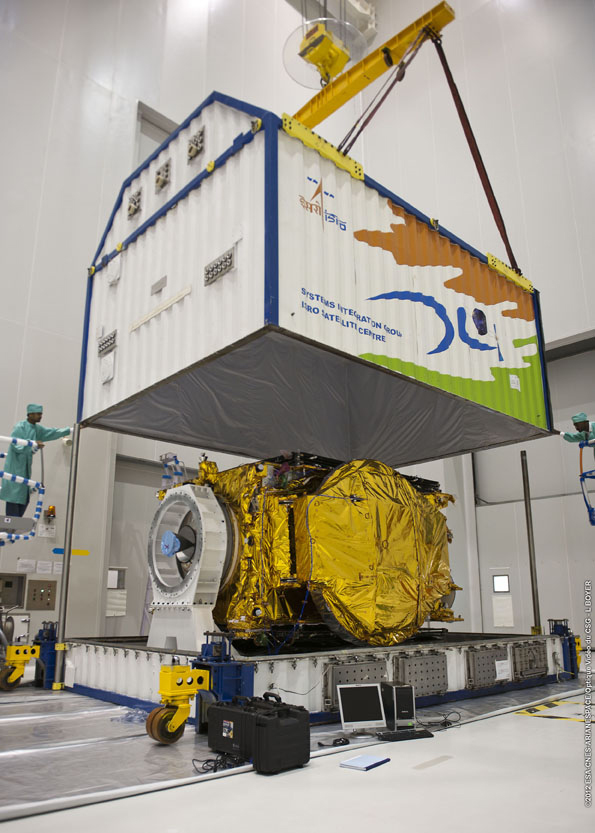
    The shipping container that protected GSAT-10 during its travels from India to French Guiana is removed inside the Spaceport’s S5 payload preparation facility, revealing the spacecraft.


    News courtesy of CANSPACE Listserv.

    UPDATE: According to an Arianespace press release issued Thursday, the launch of the GSAT-10 and Astra 2F satellites is now scheduled for September 21.
    SES-5. The SES-5 geostationary communications satellite (also known as Sirius 5 and Astra 4B), which was launched on July 9, 2012, arrived at its orbital slot of 5 degrees east longitude on or about July 19. The current position is actually about 5.2 degrees.

    The satellite carries L1 and L5 transponders for the European Geostationary Navigation Overlay Service (EGNOS) satellite-based augmentation system. According to a spokesperson from the Space and Missile Systems Center, the Global Positioning Systems Directorate has assigned C/A PRN code 136 and L5 PRN code 136 for use by the satellite.

    GSAT-10. The Indian Space Research Organisation’s GSAT-10 geostationary communications satellite has arrived at the European spaceport in Kourou, French Guiana. The satellite carries a transponder for the GPS and GEO Augmented Navigation (GAGAN) satellite-based augmentation system.

    GSAT-10 will be launched together with the Astro 2F satellite by an Ariane 5 rocket on September 21. GSAT-10 is expected to be positioned at 83 degrees east longitude and use PRN code 128. It will join the first GAGAN-equipped satellite, GSAT-8, which is at 55 degrees east longitude and is transmitting test signals on the L1 frequency using C/A PRN code 127.

    Although GSAT-8 reportedly carries a dual-frequency transponder, no L5 signals from this satellite have yet been detected by International GNSS Service tracking stations.